
A Wedding Gift for MOST

A Wedding Gift for MOST

By
Bridget LeRoy

A wedding for a young couple can sometimes be a way of acquiring, through gifts, the necessities to jump-start a home life. But when a couple have been together for over 20 years and are in need of nothing in particular, what do they do?

    For Bill Rosenthal and Jerry Gebo, who were recently legally married, it was a no-brainer. When the couple wed at Townline BBQ in Sagaponack on Nov. 11, they asked their guests to donate to Project MOST.

    The couple’s son, Adam, who has special needs, attends the after-school enrichment program five days a week. “It’s a safe, productive space to develop friendships,” Mr. Rosenthal said on Monday. “It offers yoga, cooking, and other life skills.”

    Mr. Rosenthal and Mr. Gebo started a Web site for their wedding, with a page titled “Gifts.” When guests clicked to that page, they saw Mr. Gebo’s message: “In lieu of wedding gifts, Bill and I request that donations be made to Project MOST.”

    The site went on to say that “this organization has lost half of its New York State funding due to budget cuts. The donations made will greatly benefit the children in our community.”

    “It’s a sizable gap, but we did our best to close it a little,” Mr. Rosenthal said. All in all, the couple’s effort brought in $6,425 to Project MOST.

    “The program was originally directed toward more lower-income working parents,” said Mr. Rosenthal, who runs an organization that teaches communication and presentation skills, mostly to executives. “But now it has expanded to be more inclusive, and also to offer programs the kids can’t get anywhere else,” he said. “I think that’s fabulous.”

    The couple encourage others to take the path they chose at their wedding. “Project MOST is offering a place that kids can have enriching social activities and do something fun while learning,” he said. “They can always spend some time vegging in front of the TV when they get home.”
Kids Culture 03.22.12

Kids Culture 03.22.12

Family Art Workshop

    The Parrish Art Museum in Southampton will host a family tour of the museum along with an art project on Sunday, in conjunction with its current show of contemporary California art. The exhibition, “E.S.T.-3: Southern California,” focuses on art that emerged from Los Angeles and surrounding areas between the end of World War II and 1995.

    Madolin Archer, an art educator, will conduct the gallery tour, and then families have been invited to the Carroll Petrie Center, next to the museum, to make paintings or collages inspired by the collection. The tour and workshop start at 2 p.m., are free and open to the public, and need no advance registration.    

Young Playwrights Festival

    The Young American Writers Project is back for another playwrights festival, featuring six short plays by East End middle school students performed this weekend. The project is sponsored by Stony Brook Southampton’s M.F.A. program in writing and literature.

    Almost 200 students participated in the playwriting residency over the winter, and the shows this weekend are the culmination of their efforts. The 10-minute one-act plays are staged by professional directors and drawn from the students’ own lives.

    A performance that is open to the public will be at 7 p.m. on Saturday in the Avram Theater of the Stony Brook Southampton campus. Admission is free.

Spring Break Theater Camp

    Spring vacation is coming up, and the Bay Street Theatre in Sag Harbor is offering a theater camp from April 9 through 13 for kids 8 to 12. The weeklong session, which will be held from 9 a.m. to 3 p.m. each day, includes lessons in acting, singing, dance, improvisation, and more. The students write and perform in their own original production.

    “The sheer fun of improv comedy and acting exercises, or learning a song or developing a short theater piece, engages children in problem solving, creative thinking, and collaboration,” Susan Galardi, who is running the program with Bethany Dellapolla, said. “Through simple character study, they walk in someone else’s shoes and gain insight into themselves and others.”

    The cost for one week is $375. To sign up, Mary Ellen DiPrisco at the Bay Street office is the contact.

“Raccoon Tales”

    The animals in the forest are always getting into trouble — will they ever learn their lessons? Audience members can find out when they watch “Raccoon Tales,” three humorous stories inspired by tales of the Seneca tribe, on Saturday at the Goat on a Boat Puppet Theatre in Sag Harbor. Brad Shur, the visiting artist, is known for high-energy shows.

    Performances are at 11 a.m. and 3 p.m. at the theater, which is on East Union Street. Ticket prices range from $5 to $10.

Gentlemen, Start Your Sneakers

    The Dance Away Cancer dance-a-thon is on. Tomorrow evening at the John M. Marshall Elementary School, families can kick up their heels for a minimum donation of $25 per dancer. Event T-shirts will be on sale for $10 a pop.

    Sponsored by the PTA, all proceeds from the dance will be donated to the American Cancer Society’s Suffolk County Relay for Life and to the Memorial Sloan-Kettering Pediatric Research Fund in memory of Katy Stewart. The event is to take place from 6 to 8 p.m.

Nutrition for Preschoolers

    A 14-week program teaching 3, 4, and 5-year-olds about the importance of healthful eating through food preparation and games is still accepting applications. The free program, run by Lisa Shaw, a family and consumer science teacher at East Hampton High School, has students studying child development and psychology work one on one with the wee ones.

    The deadline for applications is today, and the only requirement is a firm commitment to take accepted preschoolers to every session. The program runs from April 17 through May 31, from 1 to 2:25 p.m. Ms. Shaw can be reached at [email protected]

Budget Cuts in East Hampton

Budget Cuts in East Hampton

By
Bridget LeRoy

    Tuesday night’s East Hampton School Board meeting saw virtual scissors being used on next year’s budget for special education and high school expenses, among other areas, while those involved attempted to keep the necessary meat in place.

    High points included Cindy Allentuck’s cuts of over $300,000 in special education expenses and Chuck Westergard’s suggested slice out of the technology pie to the tune of $94,432, a 16-percent decrease from last year’s budget, and even more as the board and Mr. Westergard went through the technology budget line by line. One cut he suggested was the elimination of the Safe Schools helpline, which allows residents to anonymously report problems but is never used.

    Ms. Allentuck, director of pupil personnel services, outlined the savings to be realized by bringing “special needs” kids back to district classes rather than sending them to programs of the Eastern Suffolk Board of Cooperative Education Services and other out-of-district places.

    “We try our hardest to convince parents of the great programs we have here, and that’s no lie,” Ms. Allentuck said. She added that the special education department was trying to do whatever it could to offer programs locally, so children don’t need to travel so far every day and are afforded the opportunity to make better connections with peers and the community.

    “The state aid that we would get for occupational therapy or on-site services has to go to the charter school or elsewhere,”  Richard Burns, the interim superintendent said. “It’s a big number going out of the district. We need to teach the parents early that we have many of the available programs here.”

    Laura Anker Grossman suggested that accommodating special needs children in prekindergarten become a priority. “We would lose less kids to BOCES if they started here earlier,” she said.

    Adam Fine, the high school principal, plowed through the behemoth high school budget, with very few objections from board members.

    “It’s obscene,” Jackie Lowey, a board member, said about the cost of leasing Xerox copy machines, almost $50,000 a year. “I would really like to see someone smarter than me look at this and make a goal to do something about this, like reduce paper usage by half,” she suggested.

    Caps and gowns for graduation, which are purchased for students, cost the district $9,000 a year, but Mr. Fine said East Hampton was “the only school district in the world that buys caps and gowns for its kids.” It was suggested that parents absorb the approximate $30 cost, except in hardship cases.

    Catering for parent breakfasts and other noninstructional events was also given a sideways glance. Ms. Lowey asked Isabel Madison, the district business administrator, to come up with a list of catering expenses for such items as cakes for imminent retirees and so on.

    “I think it’s great that we do it,” Ms. Lowey said, “but if we’re talking about $10,000 to $15,000 of feel-goods, and it’s between that and another teacher or program, it should be ‘bring your own doughnut.’ ”

    Retrieving textbooks from students still causes grief in the district, it was reported, and lost textbooks cost thousands every year. Patricia Hope, a board member and former high school teacher, suggested the burden for textbook retrieval, and the associated fines, be placed on teachers.

 “I used to go to students’ houses and look for them,” she said. “It’s not a victimless crime,” added Ms. Lowey. “It’s a real sock to the district.”

    Something not in the budget was described as a “want rather than a need” by Kristine Swickard, chair of the foreign languages department — the popular, after-school Mandarin Chinese program. Students who participate use Skype to speak with a teacher in China.

    “The teachers are animated and entertaining,” Mr. Westergard said. “The kids really love them.” However, the cost is about $26,000 to $28,000 a year, and Ms. Swickard and Mr. Fine want to add a third level for those students who have finished the first and second. “It looks so great on their college résumés,” Ms. Swickard said. “There is a tremendous interest in students who have taken Chinese.”

    Although the benefits of offering Chinese were clear, the cost was not something to be taken lightly by the board. The board nevertheless agreed to keep the program in place.

    “Cut all the textbooks and battery packs out of the math department,” Mr. Fine said abruptly. “There, that’s about $11,000.”

    Ms. Hope looked shocked. “You can’t just do that, can you?” she asked.

    Mr. Fine burst out laughing. “Don’t worry,” he said. “I talked to Pat St. John about this earlier. I wouldn’t just cut stuff from his department without checking with him first.”

    Meanwhile, the district expects to save $700,000 because seven employees  have opted to take an early retirement incentive, and it is expected that their jobs will not be filled. The resignations go into effect on June 30.

Preschool Numbers at Issue

Preschool Numbers at Issue

By
Janis Hewitt

    The number of preschoolers at the Montauk School is growing rapidly, the school board learned on Tuesday. So much so that board members may have to make some tough decisions to accommodate the little ones for next year.

    There are at present two preschool classes with 18 and 21 students in them and one teacher and an aide in each class. But if those numbers increased at preschool registration yesterday, as was expected, the school board would have to determine whether to make the classes into half-day sessions or cut the number of days each student attends between Monday and Thursday, with all of the students coming in on Fridays.

    Adding a third class would not be feasible because of the 2-percent tax cap, Jack Perna, the district superintendent, said after the meeting. “If we did that, we’d have to pull something else,” he said.

    Mr. Perna said class size is regulated by the state in schools that choose to accept Universal Pre-Kindergarten program money, which he called a “minimal” amount of $33,000, funding that Montauk currently receives for one class. “We can run our program as we see fit,” he said.

    The preschool teachers, Wendy Flanagan and Kerrin Corron, explained the concept to the board. They said if it comes down to a shorter school week for the preschoolers, parents would be asked to choose the days they wanted their children to attend between Mondays and Thursdays. There would be no swapping or switching of days allowed, they said. If that doesn’t work out, a lottery system would be put in place to choose each student’s days.

    On Fridays, an aide would be pulled from elsewhere in the school to help out. “That would be a lot of bodies, and it can get chaotic,” Ms. Flanagan said.

    The teachers and Mr. Perna said they prefer to offer that solution so the students wouldn’t be isolated from one another in half-day sessions and the program would remain consistent.

    Also on Tuesday, the board agreed by resolution to participate in a plan to seek state funding for a $2,777 study that would examine district consolidation. “For $2,700 the possibility of sharing services would be worth it,” Diane Hausman, the board president, said.

    At the end of the meeting, the board briefly adjourned into a budget workshop session in which members received the latest numbers for next year’s budget proposal, which stands at $18.5 million and reflects a nearly $400,000 increase from this year. A full budget workshop will take place on Tuesday at 4 p.m. in the school library.

Scholarships, Open House

Scholarships, Open House

    For high school students who love to create, the Ross School is offering a writing and visual arts competition which will give artistic students a chance at receiving financial assistance to attend Ross.

    The event will be held on March 30 at the school’s campus on Goodfriend Drive. Writing applicants will be given a prompt and will then produce a piece of writing, while visual arts applicants must submit five artworks along with a one paragraph statement detailing what art means to them.

    A family reception will be held for all applicants from 5 to 6 p.m. Those interested must respond by March 26. Nina Serach at the Ross School has more details about eligibility requirements.

    In Bridgehampton, Our Sons and Daughters early childhood school holds an open house every Thursday from 9 to 10:30 a.m. for prospective parents, who are invited to observe teachers and students during the course of a regular school day, which includes imaginative play, artistic activities, and outdoor play.

    The school is located on the grounds of Hayground School at 151 Mitchells Lane, and is inspired by the Waldorf educational philosophy. Parents have been asked to call 332-0950 to reserve a visiting time.

    Our Sons and Daughters also offers a parent-child class on Saturday mornings from 10 to 11:30 a.m., with story time, songs, puppet shows, bread baking, and a chance to socialize with other children. Children ages 18 months to 3 years are welcome. Classes run for six weeks and cost $75, or $20 per class. More information is available at the number above or by e-mailing [email protected].


Kids Culture 03.15.12

Kids Culture 03.15.12

High School Art and Music

    The second half of the Student Art Festival spotlighting the work of high schoolers opens at Guild Hall in East Hampton on Saturday with a reception featuring music by students from participating schools. The show features art, in a variety of mediums, by South Fork 9th graders through 12th graders.

    The reception will take place from 2 to 4 p.m. Free performances by East Hampton’s jazz band and the Bridgehampton School’s marimba ensemble, among others, are expected to start at 3 p.m. in the John Drew Theater. The art will be on view through April 15 on Fridays and Saturdays from 11 a.m. to 5 p.m. and on Sundays from noon to 5 p.m.

Workshops at CMEE

    The Children’s Museum of the East End in Bridgehampton is offering a series of drop-in workshops on Mondays and Fridays at 10 a.m. starting this week. Those who stop by will have an opportunity to participate in arts and crafts, cooking, and more.

A Neurotic Pea

    The Goat on a Boat Puppet Theatre in Sag Harbor will put a new twist on a couple of old fairy tales on Saturday, with “The Princess, the Frog, and the Pea.” Combining three well-loved stories, Liz Joyce’s 30-minute production brings to life a princess, an unenchanted frog, and a neurotic pea.

    Performances will be at 11 a.m. and 3 p.m. General admission is $10, $5 for children under 3.

Rainbow Fund-Raiser

    The Rainbow Preschool in the meetinghouse of the Unitarian Universalist Congregation of the South Fork in Bridgehampton will hold its seventh annual silent auction fund-raiser on Friday, March 23, from 6 to 9 p.m. The school, which operates entirely on donations and tuition, will auction off golf for four at the Bridge, tickets to “The Wendy Williams Show” and “Late Night With Jimmy Fallon,” dinner at South Fork restaurants, and more.

    Tickets to the event cost $20, and there will be food, beverages, and music by Vivian and the Merrymakers.

Students Who Know History

Students Who Know History

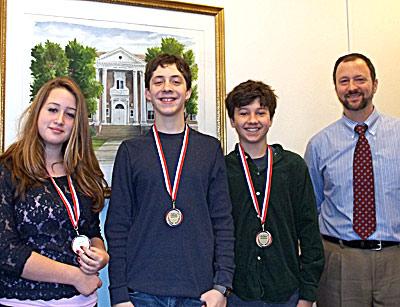
Alexandra Ebel, Jason Karlin, and Jimmy Makrianes, with their East Hampton Middle School social studies teacher, Peter Friscia, displayed the medals they picked up at the Long Island regional celebration of National History Day.
Bridget LeRoy
By
Bridget LeRoy

    Peter Friscia, a social studies teacher at the East Hampton Middle School, is exceptionally proud of his students this week. Fourteen eighth graders accompanied him to Hofstra University on Sunday to participate in the Long Island regional competition of National History Day. Two of them, Jason Karlin and Jimmy Makrianes, made it to third place, and Alexandra Ebel will advance to the state competition next month with her second-place project.

    Training East Hampton middle schoolers to vie for National History Day recognition is a tradition started by Gary Zay, Mr. Friscia’s predecessor. Although many have competed, this is the first year that students have taken home honors for their projects.

    The theme was “revolution, reaction, and reform,” and the object was to choose a historical topic related to that theme and then present the work as a paper, exhibit, performance, documentary, or Web site. The middle school winners competed in Web site categories.

    Jason and Jimmy’s project, in the group Web site category, focused on Henry Ford’s assembly line, and their research included a trip to Detroit to the Rouge plant and the Henry Ford Museum.

    It took months of research, Jimmy said, and there were many rules — the text had to be limited to 1,200 words and the Web site could not contain more than 100 megabytes of information.

    “That wasn’t a problem,” Jason joked.

    Alexandra had been fascinated by a recent study of Native Americans, and her project, Plight of the Sioux Indians on the Great Plains, reflected her interest in that subject. She took second place in the individual Web site category.

    Jason and Jimmy will not be able to continue on to the state tournament. The team of 19 students they led was 2 short of the number needed to advance.

    Alexandra is looking for ways to polish her presentation before it heads to Cooperstown, N.Y., for the April 23 state championships. “I made a lot of stupid mistakes,” she said, all of them technical.

    But for Mr. Friscia, the glass is more than half full. “We were competing against schools that run an elective for this,” he said. “It’s part of their day. For us, we were touching base during lunchtime and after school. The kids did great.”

Looking to Expand Programs

Looking to Expand Programs

By
Bridget LeRoy

    Project MOST is known for its after-school programs that serve approximately 280 students at the John M. Marshall Elementary School in East Hampton and the Springs School. But that’s not enough for Tim Bryden, the executive director of the 10-year-old program, who would like to see Project MOST’s numbers grow to 600 eventually, if the funding becomes available.

    “Kids need to learn,” Mr. Bryden said passionately from his home office in Springs, a desk strewn with papers before him. “The children themselves are asking to learn more.”

    Far from a baby-sitting service, Project MOST offers programs in yoga, science, technology, art, gardening, and even a newly minted chess club.

    “We’re working to add 35 percent more time to the school day, to expand educational opportunities,” Mr. Bryden said.

    At a time when many schools are forced into a program-cutting corner, Project MOST is seeking to expand enrichment education. But how important is it for children to learn more than reading, writing, and ‘rithmetic?

    According to Afterschool Alliance, a national advocacy group, “the hours between 3 p.m. and 6 p.m. are the peak hours for juvenile crime and experimentation with drugs, alcohol, cigarettes, and sex.”

    On the positive side, according to Americans for the Arts, young people who participate in the arts — and arts are included in Project MOST — for at least three hours a day, three days a week are four times more likely to be recognized for academic achievement, three times more likely to be elected to class office, four times more likely to participate in a math or science fair, three times more likely to win an award for school attendance, and four times more likely to win an award for writing an essay or poem.

    Project MOST charges parents $45 a week for the 3 to 6 p.m. program, which meets daily, and the rest of the yearly budget of approximately $356,000 is raised by payments from the districts, grants, and private donations.

    On Sunday, one of the more popular fund-raisers, Empty Bowls, was filled to capacity with supporters of Project MOST and the Springs Seedlings Project, an offshoot of the after-school program. The Hamptons Marathon is also a boon, Mr. Bryden said, bringing in $30,000 this year.

    “We’re working closely with the schools to develop more project-based learning,” he said. There is also a recently developed summer camp program, which was started to familiarize children with the beauty and bounty in the area.

    But the three Rs get attention, too. “We offer academic support for all learners,” Mr. Bryden emphasized. “No kid in the school should ever get behind.”

    There is a remedial reading group, “but it’s done in a way that’s fun and engaging,” he said. “More than half the kids here have jumped up several levels. Their reading has improved, and we only started in October with this,” he said. “We’re tapping into the love of reading, simply for the pure joy of it.”

    He wants to make the “strategic alliance” between the districts and the program “smooth and seamless,” with more offerings focused on drama, chorus, the environment, intramural sports, and art.

    Like other programs, however, Project MOST has had to tighten its proverbial belt, making cuts in administrative staff. Mr. Bryden and Rebecca Morgan do almost all the work themselves. There is no secretary or Web manager.

    Mr. Bryden, unfazed by the changes, is confident that the project will survive and grow. “We’re asking the schools to maintain or strengthen their support,” he said.

    “It’s such a thrill to see these kids learn,” he said, smiling. “I love to see the kids being amazed.”

Basically Pleasant Meeting

Basically Pleasant Meeting

By
Bridget LeRoy

    For the most part, the topics at Tuesday night’s East Hampton School Board meeting were positive ones, ranging from a proposal for a garden at the John M. Marshall School to fund-raising on school grounds. But Mary Laspia, a Gould Street resident, who had been before the board in December to complain about the noise generated by cooling equipment on the roof of the high school, was back, and shaking visibly.

    “It’s a loud, droning noise that wakes you up,” she had said in December, describing “sleepless nights and tortured days.” The issue had not been resolved.

    “This has been a year. Nothing has changed. I am not taking this crap anymore,” she said, her voice cracking. “If you send me one more person with one more noise meter, I’m going to shove it down their throat,” she said.

    “We’ve arranged a meeting with Ms. Laspia in the very near future to address her concerns,” Richard Burns,  the interim district superintencent, said yesterday morning. “In fact, a whole team is meeting with her to try and resolve this.”

    On a happier note, Kate McCarty, a kindergarten parent, East Hampton graduate, and landscape architect, floated the idea of a “discovery garden” at the elementary school. The goal, Ms. McCarty said, would be to “transform the courtyard into a beautiful sanctuary,” where children could learn about nature and protecting the environment through age-appropriate hands-on activities.

    The cost of the project, which would include edible plants, a boardwalk, mossy and digging areas, and a worm bin, among other things, would come from private donations, to be “umbrella-ed” by Project MOST, the nonprofit school advocacy organization. The board agreed to continue discussing plans with Ms. McCarty, noting that long-term maintenance and state guidelines had to be ironed out.

    The matter of the district’s fund-raising policies was addressed at the meeting by Patricia Hope, a board member on a committee formed to take a closer look at the policies.

    Reading some of the group’s findings, she said, “We’ve come up with an overview.” Fund-raisers “must directly support the East Hampton Union Free School District.” This brought an immediate response from some members of  the audience who wondered, for example, about an event “benefiting a student whose house has burned down.”

    Each request would be looked at on a case-by-case basis, Ms. Hope said. Mr. Burns added, “This is still totally open to discussion.”

    “We’re just trying to prevent misuse of public property,” added George Aman, another board member.

    Ms. Hope said she was amazed by some of the rules set forth by the Department of Education, including a statewide kibosh on selling baked goods that were not prepared in a kitchen approved by the county Health Department. “We will have to decide which rules to obey and which to ignore,” she said with a smile.

    The board also heard news of a pleasant nature about an international heritage fair at the elementary school on Friday, which brought out 800 people, and a teachers versus students basketball game at the East Hampton Middle School, which raised about $1,300, half of which will go toward a fund in memory of Herman Stephens, a much-loved custodian who died in the fall.

    Also boosting spirits were kudos for last weekend’s production of “Anything Goes” at the high school. The Sunday performance was preceded by a lunch for senior citizens, with over 200 attending from the over-65 set.

    The performance, Mr. Burns said, “really showed that there is so much more to education than just standardized test scores.”

    “Academics, arts, and athletics,” offered Ms. Hope.

    In addition to Ms. McCarty, Paul Fiondella, an East Hampton resident who frequently speaks at board meetings, had a troubling concern.

    “There are 150 people in the district making over $100,000 a year,” he said.        “We’re already paying $2.8 million in pension contributions. When these people retire, how can you sustain this? This is what happened in Greece,” he said.

    “We’re negotiating with the unions,” Jacqueline Lowey, a board member, responded. Since the matter involved personnel, she said the board could not comment further.

    “There are teachers in the district who are sensitive to this.”

Residents Already Feeling Tax-Cap Pain

Residents Already Feeling Tax-Cap Pain

By
Bridget LeRoy

    The Springs School Board is considering eliminating a special education teacher in the 2012-13 school year as part of its efforts to bring the district budget in line with the state’s new 2-percent cap on property tax levy increases.

    All public schools in the state were waiting on the final protocol to come from Albany regarding the cap. March 1 was to be the deadline for boards across the state to submit their hard numbers for the property tax levy calculation, based on equations to be sent from the governor’s office, but as of the night before, no one had yet heard a gubernatorial peep.

    Last year’s approved budget was $24.8 million, but Springs has yet to release a hard number for 2012-13.

    At a budget workshop on Feb. 29, Kathee Burke Gonzalez, the school board president, introduced Colleen Card, the school’s business administrator, to discuss the high school tuition rates, and some other salient points.

    “The rules of engagement have changed,” Ms. Burke Gonzalez said. She called the decisions to be made this year “critical.”

    Last year, Springs paid $25,677 per high school student to the East Hampton school district. This year, per the tuition contract signed last year, the price rises to $27,345 per student, more than 6 percent. This year there were 273 Springs students at the high school, but there are 8 fewer expected in the 2012-13 school year. Because of increased tuition costs, however, the tuition amount due to East Hampton will climb from $7.01 million to $7.24 million.

    The tuition for students with disabilities at the high school has jumped from $55,292 per student to $63,114. There are six Springs students with disabilities at the high school this year, and two more are expected to join them next year. The Springs principal, Eric Casale, said that he had reviewed the school’s special education programs and “to not only meet their needs but also be fiscally responsible,” the decision has been made to subtract one special education educator from next year, “either by excessing or through retirement,” he said.

    The “real cost” of a step one teacher was also explored. Although the teacher’s salary would come in at $54,000, the district is also responsible for paying 11.84 percent of that salary into the teachers retirement fund, and an additional 18.5 percent of the salary into the New York State employees retirement system. Health insurance can run from $9,000 to $21,000, depending on whether the teacher is single or has a family, and Social Security and Medicare payments are another 7.65 percent. A teacher hired at a salary of $54,000 costs the district $84,599, Ms. Card explained.

    In a statement, Nancy Olson and Amy Turner, two Springs teachers and co-presidents of the Springs Teachers Association, commended the board on holding the community forum. “We are aware that the recent tax cap legislation and economic crises present you with very difficult choices this budget season,” Ms. Olson read. “As we have stated in a recent press release, the S.T.A. is committed to doing its part to help preserve the valuable programs that benefit kids here at Springs School.”

    The letter suggested that the board reconsider its new administrative model and forgo adding an assistant principal.

    “Although we recognize the advantages of adding an assistant principal, under our financial circumstances, we believe it would be preferable to apply that money to the preservation of programs for students and distribute these administrative duties to existing staff,” Ms. Olson read.

    An earlier letter from the S.T.A. stated, “We are pleased to say that, although there is still much to be worked out, the S.T.A. and the district have a tentative agreement that calls for salary freezes and benefit concessions totaling over half a million dollars in savings to the district.” As of the meeting on Feb. 29, though, the teachers are still receiving their “step” increases annually, according to Michael Hartner, the school superintendent.

    “This community cannot afford the ever-increasing taxes,” Carol Buda, a retired teacher and Springs resident, said during the public comment period. “It is literally forcing some people out of their homes. I don’t want to see the school fall apart,” she added, “but there are 30 teachers here making $100,000-plus. If a teacher is married to another teacher, or a policeman, I think that puts them in Obama’s 1 percent.”

    Others in the audience echoed the sentiment and the school’s motto — “Springs School: Where Children Come First” — and were upset that possible cuts discussed at the budget meetings and the community forum held on Feb. 11 seemed to focus on eliminating school programs.

    “If you slash and burn this year, what are you going to do next year?” Ms. Buda asked.

    Rameshwar Das pointed to the fact that the school tax in Springs is four times that of Amagansett.

    Kristy LaMonda, a Springs teacher and resident, said her father “grew up steps from this school, the youngest of 12 kids who all went here.”

    “I feel like I’m constantly defending this school,” she said. “It’s not that we [the district] are doing anything irresponsible with the money we’re given. We have no oceanfront property, we have no business district.” What Springs does have, as several speakers pointed out, is a 27-percent population jump in the past four years.

    “There’s a sense of entitlement in this community,” said Dawn Flagg, a Springs resident. “Some people have been out of a job for years. Nothing is free. When I wanted my kids to go to preschool, I paid for it.”

    “If you have a job and you have security, that’s something to be grateful for, instead of looking for the next green leaf from a tree that isn’t there.”