News for Foodies 06.02.16

News for Foodies 06.02.16

Local Food News
By
Joanne Pilgrim

New Food Show

Steve Haweeli, the founder of WordHampton Public Relations and an avowed foodie, is the host of a new show on LTV, East Hampton’s local cable TV provider. In each episode, Mr. Haweeli, with two guests involved in the food industry, will discuss local food, farms, restaurants, and culinary world personalities. The pilot episode featured two representatives of Nick and Toni’s restaurant in East Hampton, Mark Smith, an owner, and Joseph Realmuto, the executive chef. The show, called foodTALK, will air on Thursdays at 12:30 p.m. and 10:30 p.m. and on Fridays at 7:30 a.m. It may also be viewed online at ltveh.org.


Getting a Reservation

Speaking of Nick and Toni’s, where tables are at a premium during the season, the restaurant has moved to an online reservation system administered through Resy. The Resy system can be accessed through a link on the restaurant’s website, at Resy.com, or through an app.


Food Lab Conference

The second annual Food Lab conference will take place tomorrow through Sunday at Stony Brook Southampton, sponsored by Slow Food East End. The conference includes workshops and panel discussions on a variety of food business topics, along with a keynote address by Carla Hall, a host of the ABC-TV series “The Chew.”  A kick-off cocktail reception will be held tomorrow night, and a gala dinner, catered by Colin Ambrose of Estia’s Little Kitchen, is planned for Saturday.


Now at Ruschmeyer’s

Savannah Jordan, the new executive chef at Ruschmeyer’s in Montauk, has come from Virginia, an East Village bistro, to revamp the menu at the restaurant to include some of Virginia’s signature dishes.


Kid Cooks

Speaking of “The Chew,” a film crew from the show recently spent three days at the Hayground School in Bridgehampton documenting the school’s culinary arts and gardening programs. They filmed students ages 7 to 14 making bread, pesto, and mozzarella, after planning a menu and harvesting kale and salad greens. Students in the school’s filmmaking class apprenticed with the professional crew. The segment will air on “The Chew” on ABC on Tuesday at 1 p.m. 


New in Southampton

Zach Erdem, the restaurateur behind 75 Main in Southampton and a new club called AM, has opened Kozu, a restaurant that offers Japanese cuisine and sushi with Peruvian influences. The head chef, John Keller, is formerly of Nobu; the sous chef, George Nikolo­polous, worked at Le Bernardin, and the sushi chef, Joseph Kim, is formerly of Morimoto. The establishment, on Southampton’s Main Street, includes a lounge that will be open Thursdays through Saturdays and feature well-known D.J.s from around the world, and a boutique hotel. Brunch will be served from 11 a.m. to 4 p.m. on Saturdays and Sundays throughout June, featuring a live D.J., and dinner will be served nightly from 5 to midnight.


Union Cantina

Also in Southampton this summer, Union Cantina will open in the Bowden Square space that was formerly the Southampton Publick House. Principals from the Southampton Social Club — its owners, Ian Duke and David Hitly, and its executive chef, Scott Kampf — have teamed up to create an “innovative, modern” Mexican eatery, according to a press release. The restaurant will be open year round for lunch and dinner and for a Saturday and Sunday “bottomless brunch.” Its 400 Rabbits Tequila Bar will carry more than 100 types of tequila. 


Summer Happy Hour

The new season brings new happy hour specials at Townline BBQ in Sagaponack, Mondays through Fridays from 4 to 7 p.m. at the bar. Besides free games of pool, the afternoon specials include deals on beer, shots, and cocktails, including margaritas, and snacks such as nachos, wings, warm pretzels, and hushpuppies.


Specials at 1770

  Specials at the 1770 House in East Hampton include a $35 three-course prix fixe offered through next Thursday, with the exception of Friday and Saturday nights. At the inn’s tiny downstairs tavern, the menu tonight and next Thursday will include $17.70 entrees, with choices including burger or meatloaf plates, chicken parmigiana, and Korean barbecue pork ribs. There will also be specials on wines by the glass and beer.

Culinary Luminaries Will Convene at Stony Brook Southampton

Culinary Luminaries Will Convene at Stony Brook Southampton

Carla Hall will be the featured speaker at this year's Food Lab conference.
The Stony Brook Southampton Food Lab will hold its second annual confab at the Southampton campus
By
Mark Segal

While the culinary world’s emphasis on locally sourced ingredients shows no sign of abating, the ingredients and techniques of global cuisine are increasingly important to the chef community, as exemplified by the presence at the Stony Brook Southampton Food Lab’s upcoming conference of Deuki Hong, a 25-year-old chef at one of New York’s hottest Korean restaurants. 

The Food Lab, launched in the fall of 2014 as a center for food-related information, education, and business development, with a particular focus on the East End’s burgeoning culinary community, will hold its second annual confab at the Southampton campus from Friday, June 3, through June 5.

The keynote speaker at the conference, titled “Future of Food — Trends, Tastes, and Directions: Who’s Shaping Them and Where They’re Heading,” will be Carla Hall, co-host of ABC-TV’s “The Chew,” former “Top Chef” and “Top Chef All-Stars” competitor, and soon-to-be proprietor of Carla Hall’s Southern Kitchen, which will open in Brooklyn next month.

“Last year’s conference was predominantly about growing a food business,” said Geoffrey Drummond, executive director of the lab and producer-director of culinary programs for television for some 30 years. “This year’s is about trends and tastes — where are they going, who’s driving them, and what things are happening now and in the future.”

The conference’s seven panels will include chefs, food writers, journalists, professors, and food and beverage industry executives, among them the East End culinary luminaries Kathleen King of Tate’s Bake Shop, Brian Halweil, editor of Edible East End, Michael Cinque, owner of Amagansett Wines and Spirits, Colin Ambrose, chef/owner of Estia’s Little Kitchen in Sag Harbor, John Liegey, founder of Greenport Harbor Brewing Co., and Laura Donnelly, food writer for The Star, who will interview Ms. Hall.

“I want to talk about some of the expectations I think were placed on me unknowingly, and what I have learned, and the importance of authenticity,” said Ms. Hall. “Sometimes you look at other people and think, I need to be like that, and you forget to look at yourself and why you are here and what you’re supposed to be doing. I’m going to talk about that, and some of the challenges I have faced matriculating through this path.”

While the conference, with participants such as Eric Ripert, Le Bernardin’s chef; Jeffrey Zurofsky, founder and C.E.O. of Witchcraft and Riverpark restaurants; Andy Arons, founder and C.E.O. of Gourmet Garage, and Susan Spungen, culinary consultant and former food editor of Martha Stewart Living, is perhaps the Food Lab’s most visible component, much more is percolating on the campus.

In partnership with the Amagansett Food Institute and its South Fork Kitchens incubator program, the Food Lab provides small-batch food production space, entrepreneurial training, and technical assistance to food businesses and food-related enterprises. 

“The kitchen facility is a tremendous asset and resource,” said Mr. Drummond. “We have this amazing, health department-certified back kitchen, which functions primarily as an incubator for new business, and we hope to bring more people in.”

The front kitchen is a food service operation for Stony Brook Southampton students and faculty. “We’d like to give it a much broader reach, to really elevate the restaurant to make it an attractive place people from off campus will want to come to for lunch.”

Another initiative, which Mr. Halweil has been pursuing, is teaching courses in basic food literacy, nutrition, and even shopping skills to different groups, such as health care workers. “What I foresee is ultimately creating a media resource,” said Mr. Drummond, “because I come from decades of doing food media. We’ve been doing stage one of the logistics of putting together ideas about how to take Food Lab and make it go beyond the conference to become a hub of communication and conversation for distributing information about food education issues.”

One of the panels in this year’s conference is titled “What’s Next? Trends in Food Tech and Service.” One panelist, Jonah Rider, is a recent graduate of Columbia University who opened a supper club in university housing, with long waiting lists for reservations. “He’s approaching food from a kind of social side, he’s almost treating it as performance.” 

Mr. Drummond also cited the increasing importance of global influences on the culinary community. Mr. Hong will be one of the chef panelists,  along with Matt Rodbard, a food journalist and co-author with Mr. Hong of “Koreatown: A Cookbook.”

“There are new ingredients, new techniques, new tastes,” said Mr. Drummond. “These things all cross over. When you go to an incubator, there’s always someone making kim chi. So, global influence is one of the big topics.”

Ms. Hall said of the conference, “Sometimes we’re really isolated in terms of the things we go through. That’s why when I do things like this conference, I try to be as honest as possible about the experiences that I’ve had, the ups as 

well as the downs. Sometimes people think it’s all roses. So, I love hearing other people’s stories. I think, ‘Oh, I’m not by myself!’ ”

Admission to the conference is $150. Students and farmers can attend for $75. Tickets to Saturday night’s dinner only, which will be prepared by Mr. Ambrose, are $75. Complete information can be found at thefoodlab.org/conference.

Seasons by the Sea: Food to Soothe Booze Blues

Seasons by the Sea: Food to Soothe Booze Blues

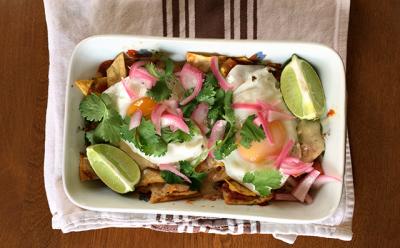
Salty and cheesy chilaquiles are an easy option using things most people have on hand. Here, they are made with tortilla chips, salsa, and cheese and topped with fried eggs and a garnish of lime and cilantro.
Laura Donnelly
Late-night drunkie food
By
Laura Donnelly

I like to drink, but I don’t like to get drunk. If I’m going to drink with alacrity I do it at home or within walking distance of home. Do I even need to say you people should drink responsibly? Call a cab if you’ve had one too many out on the town, or have a designated driver. Our roads are dangerous enough, what with all the dumb deer and city folk in Escalades.

Now that we’ve gotten that public service announcement out of the way, let’s talk about late-night drunkie food. This is the food you crave in the wee hours after a long, fun evening of lager and shouting. I spoke with one of East Hampton town’s finest, who informed me that bars out here can stay open until 4 a.m. He also suggested I consult the New York State Liquor Authority to find out the specific closing times of particular bars. 

When I attempted to do this, I got so overwhelmed by the website’s morass of government twaddle I gave up. And had a drink. Kidding! If you’re interested in finding out how late your favorite drinking hole stays open, contact it directly. 

Montauk, which used to be referred to as “a drinking town with a fishing problem,” has plenty of options for your late-night fat and salt cravings. South Edison offers Disco Fries, smothered in braised short ribs, cotija cheese, rich brown gravy, and herbs. The Borracho, (which means “drunk” in Spanish) is chicken tinga with salsa verde, cotija, jalapeños, crema, and cilantro. And who doesn’t love a big bowl of truffle fries at 1 a.m.? 

You can also always get a slice at Pizza Village, which is open until . . . closing. If you’re going to hold out until breakfast time, Westlake Fish House starts serving a very reasonably priced breakfast at 5 a.m.

For people who live in the city, finding food or transportation at any time of the day is not difficult. You can get Szechuan pork dumplings delivered to your door. You can find matcha green tea doughnuts at any Doughnut Plant location, and pizza 24/7. Out here, there are very few delivery choices. So unless you’re willing to punish your stomach and hate yourself in the morning (oh, wait, it already is morning) by going to 7-Eleven for a nasty hot dog or “custard” filled doughnut, you have very few options. 

The solution? Make your own late-night drunkie food by mastering some satisfying, squiffy dishes. Your bleary-eyed, rum-soaked pals will thank you.

Why do our bodies crave these fatty, salty, not-so-healthy foods when we are inebriated? Fat is the most energy-dense food, and as mammals, we gravitate towards that. But when we’re sober we are, hopefully, more disciplined about our eating habits. We also have a brain chemical called galanin, which increases our appetite for fats. Drinking alcohol bumps up our galanin production, which is stimulated by triglycerides (converted calories stored in fat cells), which are released by fat and alcohol. In other words, it’s kind of a vicious circle. And that is why you crave a big ol’ breakfast of pancakes and bacon instead of a salad after a long night of drinking, according to Popular Science magazine.

Most cultures have some version of late-night drunkie food. In Singapore you can find chicken rice at all hours of the day, but you’ll find most people slurping this up at 3 a.m. It is chicken poached with ginger and other spices, hacked up and served with rice that has been boiled with chicken fat. In Canada, most specifically Quebec, poutine is considered the national dish. It is a pretty gross combination of French fries topped with cheese curds and gravy. Cheese curds are the result of milk being pasteurized, then cooked, then separated from the whey. When fresh, cheese curds squeak when chewed, or sound like “balloons trying to neck,” as The New York Times described them. 

When my son attended McGill University in Montreal, we sampled all manner of poutine, from the underground subway food courts to the high-end Martin Picard’s Au Pied du Cochon version, topped with foie gras. Oof.

In Japan, where good manners are revered and restraint is required, there is no social stigma about getting rip-roaring drunk and throwing up in public. They even have binge drinking bars called nomihodai, where for a set fee and certain time frame, you can drink all you want. After this, you go out and gorge on okonomiyaki, a kind of kitchen-sink pancake. (Okonomi means “whatever you want.”) They actually eat these with miniature trowels or spatulas, which somehow seems appropriate. 

I have fallen in love with this essentially cabbage pancake with pickled ginger and scallions and like to make it in advance of late-night shenanigans. All I have to do is heat it up and serve it to my banjaxed and befuggered buddies.

A friend who just moved from Sag Harbor to Berlin says the Germans have become obsessed with “the hamburger movement.” Yes, apparently, they’ve just discovered hamburgers. The bars don’t close until the last patron is gone, so the tourist guidebooks offer the gentle reminder “don’t forget to leave because they won’t kick you out.”

Once you are done with your bier consumption, you can go get currywurst, a white, fat sausage, sliced, fried, served with French fries, and topped with chopped red onion, mayonnaise, homemade ketchup, and a dusting of curry powder. How do they come up with some of these things???

When I was a young lass I spent plenty of time at the Stephen Talkhouse. It had a great jukebox filled with Motown hits. We’d stay until closing and then go to Astro’s for a slice of pizza that cost 55 cents. (We couldn’t go to Smuggler’s Cove, because I had waitressed there and I was a really bad waitress.) 

My friends and I are lucky we survived so many long, late, tequila-shot-infused evenings. Summer is upon us, along with the crowds and the parties and traffic. So before you reach for that “source of happiness and oblivion,” please remember to drink responsibly, take a cab or have a designated driver, and master a few of these late-night drunkie tummy blotters.

Click for recipes

Seasons by the Sea: All the Tools You Need

Seasons by the Sea: All the Tools You Need

Three new cookbooks with local ties
By
Laura Donnelly

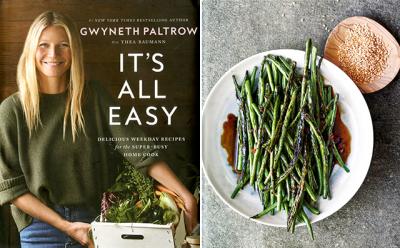
There are three new cookbooks with local ties — “Plated: Weeknight Dinners, Weekend Feasts, and Everything In Between” by Elana Karp and Suzanne Dumaine, “Tiki With a Twist” by Lynn Calvo with James O. Fraioli, and “It’s All Easy” by Gwyneth Paltrow with Thea Baumann.

“Plated” is an offshoot of a company by the same name that provides fresh, pre-portioned ingredients with chef-designed recipes. The company uses local, sustainably sourced ingredients, and the focus is on seasonality. Ms. Karp comes with a background in school-based food education programs, and Ms. Dumaine was a recipe contributor for the Food Network. There is certainly plenty of gravitas to those backgrounds, but when you read “we discuss our lunch options before we eat breakfast, spend hours contemplating the best melty cheese, posit hundreds of recipe ideas a week — and light up in the presence of a new restaurant, dish, or food destination,” you know you are about to go on a journey with real foodies.

The book begins with basics: the tools you need, pantry items, the importance of knife skills, etc. It is not intimidating or overly descriptive. Next are dry rubs, marinades, dressings, sauces, and condiments — again, simple, direct, and doable. The best section is next: weeknight dinners. The recipes range from simple roast chicken to risottos, steak, fish, and pastas. Each page has the master recipe and includes seasonable vegetable add-ins, a la Mark Bittman’s columns from The New York Times. For instance, your spring risotto could include asparagus and fava beans, while in the fall you could add seasonably available chanterelles or cremini mushrooms.

Next comes a chapter on leftovers, always a good idea and occasionally a challenge. There are weekend feasts, a bit more labor-intensive, dishes for a crowd, and a few themed meals like “date night.” The menus range from the cozy and relatively simple — Sunday night roast chicken with apple and fennel salad, green beans, and chocolate brioche bread pudding — to the more elaborate — Peking duck with sweet chile eggplant. I did find one boo-boo, however. In the recipe for Key lime pie, the ingredients list calls for 50 Key limes to yield a half cup of juice. I have made many Key lime pies in my life, with the real Key limes, and while they are small, I assure you, you do not need 50 to get a half cup of juice.

This would be a good book for beginner cooks as well as the more experienced. The emphasis on tailoring a basic dish to what is seasonably available is a welcome twist.

When I first skimmed through “Tiki With a Twist,” I thought, “Oh, c’mon, how many variations on a sugary rum drink can you come up with?” Then I read the book from cover to cover and discovered that this isn’t just a book with “75 cool, fresh, and wild tropical drinks,” it is a travelogue, an adventure, an education, and it is as fun as can be. Ms. Calvo, the proprietor of Montauk’s very cool Lynn’s Hula Hut located at the Montauk Marine Basin, has had many, many adventures in her life and shares anecdotes from motorcycle trips through the Mayan Riviera to the Virgin Islands and more.

The book begins with the basics like glassware, infusions, juices to have on hand, purees, and how to tell if a pineapple is ripe. She helpfully points out how long these concoctions will last in the fridge and that many — such as fennel and orange or hot mango puree — can be used as salad dressings and seafood toppers. If you are inclined to go the whole tiki couture route, Ms. Calvo shares resources for cocktail umbrellas, goofy glasses, coconut shells, edible orchids, sparklers, and so on. 

The chapters go from the Hula Hut’s signature cocktails to martini-style, coconut-based, frozen Bloody Mary variations to “classics with a twist.” Ms. Calvo has an herby garden nearby and shops at the Montauk farmers market for ingredients, so freshness is emphasized in a most inspiring way.

When you find yourself dog-earring pages, dreaming of tropical oases, and buying the ingredients you just read about, that is the sign of a good recipe book. The tone is breezy, the narrative informative, and the drinks delicious.

Good news, everybody! Gwyneth Paltrow’s new book, “It’s All Easy” is way mo’ better than the last one. You may recall the last book was a punishing, ill-informed litany of blood parasites, panic attacks, psychospiritual nutrition (WTF?), anthroposophical medicine, and one cup of xylitol. Gwyneth was forbidden by one of her doctors from indulging in coffee, alcohol, oats, dairy, sugar, shellfish, gluten, and soy. Well, guess what? This new book is full of gooey grilled cheese sandwiches, bacon, spaghetti carbonara, truffle oil, and chicken tenders with barbecue sauce. She drinks wine and coffee.

Dare I say this book is verging on “Barefoot Contessa Lite”? Ina Garten’s last book was “How Easy Is That.” Like a bird’s call and response, this new book is titled “It’s All Easy.”

Similar to her previous cookbooks, this one is filled with photos of the author in cozy sweaters, in bare feet, in staggeringly beautiful settings. Unlike many celebrity parents, she is not averse to also having a gazillion pictures of her children, Apple and Moses, in the book.

The premise of the book is meals that “can be made in the time it would take to order less healthy takeout.” It is a “self-help book for the chronically busy cook.” I don’t know what that means. Stress is mentioned a lot, as are soccer practices, soccer matches, and soccer. I get the feeling this book is geared towards super busy, stressed out soccer moms who can’t figure out what to put on the table, just like Gwyneth and her friends Beyonce and Jessica Seinfeld. Really? Really?

The book is co-authored by Thea Baumann, the food editor of GOOP, and is laid out by pantry staples, then breakfast, “On the Go,” “Pick Me Ups,” “in a pinch,” and so on. The pantry suggestions are waaaay more than the average cook needs, so don’t feel compelled to buy every esoteric ingredient listed. The “Plated” book’s list is far more realistic for the home cook.

Some of the “On the Go” recipes, such as bibimbap — full of kimchi, scallions, and garlic — are said to be “good for airplanes.” Something tells me Gwyneth is not going to be flying coach class next to me with that uber-fragrant concoction!

Aside from a few painful proclamations (of both the grammatical and culinary variety) like “I try to eat healthy and detox my body as much as possible,” the book really is filled with some delicious-sounding items. I tried two recipes, the Szechuan-style green beans and zucchini cacio e pepe, a riff on spaghetti but substituting zoodles (spiralized zucchini). The Szechuan green beans were excellent, although offering only an eighth of a pound per person makes this recipe more of a garnish than an actual portion. The zucchini cacio e pepe had good flavor (thanks to the whole cup of grated Parmesan cheese!) but acquired a gluey texture from the moisture of cold zucchini strands mixed with cheese. I baked the leftovers and it was then quite tasty, if a bit watery. 

There’s not a lot of originality: The basic tomato sauce recipe is the exact same one from the previous book, but dishes like miso turnips and cauliflower tabbouleh (a favorite at the annual GOOP detox!) sound worthwhile.

I am glad that G.P. is no longer punishing her body with a bunch of ascetic hooey; her avocado toast now has bacon, and the taquitos have shredded Mexican cheese blend, and pancetta has its rightful place in her rich carbonara.

“It’s All Easy” isn’t necessarily all easy, but it is a lot more palatable.

Click for recipes

Recipes 05.19.16

Recipes 05.19.16

Seasons by the Sea: All the Tools You Need
By
Laura Donnelly

Mediterranean Lemon and Herb Marinade

This versatile marinade from “Plated” would be good with meat, chicken, fish, shellfish, and vegetables. I think it would be especially good on grilled shrimp.

Makes half a cup.

Leaves from 4 sprigs fresh oregano, finely chopped

Leaves from 2 sprigs fresh rosemary, finely chopped

Leaves from 2 sprigs fresh thyme, finely chopped

3 cloves garlic, chopped

1 lemon, zested and juiced

1/2 tsp. crushed red pepper

1/4 cup olive oil


Combine. Done!


Szechuan-style Green Beans

This recipe is from “It’s All Easy.” I would recommend against using olive oil for Asian-style dishes. The flavor is wasted and neutral oils such as peanut can withstand higher heat. 

Serves four, but not really. I suggest using 12 ounces green beans and increasing the sauce accordingly.


Salt

2 tsp. minced fresh ginger

2 tsp. sambal oelek

1 Tbsp. tamari

1 tsp. toasted sesame oil

1 tsp. maple syrup

1/2 lb. green beans 

3 Tbsp. olive oil or peanut oil (Please use peanut.)

Toasted sesame seeds for garnish, optional.


Bring large pot of salted water to boil for green beans.

In a small bowl, combine next five ingredients to make sauce.

Add green beans to boiling water and cook just until water comes back to a boil, about three minutes. Drain well and dry on kitchen towel.

Heat oil in large sauté pan or wok over high heat. When oil is very hot but not smoking, add green beans and cook until sizzling and beginning to blister, about three minutes. Add sauce. Turn off heat, and let sit for two minutes before serving. Garnish with sesame seeds if desired.


Lynn’s Lemonade

This is a base recipe from which many other cocktails at Lynn’s Hula Hut are made.

Makes one gallon.

1 gallon non-carbonated spring water, warmed slightly

1/2 to 1 cup agave nectar, to taste

6 lemons


Pour spring water into large glass pitcher, making sure to leave enough room for lemons and nectar. Add agave nectar and stir till dissolved.

Roll lemons on a hard surface to release juice from the fruit pulp. Slice them in half and strain the juice using a mini strainer or citrus press. Add to pitcher and stir well. Chill.

News for Foodies 05.19.16

News for Foodies 05.19.16

Local Food News
By
Joanne Pilgrim

Season’s Openings

The Beacon restaurant in Sag Harbor opened yesterday for the 2016 season. Dinner is being served starting at 6 p.m., Wednesdays through Mondays. The chef, Sam McCleland, will be adding new seasonal dishes to the tried-and-true menu choices. 

The Greenwich is a New American restaurant taking the place of Red Stixs in Water Mill. Carmine Di Giovanni is the chef, and David Schulman and Sean Kehlenbeck the restaurateurs behind the new place, whose principals have been involved in the Greenwich Project, the Mulberry Project, and Aunt Jake’s. 

Farmers markets are beginning again. The Hayground School market in Bridgehampton opens tomorrow, with Friday hours each week from 3 to 6 p.m. at the school grounds on Mitchell Lane. 

The East Hampton farmers market, which sets up in the Nick and Toni’s parking lot on North Main Street, launches for the season on Friday, May 27, and will continue weekly from 9 a.m. to 1 p.m., rain or shine, until early September.

The Amagansett Food Institute’s market on Main Street, in the Amagansett Farmers Market building, will also reopen on Friday, May 27. It will stay open over Memorial Day weekend and then each Thursday through Sunday from 7 a.m. till 7 p.m., selling produce from various farms and food products from different vendors. Opening weekend will include music by Job Potter and afternoon tastings by Wyse Organics and Sweet ’Tauk Lemonade.


For Little Leaguers

The Harbor Grill in East Hampton is offering Little League players who come in for a bite after games, still in uniform, a half-price deal on burgers and a free scoop of ice cream. 


Sole East Anniversary

Sole East resort in Montauk, which houses the Backyard Restaurant, will celebrate its 10th anniversary this weekend. Festivities include a cocktail party from 6:30 to 8:30 p.m. on Saturday with free hors d’oeuvres, wine, beer, and signature cocktails. Musical performances, part of the Montauk Music Festival, will take place throughout the weekend. Dinner will be served today through Sunday beginning at 5:30 p.m., and lunch will be served as well on the weekend.

Arrivederci to the Pizza Master

Arrivederci to the Pizza Master

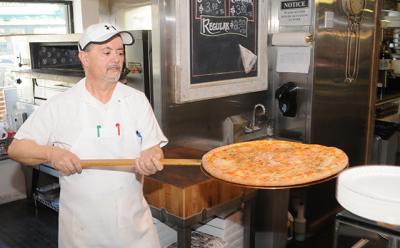
Gennaro Giugliano, who was born in Naples, the birthplace of pizza, has practiced the tradition of his homeland in East Hampton for 11 years.
Morgan McGivern
Gennaro Giugliano, pizza maker extraordinaire at the Red Horse Market in East Hampton
By
Amanda M. Fairbanks

If pizza is an expression of its maker, Gennaro Giugliano has found his true calling.    

“It’s the crust. The sauce has to be good, too. And don’t forget about the cheese,” said Mr. Giugliano, pizza maker extraordinaire at the Red Horse Market in East Hampton. “Anybody can make pizza, but you also need a heart. Without that, it doesn’t come out the way you want it to.”

All told, between the Red Horse Market and its prior incarnation, Tutto Italiano, an Italian specialty store owned by Citarella, Mr. Giugliano has made pizza in East Hampton for the past 11 years. 

Red Horse Market has hit its stride. Last July and August, it sold 12,000 pizzas and nearly 40,000 pounds of fresh mozzarella. 

Now 64, this coming summer will be Mr. Giugliano’s last at the pizza oven. “It’s too much. It’s a demanding job. It’s not like I’m 20 anymore,” he said, during a recent lunchtime rush, wearing his usual uniform of checkered chef’s pants, black sneakers, and a white apron. “You finally hit a certain age.”

Last summer, he was on his feet 13 to 14 hours each day, not including his daily commute from Bohemia, which averages anywhere between one to three hours. Come next January, he plans to retire, just two days shy of his 65th birthday.  

Mr. Giugliano was born in a small town near Naples, Italy. His mother was a homemaker, raising four sons and one daughter. His father worked as a carpenter. 

In 1970, with the Italian economy in ruins, the family arrived in the United States in search of a better life. Mr. Giugliano lived first in East New York, Brooklyn. At 18, he spoke not a word of English and learned the skill of pizza making from his older brother. At 24, he married and moved to Bensonhurst, near Coney Island, where he and his wife raised their two children, now 30 and 35.

After 18 years of marriage, they divorced. Mr. Giugliano moved first to Pennsylvania and later to Columbus, Ohio, to help a friend who had opened a pizzeria. 

Eleven years ago his phone rang. Pasquale Langella, 59, his brother-in-law, was on the other end, hoping to lure Mr. Giugliano back to Long Island. At the time, Tutto Italiano needed a pizza maker, and Mr. Langella knew just the guy for the job. 

In 2012, the Red Horse Market opened its doors. Mr. Langella now runs it alongside his two partners: Pedro Pineda, the specialty butcher, and Jeff Lange, the general manager. Mr. Langella makes fresh mozzarella every day in a giant tub of 190-degree water. During the high season, he makes anywhere between 400 to 600 pounds a day. His all-time record was last May, on the Saturday of Memorial Day weekend, when he made 735 pounds of mozzarella. 

Meanwhile, on the other side of the market, Mr. Giugliano keeps watch over his 525-degree oven. He never sets a timer, instinctively knowing when it’s ready. A large pie cooks for 7 to 10 minutes, while a small pie takes only 5 to 7. Midway through, Mr. Giugliano pulls out a giant fork and squashes down the crust to prevent the dough from puffing up. 

The crust is thin and crunches in your mouth. The most popular item is the pepperoni pizza, followed by sausage, and then mushroom. A large cheese pizza costs $18 and a small one costs $7. The market also sells round discs of homemade pizza dough.

Giovanni Carlos, a 35-year-old native of Ecuador, prepares the tomato sauce and dough, both whole-wheat and regular. Each day, he makes one to three batches of dough. One batch yields 192 small pizzas. Despite repeated attempts, Mr. Carlos refused to disclose his recipe, saying only that the ingredients are high-quality and made using fresh basil, kosher salt, and extra virgin olive oil. 

Six days a week, Mr. Giugliano can be found guarding his usual post — endlessly stretching dough, spreading tomato sauce, and sprinkling it with shredded mozzarella cheese. “I’m counting down the days,” Mr. Giugliano said. “Before the summer even starts, I’ve got 100 days behind me.”

A 6-month-old grandson, Steven, who lives in New Jersey, has spurred Mr. Giugliano toward retirement. He is determined not to miss out on his childhood. “I’m going to teach my grandson how to make a pizza.”

Of his trim physique, Mr. Giugliano says he indulges in his own food, albeit sparingly: “I like good food. I like good wine. But I have to stay away — or I’ll be like Pasquale.”

News for Foodies 05.12.16

News for Foodies 05.12.16

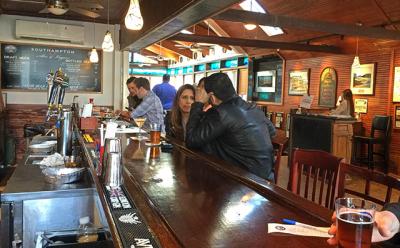
The Southampton Publick House opened at its new location in the old Driver’s Seat restaurant on Job’s Lane in Southampton Village late last month and began pouring its beer and other alcoholic libations on Friday. Patrons enjoyed the new space and the last hours of the weekend on Sunday evening.
Jennifer Landes
Local Food News
By
Joanne Pilgrim

Travel Foods

The Rogers Memorial Library is taking names for a program by Jeanne Schnupp, “Foods to Travel By: A Lunch­time Cheese Tasting and Cho­colate Fondue Party,” taking place at noon on Wednesday. 

Registration is $5 and is required by Sunday by calling the library or going to myrml.org. 

Fresh Juices

Juice Press, a chain offering fresh juices, is adding an East Hampton shop to its stores in Bridgehampton and Southampton. All three will open for the summer on May 23. 

The Juice Press menu includes more than 85 beverages along with foods such as salads, soups, and raw foods and snacks. It will be located in the shopping cove at 55 Main Street. 

Red Maple

Red Maple, the “rustic American” restaurant and bar at the Chequit inn on Shelter Island, has added weekend lunch and brunch service for the 2016 season. 

Lunch is offered on Saturdays from 11 a.m. to 5 p.m., and brunch is served on Sundays from 10 a.m. till 3 p.m. 

Over the Water

At Bay Kitchen Bar, which just reopened for the season at Harbor Marina in Springs, a $34, four-course chef’s tasting menu is served on Sunday, Wednesday, and Thursday, but only to early birds who order before 6:30 p.m. Soft-shelled crabs are in season, the restaurant has noted.

Bring Your Own

At the Bridgehampton Inn, dinner is served on Wednesday through Sunday, with a prix fixe offered before 7 p.m. There is no corkage fee charged on Sundays. 

Winemaker Talk Rescheduled

The final tasting and talk in a wine education workshop series at Wainscott Main Wine and Spirits took place yesterday, after a session with Roman Roth of Wolffer Vineyards and Roanoke Vine­yards was rescheduled. 

Mr. Roth will be on the agenda when the popular series resumes in October.

Seasons by the Sea: The Skinny on Squid

Seasons by the Sea: The Skinny on Squid

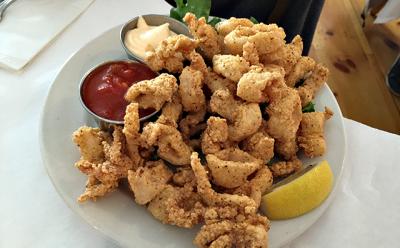
The difference between perfect calamari and its rubbery cousin is really a matter of seconds.
Laura Donnelly
A good test of the chef’s abilities
By
Laura Donnelly

When reviewing restaurants, I almost always sample their fried calamari offerings. Just about every restaurant out here has it on the menu. It’s a good test of the chef’s abilities. Is it lightly crisped and tender? Are the tentacles included? Is it served with an imaginative sauce or just a tepid marinara? 

Overcooked calamari (squid) is a distressing thing to behold. Long after the crispy coating has traveled down your gullet, you are chewing, chewing, chewing the remaining rings. Visions of lobster claw rubber bands dance in your head. If there are no tentacles, I feel gypped. And while marinara is a perfectly fine accompaniment, it’s nice to find the occasional aioli, brightened with lemon or lime juice, heightened with garlic, or spiced with a judicious squirt of sriracha.

Cittanuova in East Hampton has an excellent version, served with fried zucchini strips and a tomato basil aioli. It is pale, crisp, and tender. If you fry squid more than two minutes, you will end up with the aforementioned rubbery effect. While you can do just about anything with squid — fry, saute, boil, grill, pickle, stew, smoke — it must be either cooked very quickly or low and slow for half an hour or more.

I have to admit I have never prepared squid at home. I have no problem plucking birds, butchering meat, cleaning and scaling fish, or even snipping the face off a soft shelled crab before removing its other kee-kee innards before cooking. But there’s something about the slippery, sci-fi aspects of squid that keeps me from doing the work myself.

Squid are cephalopods, along with octopus and cuttlefish. They have been a prized food in Japan and Italy and Portugal for centuries but were only considered bycatch and bait in America until about 40 years ago. When trawlers from Japan started showing up along the Atlantic Coast in the 1960s, the government and local fishermen took notice.

Because it is cheap and abundant and freezes well, it soon became so popular that it started showing up on fast food menus, rivaling the popularity of buffalo chicken wings and jalapeño poppers. In 2013, the New York catch was worth $8 million.

Sean Barrett of Dock to Dish calls our long-fin squid “a darling of versatility in the kitchen and sustainability in the ocean.” The only inedible parts are the beak and gladius (pen). It is a good source of zinc, manganese, and is high in copper, selenium, B12, and riboflavin. Squid grows fast and spawns several times a year. It is not an “apex” or alpha predator in the food chain and is low in toxins like mercury. As various factors have decimated some squid predators like sharks, tuna, and cod, the squid have been able to multiply.

North Atlantic squid can be found in waters from Newfoundland to Venezuela. There is a bridge in Newport, R.I., that is so popular for squid jigging that it has been nicknamed the Calamari Causeway.

When buying at the market, look for squid that is shiny and firm, not saggy like a deflated balloon. It should smell fresh and ocean-y. The thin, dull membrane covering it should be grey rather than pink or purple. You can buy it cleaned or tackle that job yourself. James Peterson’s encyclopedic volume “Fish and Shellfish” has thorough instructions and illustrations on how to do this.

I found it interesting that many local cookbooks don’t contain recipes for squid. Not “The East Hampton L.V.I.S. Centennial Cookbook” or “Hamptons Weekends” or “The Beach House Cookbook” or “The Hamptons and Long Island Homegrown Cookbook.” There are a few recipes in “The Seafood Cookbook” by Pierre Franey and Bryan Miller, and my favorite, “Foods of Long Island” by Peggy Katalinich, but even those keep it restricted to fried and pasta dishes. 

For the adventurous cook, I recommend looking into Italian, Japanese, Chinese, and Korean cookbooks. David Chang’s “Lucky Peach” cookbook has a recipe for quickly blanched squid rings in a grapefruit salad with garlic, fish sauce, and mint. Kylie Kwong’s “Simple Chinese Cooking” has a cornstarch and flour battered squid with salt and pepper and Sichuan peppercorns that sounds so good, I might even be brave enough to try it.

Squid is versatile, inexpensive, healthy, available year round, and delicious, so don’t be a little scaredy cat like me; try some of these recipes at home.

Click for recipes

News for Foodies 05.05.16

News for Foodies 05.05.16

Local Food News
By
Joanne Pilgrim

This weekend brings two occasions that might take foodies to local eateries — the Run for the Roses (Kentucky Derby) on Saturday and Mother’s Day on Sunday. 

Southern fare and mint juleps will be served at a Kentucky Derby party at Baron’s Cove in Sag Harbor from 4 to 7 p.m. on Saturday. 

The next day, Baron’s Cove will serve brunch for Mother’s Day from 11 a.m. to 4 p.m., as well as a Sunday roast menu from 11 a.m. to 9 p.m. 

The Backyard Restaurant at Sole East in Montauk will serve a Mother’s Day brunch from 11 a.m. to 2 p.m. There will be music poolside, and those who want to get a jump on the season will find the pool open for swimming and, thankfully, heated. Reservations have been suggested. 

Momi Ramen restaurant in East Hampton will reward moms on their holiday with a free piece of green tea lava cake and $5 Wolffer Estate rosé by the glass. 

At Nick and Toni’s in East Hampton, a la carte specials for Mother’s Day will be offered at brunch and dinnertime. They include jumbo lump crab cake with sweet pea cream and pea tendrils salad, grilled wild salmon, and a strawberry sundae for dessert. 

At Navy Beach in Montauk, mothers who visit on Sunday will receive a free Bloody Mary or mimosa with their meals. A prix fixe lunch will be served from noon to 4 p.m., with three courses including a choice of Montauk clam or corn chowder, or beet or arugula salad; grilled salmon, a burger, or eggplant ragu, and the dessert of the day. The cost will be $45 plus tax and gratuity.

Flowers are the focus, along with food, at the Living Room restaurant and c/o the Maidstone in East Hampton. Sunday’s Mother’s Day brunch will include bouquets for moms whose families or friends make arrangements with the inn ahead of time. During the month of May, the inn and restaurant will be full of floral arrangements from local florists, and the menu will feature dishes that include flowers and microgreens. Bartenders have created a version of a Tom Collins with a splash of lavender, to go along with the theme. 


The Season Continues

Bay Kitchen Bar, the restaurant at Harbor Marina in Springs, reopens for the season tonight. Overlooking Three Mile Harbor, it has a sunset happy hour from 4 to 6 p.m. featuring $2 oysters and $6 glasses of rosé — a special that is repeated after 10 p.m. The restaurant is serving now on Wednesday through Sunday; it will serve dinner daily beginning mid-June. 

Continuing the inevitable roll toward the season, the Lobster Roll on Napeague starts its 2016 season tomorrow, marking more than a half-century in business. New this year is a Lobster Roll food truck, which can be hired for off-premise events and will be able to serve the restaurant’s full catering menu. The Lobster Roll will be open from 11:30 a.m. to 9 p.m. on Friday and Saturday, and until 8 p.m. on Sunday; hours will be daily beginning on May 26.

The Surf Lodge in Montauk also reopens tomorrow with a revamped menu. Chris Rendell, the executive chef, will be getting local produce from Bhumi Farms and Quail Hill Farm and will offer daily specials based on what is available. Jay Astafa, a vegan chef, will join him in the kitchen this summer. According to a press release, he is known for “reimagined comfort food” and for “haute vegetable-forward” cuisine. 

At Gosman’s Dock in Montauk, the Gosman’s fish market reopens for the season tomorrow, with hours from 10 a.m. to 6 p.m. 


Celebrate Cinco de Mayo

If you look at the calendar, you’ll know that today is the Mexican holiday of Cinco de Mayo, and La Fondita in Amagansett will be serving some specials all day to celebrate. They include chicken tamales in green sauce, tamales with sautéed poblano peppers, and poblano chiles with picadillo, topped with walnut cream sauce and pomegranate seeds, served with rice and refried beans. Homemade churros with vanilla ice cream will be available for dessert. 


Planning Ahead

Tickets are being sold for the August Great Food Truck Derby in Bridgehampton, sponsored by Edible East End magazine. A caravan of New York City and Long Island-based food trucks sets up shop at the Hayground School, which benefits from money raised at the event. Tickets, which start at $65, entitle those who make it to the takeout windows of the vendors to one dish from each. They can be obtained through the events section of the Edible East End website.