News for Foodies 08.04.16

News for Foodies 08.04.16

Local Food News
By
Joanne Pilgrim

With the Olympics set to begin in Rio, Townline BBQ in Sagaponack will be serving a Brazilian-inspired cocktail, the watermelon caipirinha, beginning tomorrow. During happy hour the cocktail will be half price, at $6. Olympic events will be shown on the Townline TV throughout the games. Those restaurants in East Hampton with the same ownership will also serve Olympic-themed cocktails. At Rowdy Hall and Nick and Toni’s, a passion fruit caipirinha will be offered; the games will be screened outdoors in Rowdy’s courtyard. 

The Summer Olympics will be celebrated at Indian Wells Tavern in Amagansett with food and beer specials during the games, which will be shown in the bar area. Specials will include several beers for $4 or $6 and a Brazilian churasco skewer, with chicken, steak, or sausage, and a fried plantain, for $10.


At the Market

The Amagansett Farmers Market has had some additions. Cinque Family Wines has opened a satellite tasting room at the site, offering East End and other Long Island wines for purchase and sampling daily from noon to 7 p.m. In celebration of the opening of the tasting room, a stand featuring $1 Montauk Pearl oysters on the half shell will be offered tomorrow from 5 to 7 p.m. and on Saturday from 4 to 7.

Also at the market, Around the Fire Catering is now serving breakfast, lunch, and dinner from Thursday through Sunday. The menu includes smoked chicken, salads, sides, and pizza for lunch and dinner, along with a special kind of breakfast pie.


Barbecue in the Vines

Roman Roth, the winemaker at the Wolffer Estate Vineyard in Sagaponack, will present a preview taste of the winery’s Christian’s Cuvée 2013 at a barbecue dinner on Wednesday night. Reservations are $95 per person, or $80 for members of the vineyard’s wine club.


Doughnuts and Coffee

Grindstone Coffee and Donuts has opened on Sag Harbor’s Main Street. On the menu is Four Barrel Coffee, a San Francisco brew, along with brioche-style doughnuts made fresh throughout the day using locally ground flour from Amber Waves Farm. Varieties include blueberry lemon, chocolate with toffee popcorn, and peanut butter mousse with chocolate. Fresh-pressed juices are available as well. 


Snacks at the Maidstone

A “Get Shucked” raw bar on Sundays from 3 to 6 p.m. at c/o the Maidstone in East Hampton features $2.25 Peconic Bay oysters, $1 local Little Neck clams, and a $4 crab cocktail. 


Jamaican Cuisine

The Soursop Tree Café, which has taken the spot above Plaza Sports in Montauk where Wok ’n’ Roll used to be, is serving Jamaican dishes like fish and chips, jerk chicken, oxtail, fish tacos, Jamaican barbecue, and more. 

The café, open daily for lunch and dinner, for dining in or taking out, is continuing Wok ’n’ Roll’s “you hook ’em, we cook ’em” tradition, allowing people to bring in fresh catches for preparation Caribbean-style.

Seasons by the Sea: Cook Them While You Can

Seasons by the Sea: Cook Them While You Can

Just ahead of the height of corn and tomato season, there are still plenty of options at the farm stand.
Laura Donnelly
There are plenty of interesting fruits and vegetables available right now
By
Laura Donnelly

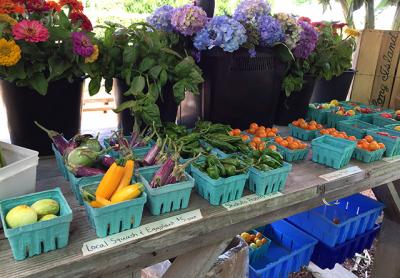
Although I am eagerly awaiting the arrival of big fat beefsteak tomatoes and sweet white corn at the farm stands, there are plenty of interesting fruits and vegetables available right now. Actually, tomatoes and corn are starting to come in from the North Fork, so have at it. You know what to do with them.

Shishito peppers are everywhere nowadays, and they are tasty morsels that we just didn’t see until about 10 years ago. They are thin, about three to four inches long with puckery skin. I call them the Russian roulette of peppers, because you can munch on a bowlful of them and then suddenly get a super hot one. Usually 1 in 10 is spicy. (They are related to, and often confused with, padron peppers, which are shorter and fatter and tend to be a bit spicier.) Shishitos are also referred to as shishitogarashi in Japan, because the tip of the pepper is thought to resemble a lion’s head, or “shishi.”

The simplest way to prepare them is to fry in a pan with a little bit of oil or blister them on the grill. They take very little time to cook because they are thin-skinned. Some people recommend poking a hole in each before frying, because they can pop and spurt all over the stovetop if you’re not careful. Sprinkle with a little salt and perhaps some lemon juice and you’ve got a quick, healthy appetizer to go with your cocktails.

Japanese eggplant are another fruit (yes, fruit) that is plentiful right now,  and they are a lot easier to cook than their elephantine relatives. They have thinner skin, are almost seedless, and are less bitter. These are also simple to cook; throw them on the grill or roast on a sheet pan in the oven. They absorb flavors easily, so just a little bit of miso or soy sauce and garlic or sesame oil are perfect on top.

There are a lot of other small, mild eggplants available right now like Chinese (long and thin like the Japanese), Rosa Bianca, an Italian heirloom variety that is round with purple and white stripes, and many green, white, lavender, and pink eggplant of different shapes and sizes. Some believe the male is less bitter because of fewer seeds, so if you want to sex your eggplant, take a look at the bottom. If the indentation is deep and shaped like a dash, it is female. If it is shallow and round, it is a male.

And now for one of my favorites this time of year: the zucchini blossom. These are used a lot in Italian and Mexican cooking, but you don’t see them often on menus out here. They can be shredded and incorporated into risottos, used as a pizza topping, and stuffed with cheese and spices. I prefer them simply fried, because their flavor is so delicate. In Italy they are the jalapeño popper of the jet set.

First a little botany lesson. The male blossom grows from a stem and has stamens, the thin filaments with anthers at the top. The female blossom has the fruit at the stem and has a pistil at the center of the flower. I prefer the male blossoms. While some say you don’t need to remove the pistils or stamens, I do, as this can add some bitterness to the flavor. The Italians also recommend shaving off a bit of the leaves because these are prickly. You should take a look at what’s available at farmer’s markets and farm stands because the size and price can vary wildly. I saw a sad bunch wilting in the sun a few weeks ago at one vendor’s stand (at $1 per blossom!) and saw another bunch, bigger and healthier and cheaper at another. Once you get them home, open them gently and rinse. There may still be some pollinators inside going about their business. Remove the pistils and/or stamens and lay out on paper towels to dry. Once dry you can proceed with whatever recipe you like, but I strongly suggest you try them simply fried with a bit of garlic and chopped parsley in the batter.

 Last but not least is another in-season “what do I do with these” fruit: okra. Having grown up in the South, I am absolutely mad for okra and grits and all those things that Northerners turn their noses up at. When stewed, okra releases its gummy, gluey mucilage, which is useful for thickening gumbos and soups. But if you fry them briefly, either sliced or whole, they retain a crispness similar to green beans. You can also pickle them. 

Okra, a member of the mallow family, is very nutritious. If you’ve ever seen an okra flower you would see the resemblance. They are also related to cotton and hibiscus and are of northeast African origin. They are full of vitamins A, K, and C, along with folates, minerals, flavonoid anti-oxidants like beta-carotene, xanthan, and lutein. Okra has also been called “green Viagra,” because the polysaccharides in okra open up the arteries in a similar way, according to the Institute of Food Technologies. When buying or picking okra, you want smallish ones, about three to four inches long, and you should cook them within a few days.

Tomatoes and corn will be here soon enough, along with zucchini the size of an N.B.A. player’s Nike Jordan Melo M12 sneaker. So try these often overlooked but oh, so delicious fruits and vegetables while they’re still available at our farm stands.

Click for recipes

News for Foodies 07.28.16

News for Foodies 07.28.16

Local Food News
By
Joanne Pilgrim

Manna Restaurant and Bar in Water Mill is offering a $30 lunch prix fixe on weekdays between 11 a.m. and 3 p.m. Among the menu choices, which are subject to change, are, for appetizers, a choice among eggplant with sheep ricotta, mozzarella, and basil, Mediterranean crabcake with zucchini noodles, and a Manna salad with arugula, black kale, beets, onions, and chicken or shrimp. Entree choices may include chicken paillard, an Angus beef burger, and rigatoni with eggplant, basil, onions, tomatoes, and ricotta. A dessert of the day will round out the meal. 

Those who visit Manna tomorrow night between 6 and 8 will find a variety show being presented in the restaurant’s courtyard. Several students of Samantha Cole, a voice coach, will perform live acoustic sets. 


Pizza Dough Lives

In the first of several workshops this season on fermentation, the Amagansett Food Institute will partner with Around the Fire Catering for a session on Wednesday on “living pizza” that will result in dough made from sourdough starter. 

Topics to be covered by Adam Kelinson of Around the Fire will include managing a sourdough starter, preparing dough, and using a wood-fired oven. An additional discussion led by Tyler Armstrong will center on fermentation in winemaking, and include a wine tasting. 

Tickets, which can be reserved by sending an email to info@amagansett­foodinstitute.org, are $85, and include pizza-tasting, the wine, and a take-home dough starter. The class will take place at the Amagansett Farmers Market from 5 to 7 p.m. 


Slow Food Potluck

Slow Food East End will have an August potluck “snail social” dinner at Jonathan Glynn’s residence in Sag Harbor on Aug. 7 from 6 to 8 p.m. Participants are asked to bring a local, seasonal dish — hors d’oeuvre, dessert, or beverage — large enough to serve six to eight. Admission is $20, or $15 for Slow Food members, and reservations can be made on the Slow Food East End website.

Seasons by the Sea: Food of the Gods

Seasons by the Sea: Food of the Gods

Passion, olive oil, and perhaps even pastitsio may be the fountain of youth as served up at this year’s Greek Festival at the Greek Orthodox Church of the Hamptons over the weekend.
Laura Donnelly
A perfect day to sample the lamb roasting on a spit over hardwood charcoal, seasoned with lemon, garlic, oregano, and salt
By
Laura Donnelly

The Hamptons Greek Festival was held last weekend in Southampton at the Greek Orthodox Church of the Hamptons. It was scorchingly hot when I went on Sunday, so hot that Tony the Pony was kept in his cool, shady trailer. Nobody wants to mount a furry animal on a day like that. It was, however, a perfect day to sample the lamb roasting on a spit over hardwood charcoal, seasoned with lemon, garlic, oregano, and salt, the rich pastitsio (macaroni with beef and béchamel sauce), spanakopita (spinach, dill, and feta cheese in crisp phyllo dough), salads, hummus, and divine honey, cinnamon, and walnut pastries galore.

There were plenty of vendors selling T-shirts and jewelry embellished with variations of the “evil eye,” a talisman meant to protect against a malevolent glare believed to bring misfortune or injury. There was beautiful hand-painted pottery, chamomile and rosemary soaps, and mastic chewing gum. Under the tent each table had a blue and white tin can with mint and oregano plants.

The first person I met was a photographer, Anastassios Mentis, who was selling his mother’s extra virgin olive oil from the Laconian village of Neapolis, Greece. It was absolutely delicious, buttery and pale green. Anastassios was offering samples over bits of semolina bread sprinkled with sea salt from the same village. He showed me a picture of his 81-year-old mother atop a tractor, and I remarked on how young she looks. “That’s because she has passion and eats olive oil!” Mentis Estate’s olive oil has been written about in Wine Spectator and Crain’s, which referred to it as “a green diamond.”

Next was Konstantine Rountos, an active member of the church who teaches the youth dance program. He was serving a variety of Meligyris honeys from Crete, which had a faint hint of the wild herbs and white thyme grown there. The white thyme is somewhat rare and only grows at high altitudes.

Under the food tent I tried spanakopita, green beans, and salad. All of the food was prepared by church members in the church kitchen. The spanakopita was exceptionally good, tasting fully of all its ingredients: spinach, dill, and salty feta cheese. What was most impressive was the fact that the phyllo dough had remained crisp on such a sweltering, humid day.

I met Alexandra Sofis, who works in the specialty food business and procures most of the Greek products available at the church shop. She showed me the refrigerator filled to the brim with Epiros-brand feta and said traditional Greek feta should always be made with a combination of sheep and goat milk. Feta is also made in France, Denmark, Bulgaria, and the United States and is sometimes made with cow milk or only sheep milk. The tanginess, saltiness, and texture can vary from country to country. When America’s Test Kitchen sampled Greek, French, and American varieties, both plain and cooked with shrimp and tomatoes, the Greek fetas won hands down due to their “funky, grassy, barnyard” flavor.

Next was a tour through the art gallery, where Alexandra showed me a painting by a Syrian Muslim artist named Jamal who is the artist-in-residence for the Emir of Qatar. The church believes that religions can be brought together through art and always has works on display from artists of different cultures and beliefs. 

Probably the biggest treat of all was meeting Maria Loi, a chef and cookbook author. Within five minutes she gave me a copy of her book, “The Greek Diet,” signed “with love,” insisted I be her guest at her restaurant in New York City, Loi Estiatoria, and then gave me a leather and canvas bag adorned with an evil eye so I could haul all of my loot. It is at this point that I must say I have never, ever met so many generous, gracious, warm, and passionate people, from Anastassios to Konstantine to Michael (manning the lamb grill, son of Father Alex Karloutsos, nephew of Father Constantine Lazarakis) to Alexandra and Maria. 

As I was purchasing some halloumi cheese and taramasalata, Alexandra gave me a carton of Kourellas organic yogurt that she had discovered at the Fancy Food Show. “Eat Like a Greek!” it says on the label, and I did just that, swirling some of the Meligyris honey into the Kourellas yogurt. Healthy, flavorful, and light, this was the best yogurt I have ever tasted.

And now I am going to share with you the best-kept secret ever. On Sundays, after church services, around noon, the shop is open and selling all of the aforementioned delicacies and more. There is a freezer full of homemade spanakopita, pastitsio, and moussaka, refrigerators full of cheeses and yogurt and tarama. 

Halloumi cheese is a perfect appetizer for summertime. It is a firm, kind of squeaky, salty sheep and goat cheese from Cyprus that you can slice and throw on the grill or into a frying pan. It softens slightly but does not melt. Top it with ground pepper and lots of lemon juice. Tarama (carp roe) or taramasalata is a marvelous salty and rich spread, excellent with crudités and on crackers or toasted pita bread.

Many thanks to all of those at the Greek Orthodox Church for educating me and sharing these fine examples of Greek food, music, art, and most of all, warm hospitality. Opa!

Click for recipes

News for Foodies 07.21.16

News for Foodies 07.21.16

Local Food News
By
Joanne Pilgrim

Several of the summer’s big food events are on the horizon. 

This weekend will bring Dan’s Taste of Summer’s GrillHampton event tomorrow and a Taste of Two Forks and the James Beard Foundation’s Chefs and Champagne on Saturday. At GrillHampton, to be held at Fairview Farm at Mecox in Bridgehampton tomorrow night, a team of New York City chefs will face off with their Hamptons counterparts for a cooking competition and tasting. Among the local participants will be Jason Kallert of the Beach Club at Gurney’s, Jon Warnock of Grey Lady Montauk, Drew Hiatt of the Topping Rose House, George Gounelas of Old Stove Pub, Peter Ambrose of Endless Summer Event Catering, and Arthur Wolf of Smokin’ Wolf.  Early admission, which starts at 7 p.m., is $165; general admission is $135 and allows entry at 8 p.m. V.I.P. passes are sold out. Diners will cast their votes for the best food of the night.

A Taste of Two Forks, also at Fairview Farm, will begin at 6:30 p.m. with V.I.P. access at $295, which will include entry to a lounge with “ultra-premium” drinks, a dessert bar, and a sparkling wine bar, and a copy of a cookbook by Alex Guarnaschelli of “Iron Chef,” along with a meet-and-greet and book signing with the author. General admission tickets are $185; doors open at 7:30 p.m.  There will be food, wine, and beer from numerous East End restaurants, wineries, breweries, and purveyors. 

A portion of ticket proceeds from both events will benefit All for the East End, a nonprofit that supports various East End charities. The Retreat, a center for those dealing with domestic violence, will also be a beneficiary. 

The Chefs and Champagne fund-raiser on Saturday at the Wolffer Estate Vineyard in Sagaponack will feature food by more than 40 chefs representing James Beard Award-winning restaurants. A V.I.P. reception will be held from 5 to 6, followed by the main event from 6 to 8:30 p.m. and an after-party from 8:30 to 10. The Christian Wolffer Scholarship program to support food and wine studies will be announced. V.I.P. tickets are $375, or $4,000 for a table of 10. General admission costs $200 for James Beard Foundation members and $275 for nonmembers. Reservations may be made at jamesbeardfoundation.org.

Looking ahead to next weekend, the Hayground School Chefs Dinner will bring together powerhouse chefs to raise money for the Bridgehampton school’s culinary programs and its overall curriculum. This year’s dinner will honor Toni Ross of Nick and Toni’s restaurant, a founder of the school, and Claudia Fleming of the North Fork Table and Inn. Among the chefs contributing to the meal will be Joseph Realmuto of Nick and Toni’s, Josh Capon of Lure Fishbar and Bowery Bowery Meat Co., Tom Colicchio of Crafted Hospitality, Elizabeth Falkner, Alex Guarnaschelli of Butter, Abigail Hitchcock of Camaje Bistro, Marc Meyer of Cookshop, Hundred Acres, and Rosie’s, Christian Mir of Stone Creek Inn, and Jason Weiner of Almond. Julie Berger, the sommelier at Nick and Toni’s, will take on that role for the event, and Michael Cavaniola of Cavaniola’s Gourmet will be the evening’s fromager. The dinner will start at 5, and tickets are $1,200 through haygroundchefsdinner.org.

Through Farms and Fields, an annual fund-raiser for the Peconic Land Trust, will take place at Quail Hill Farm in Amagansett this year, on Aug. 7 beginning at 4 p.m. Honest Catering, with Mr. Realmuto at the helm, will provide the food. The event will honor Margaret de Cuevas and her father, John de Cuevas, two local conservationists. Tickets may be ordered through the Peconic Land Trust office or its website. They are $300 each, with package prices for multiple tickets for supporters, up to $25,000 for a table for 10. 

The Gala in the Garden is a September event created by Colin Ambrose, the chef at Estia’s Little Kitchen in Sag Harbor, to raise money for Slow Food East End, the after-school program Project MOST, and for the A.L.S. Ride for Life, in honor of Gerry Hayden, a chef who died from that disease. There will be music, hors d’ouevres, and wine and craft beer served in the garden at Estia, where a special East End wine cellar will be set up, with a collection of limited edition bottles signed by East End winemakers up for auction during the event. Mr. Ambrose and Paul Del Favero of Harbor Market and Kitchen in Sag Harbor will work together to create a multi-course meal centered on local, seasonal ingredients. Tickets are $350 and are on sale now through Slow Food East End. 


East Hampton Point

Afternoon bar specials at East Hampton Point include local clams and oysters at $1 each from 3 to 5 p.m. on Friday, Saturday, and Sunday, a nightly happy hour from 5 to 7 p.m. with $5 draft beers and half price sangria drinks, and Thursday night bar bites, such as five-spice braised duck tacos and chicken and cheese pupusas at, along with selected beers,  $5. The Point serves dinner nightly beginning at 5 as well as lunch from noon to 3 p.m. on Friday through Sunday. 


No More Chinese

With the closing of Wok ’n’ Roll in Montauk, the hamlet lacks a Chinese food outlet. In addition, fishermen who were able to bring their catch to Wok ’n’ Roll, where the chef would cook the fish in one of a number of ways, to the diner’s preference, now have to rely on home cooking. 

Caravan Food Shop Rolls Into Amagansett

Caravan Food Shop Rolls Into Amagansett

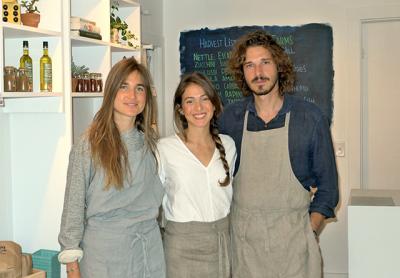
Deeva Green, Alexandra Cohen, and Lee Reitelman launched Caravan to share their love of agriculture, travel, and the environment through food.
Christopher Walsh
Caravan’s offerings are “always moving, always evolving,”
By
Christopher Walsh

Previously housed in a 1970s Shasta trailer parked at Bhumi Farms in East Hampton, Caravan, a purveyor of prepared foods of genuinely local provenance, opened down the road at 137 Main Street in Amagansett just in time for the July 4 weekend.

In keeping with its name and logo, a friendly looking beast dubbed the Caravanimal, Caravan’s offerings are “always moving, always evolving,” in the words of Lee Reitelman, who launched the shop with Alexandra Cohen and Deeva Green. “The menu changes every week, based on what the farmers are taking out of the ground, what the fishermen are catching, what the raw cheese guy is doing,” Mr. Reitelman said. “But the format stays relatively consistent.”

A recent week’s offerings included a zucchini parmesan frittata. “We call it a 24-hour frittata,” Mr. Reitelman said, “because for the most part, the ingredients are in the ground less than 24 hours before we make the frittata, and frequently the eggs” — from Iacono Farms in East Hampton — “are laid within that period, too.” 

Their bluefish salad tartine is a hit, Mr. Reitelman said, and will be a mainstay through the summer. “We get it from a husband-and-wife team on the North Fork. He catches it, she smokes it, and then we treat it very simply, with olive oil, lemon juice, and some herbs. No mayo, no dairy.” 

A terroir bowl is the signature dish, choices of which may be based on quinoa, wheatberries, chicories, or cabbage and kale, as in a recent week. “ ‘Terroir’ meaning the taste of a place, the way the soil and climate, and even the philosophy of the farmers, inflects the food,” Mr. Reitelman said. “The terroir bowls are meant to feature what is happening right now agriculturally on the East End.” Anything that is not from the South Fork, he said, such as quinoa or wheatberries, is included so that gluten-free options can be offered.

A compote might include rhubarb and strawberry. “Pretty soon,” he said, “we’re going to start getting wild blueberries, so we’ll do a blueberry compote and serve that with a gluten-free granola that we make.” 

Sides, baked goods, and drinks are also on the menu. The cute, intimate space also offers raw produce and some of the partners’ favorite packaged foods, including spices, mustards, olive oils, and tinned mackerel and sardines. 

Caravan is open Thursday through Monday from 9:30 a.m. to 6 p.m. The lease runs through September, though “we’ve fallen in love with the space and the town,” Mr. Reitelman said, “so if we can make it work year-round, we’d like to.” Caravan, he said, “is born of a love of eating, a concern for the environment, a love of agriculture, a love of travel. Everything is about sharing that with other people.”

News for Foodies 07.14.16

News for Foodies 07.14.16

Local Food News
By
Joanne Pilgrim

East Hampton Point will serve a special tasting menu dinner on Saturday,  paired with front-row seats to the midsummer pyrotechnics show from Fireworks by Grucci that will go off after dusk over Three Mile Harbor. Five courses of French-inspired dishes by the restaurant’s chef, Thomas Rougey, will cost $125, or $195 if paired with wine. Menu items will include striped bass crudo, vichyssoise, Montauk sea scallops with risotto with Crescent Farm duck, and braised short ribs. Reservations for dinner, to be served from 5 to 11 p.m., have been recommended.


At the Highway

The chefs from Shuko, a Japanese restaurant in New York City, will serve a tasting menu for $200 a head at Highway Restaurant and Bar in East Hampton twice this summer, with the first event on Saturday. Nick Kim and Jimmy Lau will serve a number of courses during the two-and-a-half-hour event. The cost does not include tax and gratuity. Reservations can be made at resy.com /cities/ny/shuko-hamptons. A second Shuko event will take place on Aug. 13. 


A Taste of Montauk

The fourth annual A Taste of Montauk event, sponsored by the Montauk Chamber of Commerce and featuring food and drink from local establishments, will take place under a tent at the Montauk Yacht Club on July 24 from 6 to 9 p.m. Tickets are $75 in advance from the chamber and will be $85 at the door. 

Among the participating restaurants are Tillie’s at Gurney’s, the Backyard restaurant at Sole East, East by Northeast, Arbor, Westlake Fish House, and Swallow East. Wines from East End vineyards, including Martha Clara, Pindar, and Osprey’s Dominion, and Montauk Brewing Co. beer will be served. 

The Lynn Blue Band will perform. 


Slow Food Potluck

Slow Food East End has organized a summertime potluck “snail supper” to be held on Sunday from 5 to 8 p.m. at Judith Axelrod’s house along the bay in Sag Harbor. Reservations may be made at slowfoodeastend.org, but are first-come, first-served to a maximum of 35 guests. Guests will be asked to bring an appetizer, dessert, or drinks to share, all with a focus on local and seasonal ingredients. The cost is $15 for Slow Food members and $20 for nonmembers. 


Through Farms and Fields

The Peconic Land Trust’s annual outdoor supper will take place at Quail Hill Farm in Amagansett this year on Aug. 7 at 4 p.m.  Tickets start at $300 each for individuals and can be purchased online at peconiclandtrust.org or by calling the land trust’s Southampton offices. 


Ramen Chef Visits

Ivan Orkin of Ivan Ramen and Ivan Ramen Slurp Shop will be at Momi Ramen in East Hampton next Thursday night to present a special dinner. It will include a selection of starters from the menus of both Momi Ramen and Mr. Orkin’s restaurant, followed by a choice among four ramens. The cost, payable upon making reservations at momihamptons.com or on the Resy app, is $60 per person, which includes tax and gratuity. 


Smokin’ Wolf Adds Hours

On Pantigo Road in East Hampton, the Smokin’ Wolf Barbecue takeout shop is now open seven days a week from 11 a.m. to 9 p.m.

East End Eats: Left Hoping at Topping Rose

East End Eats: Left Hoping at Topping Rose

Goodbye Tom Colicchio, hello Jean-Georges Vongerichten
By
Laura Donnelly

Topping Rose House

1 Bridgehampton-Sag Harbor Turnpike, Bridgehampton

631-537-0870

Breakfast, lunch, and dinner seven days

Gone are the days of tenderloin of rabbit, white tablecloths, and a $60,000 winking snowy owl art installation by the bar. Goodbye Tom Colicchio, hello Jean-Georges Vongerichten. Goodbye lobster mushroom gnocchi, hello . . . hamburgers and spaghetti? Whaaaat?

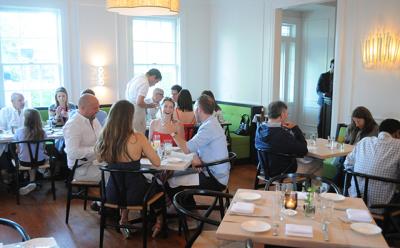
In its early years, under the guidance of Mr.  Colicchio (Craft, ’Wichcraft, “Top Chef”), Topping Rose House was a high-end destination restaurant. It was very, very good, but the few times I went it was never full and never had a buzz. Nobody was hanging out at the pretty, high-gloss teal bar by the front door, and the tall-ceilinged all-white dining room verged on austere. 

A few things have changed; a few remain the same. The bar is now painted a glossy black and has some attractive seating arrangements, modern wicker, a lime green banquette, and some black leather lounging chairs. 

We lingered in the bar with our extremely expensive drinks ($17 for a cucumber mint martini) and nibbled on popcorn and wasabi peanuts. I had thought the popcorn might be something super special, like truffled or herbed or perhaps even accented with some of Jean-Georges’s signature pan-Asian flavors, but no, it tasted of the stuff girls eat when they’re on a diet, kind of like air-popped air.

In the dining room the plain wood tables now have tan paper place mats, there are more lime green banquettes, and black wood chairs that are somewhere between Ilmari Tapiovaara crinolines and Danish modern Windsors from West Elm. (I’m just trying to cover all the Scandinavian design bases here because, really, I have no idea what I’m talking about!)

After settling in at our table, we got some delicious, warm slices of crusty bread that our waiter told us was made in house. It is served with small dishes of wonderful olive oil, and there are little bowls of Maldon sea salt on the table as well. An amuse bouche of four radishes with a foamy vinaigrette came next. We noted that it was odd to only get four since there were five of us.

We began our meal with warm asparagus salad, tuna tartare, calamari, and fluke crudo. The warm asparagus salad was very good, with most of the stalk utilized as the French do, by peeling the woodier portion off. The dressing had a variety of brunois-cut (tiny dice) vegetables: carrots, fennel, scallions, and parsley, and, best of all, a lot of tender, tasty morel mushrooms. 

The tuna tartare was delicious, but we all agreed that diced tuna would have been a better texture than the finely ground version here. It was served on an avocado puree and topped with slices of radish. The ginger dressing was spicy and super salty. The calamari was a delicious rendition, although a somewhat dainty portion for the price. The batter was crisp and parsley-flecked, and the dish included a mild citrus-chili aioli. 

Probably the best appetizer of all was the fluke crudo. The slices of fluke were dressed in a lemony olive oil vinaigrette and topped with crispy rice, cilantro microgreens, and a few pinches of crunchy sea salt. It was beautiful to look at, refreshing, and light.

For entrees we ordered the Parmesan-crusted chicken, spaghetti with smoked bacon, a cheeseburger(!), striped bass, and garden vegetable brown rice bowl. The chicken was quite good, a deboned breast with a well-seasoned crust on it and a tart lemony sauce. The artichokes served with it, however, were way overcooked, verging on mushy. The spaghetti with smoked bacon was very good as well, but the arugula mixed into it was tough and woody, way past its prime. 

The cheeseburger was nicely presented and cooked to order. It came with a big slice of yellow tomato, some butter lettuce, house-made pickle slices, frizzled onions, and hand-cut, skin-on fries. The fries were excellent, but the frizzled onions were oddly lacking in onion flavor. 

The last two dishes were somewhat disappointing. The striped bass was requested slightly underdone, but it was the opposite, way overcooked. This toughens striped bass. It was served on top of zucchini and summer squash with a pool of apricot sauce and edible flower petals. It was a very pretty presentation. 

The garden vegetable brown rice bowl was also pretty, and the vegetables fresh, but it tasted overwhelmingly of ginger and nothing else. There were fiddleheads, snow peas, sugar snap peas, squash, yellow and orange carrots, scallions, and an excellent short-grain brown rice. It just needed more flavor, or perhaps more variety of flavor.

The service on the night of our visit was spotty. Our waiter was very nice but inexperienced. We got two of our appetizers almost immediately, and before we had had a chance to place an order for wine. So it was water and fluke to begin the meal. Another anomaly of the evening was the fact that there was no manager, no maitre d’, no presence in the dining room. Although it was a weeknight, the restaurant was almost full and it is brand new, so this was surprising, especially for such a high-end establishment. 

Prices are moderate to expensive. Appetizers are $14 to $22, pastas and pizza are $15 to $26, entrees are $21 to $44, sides are $9 (mashed potatoes, French fries, or steamed broccoli; I think this needs work), and desserts are $12 to $14.

For dessert we tried a strawberry linzer bar, carrot cake, and basil panna cotta. The strawberry linzer bar was topped with whipped cream, quenelles of strawberry sorbet, vanilla ice cream, and strawberry ice cream. There were fresh and dehydrated strawberry slices as garnish, and the whole thing was delicious. 

The carrot cake was pretty and fluffy but not terribly exciting. I guess it was mild. It was a round cake topped with a swirl of fluffy cream cheese icing and a dollop of coconut sorbet. The best dessert was the basil panna cotta. It was flecked with vanilla bean seeds, had just the right amount of basil infusion, a pretty, tropical fruit salad on the side, and a small scoop of passion fruit sorbet. At the end of the meal we received a plate with tasty, tiny brownie squares, chocolate chip cookies, and cassis paté de fruits, a nice touch that carried over from the Colicchio days.

On one hand I feel it is smart to now have burgers and spaghetti on the menu, because this is also a hotel and there are plenty of munchkin guests who must be fed. But I had hoped for better, more carefully prepared food, because Jean-Georges Vongerichten is one of my idols and he has a reputation for being hands-on in his kitchens and kind to his staff. 

My guests for this review were people who know food far better than yours truly. One of them sent a long and thoughtful email the day after our meal: “Jean-Georges’s name may be on the door, but there was no sense that he had ever spent time bringing the inside of the house up to the standards his reputation carries from N.Y.C.”

I would absolutely go back for the fluke crudo and a few other dishes, but in the meantime, here’s hoping things improve on all fronts.

News for Foodies 07.07.16

News for Foodies 07.07.16

Local Food News
By
Joanne Pilgrim

Waterfront Brunch

Rick’s Crabby Cowboy Cafe on East Lake Drive in Montauk has added weekend brunch to its offerings. On the menu are such dishes as eggs benedict, asparagus and caramelized onion omelette, lobster asparagus frittata, brioche French toast, and more. Items from the lunch menu are available as well. Rick’s serves from noon to 10 p.m. seven days a week and has fires in its fire pits nightly, with the opportunity to make campfire s’mores. 


At the Highway

Highway Restaurant and Bar in East Hampton has added some new dishes to its summertime menu: a rack of St. Louis-style ribs, slathered with house-made barbecue sauce and served with coleslaw and sweet corn, and an ice cream sandwich with caramel and hazelnuts for dessert. Summertime cocktails concocted by the restaurant’s bartender include a Georgica Cooler, with strawberry gin, Aperol, and white vermouth, and Hot on the Highway, a drink made with spicy tequila, mezcal, and lime. The restaurant is owned by the same team behind several New York City restaurants including Eleven Madison Park, Charlie Bird, and Shuko. 


The “Food Landscape”

T.W. Barritt, a food writer and amateur chef and the author of a new book, “Long Island Food: A History From Family Farms and Oysters to Craft Spirits,” will give a talk on the food culture of Long Island at the Rogers Mansion in Southampton next Thursday at 11 a.m. The talk will cover all manner of cuisine here, from produce from local soils to bounty from local waters to the contributions of modern-day food pioneers. Admission is free, although those who wish to attend have been asked to call the museum to R.S.V.P. 


New on Long Wharf

The space on Sag Harbor’s Long Wharf that most recently held Harlow, and before that, B. Smith’s, has a new incarnation as Decker’s Bar and Grill. Opening day was last week. 


New Farm Stand

Open Minded Organics has a new farm stand on Butter Lane in Bridgehampton. It is open from 9 a.m. to 5 p.m. More information can be found on the farm’s website, openmindedorganics. com. 


Oreya in Southampton

A new Mediterranean restaurant called Oreya is open at the Capri Hotel in Southampton. Greg Grossman, the 21-year-old chef and an owner, previously ran the kitchen at Georgica restaurant in East Hampton and at Beautique, which occupied the same space at the Capri last summer. 

Items on the menu include raw bar items such as Columbia River salmon crudo, cured hamachi carpaccio, and beef and roasted carrot tartare with harissa, candied apricots, black olives, and crispy bread. Small plates to share feature taramasalata, tempura figs with stracciatella cheese, and baby vegetable crudités. Choices for more substantial fare include grilled shrimp, jasmine-smoked salmon, and other whole fish preparations, along with side and vegetable options. 

Oreya is serving breakfast and lunch on Mondays through Fridays, brunch on Saturdays and Sundays, and dinner on Wednesdays through Sundays. It is also open for an apres-beach session on Fridays through Sundays from 4 to 7 p.m. 

Strawberries Are Happy Plants

Strawberries Are Happy Plants

This year’s variety is M.5
Justin Spring
By Justin Spring

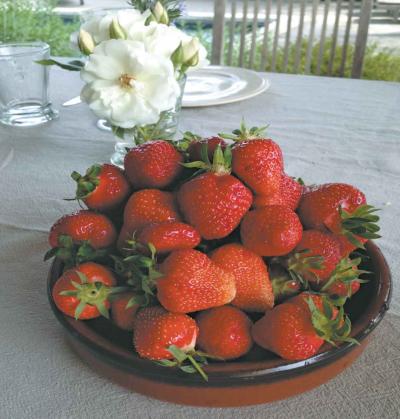
There are certain plants that any gardener interested in eating well will want to have, and among them, strawberries top my list. Unlike most vegetables, which can take all summer to grow and need to be replanted each year, strawberries ripen from late spring through midsummer. Once established, they need minimal care. And they are particularly good plants for the casual or weekend gardener, since a well-planted strawberry bed will produce generously for years without much fuss. Strawberries are easy, happy plants, well adapted to our climate, thriving in full sun and free-draining soil — and we have plenty of both out here on the East End.

Fresh home-grown strawberries have a fragrance and delicacy far superior to any in supermarkets, because all strawberries need to be picked ripe; unripened berries will travel and keep well, but they lack the sweetness, juiciness, and fragrance of a sweet, ripened berry. When you grow your own strawberries, you can be sure of picking them at just this right moment. What is more important, you can be sure they carry no toxins: Starting this year, according to the Department of Agriculture, commercially farmed strawberries top the list of all fruits and vegetables for highest concentration of pesticide residues.

Strawberry plants for the home garden can be ordered in fall or early spring and are shipped bare-root, in bundles. They are inexpensive: 100 plants cost about $30 from Nourse Farms in Whately, Mass. (noursefarms.com). For the complete beginner, however (or for people who simply want to experiment with growing a strawberry or two), potted strawberry plants are readily available at garden centers such as Lynch’s in Southampton for approximately $5. 

 If you read up on strawberry cultivation you might get a little intimidated by their requirements. But that would be a pity, because given half a chance, any strawberry plant will grow, flower, and fruit with few problems. You can plant up an entire bed in the fall, or else in early spring, but they also grow well in small spaces (or even pots) and look beautiful, as well, at the front of a mixed border. 

Strawberry cultivars come in two types: June bearing or everbearing/day-neutral. If you would like to have all your berries at once, want the largest berries possible, and want the most productive possible beds, then June bearing varieties are right for you. Everbearing, by comparison, tend to be smaller strawberries, but they will fruit all summer and into the fall. The tradeoff here is that the plants are a bit less productive, and will need to be replanted every three years.

For as long as I have grown strawberries, I have grown everbearing varieties, because I prefer to have them all season, and I don’t need that many of them. (June bearing varieties can make good sense for those home gardeners who enjoy making strawberry jam, but I don’t — or when I do, I don’t mind buying extra from a farm stand.) Three everbearing varieties that have worked well for me over the years are Seascape (the most productive), Tribute, and Tri-Star. This year, however, I am growing a new variety, Mara des Bois. These strawberries have the intensely fragrant flavor of fraises des bois (wild strawberries) but are as large as a regular strawberry. You can’t buy them in stores. I discovered them last May in Provence and was delighted to find them on sale, bare-root, at Nourse and Burpee. 

Preparing a good, productive strawberry bed takes a little bit of work. Site your bed in full sun and prepare your soil carefully. Several weeks before planting remove all grasses and weeds and till the bed to a depth of about a foot, incorporating some well-aged compost or manure. (You can rent a small, gas-powered cultivator for this purpose from One Source Tool Supply in Southampton for approximately $20 for half a day.) Space plants 12 to 18 inches apart, digging holes deep enough so that the roots go straight down into the ground. 

After planting and watering in, mulch the plants (traditionally using straw; hence the name strawberry). Doing so will discourage weeds, keep the plants’ roots cool, and allow ripening berries to stay dry and away from the soil. For the first month of growth, remove all flowers, fruits, and runners, thereby allowing the plants to mature. Water regularly to keep them happy. After six weeks you can also apply fertilizer. You can net the plants against birds, if you like — or else simply have fewer berries (and more happy robins and catbirds in your garden). At the end of the season, as winter comes on, cover the bed with more straw to protect these shallow-rooted plants from the winter cold.

My approach to strawberries in the kitchen is to do very little with them, since the ripe, sun-warmed berries are essentially perfect. Wash, slice, and eat them soon after picking. Tate’s Bake Shop in Southampton makes a shortbread that accompanies these berries beautifully. 

Click for recipe

For more information see: time.com/ 4289871/dirty-dozen-pesticides-fruit-vegetable/

One of the best guides to home fruit cultivation in our region comes from Cornell University.


Justin Spring is a writer whose most recent book, “Secret Historian,” was a finalist for the National Book Award. He divides his time between Bridgehampton and New York.