Food Lab Conference Brought the World to Southampton

Food Lab Conference Brought the World to Southampton
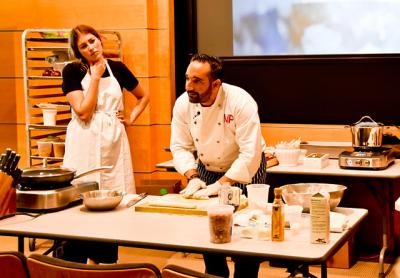
Chef Nicholas Poulmentis rolled out goat cheese gnocchi dough on Friday at the Food Lab conference.
Jennifer Landes
Health and access to nutritious food were a compelling and constant theme
By
Jennifer Landes

Diversity and a global perspective that reflected back on the East End were the emphasis of this year’s Food Lab conference, held over the weekend at Stony Brook Southampton’s campus.

The conference began with a Greek cooking class on Friday and ended with a discussion of how winemaking traditions tie together countries and continents. In between, there were receptions, breakfast, lunch, and a small tasting plates dinner of international dishes inspired by recipes from recent immigrants.

Through it all, health and access to nutritious food were a compelling and constant theme linking many of the sessions. 

Nicholas Poulmentis, a winner on the Food Network’s series “Chopped,” provided a demonstration and detailed instructions on how to make updated and mostly healthy versions of classic Greek food such as spinach pie, meatless keftedes or meatballs, and goat cheese gnocchi with a not-so-healthy creamy bacon sauce. The keftedes were made with lentils and bulgar wheat and served on romaine lettuce with a squeeze of lemon. While he cooked, assistants passed his dishes into the audience, where people also sampled Greek wines as they watched the action. The two-hour class gave participants a chance to ask questions during the preparations and they received tips such as how to store olive oil and reduce a cream sauce.

The next day, Mr. Poulmentis reappeared for a panel titled “Nourishing Diversity: Our Social, Emotional, and Spiritual Relationships With Food” with four other panelists and Paula Gilovich, a well-focused and organized moderator. He spoke about his youth in Greece and the cooking, fishing, and other food gathering he did with his father and how he still tries to import the ingredients he misses from home.

Carolina Santos-Neves, another panelist, described her childhood in Brazil and Mexico and the way she has used food to bring people of many different cultures together, both through her work as a chef and the meals she prepares at home for crowds of new and old friends.

Mohammad Modarres, the founder of Interfaith Ventures and Abe’s Meats, discussed his odyssey in developing products and programs that encourage interfaith dialogue, particularly between Muslims and Jews. His efforts have culminated in Shabbat Salaam, dinners featuring meat that has been processed under the most devout religious standards of both faiths. 

It took a long time and it wasn’t easy. “The first couple of religious leaders said ‘absolutely not, this needs to be kept separate,’ but that kind of emotion pulls you forward. It makes you want to cause some trouble.” Bringing the two groups together to break bread has fostered a sense of commonality. “The talk around the table becomes about how expensive day care is,” he said, not religious differences.

In the same panel Josephine Smith, the director of cultural resources for the Shinnecock Indian Nation, recalled foraging for wild grapes, blackberries, and blueberries on the reservation. Although she still can, “they’re not as plentiful, choked out by invasive species” and home building as the population has increased over time. 

The reservation once had acres of land planted with corn, squash, and beans, but now there is only an 18-by-10-foot community garden plot, she said, and the waters are affected by nitrogen-loading and other issues connected with regional development. Although the tribe would like to achieve “food sovereignty,” i.e., produce its own food on a scale to become self-sufficient, its goals are limited by the available land on the reservation today. She said the tribe lost 4,000 acres in the 19th century to the state in falsified documents and now its fishing rights are also being challenged. “Where can we have land for farming and livestock when our homes are already so close together?” she asked.

In the following panel, Frank Lipman, a South African-born doctor who favors an integrated and functional approach to medicine over traditional Western medicine that works only to cure specific illnesses, compared notes with Shawn Cannon, who runs Stony Brook Southampton Hospital’s residency and fellowship programs. Both agreed many of Americans’ health problems — which they said stem from inflammation and poor diets high in processed foods — are not being properly addressed.

Quoting the author Wendell Berry, Dr. Lipman said “the food industry pays no attention to our health, and the health industry pays no attention to our food.” 

Dr. Cannon says he sees the interest and dedication to a whole body approach to medicine in his millennial-age students. Yet, the information they need for such a practice won’t be found on any medical board tests, which discourages further study. As a result, patients often must pursue this type of wellness-based health care on their own, if they are even aware of it.

Seasons by the Sea: What Makes Local Local?

Seasons by the Sea: What Makes Local Local?

Cat got your pumpkin? Don’t worry, there’s more where that came from, now that it’s fall on the South Fork and vegetables like cauliflower, kale, turnips, and winter squash — such as pumpkins — are in great supply.
Laura Donnelly
“Local Food . . . Really?”
By
Laura Donnelly

Panels at Stony Brook Southampton’s fourth annual Food Lab conference last weekend included international chefs, activists, doctors, nutritionists, foragers, wine and spirits makers, and more, all centered around the theme “Eat Global . . . Cook Local,” a timely topic indeed.

I had the honor of moderating a panel titled “Local Food . . . Really?” and I heartily believe I had the best experts of all on the topic: Katie Baldwin, farmer and co-owner (with Amanda Merrow) of Amber Waves Farm in Amagansett; Scott Chaskey, a farmer and founder and director of the Peconic Land Trust’s Quail Hill Farm, also in Amagansett; Dee Muma, owner of North Quarter and Centreville Bison and Long Horn Cattle Farms and of Tweed’s and Dark Horse restaurants in Riverhead, and Brian Halweil, editor in chief of the Edible East End, Long Island, Brooklyn, and Manhattan magazines. Asa Gosman, fisherman and fishmonger of Gosman’s in Montauk, was scheduled to join us but couldn’t make it back from a wedding in time. 

We began with the theme itself: “What defines ‘local’ when it comes to food? Has it become a trendy term like ‘natural’ or ‘organic?’ ” This was shut down with a slight eye roll and declaration from Mr. Halweil: “It means anything within a 150-mile radius.” 

Ms. Baldwin talked about how exciting it has been to transition from farmer to now also co-owner of the Amber Waves Farm Market, formerly Amagansett Farmers Market. She said working with the chef Jack Formica (he was previously chef for Amagansett Food Institute’s South Fork Kitchen), “we can travel the world, making dishes with Amagansett grown foods.” Ms. Muma expressed her wish that more local chefs would use the French techniques of utilizing animals “nose to tail,” saving the bones for stock, and keeping vegetable peelings and shavings for same. Mr. Chaskey reminded everyone of the importance of saving our land for agricultural use. Mr. Halweil, more of an expert than any of us, spoke eloquently on every aspect of the topic. 

It was unfortunate that Mr. Gosman couldn’t make it because “local” fish is a hugely misunderstood concept. Seafood is a $17 billion industry annually; imports make up more than 90 percent of that, and 70 percent of the tuna sold here is imported.

Florence Fabricant, the New York Times food journalist, was in the audience and piped up that she is editing the next edition of the East Hampton Ladies Village Improvement Society cookbook and hopes to make it “salmon-free.” Brava! Ms. Fabricant had led a conversation earlier in the afternoon with Sonya Kharas, founder of League of Kitchens, and Kerrie Brodie, founder of Emma’s Torch. The League of Kitchens is a cooking school taught by immigrants in their own homes throughout New York City. Emma’s Torch is a nonprofit cooking school/restaurant that offers culinary training to refugees, many of them young women who have escaped from human trafficking situations around the world. Double brava!

When the time came for the Q. and A., Ms. Fabricant asked why  local wines are not better represented, respected, and sold in East End restaurants. This got Mr. Halweil and myself jiggling up and down on our stools like a pair of capuchin monkeys. The discussion became animated, with everyone talking about their favorite local wines, while Mr. Drummond attempted to restore order and sweep us off the stage. The final panel was about to begin, and it was about exactly that: local wines and spirits. In other words, it was a lively and passionate panel with an equally devoted and educated audience.

Which brings us to what is local now, and what to do with it. While I am not a fan of shortened days and mums make me sad, the still-warm waters of the ocean and bays, ability to get into restaurants, and cruciferous vegetables make me love September and October. It is a time when the heartier fall vegetables share the plate with the remaining corn and tomatoes. Spinach and other greens are growing again, cauliflower and broccoli are showing up, and Brussels sprouts are not far behind.

Dishes like ratatouille and caponata are perfect for combining end-of-summer produce, and they are very compatible with fish and chicken, as a pasta sauce, with cheeses as an appetizer, and they freeze beautifully. Winter squash like butternut, acorn, and delicata are everywhere, along with big and small eggplants, sweet potatoes, and Hakurei turnips. And the shishito peppers just won’t quit. Alliums like leeks and garlic are plentiful and farm chickens are laying eggs again.

The cruciferous vegetables and alliums are particularly well suited to richer ingredients like cream and gruyere cheese, or hot spices like chili flakes and harissa. With leeks, try James Peterson’s simple French preparation, manicured leeks covered in cream with salt and pepper, baked for one hour. Decadently rich and soooo good. Butternut squash is great cubed and baked with maple syrup, ginger, and rosemary. For a grand presentation make our very own Long Island cheese pumpkin stuffed with bread cubes, cheese, herbs, garlic, bacon, and a whisper of cream a la Dorie Greenspan.

As you dip your toes into fall vegetable cooking, don’t forget to start freezing corn off the cob, making pestos for the winter months, and putting up some tomato sauces. We truly can eat global and cook local.

Click for recipes

News for Foodies: 09.20.18

News for Foodies: 09.20.18

Local Food News
By
Jamie Bufalino

Doors Closing, Opening

The closing of East by Northeast in Montauk was announced on the restaurant’s answering machine. Bruce Bernacchia, the president of the Fort Pond Bay Company, which also owns the Harvest on Fort Pond, could not be reached for comment. 

“Master Chef,” the cooking competition show hosted by Gordon Ramsay, will hold a casting call on Saturday from 9 a.m. to 5 p.m. at the Doubletree Suites Times Square hotel in New York. Pre-registration is at masterchefcasting.com.


Oktoberfest

Rowdy Hall in East Hampton will be transformed into a classic beer garden with picnic tables in the courtyard and communal tables in the dining room as part of an Oktoberfest festival on Saturday from 3 to 5 p.m. as well as on Oct. 7.

Fresh-baked jumbo pretzels and bratwurst with mustard, each for $10, will be offered. Drinks will include pints of beer for $7, half-pints for $4, and a tasting flight for $10. 

The restaurant will also have a nightly $27 prix fixe dinner featuring German foods through Oct. 7. A knockwurst, bratwurst, and bockwurst entree with potato salad, sauerkraut, and mustard will be on the menu from Saturday through Wednesday. 

Football Specials 

The Springs Tavern is serving bar bites and Heinekens for $5 each during N.F.L. games on Sunday, Monday, and Thursday. Menu specials, offered until 10 p.m., include jalapeno poppers, mozzarella sticks, chips and salsa, and chicken wings. 

Townline BBQ in Sagaponack will have happy hour and football specials at the bar all day Saturday, Sunday, and Monday, as well as from 4 to 7 p.m. on Wednesday, Thursday, and Friday. The menu includes fries topped with cheese sauce and chopped brisket, sour cream, and jalapenos, for $6.25; a giant pretzel with cheese sauce or mustard, for $7.50, and a cheeseburger or hot dog with fries and a can of Modelo Especial, for $9. 


Wine Tasting

A wine tasting event, with two wines each from France, Italy, and Spain paired with cheeses from each country, will take place on Sept. 29 from 4:30 to 6:30 p.m. at Baker House 1650 in East Hampton. The cost is $50 per person. Tickets are available on eventbrite.com 


Sel Rrose in Montauk

A branch of Sel Rrose, a Manhattan cocktail and oyster bar, will open in the building formerly occupied by Zum Schneider in Montauk in the spring. Kristin Vincent, the owner of Sel Rrose, bought 4 South Elmwood Avenue on Sept. 12 and plans to fully renovate the space. It will be called Vincent’s Sel Rrose Oyster Bar and Restaurant. The Parisian-themed restaurant is named in honor of Rrose Selavey, the female alter ego of the artist Marcel Duchamp.

Seasons by the Sea: Winning the Lunchbox Battle

Seasons by the Sea: Winning the Lunchbox Battle

With a few minor adjustments, the foods kids like to eat, like banana bread and hummus, can be made to be healthier.
Laura Donnelly
Parents are tearing their hair out trying to come up with nutritious lunchbox and after-school snacks
By
Laura Donnelly

“It’s that time of year again.” This is the most common first sentence at the beginning of September, the start of the school year, a time when most, if not all, parents are tearing their hair out trying to come up with nutritious lunchbox and after-school snacks. It can feel like a losing battle.

First of all, if your children have been exposed to all kinds of foods, at home, at restaurants, and friends’ houses, chances are their taste buds are more adventurous, their view of cuisines more developed, and their willingness to try new things more probable. If they have grown up in a household of Tater Tots, Hot Pockets, Totino’s, and Wonder Bread, good luck. 

That being said, I have a friend who raised two boys. She tried to serve healthy, balanced meals but the younger of the two balked at everything. She would cave and cook him a separate meal, replete with white chicken, white bread, more white starch, cheese, and milk. I called this his “strict white-food diet.” His inevitable fate? He is now married to a vegan, bwah-ha-ha!

Eating out can be expensive, but you can get decent sushi rolls and edamame at various gourmet stores and even some grocery stores. Start your kids off with simple California rolls, cucumber and avocado rolls, and tsukemono, Japanese pickled vegetables. Everyone likes edamame and kids like to play with their food so popping the soy beans out of their pods keeps them busy and they’re getting some protein. 

How about Indian food? The restaurant Saaz in Southampton offers a ridiculously reasonable lunch buffet, full of chicken dishes, vegetable curries, rice, daals, raitas, and parathas. You can fill a takeout container with your leftovers and have a whole other meal at home. I am mentioning these two options because after researching Indian and Japanese lunchboxes (tiffins and bentos, respectively), I discovered that the array of healthful possibilities is endless. They are kind of like our Lunchables, those little premade “meals” with lunchmeat, fake cheese, crackers, and puny juice boxes. Whether for lunch or snack time, you can pack small boxes with a lemony brown rice, a flavored yogurt (raita), chicken salad, and cut- up fruit. Try a cauliflower and sweet pepper pasta salad, with watermelon chunks for dessert.

Wraps can be made with just about anything, and depending on the ingredients, they can often be chilled, then sliced to resemble sushi rolls. Try whole wheat tortillas with turkey and hummus, chicken with ranch dressing and shredded lettuce, apples with peanut or almond butter, or avocados with cucumbers and cream cheese. Make something you know they’ll like and sneak in the good stuff.

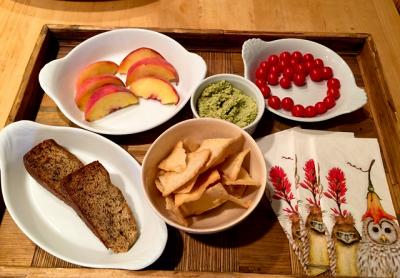
For those who like to bake simple quick breads, make banana muffins with vanilla yogurt in place of sour cream, along with carrot muffins, and zucchini breads. All of these can be made in mini sizes and frozen.

For soups and sandwiches, employ the Jessica Seinfeld trick: Sneak in some pureed vegetables like cauliflower or broccoli. She puts a layer of bean spread in whole wheat grilled cheese sandwiches and pureed sweet potato and broccoli in creamy tomato soup. Some people think you shouldn’t hide the vegetables, but if it gets some extra nutrition into your children, I’m all for it. Your darlings will eventually learn that you’ve lied to them about plenty of stuff.

Of course, getting your kids involved in the shopping and meal preparations can help. Let them taste a recipe as you go along. Ask them what it needs: a pinch of salt, a squirt of lemon? 

Hummus is something most children like, whether spread on a sandwich or served with toasted pita chips, carrot sticks, and celery. Store-bought is bland; you should make your own. A friend recently brought over a hummus that was made with half green peas, half chickpeas, and lots of mint and lemon juice. Hummus made with edamame is another good variation.

You could go the route of cutesy sandwiches cut out to resemble teddy bears, hippos, and ladybugs, but these still have to taste good! String cheese, dried fruit, popcorn, and homemade Chex mixes are not the end of the world, so go ahead and serve or pack those.

For a more festive weekend snack, make a Mexican seven-layer dip on the healthier side, refried beans on the bottom, a layer of guacamole, some whole milk yogurt instead of sour cream, grated cheese, and salsa. For a lunch box (insulated) make a layered Southwestern bowl with rice, chicken, corn, beans, avocado, and mild salsa.

Promoting healthy eating and combating childhood obesity were top priorities for the former First Lady Michelle Obama. This resulted in the Healthy, Hunger-Free Kids Act of 2010. The success of this program has been debatable, but at least it forced some compromises: more fruits and vegetables, whole grains, lower-fat milks, and lower sodium content in school lunches. Unfortunately, in 2017, Agriculture Secretary Sonny Perdue took steps to roll back many of the school lunch changes, so now we are back to high sodium foods, few whole grain options, and more flavored milks (think corn syrup) in our public schools. So, sorry to say moms and dads, good nutrition, like charity, begins at home.

Click for recipes

News for Foodies: 09.13.18

News for Foodies: 09.13.18

Local Food News
By
Jamie Bufalino

Surf Lodge Prix Fixe

The restaurant at the Surf Lodge in Montauk will hold a prix fixe low-country boil on Saturday. The menu will feature seafood, steak, potatoes, corn on the cob, plus beer and specialty cocktails. The price is $65 per person. Email [email protected] for reservations. 


Goodbye, Bay Burger

Bay Burger in Sag Harbor will close on Oct. 8. Joe and Liza Tremblay, the owners of the restaurant as well as the Joe and Liza’s ice cream brand, announced via a Facebook post last Wednesday that they were selling the businesses to “shift to careers that allow us to spend more time with our family.” Mr. Tremblay said last Thursday that, although the couple had no firm plans as of yet, it was likely that they would transition out of the food service business. 


Artists’ Table

Jason Weiner, the executive chef at Almond in Bridgehampton, will prepare a farm-to-table meal for an Artists’ Table event at the Watermill Center on Sept. 30 at noon. The event will also include a presentation from the center’s artists-in-residence. Tickets are $100 per person and can be purchased on eventbrite.com.


Brunch Is Back

Now that Labor Day has passed, Nick and Toni’s in East Hampton has begun serving Sunday brunch again from 11:30 a.m. to 2:30 p.m. The a la carte menu changes from week to week but includes such dishes as wood-oven pizzas, French toast, zucchini and goat cheese frittatas, or smoked salmon toast with poached eggs.

Food Lab Returns, This Time for Fall Harvest

Food Lab Returns, This Time for Fall Harvest

Colin Ambrose of Estia’s Little Kitchen will be interviewed by Biddle Duke.
“Eat global, cook local,”
By
Jennifer Landes

The Food Lab will return to Stony Brook Southampton on Friday, Sept. 14, much later in the year than its earlier iterations, which have been in June. Although the U.S. Open at the Shinnecock Hills Golf Club in June this year was a factor, the organizers realized that holding a conference about local food during harvest time and when the fish are running made much more sense, according to Andrew Botsford, a representative of the college.

The theme this year, “eat global, cook local,” seeks to underscore the diversity of the community and how it can be joined together at the table. “The conference captures that idea and the spirit of nourishing, diversity, and acceptance of all people in our special area,” Geoffrey Drummond, executive director of the Food Lab, said last Thursday. 

The conference will open officially on the evening of Friday, Sept. 14, at the windmill with Shane Weeks, a member of the Shinnecock Indian Nation, who will offer a blessing to the four directions and a traditional song as a cultural ambassador for the event. “Then sitting at the table will be people from all different parts of the area and the world,” Mr. Drummond added.

That afternoon, Nicholas Poulmentis, a champion chef on the Food Network’s “Chopped” series, will give an intimate cooking demonstration on updated Greek classics. There will be live cooking and samples of the dishes created, including goat cheese gnocchi, spinach pie, vegetarian meatballs, and more. Chrisa Arcan, an assistant professor of nutrition at Stony Brook, will discuss the health benefits of a Mediterranean diet. The demonstration costs $50 and is likely to sell out, so preregistration is recommended.

Mr. Poulmentis will also participate in the panel “Nourishing Diversity: Our Social, Emotional, and Spiritual Relationships With Food.” The panel will bring together chefs along with Mohammad Modarres, the founder of Abe’s Meats, which processes meat that is both Kosher and Halal and is served at interfaith meals across the country. Josephine Smith, the director of cultural resources for the Shinnecock Indian Nation, will discuss foraging.

This year’s keynote speakers are Pati Jinich and Colin Ambrose, who will be in conversation with Biddle Duke. Ms. Jinich is the host of “Pati’s Mexican Table,” a PBS series. Mr. Ambrose is the chef and proprietor of Estia’s Little Kitchen in Sag Harbor. Mr. Duke is the founding editor and a contributor to East magazine.

Panelists representing the global element of the conference include Sonya Kharas and Lisa Gross, the founders of League of Kitchens, who sponsor and teach recent immigrants how to give cooking demonstrations in their homes. Upcoming classes on their website offer looks at Argentinian, Nepali, Uzbek, and Lebanese cuisine. Florence Fabricant will moderate the panel, which also includes Kerry Brodie from Emma’s Torch. Her organization provides culinary training to refugees in its restaurant, preparing them for jobs in New York City kitchens, which are always in need of line cooks.

Participating in a panel titled “Diversity in the Bottle,” Maria Rivera Gonzales is from one of the original winemaking families in Mexico, according to Mr. Drummond. She is now the proprietor of Martha Clara Vineyards in Riverhead.

Fulfilling the conference’s theme and one of its subthemes of health and nutrition is Frank Lipman, a medical doctor from South Africa who practices in New York and has a house in East Hampton. He is an integrative medicine coach and the author of “The New Health Rules” and “How to Be Well.” He will be on a panel with Shawn Cannon, an osteopath who runs the residency program at Stony Brook Southampton Hospital, and Seamus Mullin, one of Dr. Lipman’s patients. Mr. Mullin, once debilitated by rheumatoid arthritis, has been asymptomatic for several years. He is an award-winning chef at Tertulia, known for his interpretations of Spanish cuisine. He is also the author of “Hero Food” and “Real Food Heals.”

No Food Lab would be complete without a panel discussing locally harvested food. The Star’s food editor, Laura Donnelly, will moderate “Local Food — Really??” It will feature some of the familiar faces of the local slow food community including Scott Chaskey, Katie Baldwin, Asa Gosman, Dee Muma, and Brian Halweil discussing how to know when food is really from the East End.

The conference will be framed by two receptions featuring regional food and wine and a closing reception with food from the League of Kitchens. Tickets are $150, $75 for farmers and students.

News for Foodies: 09.06.18

News for Foodies: 09.06.18

Local Food News
By
Jamie Bufalino

So Long, H.M.P.

The Hampton Market Place food store in East Hampton will be closing, confirmed Robert Tillinghast, the owner of the shop’s Race Lane building. Although an exact closing date could not be determined, many of the market’s shelves were empty late last week. Mr. Tillinghast said that Goldberg’s Famous Bagels had expressed interest in taking over the space, but Paul Wayne, the owner of Goldberg’s, said on Friday that the restaurant’s East Hampton branch would remain in its current Pantigo Place location. 

Oyster Specials

Bell and Anchor in Noyac will offer Montauk pearl oysters for $1 each on Sundays from 5:30 p.m. until closing. Its sister restaurant Fresno in East Hampton will have the same deal on Monday nights.

East End Eats: Sag Pizza, Give a Piece a Chance

East End Eats: Sag Pizza, Give a Piece a Chance

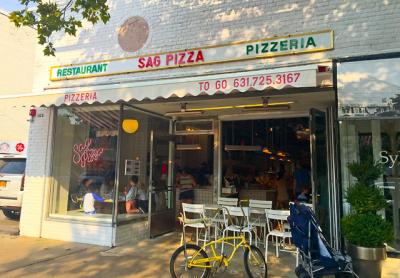
Now that summer is unofficially over, it’s a good time to try Sag Pizza in the old Conca D’Oro space in Sag Harbor.
Laura Donnelly Photos
“Plus ca change, plus c’est la même chose"
By
Laura Donnelly

Sag Pizza

103 Main Street, Sag Harbor

631-725-3167

Lunch and dinner daily

Remember when Espresso closed and Harbor Market took its place on Division Street in Sag Harbor? The outcry was vociferous. Neighbors tried to stop it, citing the ventilation system mostly. Parents of Pierson students protested. Where will our kids get their affordable lunches? 

Long story short, Harbor Market serves the neighborhood and the students and teachers well, with healthy, affordable food. The vents are neither noisy nor smelly. Oh, and Espresso reopened a short while later in the heart of the village. Freakout resolved.

A similar outcry occurred when the Venesina family sold Conca D’Oro (Golden Basin) to Laurent Tourondel and Michael Cinque, business partners in LT Burger across the street. “There goes the neighborhood.” “Sag Harbor is changing.” “Now there’s no place where kids can get pizza by the slice!” The last patron on closing day reportedly froze the final pizza put out at Conca D’Oro. For Pete’s sake, shouldn’t Frank Venesina and his family get a chance to relax after over 40 years at Conca D’Oro? If you really miss their food, their relatives still own and run La Parmagiana in Southampton, Edgewater in Hampton Bays, and Baby Moon in Westhampton Beach. So there’s that. And if you just want some old-school Italian food, hearty portions, and garlic knots, don’t forget the charming Il Capuccino, blocks away on Madison Street.

I loved Conca D’Oro too, but as the French writer Jean-Baptiste Alphonse Karr once said “plus ca change, plus c’est la même chose,” roughly translated to “the more things change, the more they stay the same.” You can get pizza by the slice at Sag Pizza. Garlic knots! They deliver! The food is excellent! And, the prices at Sag Pizza are very close to what Conca D’Oro’s prices were when I reviewed it five years ago.

To recap: We now have Tutto Il Giorno, Dopo La Spiaggia, and Il Capuccino, serving Southern and Northern Italian food within blocks of each other. We also now have three places that serve wood-oven pizzas: Lulu’s, Harbor Market, and Sag Pizza. Abbondanza! Mangia! Lulu’s pizza is good and more expensive than the others, between $21 and $24. Harbor Market’s pizzas are excellent, priced at $14.95 to $17.95. Sag Pizza pizzas are $15 to $19, slices are $3.75 to $4.50. In 2013, Conca D’Oro’s pizzas were $14 to $24, albeit for larger pies. Crikey, what an intro.

My friend Steven said he just had to come along on our review because he had had a dreadful experience at Sag Pizza when it had just opened. Food took too long, they had to leave before being served, etc. “It is for that exact reason, your predisposition to be prejudiced against them, that I shouldn’t include you,” I said. 

“No, that’s why you should bring me, to change my mind.” Touché. I did. He did.

The space looks bigger than before, ceiling higher, walls blown out of the back, and white, white wood and tile everywhere, similar to LT Burger. Takeout, slices, and more are available at the front. There is a small bar on the left and the back wall is filled with firewood, big cans of San Marzano tomatoes, and bags of flour. 

We began our meal with the raw zucchini salad, meatballs, and calamari. The raw zucchini salad was delicious, a combination of shredded yellow squash and zucchini, sliced, toasted almonds, and pecorino cheese in a light, very lemony dressing. The meatballs — three big ones — are made with veal and mortadella (hubba, hubba!). The tomato sauce they were served in is superb. They were topped with two chunky slices of toasted rustic bread slathered with pesto. The calamari fritti was another winner. Plenty of tender tentacles and rings that were crispy crunchy and not oily. Matchstick-sized pieces of zucchini were interspersed with the calamari, and it was served with one of the best aioli I’ve ever had. It was hot and vinegary, made with Calabrian chiles.

For entrees we ordered rigatoni with Bolognese sauce, mushroom pizza, pepperoni pizza (teenager!), and clam pizza. Steven, becoming a Sag Pizza convert, loved his rigatoni. The pasta was cooked al dente, the sauce rich and meaty. All three of the pizzas were great. The mushroom was covered with paper-thin slices of a variety of mushrooms, slivers of fresh garlic, truffle paste, Taleggio cheese (but not so much that the odor could be offensive to nearby diners), and sage. The pepperoni pizza got high marks from young Harry Reiner. The clam was our favorite. It had plenty of chopped clams, guanciale (similar to bacon), a thin layer of garlic scallion butter, and a scattering of Manila clams in their shells on top.

Everyone has different preferences about pizza crusts. Some like them thick and chewy, some like them thin and crisp. I am in the thin and crisp category. This pizza dough was a good compromise, somewhat thin, very flavorful, and marked with black, blistered spots from the hot, hot, hot wood-burning oven. It was reminiscent of one of the best pizzas I’ve ever had, from BAR in New Haven.

The waiter on the night of our visit was a delight. If Jake Gyllenhaal and Justin Long had a baby, it would look like James, our waiter. He was thrilled with this observation because he is currently studying at the Stella Adler Studio of Acting. That being said, the place does get very crowded by 6:30, so runners were delivering food out of order, plates were not cleared to make room for more food, and utensils had to be requested before dessert. 

Prices are reasonable. Starters and salads are $14 to $21, pastas and pizzas are $15 to $27, takeout pizza slices (from 18-inch pies) are $3.75 to $4.50, and two “scoops” of soft serve ice cream are $8.

Sadly the original menu says there is a variety of gelato and sorbets offered for dessert and the flavor choices are (were) tantalizing. We never found out why they are no longer available, but the only desserts now being offered are variations of stuff on soft serve ice cream. We tried two: affogato and a chocolate hazelnut crumb-topped chocolate ice cream. Affogato is vanilla ice cream topped with hot espresso. It was good. The chocolate hazelnut crumb topping on the chocolate ice cream was made even better by an amazingly good hot chocolate sauce poured over it at the table.

By the time you read this, the hordes of summer visitors will have departed. You will have a chance to see for yourself that indeed, the more things change, the more they stay the same. There may be a plethora of pizza now in Sag Harbor, but there’s nothing wrong with more, good, affordable food.

Seasons by the Sea: Fresh, Grilled, and Fabulous

Seasons by the Sea: Fresh, Grilled, and Fabulous

Grilled vegetables are simple, ubiquitous, and hard to get right. A few basic rules can help coax the most out of this summer staple.
Laura Donnelly Photos
There are numerous ways to cook vegetables on the grill
By
Laura Donnelly

How many mediocre grilled vegetables have you had in your life? At friends’ cookouts, at the deli counter, from caterers, the supermarket? It seems like everyone has a side platter of the usual suspects: zucchini and peppers, perhaps eggplant and onions. They are limp and floppy, under-seasoned, and sometimes suffering from refrigerator storage flavor. It doesn’t have to be that way!

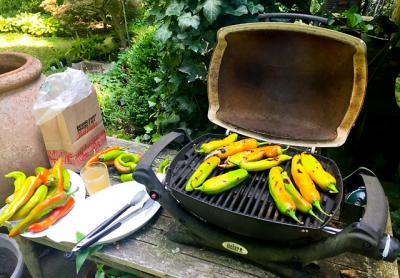
I love grilled anything. I have a regular Weber grill with which I use a chimney to start the fire, and I always use Cowboy brand hard lump charcoal. This charcoal starts and burns faster and doesn’t give food that off-flavor that can come from briquettes. I never use lighter fluid, or the lighter fluid infused briquettes; these definitely give off a chemical taste. While I am not a huge fan of gas grills, I do have a little tabletop Weber gas grill that does a perfectly adequate job in a hurry or in the winter. You will not get the extreme heat that you get from charcoal but it’s pretty cool to be able to flip a switch and be ready to cook in minutes.

It’s important to have the right equipment for grilling vegetables. The Japanese use wooden skewers to spear asparagus stalks at the top and the bottom, forming a little raft so the stalks don’t fall into the fire. Same goes for smaller mushrooms like shiitakes. You may also want a grill rack (for fish and veg) or even a perforated grill skillet or grill wok. Tongs and wide spatulas are obvious necessities, as is a bottle of water kept nearby for potential flare-ups.

There are numerous ways to cook vegetables on the grill. You can cook them directly over the fire on the rack, wrapped in foil, and even buried in the hot ashes (this is good for potatoes and sweet potatoes). Most vegetables cook within 5 to 10 minutes and can be served hot, room temperature, or cold. Leftovers can be made into sandwiches combined with mozzarella or other cheeses and meats.

Some vegetables can be grilled and then turned into something else. For instance, whole eggplants can be turned into baba ganoush or another roasted eggplant dip. Same for peppers: Grill them, peel off the charred skins, and puree them with garlic, black olives, and Parmesan cheese to top grilled salmon, new potatoes, and asparagus.

Grilled zucchini, sliced about half an inch thick, is one of my favorites. I brush a little olive oil on the slices and sprinkle some salt and pepper on them before cooking. Once done (in mere minutes) I lay them out on a platter and top them with lots of chopped spearmint and coarsely chopped garlic. For eggplant slices, I use Arlotta’s hot pepper oil and Hog’s Breath seasoning mix. Hog’s Breath is a big, nasty, noisy bar in Key West that I avoid like Margaritaville, but it makes a great seasoned salt. Goya’s adobo is another great shortcut for flavoring grilled vegetables.

You can marinate some vegetables before cooking but be careful with oils; vegetables such as eggplant and portobello mushrooms will absorb oils like sponges.

Have you ever tried grilling lettuces like romaine, endive, and radicchio? The latter two are favorites in Italy, often finished with a sweet and sour dressing with currants, pine nuts, and garlic. Grilled romaine wedges are a great base for an interesting Caesar salad. Grilled onions and garlic are enjoyed by many cultures; there’s Japanese negi, leeks, and Spanish calcots, giant spring onions. The high water content of onions keeps them moist, and the sugars acquire a caramelized toffee flavor from the high heat.

If you are concerned about the possibility of carcinogens from grilling, Harold McGee in his book “On Food and Cooking: The Science and Lore of the Kitchen” recommends using marinades because the added moisture and acidity can reduce carcinogen production. Heterocyclic amines (HCAs) and polycyclic aromatic hydrocarbons (PAHs) are produced by meats cooked at high temperatures, especially when the fat drips down into the fire. So that’s another good reason to have more vegetables than meat on your grill!

Before beginning, it is important to make sure your grill is clean. If you don’t have one of those brush scrapers, a good cheat is a big wad of crumpled aluminum foil to clean the grill. Follow this with a wipe-down with paper towel. You can then brush some oil on it (neutral or olive) or spray Pam on it to prevent the vegetables from sticking.

Methods for grilling corn are varied. Some people say grill them in their husks with silk removed. Steven Raichlen, in his book “How to Grill,” says to pull the husk back completely and tie it with string to make a handle. Brush the corn with seasoned melted butter and protect the husks from burning by either extending them over the edge of the grill grate or laying a piece of tin foil beneath them. They don’t take long to cook; just get a little char on them.

Asparagus is not in season locally (duh) but is always available year round. When I was shopping for vegetables at the Sag Harbor farmers market, I stopped to talk to Mario Pecoraro of Arlotta Food Studios. He always has good suggestions and Arlotta’s array of flavored oils (basil, rosemary, lemon, garlic, blood orange) are ideal for pairing with vegetables. He suggested blood orange oil on asparagus and it was outstanding. Along with a variety of pepper and fennel from Quail Hill, eggplant and mushrooms from Open Minded Organics, and zucchini and squash from Regina’s farm stand, I had a varied and tasty all-vegetarian grilled feast. A sprinkling of fresh herbs from the garden, chives, basil, parsley, lemon thyme, an extra drizzle of olive oil, and a few drops of mild vinegar made all of them taste sooooo much better than the pedestrian offerings we have seen too much of.

There are so many other vegetables you can grill. Try okra, cabbage, and cauliflower. I’m going to try Japanese sweet potato wedges with a miso glaze next. The possibilities and flavors are endless. Here are some recipes to inspire you to go beyond the mundane grilled vegetable platter.

Click for recipes

News for Foodies: 08.30.18

News for Foodies: 08.30.18

Local Food News
By
Jamie Bufalino

Ready for Rosh Hashana

Stuart’s Seafood Market in Amagansett has homemade gefilte fish for Rosh Hashana. Advance orders can be made by calling the store.  


Labor Day Weekend Dining

Baron’s Cove in Sag Harbor will hold a cookout on Sunday from 1 to 5 p.m. The menu will include grilled bratwurst, Karl Ehmer hot dogs, and corn on the cob. The cost is $25 for adults, $15 for kids 4 to 12, and free for those 3 and under. Price includes one pass through the buffet, plus a soft drink or bottle of water. 

Townline BBQ in Sagaponack is reminding people in advance of the holiday weekend that it prepares takeout meals that feed 4 to 10 people. A sandwich and sliders package features a choice of pulled pork and chicken or brisket, plus sides including coleslaw, pickles, and baked beans. The price of a dinner for four to six people is $65. A pulled meat sampler dinner is $69, a chicken and rib dinner is $79, and an “extravaganza dinner” featuring ribs, brisket, pulled pork, smoked chicken, and sides including cornbread is $112. In each case, it is double the price for a dinner for 8 to 10 people. Advance orders are by calling the restaurant. 


Cooking With Iron

Terence McGuire, the owner of Homeslice Pizza and Catering, will lead a workshop on cooking with cast iron on Sept. 12 from 6 to 7:30 p.m. at the Amagansett Food Institute’s South Fork Kitchens in Southampton. The workshop will take place outdoors around a wood-fired oven, and a representative from Acabonac Farms will be on hand to discuss different cuts of meat and the benefits of grass-fed beef. A meal featuring items from South Fork Kitchens will be served. The cost is $75, and $40 for students and beginning farmers. Tickets can be purchased at eventbrite.com.