
Recorded Deeds 04.25.19

Recorded Deeds 04.25.19

BRIDGEHAMPTON         

CVR First L.L.C. to D. Schwartz and A. Jaffe, 83 Birchwood Lane, .73 acre, Sept. 7, $2,995,000.

D., D., and E. Atkins, Butter Construction, 504 Butter Lane, .92 acre, Sept. 14, $1,920,000.

EAST HAMPTON 

A. Weiss (by executor) to A. and E. Sanfilippo, 36 Hampton Place, .63 acre, Sept. 14, $1,450,000.

S. Glinski and T. Cheng to A. and J. Figueroa, 44 Woodpink Drive, .55 acre, Sept. 21, $830,000.

J. and A. Grzyb to J. Hollander and S. Ducoff, 141 Swamp Road, 2.2 acres, Aug. 2, $2,085,000.

Whooping L.L.C. to C. Gorman, 53 Whooping Hollow Road, .46 acre, Aug. 30, $1,690,000.

EAST HAMPTON VILLAGE

85 Main St L.L.C. to Tulip Equities L.L.C., 85 Main Street, .04 acre, Sept. 14, $2,700,000.

Georgica Properties to K. Sutherland, 284 Georgica Road, 2.25 acres, Aug. 17, $5,100,000.

MONTAUK

R. and L. Reich to J. and J. Jamet, 99 North Greenwich Street, .33 acre, Sept. 6, $750,000.

Pumukel Inc. to 4 South Elmwood L.L.C., 4 South Elmwood Avenue, .18 acre, Sept. 12, $2,750,000.

NOYAC

P. Carlino to Wildwood Road L.L.C., 84 Wildwood Road, .44 acre (vacant), Sept. 11, $415,000.

SAGAPONACK

287 Parsonage Lane to King Arthur L.L.C., 287 Parsonage Lane, 1.8 acres (vacant), Sept. 12, $7,750,000.

SPRINGS

F. and E. O’Malley to M. Gordon and A. Friedman, 1117 Fireplace Road, .6 acre, Aug. 31, $695,000.

R. Pulaski Trust to J. and O. Reznik, 12 Salt Marsh Path and lot 1-17, .55 acre, Sept. 20, $821,000.

C. Rowan to C. Rao, 22 Babes Lane, .21 acre, Sept. 7, $1,275,000.

J. Williams (by executor) to Yardley and Samot-Yardley, 152 Woodbine Drive, .5 acre, Aug. 29, $427,500.

D. Dunn and M. Kelly to P. Stella and J. Cappadona, 18 Cedar Ridge Drive, .46 acre, Sept. 26, $640,000.

WAINSCOTT

3 Ardsley Road L.L.C. to S. Cagliostro and DiPaolo, 3 Ardsley Road, .51 acre, Aug. 13, $2,230,500.
Love and Hate in the Library

Love and Hate in the Library

By Peter Wood

It’s 1975 and I’m 16 years old.

I enter the East Hampton High School library and walk past all the boring books and corny inspirational posters taped to the walls:

Be the Change You Wish to See in the World — Mahatma Gandhi.

Nothing Is Impossible — Audrey Hepburn.

As You Think, So Shall You Become — Bruce Lee.

Mrs. Roget, our evil, prehistoric librarian, reaches up into her tight hair bun and plucks out a sharp yellow pencil. She’s squat, humorless, and wears granny glasses that hang on a strap around her neck. She’s always after me about stuff.

“Hi, Peter! I see you’re here to pay your book fine?”

“Oh,” I grimace, slapping my forehead, “I forgot.”

“Again?”

I smile sheepishly. She doesn’t smile back. 

“Well, the month of June is creeping up on us, young man,” she says, tapping her annoying pencil on the wooden counter. “Tempus fugit. Time is fleeting.”

“Tomorrow, Mrs. Roget, I promise.”

She laughs, or snorts, and it isn’t a pleasant sound.

“Drop dead, you old hag,” I want to say. Instead, I go, “I’d like to do some research.”

“On?”

“Jack Dempsey. He was a boxer.”

“Ah, Jack Dempsey — a flat-nosed prizefighter!” She laughs. It’s not a nice laugh.

“You’ve heard of him?”

“Certainly. A real degenerate, that one — a monster who enjoyed punching people for a living.” She points her annoying pencil toward the encyclopedias. “Go do your research.”

Degenerate? 

I walk past all her dusty old books — fat books, skinny books, hardcover books, paperbacks. Old Mrs. Roget didn’t know it yet, but one day I was going to write a great book, and the old biddy would be forced to buy my book and put it on her library shelf. It would be a self-help guide for old teachers. I’d title it “How to Understand Students.” It would help clueless adults, to the extent they could be helped, on how to encourage kids to read. It isn’t that kids don’t like to read; it’s that we don’t like reading boring books. I think our unwillingness to read is the result of being force-fed crap that doesn’t relate to us. No wonder we think books are ugly and horrible instead of exciting and cool.

I cop a squat and start flipping through an Encyclopedia Britannica, labeled D, searching for Jack Dempsey. Was my flat-nosed prizefighter a degenerate? A monster? There’s Dostoevsky, Deuteronomy, deviled eggs, donkeys, Denmark. 

In a weird way, opening an encyclopedia is like taking the Hampton Jitney, because it takes you places. The cute girl to my left is visiting the Mayan ruins of the Yucatan Peninsula, and the studious boy on my right is visiting an ancient Greek temple in Sparta.

I’m flipping through the encyclopedia, struggling to find my flat-nosed prizefighter. I have a three-page essay due tomorrow.

Nope — no Jack Dempsey.

I look around for help. Teachers are teaching, students are studenting, and janitors are janitoring. This assignment sucks. This library sucks. 

In defeat, I bang my forehead on the table and plant it there. This assignment is impossible! Maybe someday they’ll invent a machine that will make research easy and fun — just press a few buttons and information will magically spit out before you.

I pull out another encyclopedia — J for Jack.

Suddenly, my heart jumps. Sitting on the opposite side of the library is beautiful Mimi Breedlove. Actually, Mimi isn’t just beautiful, she’s achingly gorgeous. She’s a 17-year-old female with incredibly thick, jet-black hair and big brown eyes that look deep into you. “Gorgeous” is a thousand times too weak a word to describe her. 

Mrs. Roget’s library might suck, but, suddenly, I am very happy to be sitting in it.

I walk over to Mimi. Right leg, left leg, right leg, left leg, chest out. It’s not easy approaching a beautiful girl. 

“Hi, Mimi. I was wondering, would you be willing to help me with my writing assignment? It’s due tomorrow.”

She looks up at me and smiles.

Audrey Hepburn was right — nothing is impossible.

Excerpted from “The Boy Who Hit Back,” the latest book by Peter Wood, a former high school English teacher and Golden Gloves boxer who lives part time in East Hampton. He will read from it on Saturday at 1 p.m. at the East Hampton Library.

Point of View: A Sign?

Point of View: A Sign?

By
Jack Graves

I’ve finally gotten to the Bible my mother gave me at long last, but as yet have found no salvation in it, perhaps because I’ve not advanced far beyond the psalmist’s prayers to the jealous Old Testament God to smite his enemies.

There was a whole lot of smitin’ goin’ on long before the Psalms, of course — blows apportioned pretty much indiscriminately, sweeping away tens of thousands at a whack. I don’t have it with me, so I can’t cite you chapter and verse, but it’s pretty off-putting in general. Why would anyone offer fealty to such a Tyrant? I ask that a bit rhetorically, for we’re still doing so, paying obeisance to tyrants, to rabid ranters, egoists who would have it their way, who laugh at fair play.

A Midwesterner I met recently apparently has already thrown in the towel. No one, he said, would be able to beat Trump, at least while the Electoral College still existed. The people in his town, he said, remained fans, despite the sleaze, despite the scary instability, despite the frothing. Had they no moral compasses, I asked, mouth agape.

“The only thing they care about is themselves and their almighty dollars,” he said. “They’ve got theirs and they don’t care about anyone else.”

“How about Nancy Pelosi?”

“No, not even Nancy Pelosi. He’s going to get two terms.”

“I can’t believe it. . . .”

“Well, you don’t live in the Midwest.”

“Greed is the new compassion then?”

He agreed that things seem to be topsy-turvy these days, where displays of fellow feeling are greeted with calumny, where temperate behavior provokes jeers, catcalls.

I thought, We’re going down just like Notre Dame. Could it be? Or can we rebuild it? America, I mean. It will take some doing, some concentrated all-for-one, one-for-all effort, just as it will to rebuild Notre Dame. 

Though seeing the ancient cathedral afire was so sad and dispiriting, perhaps it was a sign. We can’t let things fall apart. I would think that Midwesterners, especially of the younger generation, to which Pete with the unpronounceable surname seems to appeal, would agree.

The Mast-Head: Wither the Eelgrass

The Mast-Head: Wither the Eelgrass

By
David E. Rattray

There’s no eelgrass to speak of anymore. Baymen and researchers have been saying this for some time, but it is nonetheless strange to think about. 

Growing up along the shore of Gardiner’s Bay, I saw sea grass accumulate in foot-thick mats along the wrack line in the late fall every year. As each growing season closed, the grass would float, knot up, and be blown ashore by the wind.

These were our autumn leaf piles in a place without many deciduous trees and where the oak leaves that did fall would blow away. As children, my siblings and I liked to bounce up and down on the eelgrass windrows and chase each other around, throwing thick handfuls. They would be gone soon enough. Maybe the sand fleas would eat it. Maybe a high tide would just carry it away.

We don’t see the eelgrass anymore. Nor are there underwater fields of it where they used to be. Blaming fingers are pointed at one thing or another these days and a likely suspect is thought to be nitrogen-loaded groundwater that fuels sun-choking algae blooms. But lots of things change along the water’s edge if you watch long enough.

My friend Geoff and I talked at length about this late Sunday while clamming in Three Mile Harbor. Skimmer clams were once abundant here, good for bait and frying. Now it has been years since I have seen one. Blue mussels are gone too. Hard clams are plenty, however, and though we return to the same spots time and again, they do not seem to run out.

Still, we know everything changes. The eelgrass mystery continues to thwart efforts to restore it, and its loss has been noted all along the East Coast. Could the absence of the great masses that died each year and then became part of the detrital food web be the explanation for many of the other losses we see? Perhaps. If there is one thing above all that I would like to see again, this grass is it. 

Connections: At the Ram's Head

Connections: At the Ram's Head

By
Helen S. Rattray

Shelter Islanders seem to somehow carry with them a sense of place that sets them apart. Have you noticed that? It’s like they have something that we don’t have, but they don’t want to admit it. 

For my family, Shelter Island is an excursion, taking us to a nook between the South and North Forks that has not been truly Hamptonized — and therefore is like taking a vacation to a more far-flung destination.

There is so much about Shelter Island that still feels very rural. In addition to the wonderful and historic Sylvester Manor Educational Farm, and in addition to the huge preserved chunk of land called Mashomack Preserve, which hangs off to the south and west, almost reaching Cedar Point on the mainland, there is a thinner appendage, Ram Island, that lies in Gardiner’s Bay and is as bucolic a place as can be found in these parts.

Regardless of how often we’ve driven down the long and winding road to the Ram’s Head Inn on Shelter Island, the lovely views come as a surprise. This year, the astonishment was magnified by an extraordinary number of osprey sitting on, and flying about, nests on still-leafless trees punctuating the roadside or on electric poles. 

In recent years we have made it a family tradition to go to the Ram’s Head Inn for brunch on Easter Day. It is the perfect spot for an all-ages get-together, with a wide lawn down which younger kids can run and an absolutely delicious brunch menu that has never let us down. 

This year, although it was wonderful to be together as the sun came out and we enjoyed our meal on the inn’s elegant porch, we unfortunately didn’t have any small children among our Easter party. However, we were seated near another group of diners who helped correct the mood: There was an infant and a toddler at their table. (It isn’t really an Easter celebration without little children, is it?) We always feel privileged when we eat at the Ram’s Head, which is so quiet and charming, a very special place.

When I married and came to live in East Hampton, back in the 1960s, the South Fork over all was a quiet place. I quickly learned that trips to other quiet places — much less to resorts — were considered rather unnecessary. No one needed to travel as an escape; what was there to escape?

In summer there was fishing, swimming, sailing, and big kettles of bouillabaisse to be made. In spring and fall, there were berries to be picked and strained and put up in jelly jars. In winter, there were two iceboats to be dragged out of the barn and hauled to one of the bays, where the ice always seemed to be thick enough for skating and racing.

East End year-rounders still do have lots of home-grown activities to choose from, of course, but they rarely are of the tranquil variety. Perhaps this is why we like the Ram’s Head so much: It feels as much like a time-travel trip to a quieter era as it does a geographical day trip to a quieter island.

Tell Tesla No

Tell Tesla No

By
Star Staff

East Hampton Town officials should tell Tesla to take a hike. The company recently renewed a pitch to install a charging station for its cars on public property in Montauk. This came after Tesla about a year ago asked to use a portion of the ocean beach parking lot at Kirk Park in Montauk and was shot down. This makes no sense whatsoever.

Imagine for a moment that we were not talking about electric cars but a company that sold, say, old-fashioned fossil fuel gasoline,  or menswear, or acorn squash that sought to take over public land. The town board would never give the proposal a minute’s attention. 

Tesla is running scared as all the major automobile manufacturers move more electric and hybrid vehicles toward the market. One way to help prop up its market share is to widen availability of its branded charging stations. There is one on County Road 39 in Southampton already, rarely used but highly visible on the roadside. This is part of the company’s messaging, as the one proposed for the Kirk Park lot would have been. Billboards are not allowed in East Hampton Town; a slick illuminated station at the entrance to hip Montauk surely seemed like a great idea to the people in Tesla’s marketing division. 

Note that Tesla famously does not advertise, at least not in the traditional sense. According to Ad Age, “Nissan in 2016 spent $4.3 million in measured media on its electric Nissan Leaf, including on a print ad early last year that took on Tesla. By contrast, Tesla spent nothing. . . .” East Hampton Town officials need not be patsies in the car company’s game.

Let’s make one thing perfectly clear: We strongly believe electric vehicles are the way of the future. PSEG Long Island has offered $500 rebates for consumers who install “smart” chargers at their houses. The town has already added several hybrid vehicles to its fleet. The Star has a universal charger available to its employees at no charge. These are good, as a charging station in Montauk would be as long as it were not on public land and met all zoning and building requirements. As good as alternative fuel cars might be, no company deserves special treatment.

Trustees Change Needed

Trustees Change Needed

By
Star Staff

In the absence of a meaningful top-of-the-ticket campaign for East Hampton Town Board this year, the time is right for voters to focus their attention on how the town trustees are chosen. Nine in all, the trustees’ seats are up for election together every two years. That sometimes means 18 or more candidates from among whom the electorate is supposed to choose — a near impossibility even for the most dedicated political observer. Voters often make decisions on whose name sounds most Bonac, forget about qualifications or even if an incumbent trustee has a poor record of attending the panel’s meetings. 

Changing the way the trustees are elected would require a public referendum, not a simple process, but one whose moment has arrived. As environmental challenges grow, greater attention to the trustees and their role as protectors of most of the town’s public lands, including beaches, bays, and harbors as well as ancient woodland roads, is needed more than ever. If those favoring staggered terms for the trustees frame a referendum in terms of improving stewardship of natural places and sustainable use of resources, it would be a sure winner.

25 Years Ago in Bonac Sports: 04.25.19

25 Years Ago in Bonac Sports: 04.25.19

It happened here, sports fans
By
Jack Graves

April 14, 1994

Even without the services of its all-county senior shortstop, Kevin Somers, who was sidelined with an injured hand, the East Hampton High School baseball team went through its first week of play undefeated.

Ross Gload — who, according to East Hampton’s coach, Jim Nicoletti, is “definitely a draftable player” and has caught the eyes of scouts — led the way, at the plate and on the mound. In the three nonleague games with Eastport (two) and Pierson, the senior left-handed first baseman and pitcher, who bats third in the lineup, went 6-for-10 with 10 runs batted in.

. . . Decision time is looming for Gload, who in the coming months may have to weigh a major-league signing bonus against college. His father, Ross Sr., who observed Monday’s game with Port Jefferson from underneath one of the pine trees behind the right field fence, predicted that his son, the Bayside Yankees’ most valuable player last season, would choose college.

—                 

Mike Burns, who coaches East Hampton High’s powerful boys track team, said Monday that for the first time he has five potential county-meet place-winners: Larry Keller, “the number-one discus thrower in the county,” John Hayes, in the shot-put, Terrell Hopson, in the triple jump, and the pole-vaulters Ron Gatlin and Rob Balnis.


April 21, 1994

Two years ago, Steve Patterson was “extremely anxious to have a 300 bowled” at the East Hampton Bowl, and put up a sign at the lanes offering $500 to the first person to do so.

Steve Graham did it Monday night, in the first game of a mixed league match between his team, the Pinbusters, and the BG’s. Graham’s perfecta, the first he’s ever spun, seems to have capped a season of extraordinary individual performances that has included a 299 game by Andy Levandoski, a 753 series by Jake Nessel, and a 730 series by Jerry Schweinsberger.

Graham, who “jumped four feet in the air” as his 12th ball jammed into the pocket and sent all the pins flying, reckoned the barrier-breaker was Levandoski’s 700 series “about three years ago. Since that happened, we’ve had about 20 or 25 of them.”

. . . Before launching the 12th ball, Graham, who had drawn a crowd of about 50, “took a deep breath, and told myself not to let it go too high, and to keep good speed on it so it wouldn’t drift on into the nose. Then I let it go. . . . It was exciting. I couldn’t sleep that night.”


April 28, 1994

Although he struck out 16 the other day, a statistic that sent East Hampton’s baseball coach, Jim Nicoletti, thumbing through the record book, Ross Gload does not think of himself as a pitcher.

As to where he came by the smooth, sweeping swing that coaches and spectators have admired for nearly a decade, Gload couldn’t say for sure. Will Clark, now of the Texas Rangers, has always been the pro player after whom he’s modeled himself.

. . . Asked where he came by his athletic ability, Gload, in a conversation with his parents, Ross Sr. and Jeanie, en route to a weekend practice, said, with a smile, “I didn’t get it from them.”

“My mother thinks he gets it from her,” said the elder Gload, who often can be seen watching his son’s games from the vantage point of a distant pine tree behind the right field fence. “She was second in the world in speed-skate barrel jumping in 1956. She’s still skating at 70.”

. . . “I know he’s ready to leave,” Jeanie Gload said of her son. “It’s a natural progression. I know I’ll miss him — he’s a good kid. We’ll all miss him,” she said, taking in with her glance Ross Sr. and Ross’s sister, Larissa. “Springs is a great family community — everybody knows everybody here. But it’s good for these kids to see the rest of the world.”

The Lineup: 04.25.19

The Lineup: 04.25.19

The week ahead in local sports action
By
Jack Graves

Thursday, April 25

BOYS LACROSSE, Brentwood vs. South Fork Islanders, East Hampton High School, 10 a.m.

SOFTBALL, Miller Place at East Hampton, 10 a.m.

Friday, April 26

BASEBALL, Harborfields at East Hampton, 4 p.m.

Saturday, April 27

TRACK, East Hampton boys and girls at Westhampton Beach invitational, from 9 a.m.

BOYS LACROSSE, South Fork Islanders vs. William Floyd in Lax for Autism tournament, Sachem North High School, 5 p.m.

Sunday, April 28

YOUTH RUGBY, St. Anthony’s vs. Section XI Warriors, Mattituck High School, noon. 

Monday, April 29

SOFTBALL, East Hampton at Sayville, 4:30 p.m.

Tuesday, April 30

BOYS TENNIS, Southold-Greenport at East Hampton, 4:30 p.m.

GIRLS LACROSSE, Elwood-John Glenn at East Hampton, 5 p.m.

BASEBALL, East Hampton at Islip, 4:30 p.m.

Wednesday, May 1

BOYS LACROSSE, Patchogue-Medford vs. South Fork Islanders, East Hampton High School, 5:15 p.m.

BASEBALL, Islip at East Hampton, 4:30 p.m.

SOFTBALL, Westhampton Beach at East Hampton, 4:30 p.m.

BOYS TENNIS, Commack at East Hampton, mandatory nonleague, 3:30 p.m.

Drive, Chip, Putt Finalist Continues to Take Dead Aim

Drive, Chip, Putt Finalist Continues to Take Dead Aim

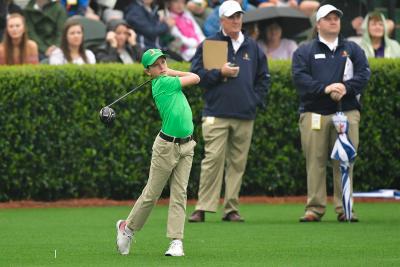
“A pretty swing . . . high extension on the follow-through,” a Golf Channel announcer said as 12-year-old James Bradley of Springs launched a drive at Augusta National.
Drive, Chip, and Putt
James Bradley, a Springs 12-year-old, hits the greens at Augusta National
By
Jack Graves

When Scott Bradley, in answering a question at Montauk Downs Friday afternoon, said he thought his 12-year-old son, James, who recently played in the national Drive, Chip, and Putt finals at Augusta National, had shown “steady improvement” in his game of late, James shook his head.

“I wouldn’t say that — my game’s improved drastically in the past couple of years,” he said brightly.

It was good to hear, for whatever disappointment James may have initially felt on finishing ninth among the 10 regional qualifiers in the aforementioned national contest — a result to a degree foreordained owing to the fact that he was up against taller and heavier, and in many cases more experienced, competitors in the boys 12-13 division — had obviously vanished.

He had done “okay,” James said when questioned. There was not much more he could have done; nothing, really. He had done his best, he said with his customary equanimity, with the assurance of someone who knows that the best is yet to come.

“He was a winner just qualifying for the nationals,” said his father, who regularly plays with his son at the Downs. “Gina and I were very proud of him. He was outgunned, through no fault of his own. I keep reminding him that he’s only 12.”

“He did very well . . . it was an awesome experience,” said Kevin Smith, James’s coach and the Downs’s longtime head golf pro, who went down to Georgia with the Bradleys. It was, he told his charge, just a matter of time, that as he grew taller and stronger the requisite balance and stability — and the longer drives — would come. The mental equipoise, so necessary when it comes to succeeding in athletic competition, the Springs seventh-grader seems already to have. 

 “My coach has been so helpful — he’s been a huge part of my success,” volunteered James, who practices at the Downs six days a week.

“In the middle of the winter,” Scott Bradley interjected, “you’ll see Kevin and James sweeping the snow off the mats and Kevin working with him for an hour, four or five days a week.”

“I can’t thank him enough,” said James, who was wearing a blue Drive, Chip, and Putt windbreaker and a white Drive, Chip, and Putt cap.

Scott said his son liked playing in front of a big crowd — the Golf Channel televised the Drive, Chip, and Putt finals. All the attention hadn’t thrown him off. “He was able to stay focused — he can block everything out.”

Well, not all the time, said James. He had to work on focusing better when not in tournament situations.

Sometimes he got frustrated, they agreed, but, as Scott said, “you have to let it go and move on to the next shot.”

“Play it as it lies,” this writer said.

“‘Take dead aim,’” said James’s father, quoting one of the late Harvey Penick’s famous maxims.

“I’ve got a lot of events planned,” James said, anticipating his interviewer’s next question. “I’m not looking to win the bigger ones, the [four-day] American Junior Golf Association events, but I want to do them and get points so I can play at an even higher level. I’m also playing 20-plus Met P.G.A. junior golf tournaments. . . .”

“Twenty?” said his father.

“Well, in as many as I can, throughout the summer. I’ll try to win those. I’ll play the bigger events to get experience.”

And what about the Augusta course? “It was amazing,” said James. “The grass was dead perfect, nothing was out of place.” 

And there were so many rules. Very strict. But he had gladly put up with them. 

He had met Bubba Watson, Rich Lerner and Frank Nobilo of the Golf Channel, Fred Wrigley, Augusta’s chairman, Condoleezza Rice, the former Secretary of State, and Annika Sorenstam.

He and his parents and Smith had stayed to see Monday’s practice round. Indeed, it had been a great experience.

And did he still want to win the Masters some day, as he has said in the past?

Oh, yes, James said in parting.

Meanwhile, he will do everything he can to qualify for next year’s 12-13 finals.

“He’ll have his growth spurt,” Smith said the next day during a telephone conversation. “We’ll keep on working on things and see where it takes us.”