Deportation Looms in D.W.I. Cases

Deportation Looms in D.W.I. Cases

“The system is broken,” said Alex Kriegsman, a Sag Harbor attorney who often handles immigration problems. “It has all sorts of consequences on the local level.”
T.E. McMorrow
For undocumented, arrests can open the exit door, with legal limbo in the middle
By
T.E. McMorrow

      Two men who had been living East Hampton Town for seven and nine years left the town in handcuffs on Feb. 6, headed for county jail in the back seat of a Suffolk County Sheriff’s Department squad car, possibly never to return again. One of them, after a long weekend of uncertainty, was reunited with his family and friends in East Hampton. But for the other man, the trip was the first step into a legal limbo where deportation loomed.

       One hailed from Guatemala, the other from Ecuador, and each had been brought that morning from the jail where he was being held to East Hampton Town Justice Court, where their attorneys were trying to resolve outstanding driving while intoxicated charges against them.

       Although bail had been set for each at amounts their families were willing to post, the men could not have been released even if bail had been posted because United States Immigration and Customs Enforcement, known as ICE, had placed a hold on them as candidates for deportation.

       According to its website, ICE uses a three-tiered system, based on criminal convictions, to determine whom it will deport and whom it will allow to remain in the country. The most likely to be deported are undocumented immigrants convicted of “aggravated felonies” or two or more felonies of any kind.

       The next most likely to be deported are those convicted of three or more misdemeanors. The lowest priority for deportation are those convicted of a single misdemeanor.

       Pablo L. Estrada, 31, was arrested on Nov. 3 on aggravated D.W.I. charges. He also had a 2006 drunken driving conviction, making the November charge a felony, and was facing a felony charge of driving without a license. When he was arraigned before East Hampton Justice Lisa R. Rana on Nov. 4, she set bail at $8,000, but informed him that the ICE hold could render bail a moot point.

       Mr. Estrada, a Guatemalan who has lived in East Hampton for nine years, was transferred to Suffolk County jail in Riverside and remained there while his attorney worked to avoid a felony conviction.

       Daniel A. Gomez, 24, was arrested on a D.W.I. charge on New Year’s Eve. When he was arraigned the next morning before Justice Rana, he learned of the ICE hold on him. It appeared from the paperwork the justice had received from ICE, that Mr. Gomez, an undocumented immigrant from Ecuador who had lived in East Hampton since he was 17, had three previous misdemeanor convictions. What those convictions were was not clear even after examining the ICE document.

       Mary C. Hartill, his attorney, still does not know what ICE believed Mr. Gomez had previously been convicted of, and thinks that Immigration simply has the wrong man.

       If that is the case, it would not be the first time, according to Alex Kriegsman, an attorney in Sag Harbor who frequently handles immigration cases. According to Mr. Kriegsman, the problem starts in Washington, D.C. “The system is broken. It has all sorts of consequences on the local level,” he said.

       There are, he said, 11 million undocumented immigrants in the country whom ICE could theoretically deport. Applying the law “is about discretion. Who is ICE going to pick up?”

       Last year, according to the ICE website, there were “133,551 removals of individuals apprehended in the interior of the U.S.,” 82 percent of whom had been previously convicted of a crime. Over the past several years, the total number of deportations, which includes those stopped at the borders or picked up after entering the country, has averaged about 400,000 per year, according to the website.

       Representative Tim Bishop, a Democrat, acknowledged Friday that comprehensive reform of the immigration system is long overdue. The Senate, he said, has passed just such a bill. “It’s not perfect, but it steps up enforcement while providing a path to citizenship.”

       Mr. Bishop has co-sponsored a version of the Senate’s bill, but fears the Republican-controlled House will never allow it to go to the floor. Speaker of the House John Boehner “doesn’t want to alienate the extreme right wing” of his party, Mr. Bishop said.

       In his eyes, while the right wing of the Republican party refuses to compromise on the issue — calling instead for heightened enforcement of the laws in place — the Obama administration has done just that, with record levels of deportations focusing, in the interior, almost exclusively on those who have been convicted of crimes. In fact, Janet Murguia, president of the country’s largest Latino group, the National Council of La Raza, pointed out in an NPR interview on Tuesday that the Obama administration “has deported more individuals than any other administration before.”

       This emphasis on deporting those convicted of a crime in an undocumented population of 11 million creates a problem for the legal system — a lack of precise identity. “In Latin countries, many people have two last names,” Mr. Kriegsman said. In many of those countries it is customary to combine the family names of the mother and father.

       The inputting of these names in the American legal system can be haphazard. It is not uncommon for the same person to be identified three or even four times in the system. Sometimes a hyphen is used in the last name, sometimes not. Sometimes, the names are combined into one name, or one of the names is dropped.

       “Your name is Jose Reyes. There is another guy named Jose Reyes Garcia, who raped somebody in Texas,” Mr. Kriegsman said, setting up a hypothetical. When Jose Reyes gets pulled over in a traffic stop in East Hampton, the system could possibly see the man as wanted for rape in Texas.

       Once ICE puts a detainer on an individual who is arrested, he or she enters a legal twilight zone. They will be held in the local jail while their criminal case is adjudicated, unable to get out on bail, but also not allowed to address the ICE detainer until the case is settled.

       This binds the hands of the attorneys representing clients who are being held with no hope of release. Ms. Hartill believes that her client, Mr. Gomez, who speaks no English, may well have been innocent. One of the charges against him was that he refused to take the station house breath test. In the field, according to the court documents on the case, his breath had been tested at .09 of 1 percent blood alcohol content, just above the legal limit of .08. However, the legal system does not consider the field test reliable enough to use in court.

       The station house test that he refused could have exonerated him, but according to Ms. Hartill, Mr. Gomez did not understand the consequences of refusing the test and was not given a clear explanation in Spanish as to what was happening.

       With several family members and friends gathered in the courtroom on Feb. 6, Mr. Gomez, wearing leg shackles and handcuffs, pleaded guilty to the misdemeanor charge of driving while intoxicated. He was sentenced to time served, 37 days.

       Because ICE believed that Mr. Gomez may have been convicted of three prior misdemeanors, he became a second-level candidate for deportation, under the tiered system. With a single misdemeanor he also could be deported as a level-three candidate.

       Most of those gathered at the courthouse for Mr. Gomez that day did not want to speak, but a woman who identified herself only as Sandy, a friend, did. She said that Mr. Gomez was popular in the community and enjoyed coaching children’s soccer.

       “He is a caring man. He is humble. He shouldn’t be in chains,” she said.

       Mr. Kriegsman said that it is rare for someone to be deported for a single misdemeanor.

       After a defendant with an ICE hold is convicted and then completes his or her sentence, the agency has 72 hours, once notified, to pick up the individual. At that point he or she will be taken to one of several jails or prisons in the area. “He could be taken to 26 Federal Plaza, or Jersey City, Hudson County Correctional. Some are taken to Brooklyn or Queens,” Mr. Kriegsman said. 

       Once Mr. Gomez’s criminal charges were adjudicated, the ICE clock started ticking for him when he was taken back to the Suffolk County jail in Riverside. Ms. Hartill told the family that if Mr. Gomez was to be released, it would be on Feb. 7 or possibly the following Monday, his friend Sandy said on the phone recently. They heard nothing on Feb. 7, but his sisters went to the jail in Riverside on Feb. 10, when Mr. Gomez was released and given a date in March to meet with ICE.

       In Mr. Estrada’s case, his attorney, Antonio S. Salva, tried to make the best of a bad situation. He waived Mr. Estrada’s right to a speedy indictment, hoping to avoid the felony convictions, which would mean almost certain deportation to his native Guatemala. Also a popular man in the community, Mr. Estrada has a child and is the co-owner of a food store, according to statements made in court on Nov. 4.

       After prolonged negotiations with the district attorney’s office, it became clear to Mr. Salva that there would be little reduction of the charges. On Feb. 6, with Alex Rizo, his brother-in-law, in the courtroom, Mr. Estrada agreed to have the case shifted to the county’s criminal courthouse in Riverside and to plead guilty the next day to the felony D.W.I and unlicensed driving charges. The guilty plea to the felony charge could only be done in the county court.

       Justice Stephen L. Braslow told him through a translator that it is likely he will be deported and asked if he had anything to say.

       “I’m sorry,” Mr. Estrada said. “I put my life and other lives at risk. It is my fault. I’m sorry.”

       “Our country opens its arms to all people who want to live here,” Justice Braslow told him. “We need people to comply with our laws. I understand that you are sorry . . . but you placed your life in jeopardy as well as others.”

       Mr. Estrada was sentenced to time served, 99 days, but because of the ICE hold was instead transported to the medium-security county jail in Yaphank.

       While the 72-hour clock on an ICE decision should have started ticking after his sentencing, East Hampton Town Justice Court still had his case marked open on its calendar, with a return date scheduled for April. Until the town was officially notified of the county court action, it could not dismiss the case, and until the case was dismissed in East Hampton, ICE would not act.

       His attorney, Mr. Salva, left the court building in Riverside on Feb. 7 convinced that the district attorney’s office would notify ICE in short order, but it did not.

       An examination of the court file last week in East Hampton revealed that the district attorney’s office prepared a case summary on Feb. 10, but did not transmit that summary to East Hampton Justice Court until Feb. 21.

       On Feb. 13, Mr. Salva sent East Hampton Town Justice Court a fax requesting an earlier court date, but the date requested, Feb. 28, fell on a Friday, not a day the East Hampton Town Justice Court takes up criminal cases. He was later informed that Mr. Estrada’s case could only be dealt with on a Wednesday or Thursday, the two days when an assistant district attorney is present in East Hampton.

       All the while, Mr. Estrada remained in jail. “He is a human being,” Luz, a friend who owns the deli with Mr. Estrada, said on Feb. 24. The woman, who did not provide her last name, had been in East Hampton Town Justice Court to support him on several occasions. “Why is this happening?” she asked. “Everybody has the right to know how many days you are going to be in jail. Is it going to be one day? Two days? For four months, nobody knows. Nobody is representing him. Not a judge, not an attorney,” she said.

       Though neither she nor Mr. Salva were aware of it, court records show that on Feb. 21, the East Hampton Town Justice Court, after receiving the D.A.’s case summary, had closed Mr. Estrada’s case on its calendar.

       On Feb. 25, ICE took Mr. Estrada from the jail in Yaphank to the one in Riverside and from there to Federal Plaza in New York City and then to Hudson County Jail. He was released on Friday, after Luz posted bond, but as of Tuesday had not yet received a date for an immigration hearing.

       “This is why you have to stay out of the justice system,” Luz said last week, before leaving for New York. “After you get there, it is not easy to get out.”


Drowning in Potholes

Drowning in Potholes

David E. Rattray
Complaints? Call the state’s toll-free hotline
By
Carissa Katz

       People often take the back roads to avoid traffic, but this time of year they might be doing the same to get around the myriad massive potholes that pockmark Route 27 from Water Mill to Montauk.

       Two factors have combined to make this year’s crop especially treacherous for drivers. First and most obvious, this winter has been a particularly brutal one, with frequent snow, ice, and frigid temperatures giving way to brief thaws, before the cycle repeats again. The fluctuation in temperatures, paired with all that ice and snow, are “wreaking havoc on the roads of Long Island,” Eileen Peters, a spokeswoman for the New York State Department of Transportation, said Tuesday. The second factor, exacerbated by the first, is that the asphalt on long sections of the state-owned roadway is at the end of its normal lifespan.

       The worst parts of Route 27 were last resurfaced 12 to 14 years ago. The expected lifespan for the asphalt used is about 10 years, depending on weather and traffic volume, Ms. Peters said. Heavy traffic takes a greater toll on the roads, and heavy truck traffic an even greater toll, she said, explaining that “one 16-wheel tractor-trailer is the equivalent of 10,000 passenger vehicles” in terms of the damage it can do.

       A short stretch of the highway, from Stephen Hand’s Path to the intersection of Buell Lane in East Hampton, was milled and resurfaced last spring and is holding up well under winter’s abuse, but the miles between the intersection of County Road 39 and Montauk Highway in Southampton and Stephen Hand’s Path, and from Buell Lane all the way to South Etna Avenue in Montauk, are due to be resurfaced sometime this year.

       The contractor who won the bid for resurfacing both those sections of highway is handling pothole repairs on those stretches in the meantime, while the Department of Transportation does repairs elsewhere on Route 27 and on other state roads like Route 114. A start date for the resurfacing should be announced by late March or early April, Ms. Peters said. “They need humidity and temperatures to cooperate for the full resurfacing.” She expects that work will be done during “off-peak hours or at night,” but could offer no specifics about when it might commence or how long it is expected to take.

       “Our priority right now is to keep the roads safe,” Ms. Peters said. Between plowing, treating the roads for snow and ice, and attending to potholes, “we are using every possible resource this winter,” she said. The same trucks and crews handle those jobs, keeping them very busy this year.

       Last year the D.O.T. spent $354,877 repairing potholes on Long Island, Ms. Peters said in an email. Since October, the department has spent almost $1.4 million on those same roads. The weekend of Feb. 22 and 23, when temperatures reached as high as the 50s, crews used 136 tons of asphalt to repair potholes on the Long Island Expressway alone, she said.

       If all those repairs seem to have left out the ones most vexing to you, fret not. Motorists can call the state’s toll-free number — 800-POTHOLE — to report potholes on state roads so that crews can be alerted and sent out to fill them as weather permits.

A Hearing for Officer Galeano

A Hearing for Officer Galeano

East Hampton Village Police Officer Julio Galeano, seen here when he was honored as the top cop for 2012, will have a hearing soon.
T.E. McMorrow
A hearing officer will weigh testimony from village and suspended cop
By
Christopher Walsh

     The East Hampton Village Board on Thursday announced the appointment of an independent hearing officer to hear disciplinary charges against Julio Galeano, a village police officer who was suspended without pay on Feb. 21 after an alleged romantic encounter in December with another member of the department at a house in which neither had permission to be.

     The board's Feb. 21 action followed its approval of new legislation on police discipline that bypasses the previous process, which had been negotiated with the East Hampton Village Police Benevolent Association. The new legislation does away with the arbitration procedures previously required and provides for dismissal as an option.

     On Dec. 30, Officer Galeano was allegedly discovered at a house on Talmage Lane with a traffic control officer, Jennifer Rosa, who was reported to have a key to the house because she had worked there as a cleaner. The house's owner was not there, but guests that were authorized to enter and stay at the house discovered the pair and called the police. Ms. Rosa was fired from her job with the Village Police Department in January. Officer Galeano's gun and badge had already been confiscated when Chief Gerard Larsen brought disciplinary charged against him on Feb. 11. He was at first dismissed with pay. Officer Galeano has denied the charges against him.

     The hearing officer, John G. Callahan, an attorney, will listen to comments and testimony from both sides and will issue a recommendation to the village for the appropriate disciplinary action. A date and location for the proceedings has not yet been determined.

PSEG Project Will Go On, Utility Official Says

PSEG Project Will Go On, Utility Official Says

Jeremy Samuelson extended his hand at a meeting Wednesday with PSEG Long Island officials, hoping for a gesture of good faith from the utility's president, David M. Daly, who declined.
Joanne Pilgrim
By
Joanne Pilgrim

The president and chief operating officer of PSEG Long Island, David M. Daly, agreed at a heavily attended meeting at East Hampton Town Hall on Wednesday to take a second look at alternatives to a six-mile extension of high-voltage electrical transmission lines, strung from poles up to 65 feet tall that, appalled residents have said, have destroyed the traditional, bucolic look of town and village streets.

Mr. Daly agreed to meet again as soon as Friday with East Hampton Town Supervisor Larry Cantwell, East Hampton Village Mayor Paul F. Rickenbach Jr., and other members of a working group to draft a plan for the reconsideration of options originally thought to be not viable, such as burying the lines along the Long Island Rail Road right of way or along Montauk Highway.

He refused, however, to suspend work for the rest of the week by crews installing the poles at a rapid rate.

"Give us Thursday and Friday," Jeremy Samuelson, a member of a participating citizens' panel asked him, rising from his seat and reaching across the table for a handshake. "You're asking for our trust," Mr. Samuelson said. Mr. Daly remained seated.

Mr. Daly promised that the options, their costs, and possible funding sources would be examined seriously.

The group to be involved will include members of Save East Hampton: Safe Responsible Energy, which presented a petition at the meeting Wednesday calling for removal of the poles and burial of the transmission lines that was signed by 2,000 people.

Mr. Cantwell pressed Mr. Daly to return on Friday willing to make a commitment to bury the power lines. "Two days . . . certainly would have been a good gesture," he said. "What's more important, I think to me at this point, is a commitment that we will bury."

Mayor Rickenbach twice expressed a similar hope. "Two points," he said. "One, stop the work on the overhead, period. And second, that we look at the underground option with sincerity and purpose."

"We're just not in a position to agree to that today," Mr. Daly said, giving the mayor "due respect."

"Not acceptable," people called out.

"Who is — Cuomo?" someone shouted, referring to New York's governor.

The $7 million overhead transmission line project is well under way, with 246 of 266 poles installed as of Wednesday, Mr. Daly said.

The new transmission line connecting three power substations is needed, Mr. Daly said, to ensure reliable power to 8,000 PSEG Long Island customers here. Without the new lines, he said, brownouts or blackouts could occur during peak summer demand.

"We feel we must complete this project and put the reliability in place, and work the other options in parallel," Mr. Daly said.

"If there is an option that can be worked out and is viable, we would pursue it. But in the meantime we will complete the work," he said, as audience members shouted "No."

"There won't be anything ... that will be impacted by us moving forward," he said of a potential future new plan.

"Those poles are coming down," said Debra Foster, one of the citizens group members participating in the meeting. Continuing the work, and incurring additional expense that ratepayers will have to shoulder, "is irresponsible unless you really don't think this will happen," she said of pinpointing a more acceptable alternative.

"I ask you to take me at my word that it's not because the real plan is that, we'll get the job done, and you'll get an answering machine when you call," Mr. Daly said.

"Where is the urgency?" a representative of State Senator Kenneth P. LaValle's office asked, wondering if there were major power outages last summer.

"It's very possible that we could go the summer with no problems," Mr. Daly conceded. But, he said, "If we stop the current job, then we're exposed this summer."

"So what?" several audience members called out.

Mr. Daly said that if a decision is made to abandon the overhead transmission route and to bury the lines, he would nonetheless suggest leaving the new, larger poles in place and transferring individual customers' supply wires to them. They could be cut down to a lower height, he said, though each would still be "a bigger, fatter, pole" than those now in use.

A below-ground installation could cost $2 million to $4 million per mile depending on how and where the line is laid and other factors, and would take about 14 months, PSEG's East Hampton project manager said.

Mr. Cantwell warned that numerous year-round residents who spend part of the winter away, along with seasonal residents, will soon arrive and will likely join the hue and cry against the new transmission line poles.

"The level and intensity of concern by the people who live here is only going to grow," he said.

The outcry has gained the attention of Gov. Andrew Cuomo, whose regional representative told Mayor Rickenbach this week that the governor wants to be involved with reaching a resolution. Both Senator LaValle and State Assemblyman Fred W. Thiele Jr. have become involved as well.

Want Revetment Restart

Want Revetment Restart

Contractors began work to construct a rock revetment in front of Mollie Zweig's house in November, but a temporary restraining order stopped the project two days later.
Morgan McGivern
Zweig races plovers to fill Georgica ‘hole’ by April
By
Christopher Walsh

       Three and a half months after construction of a rock revetment in front of 11 West End Road in East Hampton was commenced and quickly halted, an application for the same project was brought to the East Hampton Town Trustees, who say they have jurisdiction over the project area.

       Aram Terchunian, a coastal geologist with the First Coastal Corporation, the environmental consulting and marine construction company that would perform the work, filed an application with the trustees on Monday. At a trustee meeting on Tuesday night, Mr. Terchunian and Stephen Angel, an attorney representing the applicant, Mollie Zweig, outlined the project.

       Over the strenuous objection of the trustees, Ms. Zweig had obtained a permit for the work from the East Hampton Village Zoning Board of Appeals in October. With that permit and one from the New York State Department of Environmental Conservation in hand, her contractors quickly went to work on the revetment, but, on Nov. 7, the trustees filed a request for judicial intervention against Ms. Zweig, the village, its zoning board, and its Department of Code Enforcement, as well as East Hampton Town and the town zoning board, in an effort to nullify the village Z.B.A.’s determination.

       Construction began on Nov. 11, Veterans Day, when courts were closed. Two days later, the trustees, represented by their special counsel, David Eagan, obtained a temporary restraining order. The project has remained in limbo since then.

       “I understand that this is an important issue to everyone in the room,” Mr. Terchunian told the trustees Tuesday. “We have spent a long time thinking about the different options on this site. . . . What we have presented to the D.E.C., the village, and now you is, in our judgment, the best option for this site.” He called the proposed revetment “the option which will have the least environmental impact and will preserve to the extent practical, and to a greater extent, I think, than at many other sites . . . the beach and dune system.”

       From West End Road to Main Beach, all but “two and a half” properties are already protected by “some type of structure,” Mr. Terchunian said. “We’re clearly not looking at a shoreline here that is devoid of structures. In fact, it is significantly dominated by structures.”

       The proposed project, which would cost $500,000, would include placement of a rock structure in the core of the dune, construction of a sand dune on top of it, and installation of snow fencing. The structure, which he called “consistent and complementary to what exists on the adjacent properties,” would, he explained, “allow the natural system to repair itself, while holding in reserve, in the core of the dune, a flood-control device in the form of a rock wall that, during a storm surge, will enable the dune to resist the flood.”

       On the recommendation of the D.E.C., Mr. Terchunian said, the proposed structure would be 40 feet landward of the revetment in front of 7 West End Road. Earlier this month, the trustees approved plans by the owner of that property, Anthony Manheim, to repair the revetment, which was constructed in 1978 and had “lagged” after being exposed by storms in 2011 and 2012.

       Ms. Zweig, Mr. Terchunian said, “was a little distressed” by the proposed placement, which would be landward of all other revetments on the shoreline. But, he said, “We’re not here to fight against the ocean. . . . This is not a groin-type structure where you’re sticking it out in the ocean attempting to capture sand. It is in fact the reverse of that. It is parallel to the shoreline and moved as far back as possible into the dune.”

       The trustees, Mr. Terchunian said, should recognize that “what we are doing here is attempting to retreat in an orderly fashion.” He said that in placing the revetment as far landward as practical, “at what is the storm scarp right now,” and then reconstructing the dune on top of it, the beach and dune will naturally mend themselves. In the meantime, the revetment would provide protection “in the vulnerable state that the property is in now.”

       Stephanie Forsberg, a trustee, thanked Mr. Terchunian for “acknowledging our jurisdiction by submitting this application and filing it with the East Hampton Town Trustees.”

       Mr. Eagan told Mr. Angel that the trustees are concerned about “the hole that’s been dug and left on a public beach,” referring to the initial construction phase in November, and asked that it be addressed “from a public safety standpoint.” Asked if he would like the trustees to consider only the sand-replenishment portion of the application in the short term, Mr. Angel said no.

       Ms. Zweig seeks a swift determination by the trustees given the upcoming piping plover nesting season. “From what we understand, whether you have a permit from the Almighty, from the D.E.C., from you, or from anybody, the piping plover take over on April 1 to Sept. 1,” Mr. Angel said. “Realistically, if the project is not done in the next four weeks, it’s not going to happen.” The application, he said, would not be amended. “That’s the application we have approval on, that’s the application we would like you to — hopefully — promptly make a determination on.”

       Diane McNally, the trustees’ clerk, said yesterday that the trustees would consider the application with an open mind. Mr. Terchunian “made some good points, recognizing that the shoreline has already been hardened,” she said. “On the other hand, no alternative has been attempted. . . . We’ll weigh both sides.”

Restoring Alewife Migration

Restoring Alewife Migration

A dilapidated culvert on Alewife Brook in Northwest has blocked an annual fish-spawning run to Scoy Pond.
David E. Rattray
Effort aims to bring fish back to Scoy Pond
By
David E. Rattray

       For more than a decade, alewives have failed to make their spring migration up a narrow brook in Northwest Woods, East Hampton, where once they teemed. But if all goes as planned, the fish could soon return to one of the South Fork’s storied runs.

       After a false start several years ago, work is expected to begin next month on replacing a dilapidated culvert under Alewife Brook Road with a much larger one that would allow the fish to reach Scoy Pond, perhaps in time to spawn in April.

       Alewives are a variety of mostly seagoing herring that reproduces in fresh water. Each spring, great masses of schooling adults work their way up streams and rivers along the Atlantic Coast, returning to saltwater a few weeks later after they have spawned.

       Like menhaden, they are considered an essential part of marine ecosystems, providing food for a vast range of other fish, birds, and land animals. As filter-feeders, they are thought to have a role in maintaining water quality as well.

       East Hampton Town Councilman Peter Van Scoyoc is coordinating a restora tion effort that will depend on cooperation among the town’s Highway and Natural Resources Departments, Suffolk County, and officials from the State Department of Environmental Conservation. In a recent interview he said that work could begin as soon as weather permits.

       The project will involve placing a new, 36-inch-wide culvert under the two-lane road. Mr. Van Scoyoc said that all permits are in place, and once excavation begins, work could be completed in about two days.

       East Hampton Town Highway Department personnel will install the culvert and repave Alewife Brook Road. Mr. Van Scoyoc said that the only delay now was waiting for nearby asphalt plants to reopen for supplies.

       Kim Shaw of the town’s Natural Resources Department and East Hampton Town Highway Superintendent Stephen Lynch have been involved in planning for the culvert replacement and will oversee the work.

       Scoy Pond is shaped roughly like a backward question mark and drains through a sinuous brook that is about five feet wide and perhaps a foot deep in most places.

       Earlier this week, water from melting ice swelled the brook as it flowed though a rolling oak and pine woodland and then across a wide, phragmites-filled marsh before disappearing briefly under Alewife Brook Road. The narrow pipe there now, little more than perhaps a foot in diameter, is too small for the alewives to pass.

       Larry Penny, a former director of natural resources for the town, said he believes that the fish prefer there be a little light or sky above them as they move upstream. During times of high water, the Alewife Brook pipe is filled to overtopping.

       According to an assessment by the State of New York, the fish continue to swim into Alewife Pond, but the run between Alewife Pond and Scoy Pond was blocked by barriers and had ceased by 2002. The assessment’s authors said that removing the inadequate culvert would restore the alewife run there.

       In 2011, the town received a $30,000 grant to help pay for the alewife restoration effort at Alewife Brook and at the man-made Staudinger’s Pond nearby, which drains into Northwest Creek. The project will also include removing fallen logs and other barriers in both locations, as well as excavating channels and removing invasive plant species. In addition, Mr. Van Scoyoc said, adult alewives may be captured alive from one of the area’s existing runs and released in the newly improved waterways this spring.

       Mr. Van Scoyoc’s interest in the project has a personal dimension. A fisherman and fishing guide, he is also a descendant of the family for whom Scoy Pond is named.

       According to a published genealogy, Isaac Van Scoy, or Van Schiack in the original Dutch spelling, a son of the first Van Scoy to live in East Hampton, and his new wife, Mercy, built a log-and-turf hut in about 1757 in the then-wilderness of Northwest Woods. Eventually, they moved into a timber-framed house that Isaac built and raised seven children.

       During the American Revolution, Isaac was said to have wielded a pitchfork to fend off British raiders who came to his farm to steal money. He killed one and wounded two others. He was captured by the British and held aboard a warship at Sag Harbor to await a trial. Friends were able to free him through a porthole one dark night, and he spent the rest of the war in hiding.

       Councilman Van Scoyoc traces his roots to Stephen Van Schiack, a brother of Isaac’s who left East Hampton in the 1730s with his parents and settled in New Salem, N.Y. The present-day Mr. Van Scoyoc lives with his family only a few miles from Isaac and Mercy’s homestead.

       An earlier effort to improve water flow in the creek stalled in 2011 when state and county officials objected to the scale of the work. The East Hampton Town Board had authorized a much bigger project that included a six-foot-wide culvert, but that, Mr. Van Scoyoc said recently, would have required a temporary cofferdam to hold back the brook during its placement. The culvert was delivered, but sat in a contractor’s facility for a while before being sold in an online auction of surplus property. Mr. Penny had favored the larger project.

Smoke, but No Fires

Smoke, but No Fires

The Amagansett Fire Department responded to two instances of smoke-filled houses, but no one was hurt in either case.
By
Taylor K. Vecsey

     In less than 24 hours, the Amagansett Fire Department responded to two instances of smoke-filled houses, but no one was hurt in either case.

     The latest call came early on Thursday morning when a fire chief responded to an automatic fire alarm at 421 Cranberry Hole Road at 2:08 a.m. Second Assistant Chief Wayne Gauger found heavy smoke inside the house, and called in a report of a structure fire, according to Chief Dwayne Denton. "We didn't know what we had," Mr. Denton said, adding that the first engine set up a hose from a nearby hydrant to the house.

     Firefighters forced entry to the house and searched for the source of the smoke. They found no fire — the smoke was coming from a malfunctioning air handler in a crawl space. "The motor was burning up," Chief Denton said.

     The house was unoccupied at the time.

     Firefighters were able to shut down the equipment and then vented out the house with fans. Firefighters were packing up around 3:45 a.m., when they ran into a snag. In the 22-degree weather, the hydrant somehow got stuck and could not be shut off, something they have to do before disconnecting the hose. "It was so cold, water dripping off was turning to ice before it hit the ground," Mr. Denton said.

     The department called the Suffolk County Water Authority to Cranberry Hole Road, and the chiefs and the engine had to stand by in the meantime. It was about 4:45 a.m. when they headed back to the firehouse, he said.

     The East Hampton Town Highway Department also responded to put sand on that section of icy road.

     Seventeen hours earlier, in slightly warmer weather, Amagansett firefighters responded to Barnes Landing after a homeowner reported smoke in the basement following a "loud bang," Mr. Denton said.

     Firefighters arrived to find a furnace "puff back" that caused the flue to blow off, the chief said. They used fans to vent the space. There was minimal damage.

State to Revise Swan Plan

State to Revise Swan Plan

A swan and its cygnet
Dell Cullum
By
Carissa Katz

      The New York State Department of Environmental Conservation announced today that it will revise its proposed management plan for mute swans and then release it for additional public comment.

      The first plan, put forward by the D.E.C. in December, called for the eradication of the species in the wild in New York State by 2025. In New York, and in other states, mute swans, which were brought to the United States from Eurasia in the 1800s, are considered a non-native, invasive species. According to the D.E.C., "Mute swans can cause a variety of problems, including aggressive behavior towards people, destruction of submerged aquatic vegetation, displacement of native wildlife species, degradation of water quality, and potential hazards to aviation."

      But the birds, which are distinguished from native swans by their graceful, curved neck, are beloved by many in East Hampton and elsewhere around the state.

      The D.E.C.'s plan drew an onslaught of protest and "many thoughtful and substantive comments," the department's commissioner, Joe Martens, said in a press release. The D.E.C. received more than 1,500 comments on its plan from organizations and individuals and upward of "16,000 form letters and 30,000 signatures on various petitions," the release says.

      As a result, the draft management plan will be revised and put out to the public for another 30-day comment period this spring. "In revising the plan, D.E.C. likely will acknowledge regional differences in status, potential impacts, and desired population goals by setting varying goals for different regions of the state. In addition, D.E.C. will consider non-lethal means to achieve the management plan's intended goals."

See what The Star's nature columnist, Larry Penny, had to say.

Eight Felony Charges in Rape Case

Eight Felony Charges in Rape Case

Defendant said he and alleged victim, 14, had planned a life together
By
T.E. McMorrow

     The man charged with rape for allegedly having sex with a 14-year-old girl in Montauk was indicted by a grand jury seated in the Suffolk County Criminal Court building in Riverside Friday on eight felony counts, four counts of rape and four counts of committing a criminal sexual act with a child under 15 years of age.

     The eight counts corresponded to the four sexual encounters Juan Jose Zhingri-Deleg, 27, described to East Hampton Town Detective Tina Giles on Monday, after he was brought in for questioning -- two counts apiece for each alleged event, according to the police. The police had been alerted by a close relative of the victim, who called after an alleged sexual encounter between the defendant and the victim on Feb. 22. The mother and the grandfather, with whom the 14-year-old lived, had left the two alone for about an hour that evening while they went to church.

     According to a statement on file at the East Hampton Town Justice Court, Mr. Zhingri-Deleg reportedly told Detective Giles in Spanish: “We had told them that we did not want to go to church, and they trusted us to be good, and do nothing wrong.” The defendant does not speak English. Detective Giles speaks both languages.

     Mr. Zhingri-Deleg described to the detective four sexual encounters he had with the girl, the first when she was 13, according to the statement. He was contacted on Monday by the victim’s mother, who told him Detective Giles wanted to speak with him. “I made contact with Detective Giles today because I wanted to be honest and tell her about my relationship. I am in love with [the victim] and do not want to lose her. I recognize that she is only 14 years old, but we get along very well together.”

     Before making his statement to the detective, Mr. Zhingri-Deleg waived his Miranda rights. Afterward, he was placed under arrest, charged with a single count of rape, as well as a misdemeanor count of endangering the welfare of a child.

     He was arraigned late Tuesday morning in front of East Hampton Town Justice Steven Tekulsky, who agreed with District Attorney Thomas J. Spota’s office that $100,000 was an appropriate bail level, considering Mr. Zhingri-Deleg’s lack of ties to the community. Mr. Zhingri-Deleg, who is from Cuenca, Ecuador, has been in East Hampton since he was 17. He has no family here, but has a brother in New Jersey. Mr. Zhingri-Deleg was back in East Hampton Justice Court on Thursday.

     The grand jury, taking into account the full scope of the apparent confession, added the seven felony charges to the docket on Friday.

     Police and the court have removed the alleged victim’s name, as well as those of her relatives, from all documents.

     Nine people showed up in East Hampton Justice Court on Thursday, most of whom appeared to be friends of the defendant. They had banded together and hired an attorney, Robert J. Coyle, to defend him. Mr. Coyle is one of the few local attorneys able to converse in Spanish.

     He said on Thursday that he was hoping to negotiate with Mr. Spota’s office over the disposition of the case. Mr. Coyle was hoping for an eventual return to Ecuador for Mr. Zhingri-Deleg, a sentiment shared by one of the friends in the courthouse who had hired Mr. Coyle. The man declined to give his name, but described Mr. Zhingri-Deleg as a hard-working, honest man. Another member of the group, who did not give her name, said the mother wanted Mr. Zhingri-Deleg released from custody.

     The mother of the girl in question had been at the arraignment on Tuesday with her daughter, who was sobbing after seeing the defendant led out of the building in handcuffs. She was in the courthouse Thursday, as well. Speaking to the court’s translator, Ana Kestler, she said that she was there because Detective Giles had asked her to be there, but she sat with Mr. Zhingri-Deleg’s supporters, and spoke with them quietly, throughout.

     Mr. Coyle waived Mr. Zhingri-Deleg’s right to be released within 120 hours of arrest if not indicted on the single felony charge he had been arrested for.

     However, Mr. Spota’s office, aware of the ticking clock for either an indictment or a release of the defendant, pressed forward Friday, presenting the possible charges to the grand jury. The result was the eight felony charges Mr. Zhingri-Deleg is now facing. Taken together, the charges could result in significant time in state prison.

     The case has been assigned Suffolk County Criminal Court Justice Barbara R. Kahn in Riverside. Justice Kahn’s court handles major sex crime cases on the East End. Mr. Zhingri-Deleg will be arraigned on the eight felony charges in front of Justice Kahn on Friday.

A Winter to Remember

A Winter to Remember

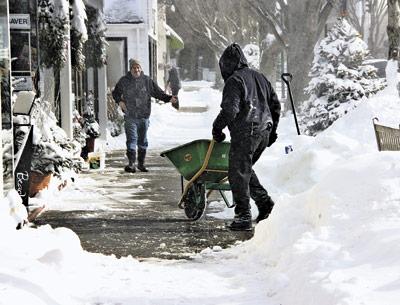
People dug out from a January snowstorm, the first of many they would face down this year.
Durell Godfrey
Builders considered tenting an entire property to let construction proceed
By
Joanne Pilgrim

       Now that it’s March, it may be safe to say it without jinxing ourselves into another dozen snowstorms: What a long, strange winter it’s been.

       All most of us will remember is snow and frigid temperatures, ice, constant shoveling, and days upon days, it seemed, of being housebound.

       In fact, this winter has not, overall, been record-breaking, but it certainly has been trying, and its impact is still being reckoned.

       By Feb. 18, according to The International Business Times, the metropolitan area had faced down 14 snowstorms and the seasonal snowfall in Manhattan’s Central Park stood at 56.6 inches. The all-time record for winter snowfall at the park, 75.6 inches, was set in 1995-96.

       According to records from the United States Cooperative weather station in Bridgehampton, there was no measurable snowfall here in December. In January, however, 20 inches fell, and in February, 18.5. January’s total far surpassed last January’s, almost 5 inches, but the totals for February, last year and this, were within an inch of each other. A bit more snow fell last year.

       Temperatures, according to the weather service, were all over the place, though record lows and cold days stand out, at least in our memories. In December, it was 16 degrees on the coldest day and a balmy 61 on the warmest. January temperatures ranged from 5 below zero to 55 above. A similar spread occurred last month.

       And so it went. Over nine inches of snow on Jan. 22, the most recorded in one day at the weather service site in Islip since 2000. A 52-degree day in early February. Back down to 9 degrees on Feb. 11. On Friday, 24 degrees, then half that on Saturday.

       With much of the country in a deep freeze, spiking demand for heating oil and gas, there was no similar fluctuation in the price for homeowners trying to stay warm — it just went up. According to the New York State Energy Research Development Authority, the average price on Long Island for propane, which was $3.12 a gallon at the beginning of March 2013, rose to $3.79 a gallon by the end of December. By Feb. 24, the per-gallon cost was $4.14, a more than 32 percent increase from the same time last year.

       According to the U.S. Energy Information Administration, propane prices are influenced by several factors, in cluding supply and demand, and colder-than-normal weather puts the pressure on, raising the cost. Home heating oil prices rose by a much smaller margin between last March and the end of last month, beginning at $4.27 a gallon and ending at $4.45, NYSERDA’s website reports.

       Outdoor conditions made walking difficult for even the most able-bodied, although Rob Balnis of East End Physical Therapy in East Hampton said last week that his practice had not seen much of an uptick in patients with injuries caused by falling on ice or in snow.

       “Normally, we do,” he said. He theorized that with the weather so bad, more people stayed home rather than venture out into treacherous conditions. “In a sense, it’s a safe thing,” he said of the incessant storms.

       That may be true. Marcia Kenny, director of marketing and public affairs at Southampton Hospital, said the emergency room had seen “quite a few sprains and falls” over the winter, but that no one had been treated for other weather-associated issues such as frostbite or hypothermia. “I guess people have been cautious,” Ms. Kenny said. “Conditions being what they are, I think people have just stayed home.” 

       The hospital does not keep records that cross-reference injuries and the weather, she said, so it would be hard to say whether there were more ice-and-snow-related injuries this year than in other winters.

       Very cold days meant that schoolchildren were sometimes unable to get out into the fresh air and run around at recess. “Children need exercise and fresh air,” Beth Doyle, principal of John M. Marshall Elementary School, said in an email last week. “We take every opportunity to have outdoor recess. Even if the ground is wet, we have a modified recess on the blacktop. It helps with focus in the afternoon, especially for the little ones in kindergarten and first grade.” But on the worst days, recess was indoors.

       Because snow day closures and delayed start times resulted in the loss of three full days and almost eight hours as of last week, “our number-one concern is the loss of instructional time,” Ms. Doyle said.

       The cost of the winter, in tax dollars, was a little more than Stephen Lynch, the East Hampton Town Highway Superintendent, budgeted for, but he said the department could cover the increase. The budget contained $25,000 for snow removal costs; as of Tuesday, the costs had reached $49,355. Overtime for workers dealing with snow, for which Mr. Lynch had budgeted $28,000, has reached $49,000.

       Contractors trying to make headway on construction projects have had a hard time of it this winter, too.

       “The key word is ‘nightmare,’ ” said Marcus Kouffman, head of construction at MKL Construction in East Hampton. The good thing is, business has really picked up, he said, calling this one of the “busiest winters in the last four or five years, if not our busiest year ever.”

       The cold and snow, Mr. Kouffman said, brought the shutdown of concrete plants (temperatures too low to pour concrete) and problems, should the thermometer happen to cooperate, in gaining access to sites due to piled-up snow. In addition, it was often difficult for the trade parade, workers who live elsewhere and commute here, to get to job sites.

       “Every day I lost a day, the subcontractors lost a day” and got behind on their work lists, Mr. Kouffman said. “This winter, particularly, we never had a real melt. Everyone’s geared up and ready to go, and scheduled — and you can’t.” One suggestion that came up — a serious consideration, he said — was to tent an entire property to let construction proceed.

       When there is a break in the weather, the builder said, “it’s scramble time.” He said he needs a good 7 to 10 working days “of no interference” to catch up.

       “I have three weather apps on my phone,” Mr. Kouffman said. “I check them against each other every day.”  With high season not too far off, he said, “this is pushing the gray zone.”

       Those in the plumbing and heating trade have been much in demand. The unremitting freeze has taxed heating systems. “More issues come to light because they’re working so hard,” said John Grant, the owner of Grant Heating and Cooling in East Hampton. Some people have called in for repairs thinking their furnace or boiler has gone down, he said, when in fact they have just run out of fuel. It was gobbled up faster than normal in the bitter cold.

       Mr. Grant said frigid temperatures increase “the urgency of any type of heat call, because there’s more danger of a house freezing.” That has meant some late nights for his technicians, who have had to contend with their own problems in getting to a job, especially during storms.

       “It can be difficult to get out, but you have to,” Mr. Grant said. “We’ve had vans stuck, and difficulty getting into driveways.”

       The tough winter might have a silver lining for Mr. Grant and those in similar businesses, however, as “people kind of see the weaknesses in their systems,” he said, and might now decide to have a more efficient and money-saving system installed.

       Even though it’s still cold out, Mr. Grant is already in “transition time,” planning ahead for the coming season. “Even with snow on the ground, we have to think about air-conditioning,” he said.

       One might think the conditions would have stemmed the tide of house-shoppers or delayed decisions about summer rentals. “It’s almost an annual event that bad weather forecast on Wednesday or Thursday kills our weekend,” said Tom MacNiven, a broker with Douglas Elliman in East Hampton.

       But, he said, “people looking to buy or rent have really been troopers,” willing, if need be, to trek down long unplowed driveways in snow boots to see a property. “Things are selling; things are renting,” Mr. MacNiven said. “I really think people have said, ‘We’re done with this. Summer has not been canceled.’ ”