
Long Island Larder: Eggsile's Return

Long Island Larder: Eggsile's Return

Miriam Ungerer | March 5, 1998

Among the rehabilitated foods recently exonerated by the Food Police, eggs are my favorite ex-culprits. They are among the finest, cheapest, most versatile foods in the kitchen and an invaluable source of protein as well.

Few foods were so thoroughly exiled from the American diet, so vilified as a card-carrying cholesterol-killer, as the simple, delicious, fresh egg.

"Oops! Our mistake!" asserts a new study by experts: Eggs don't contain nearly the amount of "bad" cholesterol that had been thought.

The subject has always been confusing. Since most of the populace never could define the difference between H.D.L. (good) and L.D.L. (bad) cholesterol and relied only on total numbers in tests, many decided to just give up eggs and be done with it.

I was never among them. However, I was intimidated enough to cut down on my consumption - the two a day (considered essential to start the day in my parental household) reduced to not more than one omelette or egg dish a week.

But I refused to count the couple of eggs among the ingredients in various recipes designed to feed six or eight people.

I often wonder what happens to the kind of client who, when traveling in other countries, grills the waiter about the egg, cream, or butter content of the dish he's just ordered. I rather imagine the reply to be an icy "I do not know, sir" or madame.

New Yorkers and Californians, particularly, are considered wackos about food not only abroad but in the rest of our own country.

Maybe with the easing of the egg embargo, we can all repair our tattered consciences about the state of our arteries and unlax with some of the tasty, nutritious omelettes, souffles, and puddings so long on the X list.

Elemental, My Dear

Whenever I am tired, or need a quick supper after a cocktail party, the first thing that comes to mind is always an omelette. An omelette plain or herbed or filled with a bit of cheese or some quickly sauteed vegetable from the fridge.

What could be easier or rest more lightly on the stomach or be more pleasing to the eye than a plump yellow omelette? With a glass of wine it makes, in Elizabeth David's inimitable words, "an almost primitive and elemental meal."

It's probably coincidental, but my favorite of Mrs. David's great body of gastronomic works is one of her last, "An Omelette and a Glass of Wine."

Anchovy Hath Charms

Despite the countless times I've watched the mouths of otherwise knowledgeable people curve down with distaste at the mention of anchovies, I'll never give up my efforts to enlighten all to their charm.

And olives: strong, sharp, imported ripe black olives from Greece, Italy, France (or just about anywhere but California, home of the inexplicably tasteless behemoths).

These voluptuous stuffed eggs, at once velvety and salty, disappear first on any hors d'oeuvres tray. A pastry bag makes short work of filling the halves.

Choose small, medium, or at most "large" eggs, so that they aren't unwieldy to eat out of hand.

Stuffed Eggs

Makes two dozen halves.

12 hard-boiled eggs

3 Tbsp. light mayonnaise

6-8 calamata or other brine-cured black olives, pitted and minced

1/2 tsp. anchovy paste

salt and cayenne pepper to taste

2 to 3 Tbsp. minced fresh parsley leaves

Various garnishes: black-olive slivers, or chopped parsley, or bits of anchovy fillet, about 8 of each kind

To boil eggs properly: Pierce the large end of each one with a heavy needle or egg-piercer and place in a pot of cool water to cover by two inches. Gently swirl in a tablespoon of plain white vinegar, bring the eggs gently to the boil, reduce heat and cook, occasionally moving them around with a spoon handle to center the yolks.

Simmer about 10 minutes, cool immediately in cold running water, roll the eggs on the counter gently to crack the shells and slip them off. Rinse and dry them.

Through A Sieve

Cut a paper-thin slice off both ends of eggs and halve eggs crosswise. Force yolks through a sieve or ricer into a bowl (or mash with a fork) and stir in remaining ingredients, except garnishes.

Transfer filling to a pastry bag fitted with a large plain or decorative tip and pipe into whites, mounding it.

The stuffed eggs may be made six hours ahead, arranged, covered with plastic wrap, and refrigerated.

Just before serving, garnish the eggs and permit them to come to cool room temperature.

Pear Clafoutis

Everywhere I've ever seen this French country dessert, it's been made with fresh cherries. However, there's no earthly reason not to make it with any fresh fruit, or even soaked dried fruit, you fancy. Simplicity itself, there are few desserts that offer a bigger round of applause for so little effort.

Serves six.

4 extra-large eggs

1/2 cup white sugar

Pinch of salt

1/3 cup unbleached flour

1 cup milk

1/4 cup (1/2 stick) unsalted butter, melted

1 tsp. vanilla extract

1 tsp. grated lemon peel

3 large pears, peeled, cored, sliced

1 Tbsp. lemon juice

1/4 cup light brown or raw, unrefined sugar

Confectioner's sugar

Heavy cream, whipped cream, or custard sauce (opt.)

A Warm Softy

Preheat oven to 325 F. Generously butter a nine-inch-diameter deep-dish glass pie plate. Whisk the eggs with the half-cup sugar and salt in medium bowl to blend. Whisk in flour. Add milk, butter, vanilla, and lemon peel, and whisk until smooth. Toss the sliced pears with the lemon juice and brown sugar. Arrange pears in bottom of buttered pie plate. Pour the batter over the pears.

Bake until the clafoutis is just set in center and golden on top, about 55 minutes. Do not overcook, as the pudding will continue to cook as it rests at room temperature for 15 minutes or so. Sift powdered sugar over the clafoutis and serve very warm, with or without whipped cream or a simple custard sauce, passed separately.

Breadcrumb-Cheese Souffle

A distaste for any but the freshest bread around my house results in a huge bread surplus. This gets spun into crumbs in the food processor and frozen to use in future recipes. This is the world's easiest souffle, quick to make and untemperamental, and it uses up a lot of breadcrumbs. In addition, in costs almost nothing to make and feeds four handsomely. Add a salad dressed with walnut oil and lemon juice, a fruit dessert, and there's money left over for a decent bottle of wine. A meal fit for a prince or a pauper.

Four servings.

31/2 cups white bread crumbs from a firm loaf

Softened butter

3 cups milk (not skim)

2 cups shredded Gruyere or Cheddar cheese

1 Tbsp. Dijon style mustard

1/8 tsp. or more cayenne

1 tsp. coarse salt

4 extra-large eggs, separated

cream of tartar

3 Tbsp. minced fresh parsley

2 Tbsp. grated Parmesan or Romano cheese

If you haven't any on hand, make the crumbs in a food processor or grate them on the larger holes of a box grater. Butter a two-and-a-half quart souffle dish and coat it with some of the crumbs. Shake them all around the dish and dump the excess back into the dish of crumbs. Heat the milk to just under the simmer and pour it over the crumbs.

Don't Overbake

Preheat the oven to 375 F. Stir the Gruyere or Cheddar, mustard, ca yenne, salt, and the egg yolks into the breadcrumbs.

Beat the whites with the cream of tartar until firm and glossy but not dry. Fold a third of them into the breadcrumbs, add the parsley, then fold the crumb mixture back into the beaten whites as lightly and quickly as possible. Pour the mixture into the souffle dish and lightly smooth the top with a rubber spatula.

Sprinkle with grated Parmesan and set the dish in the center of the oven. It will be puffed and light golden brown in about 20 to 25 minutes - undercook rather than overbake, which makes the souffle too dry.

The breadcrumbs seem to hold their own against gravity better than the conventional Bechamel-based souffle, but the souffle still deflates when cut into. Use a large flat serving fork and a spoon to serve at table.

A few fresh green beans or some new asparagus would be nice with the souffle, or just serve a salad alongside, family style. It's a family dish, after all, and a very good one to make when you need only half a recipe to serve two.
Town Clerk Is The Latest To Switch Sides - Fred Overton turns his back on Republicans

Town Clerk Is The Latest To Switch Sides - Fred Overton turns his back on Republicans

Originally published June 2, 2005

"Can someone tell me how you spell unanimous?" Bob Schaeffer, the co-chairman of the East Hampton Democratic Committee, joked last Thursday night after his party nominated Councilwoman Pat Mansir, a Republican, to run for town board.

Ms. Mansir's nomination and those of Supervisor Bill McGintee and Brad Loewen, a bayman who chairs the town planning board, were applauded by the committee members. But an announcement by the town clerk, Fred Overton, drew a standing ovation. He told the group that he is leaving the Republican Party and joining the Democratic ticket.

"I am overwhelmed and almost speechless," Mr. Overton told the group gathered in the basement of Amagansett's Scoville Hall. "Before the next [presidential] election, I will be registered as a Democrat."

Mr. Overton, a strong supporter of Ms. Mansir, who the Republicans did not back for a third run, said he felt he could no longer work with the G.O.P. "The leadership and I have gone in different directions," he said. "There are some good people in the Republican Party and some good people on the Republican Committee. They are not the majority and do not have the ear of the leadership."

Although Ms. Mansir and Mr. Overton are new to the Democratic ticket, neither of them are strangers to the local Democratic Party. Mr. Overton was a registered Democrat from the early 1970s until 1987 and worked on Democrat Judith Hope's first campaign for town supervisor.

Ms. Mansir ran for town trustee as a Democrat and was first appointed to the town planning board by Tony Bullock, a Democratic town supervisor. She said last Thursday that she will register as a Democrat before November. "The Democrats accepted me as I am. The Republicans couldn't handle me as I was," she said on Friday.

Democratic committee members were thrilled with her return. Calling her "the perennial champion vote getter," Larry Smith, a committeeman from Montauk, said "we welcome Pat as another jewel in the crown of the Democratic Party."

"She is a woman we feel deeply is coming home to the people who value her," said Dick Wolf, the committee's secretary. "I nominate and welcome Pat Mansir home," he said.

Mr. Loewen, a Democrat all along and a member of the planning board for 16 years, is following a well-worn path into local politics. Over the years, many planning board members have gone on to run for and win a seat on the town board. All of the current town board members were planning board members with him at one point, so to some committee members it was a matter of when, not if, he would make a run for town board.

"Brad, I've been waiting for this moment for over 10 years," Betty Mazur, a committeewoman from Amagansett, told Mr. Loewen last Thursday night. She described him to the committee as "a reasoned and reasonable man."

"He is a man of few words and when he does say something, it's meaningful," Ms. Mazur said. "He is sober, sensible, and solid, and he is the salt of the earth."

"He's also a Lester," Cathy Lester shouted from the edge of the room. Ms. Lester, a committeewoman and former town supervisor, is Mr. Loewen's aunt by marriage.

"You kind of grow into this," he said Monday. "You kind of get into a habit of public service. . . . There wasn't any big epiphany; the time just seemed to be right." In addition to his work on the planning board, Mr. Loewen is the president of the East Hampton Town Baymen's Association.

Bill McGintee faced opposition from one committeeman, Stephen Grossman. Although he considers the supervisor a friend, Mr. Grossman said he could not support the nomination.

"Two years ago . . . he wanted to run with the Democrats. I hoped within my heart that he would become a Democrat. I am a Democrat and I believe in my heart we must run people who are Democrats," he said.

Despite his objection, Mr. McGintee was the unanimous choice of the Democrats' 17-member selection committee, which is drawn from the party's general committee. Fred Overton's nomination caused Andy Malone, another committee member, to wonder what might happen in the event of a primary. "My concern is, if there is a primary, we may end up with egg on our face." Two committee members abstained from the vote on Mr. Overton's nomination, but Mr. Malone supported him.

The committee was unanimous in backing Christopher Russo for another term as highway superintendent, and also chose the incumbents Eugene DePasquale for town assessor and Catherine A. Cahill for town justice. Mr. Grossman, who was considered for the town justice slot, said he heard that "someone went to the committee and told them not to support me in the interest of party unity." Mr. Grossman eventually withdrew his name from consideration.

While Republican hopefuls are interviewed by the entire committee, the Democrats have a confidential screening process and do not announce the names of those under consideration. "If we're going to have screening and we're going to be confidential, we should keep it that way," Mr. Grossman said. "This is the second time this happened." He and Jeanne Frankl abstained from the vote.

For town trustee, the Democrats will run Stephen Lester, an incumbent, Brian Byrnes, Bill Taylor, Joe Peele, Jacques Franey, Bob Tulp, Tom Miller, and Arthur French.

"I think this is the year we could have a first-time majority on the trustees," Mr. McGintee said last Thursday night. "This is the community party now. This is the party of East Hampton, the party reaching out, getting the feel for what the people want, and taking time to solve their problems." Mr. McGintee thanked the committee for allowing him "the freedom to do what I felt, and the board felt, were the best things for the community. Never once in my time in office has anybody on this committee interfered with government."

"This is a great, great team," he said of the Democratic ticket.

"I never, I never, ever thought that I would be standing here," Mr. Loewen said. "It's all her fault," he added, pointing to Ms. Lester. "She kind of dragged me along in her wake. I love you, Cathy." He called Ms. Mazur his champion and thanked her for her patience. "I know that we're all going to win. I'm going to do my best and I will do you proud."

After losing the Republicans' support, Ms. Mansir said she had been reluctant even to walk into Scoville Hall, where the G.O.P. also meets. "You have no idea how good this feels," she told the committee. "In the palm of our hands we have the future and I think the future is good for this town."

Ironically, Ms. Mansir became a Republican largely because of differences with Debra Foster, a Democratic councilwoman who served with her on the planning board in the late 1980s. When Amagansett Square came before the board, the two were on opposing sides: Ms. Mansir supported the project and Ms. Foster fought it. Perry (Chip) Duryea, then the Republican leader, invited her to join the party, and she did. "It really centered around [Ms. Foster's] stance at that time, and now we get along very well. She is now willing to listen and work for business."

Mr. Overton's initial switch to the Republican Party came in the late 1980s, when the G.O.P. asked him to run for trustee. Party leaders told him, he said, that if another slot were to open he would be considered for it if he became a Republican. He did so and soon afterward an incumbent assessor retired, leaving an open spot on the ticket. Mr. Overton was elected and served for 10 years in the assessors office before accepting the Republicans' nomination for town clerk.

"The assessors office is not political and that's the way I treated my job here in the clerk's office," he said Friday. "To be honest, I couldn't tell you the party affiliation of anyone in my office. We keep politics out of the office."

On Friday, he told Thomas E. Knobel, the Republican leader, that he was declining the Republicans' nomination. "It's a decision that I didn't take lightly, in particular because of Roger Walker," he said Friday. Mr. Walker, the Republican candidate for supervisor, is a "longtime family friend." Although Mr. Overton will withdraw from the Republican Party, he will wait until after the election to change his party affiliation to Democratic. "It's a big step and I'm taking it in small steps."

Mr. Knobel was surprised by the decision. "We have nobody in the wings," he said Tuesday. "He screened with us, he asked for our nomination, he said he was going to run with us, he came to the campaign kickoff party." While the Democrats gloat, the Republican Committee will probably discuss a replacement for Mr. Overton at its meeting tonight.

"Everybody talks about let's run on the issues, and this is going to be a special year because we really mean it," Mr. Knobel said. "If you support useless expenditures, inefficiency, waste, and so forth, then you're for the Democrats." The Republican ticket includes Mr. Walker, Larry Penny, the town's natural resources director, and Bill Gardiner, a farmer with a law degree. "It's not a question of personalities. This is a question of what is good for this town," Mr. Knobel said.

The Democrats will hold a campaign kickoff cocktail party next Thursday from 6 to 8 p.m. at the Palm in East Hampton. The Republicans' next fund-raiser is planned for June 24 at Gurney's Inn. They expect to release their platform by the end of the month.

Edoardo Romani: Filmmaker Turned Restorer

Edoardo Romani: Filmmaker Turned Restorer

Sheridan Sansegundo | March 5, 1998

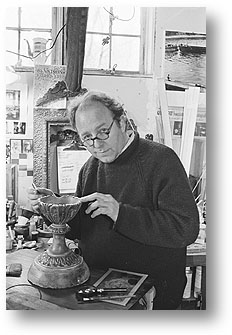
Crammed with furniture, heated by a woodstove, edged with orderly ranks of tools, polishes, and shellacs, Edoardo Romani's hugger-mugger of a workshop in Noyac feels as if it's in an 18th-century time warp. Computer-driven America is a million miles away.

In the only clear spot in the room, Mr. Romani, a filmmaker turned furniture restorer, is rejuvenating a 19th-century writing desk. The sad frame stands on a table. Braces secure its rickety legs, clamps retain strips of peeling veneer, the damaged inlay is gray and lusterless with neglect.

Photo by Morgan McGivern

Frankly, it doesn't look worth the effort.

Resurrection

But then he removes a cloth from the desk's top, which he has finished. The oiled and polished surface glows like a conker fresh from its shell, a delicate spiral star of pale golden inlay at its center.

It is a shock that such a dry, dusty corpse could be resurrected to such sensual beauty.

While nothing about Mr. Romani's life has been dry and dusty, in recent years it has undergone almost as radical a transformation as the desk.

Italian Cinema

He was born in Venice, and retains the easy warmth of a city where everyone knows everyone else's business and "if two people are arguing in the street, anyone who comes along feels they can join right in."

When he left Venice's Academy of Arts in 1967, the Italian cinema was at an artistic peak. Mr. Romani, determined to join it, secured a job as assistant cameraman on a Franco Rossi film.

Like others before him, he at first spent more time making cappuccino than celluloid, but before long he was working for Vittorio de Sica on "The Long Voyage" and then, in Rome, for John Huston on "The Kremlin Letter," starring Pat O'Brien and Orson Welles.

Working For Huston

"I was in love with John Huston," said Mr. Romani, who speaks French and Italian but whose English is a little idiosyncratic. "For the first time, I was jumping from the Italian attitude to the American. It was very exciting, very new. He was a fabulous director."

Parts of the movie had been shot in Russia, and when it was over the producer, Dino de Laurentis, mentioned that there was a chance to go back there to work on Sergei Bondarchiuk's "Waterloo."

Mr. Romani, who was still only 19, jumped at the chance. Armed with 50 kilos of pasta and not a word of Russian, he spent three months in Moscow behind the camera.

Dubbed From Mongolian

By then he knew that what appealed most to him about film-making was editing. Back in Rome, he worked for the next 12 years with Franco Arcalli, Bernardo Bertolucci's editor and scriptwriter, who became his mentor.

The movie that cemented his relationship with Mr. Arcalli was Akira Kurosawa's "Dersu Uzala." The film had to be dubbed in Italian from Mongolian and Russian, a task further complicated by the difficulty of communicating with the enigmatic Kurosawa, who spoke no Italian.

Mr. Romani bribed the night porter at the studio to let him into the editing room in the middle of the night so that he could study the rushes until he was completely familiar with them, enabling him to anticipate Mr. Arcalli's every request.

Cut To Measure

When his mentor died, Mr. Romani moved to Italian television and became a documentary editor.

"People think that editing is just joining action and sound without a concept," he said. "But a film editor must be a tailor, a chef, who sees all the defects of a film and cuts and fits to measure. When you have synchronicity and rhythm, the film becomes elastic, fits."

His TV documentaries - on the Pope, the neorealist painter Renato Guttosi, crime in the Bronx, Irish terrorism, Tibet, David Bowie, life in the Camargue, a seven-hour series called "Magic Africa" - had him crisscrossing the globe in the 1970s and '80s.

British Reserve

His exuberant warmth helped him out in unfamiliar situations.

In 1984, for example, he was sent to London to edit newscasts for Italian television. Every morning he commuted from the suburb of Brixton to the center of the city. After a while, he realized that he was travelling with the same people, in the same carriage, at the same time every morning - and no one ever spoke a word to anyone else.

After two months Mr. Romani, on a one-man mission to melt the iceberg of British reserve, got into the train and said, "Good morning, everyone." The passengers hurriedly raised their newspapers and ignored him.

The next morning, he tried again.

"Good morning, everyone. This is the second day of the second month we are all here together. How are you all?"

This time, one or two people sheepishly acknowledged him. After that, it wasn't long before everyone was greeting each other, swapping stories, and even, he said, getting together for drinks after work.

At about this time, Mr. Romani decided to make his own film. The inspiration for the movie was a major milestone in his life - his girlfriend was going to have a baby.

"I was interested how a pregnant woman softens, becomes gentle, and makes gentle the people around her."

Tragedy

Having traveled around the English canal system on a barge doing research - as a Venetian, he had been entranced to discover England's canal system - his script and story boards were ready.

In this unrealized film, a young pregnant woman takes refuge in the barge of a dour old sailor, having decided that she will have her baby there and together they will sail the secret waterways of England, isolated from the world beyond.

But the film was never made. While still in infancy, Mr. Romani's son died.

Starting Over

He found some consolation in Buddhism, but the relationship broke up. Doubly traumatized, the filmmaker decided to abandon his turbulent life in Europe and start again in America.

On and off during his peripatetic life Mr. Romani, who believes that all artists love furniture and people, had studied gilding and refinishing. It proved a good investment when the moment came for introspection, and he turned to the tranquil existence of a restorer.

His first job, the restoration of a six-paneled mother-of-pearl and ivory screen for the Smithsonian Institution, led to a long project in Chicago restoring 36 pieces of Bugatti furniture that came from a collection belonging to Elton John.

Sound Of Silence

Since then, specializing in Gio' Ponti, Bugatti, Biedermeier, and Le Lain Julen furniture but taking on practically any project, he has worked for Sotheby's and Christie's, the estates of Aristotle Onassis and Stavros Niarchos, and a number of foundations.

Three years ago, after falling ill with Meuniere's disease, Mr. Romani moved to Sag Harbor.

"The silence here is so exaggerated that it almost has a sound," he said. "It talks to you."

Natural Materials

He works only with natural materials, he said, and as a demonstration coated a small area of sanded wood with shellac, which, unlike varnish or polyurethane, allows wood to breathe rather than sealing it completely.

Some of the furniture crammed into Mr. Romani's low-ceilinged workshop is waiting to be restored for clients, other pieces he has found himself at sales or accumulated during the five years he lived in SoHo before moving east.

When these have been lovingly resuscitated, he will hold a sale and then start all over again.

Behind The Door

And then there are the pieces he has made himself from scratch - a folding bookstand, a tilting mirror, a gilded frame.

The peace has obviously been therapeutic for the restorer, as has the quiet, contemplative work.

"I opened my jungle door," Mr. Romani said, gently sanding away ugly varnish on a strip of wood to reveal the clear grain beneath. "It's so beautiful, so mysterious."

Singular Courage

Singular Courage

March 5, 1998
By
Editorial

It's not every day that we come upon a person willing to venture forth, to stand up and be counted. To be courageous.

Steve Miller, an East Hampton native son, is such a man.

As reported in these pages last month, Mr. Miller, who has AIDS, has made his life an open book, but not for commercial reasons or for fame. He puts his story "out there" for his community's kids - to help them think about the causes of dangerous behavior, to face its effects, and, in his own words, "to give something back."

For a week in February at East Hampton High School, and for another full day this week at the middle school, Mr. Miller addressed students' curiosity and fear and answered probing questions. The administrators of the district's schools have done something right in letting this happen.

When Mr. Miller is in front of a class, nothing is taboo. Because he is candid, the students respond in kind, suspending embarrassment. Because he is genuine, they believe him , obvious by the looks on their faces and their attention to what he says.

Because he is willing to talk about young love and attraction, condoms and sexually transmitted infection, and heterosexuality and homosexuality, he may well be saving lives.

Nothing could be more important.

Lyme Disease: Fear Itself

Lyme Disease: Fear Itself

March 5, 1998
By
Editorial

When it comes to Lyme disease, as it unfortunately does every season, the accepted wisdom always has been to treat early, the earlier the better.

The sooner antibiotics are administered following the appearance of the characteristic "bull's-eye" rash surrounding a tick bite, or other significant symptoms, runs the theory, the greater the patient's chance of escaping serious aftereffects, up to and including, in rare instances, death.

Stories have long circulated of visitors to the East End, or Nantucket or the Connecticut shore, who were bitten by a deer tick and went home to unwitting doctors in the Midwest or California complaining of chills, fever, pain in the joints, or exhaustion; being diagnosed with the flu, and later experiencing cardiac arrhythmia or arthritis.

In recent years, however, awareness of how to recognize Lyme disease and how to treat it has soared, both among the general public and in the medical profession.

That, according to a report released this week by the Yale University Lyme Disease Clinic, is both good and bad. It seems that many patients who undergo treatment for Lyme are so afraid of the illness that they press their physicians for a course of treatment they may not really need.

Of 209 persons in the Yale study, 125 turned out not to have Lyme disease at all, although they visited their doctors an average of seven times and took antibiotics for an average of 42 days. Fifty-two of the 125 suffered from apprehension, so certain were they that they had the disease. More than half reported adverse side effects from the antibiotics.

Pressured by fearful patients, concluded the study, some doctors are prescribing too quickly, without consideration of the possible ramifications.

There will be those who say it is better to take unnecessary antibiotics and contend with their side effects than to wind up with an irregular heartbeat or painful arthritis, and maybe they're right. On the other hand, if ever there was a shining example of an instance in which an ounce of prevention was worth a pound of cure, this must be it.

Spring is coming. Wear long pants and stay away from the tall grass.

Voters Vs. Politicians On Peconic County

Voters Vs. Politicians On Peconic County

March 5, 1998
By
Editorial

A lot of politicians in Suffolk County, especially Republican ones, are hoping that if the old movement to create Peconic County won't die it will just fade away.

Not so one of the East End's favorite Republicans, State Assemblyman Fred W. Thiele Jr. Assemblyman Thiele has worked with a half dozen other attorneys, most of whom are Democrats, to prepare litigation against the state that, if successful, would require the State Legislature to provide a procedure for the creation of new counties. Mr. Thiele has been visiting the East End's town and village boards in an effort to have them sign on as plaintiffs.

So far, every village has done so, as have East Hampton and Shelter Island Towns. The Town of Riverhead, which had under former Republican leadership been the most skeptical about Peconic County, saw a change in its Town Board majority in November when a Democratic and Riverhead Party took over. It is expected to agree to join in the suit before long.

That leaves Southold Town, which voted unanimously last month against taking part in the lawsuit, and Southampton, which has yet to vote on whether to do so. Both towns have Town Boards with Republican majorities.

Something is at work here that should not be. In November of 1996, 71 percent of East End voters favored a ballot proposition calling for a binding referendum to be held on the creation of a new county from the five East End towns. Such a referendum requires an act of the State Legislature, but the Speaker of the State Assembly, Sheldon Silver, a Democrat concerned about whether Peconic County would set a precedent for Staten Island, has kept the issue from reaching the Assembly floor.

East End voters deserve more respect. However, since the Legislature doesn't seem about to respond to their wishes, it is appropriate for the organization pushing for Peconic County and the municipalities to take legal action.

Southampton and Riverhead should get on board as soon as possible and Southold should reconsider its negative vote. Although there have been several contradictory reports on the economic feasibility of the proposed new county, the time has come to put them all on the table and to let the voters decide.

Jazz Trumpeter Wins A Grammy

Jazz Trumpeter Wins A Grammy

March 5, 1998
By
Star Staff

Randy Brecker, a jazz trumpeter and part-time resident of Northwest Woods in East Hampton, was on stage in a London jazz club when he discovered that he had won a Grammy Award.

Because he wasn't in the United States, Mr. Brecker had lost track of when the Grammys were to be awarded, thinking, even as he was winning one, that they were to be dished out the following evening.

The good news arrived in a whisper between songs at the famous Ronnie Scott's in London, his publicist said, where Mr. Brecker was in the midst of a week-long gig. The club is the oldest and most famous jazz club in England.

Solo Effort

The Grammy was for Best Contemporary Jazz Performance on "Into the Sun," an album with a strong Brazilian influence seasoned with jazz, funk, and rock. David Sanborn, Gil Goldstein, Cafe, and Bob Mintzer are among the U.S. and Brazilian guest musicians it features.

Mr. Brecker was a member of Blood, Sweat and Tears in the band's heyday, and also has played trumpet with Frank Zappa, Larry Coryell's Eleventh House, Jaco Pastorious's Words of Mouth, and the band Dreams in concerts and on recordings.

"Into the Sun" is Mr. Brecker's first solo effort in six years. He and his brother Michael had a jazz band, The Brecker Brothers, in the mid '70s, but eventually went separate ways. Reuniting in the early '90s, they put out a pair of albums, one of which, "Out of the Loop," won a pair of Grammys in 1994.

One was for Best Instrumental Composition - Michael Brecker's doing. The other - for which Randy Brecker could take credit - was for Best Contemporary Jazz Performance - the same award he picked up last week.

High Quality

Michael Bloom of San Franciso, Mr. Brecker's publicist, said he and Mr. Brecker were aware that he was a strong contender for a Grammy.

"I actually picked him to win for that category," Mr. Bloom said. "Now everybody wants me to pick horses."

"It's very good" Mr. Bloom said of the album. "He has some very good people guesting," and "it's accessible to people who may not be real jazz heads, but also harmonically sophisticated enough" for those who do know their stuff.

"It's a very high quality project," he said.

Concord Vista

"Into the Sun," recorded on the Concord Vista label, a new jazz-oriented subsidiary of Concord Records, was the subsidiary's first Grammy nominee, and winner.

Although he has not performed on the East End, he spends a lot of time in Northwest Woods, and was interviewed on WPBX, the Long Island University public radio station, a couple of months ago.

He could not be reached in England, where he was still performing, this week.

Opinion: Telephone Talk

Opinion: Telephone Talk

Patsy Southgate | March 5, 1998

A funny thing happened on the way to CTC Theater Live's planned spring productions of "The Murder Room" and "Crazy for You." Perhaps already in volved in local shows such as the Southampton Players' "Damn Yankees," few suitable male actors answered the casting calls.

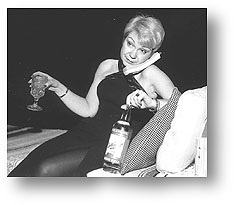
Photo by Gary Mamay

To top things off, the company's dream lead for both productions, the darkly compelling Thomas Rosamillia, who played Public Enemy Number One in last spring's wonderful "Anything Goes," lingered unavailably in Florida.

Did CTC's board of directors freak out? Au contraire, they converted potential disasters into golden opportunities, rescheduling "Belles," which opened last Friday at the John Drew with an all-female cast, and "Wonderful Town," a low-male musical with two female leads, instead.

Forty-Five Phone Calls

"Belles" is a funny, quirky, even kinky little "play in two acts and 45 phone calls," as the program puts it, by Mark Dunn.

An award-winning Southern writer who is now playwright-in-residence at the 13th Street Repertory Theatre in Manhattan, Mr. Dunn has imagined a Southern family of six girls who strive to transcend the childhood horrors of a drunken father and a mother so phobic she fears electrocution if a raindrop falls during a phone call.

Five of the sisters, ranging in age from 22 to 40, have flown their dysfunctional coop to make new lives in places as far from home as they can get.

Bedridden Materfamilias

The play unfolds on John Mercurio's witty, multilevel set as they phone one another for advice and companionship, waiting, if only subconsciously, for the heart-easing call from Mom that clearly will never come.

As the play opens, all six phones begin to ring on the empty stage while a spotlight tours their various locations. Then the stage goes dark.

The lights go up again on the long-suffering, recently widowed Peggy (Irene Stefanik) in the Memphis sitting room where the sisters grew up and where she now tends their bedridden, senile materfamilias, who, mercifully, remains off-stage.

Disasters

A tireless do-gooder, Peggy functions as a communications center for her scattered siblings, faithfully guilt-tripping them with bad-news bulletins about their declining Mom.

She first calls single-career-wom an-with-a-drinking-problem Aneece (Marion Stark) in Philadelphia, getting her out of the shower to report some fresh disaster and prompting her to phone Roseanne (Louise Shaw), an Atlanta housewife whose minister husband has just walked out on her and their two daughters.

Roseanne calls Audrey (Susann L. Ashraf) in Mississippi. Tricked out in a black lace mantilla and red feather boa, she's an exotic bar-room chanteuse who performs with a marionette she believes is her 4-year-old son, Huckle. In Ms. Ashraf's far-out yet stunningly dignified performance, she is riveting.

Telephone Tag

Audrey phones their hippie sister Sherry (Marie Dahl) in her "living space" in Elk Run, Wash. Something of a nymphomaniac, Sherry has assumed the low-self-esteem name Dust, and is deeply into the paranormal.

Finally there's Paige (Melissa W. Ralph) in Texas, who acquires and dumps boyfriends at a dizzying rate. What with her beeping answering machine, Roseanne's cries to a suicide hotline, Audrey's frantic phoning when Huckle disappears, and Peggy's dreaded bulletins, the sisters run up the huge long-distance bills of a family trying to find its center.

Under Serena Seacat's imaginative direction, "Belles" is an eccentric, funny evening with a lot of heart but occasional unevenness, at least on opening night, when some of the comic timing was thrown off by the Southern drawls.

Among its many joys is meeting three talented young actresses new to the John Drew stage: Ms. Dahl, Ms. Ralph, and Ms. Ashraf, whose future appearances we look forward to.

We also have the pleasure of seeing Ms. Shaw and Ms. Stefanik again. Ms. Shaw played Clarice in CTC's production of "You Know I Can't Hear You When the Water's Running" a few years ago, when she was known as Louise Sweeney.

Ms. Stefanik's many fine CTC performances include Agnes in "Dancing at Lughnasa" and her priceless Mom in last year's "True West."

Dramatic Role

And we find Ms. Stark, the singing star of CTC's "Guys and Dolls," "Kiss Me Kate," "South Pacific," "Bells Are Ringing," and "Annie Get Your Gun," in her first non-musical role.

Her speech as the embittered Aneece with her bottle of Stoli reveals an impressive hidden talent.

"Belles" can be seen tomorrow and Saturday nights at 8 p.m., and Sunday afternoon at 2:30. It's new, different, and very beguiling.

Bulkhead Battles Continue

Bulkhead Battles Continue

Stephen J. Kotz | February 26, 1998

A steel bulkhead erected by Ronald and Isobel Konecky without a permit to help keep their Dune Road house in Bridgehampton from collapsing into the ocean will stay in place at least another month.

On Feb. 10, the Appellate Division of the New York State Supreme Court in Brooklyn quashed the town's attempt to have the bulkhead removed.

Lisa Kombrink, the town attorney, said the court allowed the Koneckys to keep the structure in place until March 23, a month later than expected, until both sides can return to State Supreme Court in Riverhead.

Court Permit

The Koneckys obtained permission from Supreme Court Justice Peter F. Cohalan to erect the temporary bulkhead on Jan. 23. They argued that a massive subsurface dune restoration system built by their neighbor, William Rudin, had caused scouring that threatened their house. A week later, the Rudin device collapsed in a heavy storm.

Both the town and the State Department of Environmental Conservation appealed that decision and argued unsuccessfully in court that their action should have constituted a stay.

Separately, on Friday, the Town Board passed two resolutions providing funding for attorneys and expert witnesses for legal battles involving erosion control structures.

The town hired the New York environmental law firm Sive, Paget & Reisel to help it fight a lawsuit by a group of nine neighbors on Dune Road who sued the town over its decision to require an environmental impact statement before allowing them build a line of steel bulkheads.

The town will pay the firm up to $50,000 and allotted another $7,000 to cover the expenses of hiring expert witnesses. Until now, the town attorney has handled the case.

Mr. Rudin settled with the town individually when the board allowed him to build his subsurface dune restoration system. Both a steel cofferdam erected during construction and the sandbag system blocked the beach, causing a public outcry. Critics charged the structure exacerbated erosion in front of the Koneckys' and other houses as well as along the public F. Scott Cameron Beach to the west.

Another System

A smaller version of the ill-fated dune restoration system that Mr. Rudin constructed has now appeared in front of his neighbors' house. Jay Goldberg and Mary Cirillo have had a roughly 80-foot-long structure put in consisting of two fiber tubes six to eight feet in diameter that are filled with sand.

Unlike Mr. Rudin's structure, which blocked the beach before collapsing during a Jan. 29 storm, the project in front of the Goldberg-Cirillo home is closer to the dune.

Joe Edgar of the Hydraulitall Company based in Jamesport, who constructed the system, said it was a first step to rebuild the dune in front of the couple's house. The couple plans to add sand and plant beach grass on top of the system after moving the house back, he said.

Sand piled by town workers to protect the exposed parking lot at F. Scott Cameron Beach remained in place this week. The surf, which has lashed oceanfront houses along Dune Road in recent weeks, was rough, but allowed beach passage.

Trustees, Too

The town also agreed to hire the Mineola law firm of Meyer, Suozzi, English & Klein and pay it up to $25,000 to represent the Town Trustees in any legal actions it may take to keep the beaches passable and protect Mecox Bay.

Although the Trustees also granted a permit to Mr. Rudin, Scott Strough, the board's president, said the structure extended too far out in the water. At a special meeting with the Town Board on Feb. 2, the Trustees pledged to fight for the public's right to cross the beaches.

The Town Board will also hold a public hearing on March 10 to consider a six-month moratorium on applications for shore-hardening structures.


Open Space Vote Thursday

Open Space Vote Thursday

Susan Rosenbaum | February 26, 1998

The East Hampton Village Board is expected to adopt its first ever open space planning and management program when it meets next Thursday.

The plan's recommendations, village officials say, point the way to more environmentally sensitive redevelopment here, more aggressive protection of the village's wetlands, dunelands, and public corridors, and preservation of its remaining undeveloped areas - about 10 percent of the residential lands within its 4.8 square miles.

"We are proud to put this in place," Mayor Paul F. Rickenbach Jr. said yesterday, anticipating that his board would pass the plan without a hitch.

Way Is Cleared

Larry Cantwell, the Village Administrator, called the plan's adoption "a very important first step." It will become, he said, the village's "road map for preservation."

The plan details 13 remaining undeveloped village parcels larger than four acres, totaling 160 acres - the only land remaining with subdivision potential. Some smaller parcels also remain undeveloped, according to the plan, but all told only about 100 new village lots can still be created.

First unveiled in draft form last May, the plan was the subject of an informational meeting last spring and a public hearing this month. The board, finding that its implementation would not have a "significant impact on the environment," adopted a negative declaration Friday, in accordance with the State Environmental Quality Review Act and the Village Code. That vote clears the way for the plan's adoption.

Parking Demands

Some objections, however, were raised by the Village Preservation Society and the Circle Association, two residents' groups, about recommendations that the village acquire land near its beaches to expand parking, if needed, in the future. The plan specifically suggests that the village acquire two properties along the Double Dunes next to the parking field at Two Mile Hollow Beach.

Gene E. Cross, the village's planning consultant, responded that demands could increase significantly at village beaches 20 years hence, resulting in "spill-over onto adjoining residential streets." If the village owns the property, he said, parking could go "where the demands are generated."

Mr. Cantwell said the village still has "growth potential" near the beach even without the purchase.

Preservation Monies

The residents' groups also questioned the plan's recommendation to beef up one of the "special permit" sections in the Village Code. The plan suggests "reworking" the special permit procedure to compensate for changes in the State Environmental Quality Review Act the state adopted two years ago that exclude minor projects from its review.

The Village Board has said it will spend up to $1.5 million to acquire land for conservation and has also retained the services of the Peconic Land Trust, a conservation organization, to help identify property owners willing to grant easements.

The village hopes to tap state monies for preservation, too, if the State Legislature again passes, and the Governor signs, a land bank bill, slated for reintroduction next month.

Suggestions Followed

The legislation would put in place a 12-year $35 million program that State Assemblyman Fred W. Thiele Jr. estimated could bring East Hampton Town as much as $2.5 million a year though transfer taxes on sales of property. Village properties would be "eligible" for preservation under the bill, Mr. Thiele said yesterday, with the Village and Town Boards negotiating the allocation of the funds, he said.

To qualify for the state funds, the village must have adopted an open space plan.

The Governor vetoed a similar bill last year, but Mr. Thiele said it had been redrafted to cover all five East End towns and an exemption for agricultural lands, provisions the Governor suggested. Mr. Thiele said he was "optimistic" that the bill would pass both the Senate and Assembly, and see the Governor's signature by late spring.

Seeking Easements

The village's plan encourages landowners "to dedicate easements similar to those of their neighbors," where that possiblity exists, and tax reductions are recommended "beyond" what is established by the Village Code.

"The assessors will have to be brought into the loop to see what kind of deals can be cut," said John Halsey, the Land Trust's executive director. Easements, he said, "have to be appealing enough," adding that the plan will help create awareness of "the public costs of despoiling a pond," for example.

When a property owner agrees to move a pre-existing septic system back from a wetland, Mr. Halsey explained, it is "good for the community as a whole."

New District

Mr. Halsey added that each situation is different, and part of his job is to "tailor individually" charitable gifts made by property owners to the Land Trust, or easements to the municipality.

The village would dedicate a new zoning district for all public lands to be called "Greens and Parks," the plan suggests, and enhance enforcement provisions governing it.

The final version of the open space plan has few changes from the original draft, though its language has been tightened, and a few corrections made.

One of its more ambitious recommendations remains - for the village to acquire the former Mark R. Buick dealership on Accabonac Highway and Pantigo Road.

To Vote Thursday

"The recommended course of action is acquisition and demolition," the plan says, as it is located "between two village greens and would provide an important link between them."

The property, however, owned by Generosa Ammon of East Hampton and Manhattan, is said to carry a price tag of more than $2 million.

Ms. Ammon has proposed renovating the building to a single-use retail/office building, and is expected to appear before the Village Design Review Board with her plan Wednesday at 7 p.m. at Village Hall.

The Village Board, meanwhile, will take its vote on the proposed open space plan at a special meeting at 11 a.m. next Thursday, before its work session, at the Emergency Services Building on Cedar Street.