
Carters Plead: Don’t Close the Plant

Carters Plead: Don’t Close the Plant
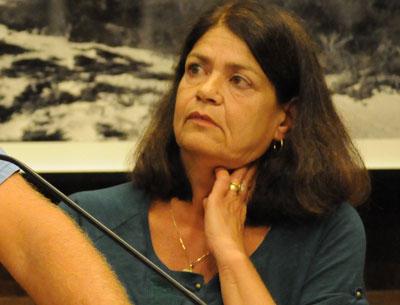
Lucille Garypie, an owner of the John K. Ott cesspool cleaning company, introduced others in the septic waste business who spoke to the East Hampton Town Board at a hearing last week.
Morgan McGivern
By
Joanne Pilgrim

    The owners of cesspool-pumping businesses turned out en masse last Thursday night to tell the East Hampton Town Board hearing that closing the scavenger waste plant, in use in recent months as a transfer station only, would have a profound effect on them — in some cases, putting them out of business.

    Representatives of five different waste carters said they offloaded septic waste at the plant, contrary to what the board had been told in a report issued by the budget and finance committee. The committee recommended temporary closure of the waste-transfer site until long-term decisions about the future of the plant could be made, based in part on a finding that only one firm, the John K. Ott Cesspool Company, was using the plant.

    “This board cannot make a decision . . . when they’re given inaccurate information,” said Lucille Garypie, who owns that company with her husband, Eugene Garypie.

    John K. Ott, she said, is the predominant user of the plant, which can take in only a limited number of gallons of waste per day. When capacity is reached, carters must drive to facilities in Riverhead or at Bergen Point in Babylon to dump. While Ott, with two trucks, can “make do,” Ms. Garypie said, others cannot.

    Jason Libath, a part owner of J & J, a new septic-waste business, said that due to the limited capacity at East Hampton’s plant, he has had to tell restaurants that have called for a pump-out that he cannot help them. “We’re not set up to go to Riverhead,” he said. “If this plant shuts down, we might shut down, too.” A representative of Schenck Cesspool Service said the situation for his company is the same.

    John Stafford of the McMahon company urged the town board to reopen the town’s facility as a waste-treatment plant.  Among the important considerations, he said, is the impact on residents and business owners as septic waste carters set prices commensurate with their costs. The two UpIsland plants, he said, charge carters the full cost of dumping a truckload of waste, regardless of how much the truck actually contains. And, he said, East Hampton’s transfer station, at a rate of 13.5 cents per gallon, is “currently unaffordable.” 

    For several days last week, he said, his company was unable to dump a full truckload of waste as the transfer station was full up. “I ask you to give careful consideration to all of this, as it could cost us all a lot of money,” he said.

    “The transfer station as we know it doesn’t fit the needs of this community,” said Arthur Malman, a member of the budget and finance advisory committee.  The committee’s review of plant manifests, he said, had shown that “almost all the waste being dumped there was from Ott,” leading to the conclusion that other companies did not use the plant.

    The town board is grappling with the larger question of what to do about the waste treatment plant — rehab and reopen it,  privatize it, or shut it for good. The issue has been under discussion for more than a year, and a majority of the board members recently agreed to seek proposals from consultants who could help the town prepare an overall septic-waste management plan, which would inform specific decisions about the scavenger waste plant. 

    A number of companies have responded, and the proposals will be vetted after the Oct. 8 submission deadline.

    Town Supervisor Bill Wilkinson and Councilwoman Theresa Quigley have disagreed with that approach. They supported accepting a bid from a company that would have leased the plant and eventually purchased it. The other board members did not find the terms favorable to the town and said that related issues, such as environmental conditions and potential groundwater pollution, should be addressed before moving forward.

 

Association Threatens Trustee Access

Association Threatens Trustee Access

By
Russell Drumm

    The Georgica Association has told the East Hampton Town Trustees they may no longer use the association-owned beach between Beach Lane and the Georgica Pond gut. The stretch has been the traditional access for trucks and excavators used to lett, or open, the pond to the ocean in the spring and fall of the year.

    At their monthly meeting on Tuesday night, Diane McNally, the trustees’ presiding officer, told her board she had received a letter from Karen A. Hoeg, an attorney with the firm of Twomey, Latham, Shea, Kelley, Dubin and Quartararo, representing the association. It states that “. . . no further use of the Association’s property is permitted to the trustees and its contractors in connection with dredging Georgica Pond . . . Moreover, the use of the Association’s property by the trustees for any commercial purpose of any kind whatsoever is not permitted. Please know that the Association has asked us to enforce their rights with extreme vigor. If the trustees desire use of Association property, please contact us to discuss the issues of price, insurance, indemnification, etc.”

    The beach between Beach Lane in Wainscott and the narrow isthmus that separates the coastal pond and the sea is one of the few beaches in town whose private ownership predates the formation, in 1686, of the town trustees. Their founding Dongan Patent declared beaches to be common land.    

    Since then, trustees have opened the pond in the spring and fall, as did their native predecessors, to allow spawning fish to enter in spring and exit in fall. In more recent times, high pond levels have occasionally flooded pondfront properties. In addition, trustees have made available to contractors, for a price, sand dredged from the beach to open the gut. The sand has been used to shore up eroded beach and dune.

    Trustees have had to balance the environmental health of the pond with the often-untimely wishes of the flooded, and they have provided sand to protect beachfront homes. By not allowing access to the Georgica Pond gut, the association has presented the trustees, and some of its own members, with a conundrum.

    During Tuesday’s meeting trustees agreed to send a letter to association members to alert them of the position their attorney’s letter has put them in, while at the same time asking East Hampton Village officials and excavation contractors to help find a way to access the gut from West End Road, on the east side.

    “We will say we don’t use the pond openings as just a commercial project but for the health of the pond. Our letter will say we’re surprised the association is not concerned with the pond’s health,” Ms. McNally said after the meeting.

    Trustees also discussed the problem of controlling the layout of docks and pilings in the various marinas at Three Mile Harbor. Trustees own, on behalf of the public, the harbor bottomland. They lease beaches and bottom for pilings and bulkheads, but have had trouble coming up with a formula that allows marina owners the flexibility to change the pattern of their docks in order to accommodate different-size boats, while restricting further expansion of the marina’s footprint.

    Peter Mendelman of Seacoast Enterprises Associates, owners of Harbor, Halsey’s, Three Mile Harbor, and Gardiner’s Marinas, urged the board to consider charging lessees by a marina’s footprint — the total area its docks, catwalks, and pilings take up.

    Trustees said that while the measuring of individual docks and numbering of pilings was indeed unwieldy, allowing marina owners to do whatever they wished within a given space whose bottomland was publicly owned, would eventually lead to the “privatization” of that area.

    Mr. Mendelman said requiring marina owners to pay for a new survey every time they changed the pattern of their docks would be prohibitively expensive.

    In the end, he and the trustees agreed to work together to design a system that would fit both the trustees’ and marina owners’ needs.

Land Acquisitions

Land Acquisitions

By
Joanne Pilgrim

    The proposed purchase of three properties with money from the community preservation fund will be the subject of an East Hampton Town Board hearing next Thursday night at 7, at Town Hall.

    One parcel, just shy of six acres, is at 41 Three Mile Harbor Road in Springs, just north of Halsey’s Marina, on Three Mile Harbor. It is owned by the Prand Corporation. The purchase price is $3 million.

    The second piece of land the town is looking to buy is at 20 Gloucester Avenue in Montauk, a .44-acre lot owned by Loretta La Ruffa. The cost is $190,000.

    The third proposed purchase is at 117 Greenwich Street in Montauk; the owners are Frank and Carol Foti. A third of an acre, its sale price is $225,000.

    The board will also hold a hearing next Thursday on limiting through traffic on a network of streets including Cooper Lane, Palma Terrace, Sherrill Road, Osborne Lane, Miller Lane, Indian Hill Lane, and Miller Lane West and East, as well as excluding trucks weighing over nine tons, except for local deliveries, from those streets.

    The proposal is in response to an appeal from a resident who said that the neighborhood is inundated with traffic seeking a way around chokepoints on nearby main roads. However, other residents who spoke to the town board last week said the restriction was unnecessary, and would cause a bigger traffic tie-up on Cedar Street. One suggested that Indian Hill Lane be made a one-way street.

    Following a hearing last Thursday night, the board approved the purchase of close to 12 acres on Town Line Road in Wainscott for $1.2 million from the preservation fund, and of 6.2 acres on Fresh Pond Road in Amagansett for $635,000, also from the fund.

Forum on Immigration Law

Forum on Immigration Law

By
Star Staff

    Representative Tim Bishop will host an information forum tomorrow on the new immigration policy giving some undocumented young people relief from deportation. Starting at 7 p.m. at Bridgehampton National Bank in Bridgehampton, the forum will feature a presentation by a Citizenship and Immigration Services representative on the Deferred Action for Childhood Arrivals program, which went into effect in August.

    Under the measure, announced by President Obama on June 15, certain young people who came to the United States before their 16th birthday will be considered for relief from deportation proceedings provided they do not present a risk to national security or public safety and meet several key criteria — being under 31 as of June 15, for example, and having at least a G.E.D. Those who meet the criteria will also be eligible for work authorization for a renewable period of two years.

    The services of a lawyer are not required to apply. Mr. Bishop has urged anyone with questions or wishing to make a reservation for the forum to call his office at 289-6500.

Scavenger Hunt Goes On

Scavenger Hunt Goes On

By
Joanne Pilgrim

    The East Hampton Town Board will listen to comments tonight about the future of the town’s scavenger waste treatment plant, which is on Springs-Fireplace Road in East Hampton.

    The board suspended waste treatment at the plant earlier this year and has been operating the facility as a transfer station that allows haulers to unload waste there, which is then trucked to a processing facility upIsland by a carter paid by the town.

    However, three board members — a majority — have now proposed temporarily closing the site altogether, until long-term decisions are made. Tonight’s hearing will focus on that idea. The hearing begins at Town Hall at 7 p.m.

    The future of the waste treatment plant is discussed in detail in an updated report issued recently by the town’s budget and finance advisory committee, which has endorsed the temporary closure of the transfer facility.

    Among the issues discussed in the report is the facility’s actual cost this year to the town, based on various scenarios.

    The two board members who wanted to accept an offer by ClearFlo Technologies, a private wastewater management firm, to lease and then buy the plant — Supervisor Bill Wilkinson and Councilwoman Theresa Quigley — have told the other board members that by blocking the sale they are responsible for a 2012 budget deficit.

    The majority found ClearFlo’s proposal, the sole response to a request for proposals, untenable, raising environmental as well as financial questions.

    Len Bernard, the town budget officer, has said that the deficit could amount to $750,000. However, in its report, the budget and finance advisory committee says that the actual cost to the town of continuing to run the plant as a transfer station for several months this year would be more like $230,000, “for which no provision was made in the 2012 budget.”

    The committee noted that certain expenses, such as the cost of a Department of Environmental Conservation-required cleanup of tanks at the plant, were known last year, and cannot be attributed to the January decision not to sell the plant. “It would have been prudent in the fall of 2011 to have considered this cost in the 2012 budget and put about $100,000 aside for it,” says the report. “At that time there was no proposal from a third party for privatization of the plant.”

    Other costs, the committee wrote in its report, also stem from events in prior years, such as some $206,000 owed to the town for use of the plant, and cannot be attributed to the board majority’s decision this year.

    The budget and finance committee has also endorsed the idea of closing the transfer station.

Mayoral Forum

Mayoral Forum

By
Star Staff

    “Ask the Mayors,” a free community forum where people can ask questions of Mayor Paul F. Rickenbach Jr. of East Hampton, Mayor Brian Gilbride of Sag Harbor, Mayor Mark Epley of Southampton, and Mayor Conrad Teller of Westhampton Beach, will take place on Monday at 7 p.m. at the Rogers Memorial Library, 91 Cooper’s Farm Road in Southampton.

   During the program, presented by the League of Women Voters of the Hamptons, the mayors will discuss the economic, environmental, and cultural challenges of their villages.

    The forum will be videotaped by Sea TV for viewing on Southampton’s public access Channel 22 or on the Southampton Town Web site, southamptontownny.gov.

Government Briefs 09.06.12

Government Briefs 09.06.12

Government News
By
Joanne Pilgrim

East Hampton Town

Beach Cleanup

    In conjunction with the Ocean Conservancy’s annual Coastal Cleanup on Sept. 15, the East Hampton Town Trustees will lead an effort to clean the town’s beaches.

    Between now and the 15th, those wishing to participate can stop by the trustees’ Bluff Road, Amagansett, office to pick up collection bags, gloves, and a special recycling decoder card used to identify recyclables from trash.

    On the 15th between noon and 3 p.m. trustees will be cruising the ocean beach between Two Mile Hollow in East Hampton and the western boundary of Napeague State Park. Collectors should make sure bags are placed well above the high water mark.

    Between 5 and 6 p.m. bags will be collected from the beaches adjacent to Gerard Drive and Louse Point Road. All trash should be placed beside town trash receptacles.

The Budget Process Begins

    East Hampton Town Supervisor Bill Wilkinson has begun the process of putting together a preliminary town budget for 2013 by meeting with town department heads to discuss individual budgets for the areas they oversee. It will be submitted to the town board for review and potential revision by the end of the month. Mr. Wilkinson said at a board meeting on Tuesday that the statewide 2-percent cap on property tax increases poses a particular challenge.

    Two councilmen, Dominick Stanzione and Peter Van Scoyoc, took the opportunity at Tuesday’s meeting to praise the work of the town’s finance division, which, through successful efforts to organize and maintain proper financial records, enabled the town’s outside auditors to complete a 2011 audit well before a state deadline. In addition, Mr. Stanzione said that town staff, in the departments he oversees, had been “extremely professional” in approaching the coming year’s budget.

Push to Pull Old Poles

    Councilman Peter Van Scoyoc, the town board’s liaison to the Highway Department, said on Tuesday that the county is mounting an effort to get utility companies to remove decommissioned utility poles after new ones are put up alongside them by imposing a fine if the old poles are not removed within a certain time. He suggested that the town do the same. According to Stephen Lynch, the highway superintendent, there are more than 100 places in the town where there are double poles, Mr. Van Scoyoc said. Residents have brought the issue before the town board several times in recent years.

Smart Solar Garbage Cans

    Two solar-powered trash cans have been installed for a one-month trial period at Indian Wells Beach in Amagansett and at the Plaza in Montauk, near the Montauk Bake Shop, Councilman Van Scoyoc reported Tuesday. He had made arrangements with the manufacturer for the free trial, which will help determine whether it is cost-effective for the town to buy the cans.

    Each takes up to seven times the amount of garbage that can fit in a regular can, Mr. Van Scoyoc said, “which means seven fewer trips for town workers.” The cans issue a text message or e-mail to alert a designated town staffer when they need to be emptied.

Police Contract Talks

    Contract negotiations with the East Hampton Town Police Benevolent Association begin on Sept. 27, Supervisor Wilkinson informed the town board this week. Mr. Wilkinson will represent the town in talks with the union. The police contract expires at the end of this year.

‘Low-Key’ Dinner for the Clintons

‘Low-Key’ Dinner for the Clintons

By
Larry LaVigne II

    When the Clintons darken a restaurant’s door, everything stops, at least for a while. Flashing camera phones and applause filled the packed house, on Friday, when word spread that former President Bill Clinton, Secretary of State Hillary Clinton, and their daughter, Chelsea Clinton, an NBC news correspondent, were being seated for dinner at Almond in Bridgehampton.

    “It’s truly mind-blowing to have V.I.P.s of this caliber dine here,” Eric Lemonides, the restaurant’s owner, said. He helped six servers at the Clintons’ table of 12, who included former Representative Anthony D. Weiner.

    Mr. Lemonides and Almond’s chef, Jason Weiner, who launched the French bistro in 2001 and is Mr. Weiner’s brother, said they were determined to make it an unforgettable experience not only for the Clintons but for every patron. Mr. Lemonides had instructed the staff, he said, to “take care, the best possible care of their sections.” He also visited each table that night to talk to diners about their experience.

    Mr. Lemonides said he had eaten at an A-list restaurant where a celebrity was seated at the next table. “I felt insulted that every server hovered around the celebrity’s table, while I was thinking, Hello? Can I get a cocktail? I wanted people to feel appreciated, even if their last name isn’t Clinton.”

    According to the chef, customers’ food orders were put on hold until after the Clinton party had been served, but no one seemed to mind. “These aren’t the Kardashians,” Mr. Weiner said. “These are the Clintons, and you can’t get much more important than that.” He sent a few appetizers to the high-powered table, and then they ordered a la carte.

    “Someone told me the president had a gruyere burger,” said John McCue, whose vantage point at the bar afforded him a view of the back of Mr. Clinton’s head. “So I had one, too.”

    Jason Kringstein, an actor, who was seated 30 minutes after his 9:45 reservation, said the staff had been accommodating. “They gave us a free drink, appetizer, and dessert to compensate  for the wait. Chelsea Clinton apologized after she bumped into me. I told her that I didn’t mind.”

    “It was very low-key,” said Andrew Cimento, who was seated with his partner, Joseph Puglisi, at a nearby table just before the Clinton party arrived. “Bill took some pictures, shook a few hands, and then everything mellowed out,” he said. “Hillary looked great with her hair pulled back.”

     The restaurant had received confirmation on Wednesday that the Clintons, who rented a house on Lily Pond Lane in East Hampton Village for the month, would be coming to dinner. For security reasons, they remained tight-lipped and recorded the reservation under a false name. President Clinton appeared the next day at the East Hampton Artists and Writers Softball Game, and was greeted with applause.

     Almond’s owner and chef were reluctant to say much more about the Clintons’ visit. “We have a good relationship with the Clintons,” Mr. Lemonides said. “We want them to feel comfortable the next time they want to eat here.”

    It wasn’t the first time President Clinton had been at Almond. He was reported to have come in alone a few years ago, pulled up a barstool, and waited for a to-go order.

    “It was on a slow Thursday night, I think,” Mr. Weiner said. “He casually chatted with other people at the bar. “It was cool.”

Sabin at G.O.P. Convention

Sabin at G.O.P. Convention

Andy Sabin, left, and Representative Peter King at the Republican National Convention in Tampa, Fla.
By
Larry LaVigne II

    Monday marked the start of the Republican National Convention in Tampa, Fla., where 2,286 delegates and 2,125 alternate delegates from all 50 states, the District of Columbia, and five U.S. territories converged on the Gulf Coast city. Among them is Andy Sabin of Springs, a businessman who recently co-sponsored a $25,000-a-plate fund-raising lunch for the Republican candidate for president, Mitt Romney, at the Creeks, Ron Perelman’s estate in East Hampton.

    Mr. Sabin made the 1,200-mile journey to be part of the festivities on Tuesday, yesterday, and today. “The convention is spectacular. . . . The ‘we built it’ theme resonated with a very energized crowd,” he said. “Ann Romney blew everyone away. She is of particular appeal to women.”

    Mr. Sabin described the event as focusing on the “American dream of life, liberty, and the pursuit of happiness.” He said conventiongoers were honoring ordinary people who built their businesses from scratch.

    Called for further comment yesterday, he said, “Can’t really talk right now. I’m sitting next to Karl Rove at the convention.” But before hanging up, he added, “I really feel Romney will surprise everyone and win by a very large margin.” 

In, Out Staircase Debate

In, Out Staircase Debate

By
T.E. McMorrow

    By a vote of 4 to 1, the lone dissenter being its chairman, the East Hampton Town Zoning Board of Appeals granted a variance on Tuesday that will allow Glen Pushelberg and George Yabu to keep their two-story house as is. The house lacks an interior staircase between the two floors, which is contrary to town code.

    The code was written to prevent homeowners from creating multiple units in a single house by building separate entrances with no internal connection between them. “There shall be at least one common entrance on the ground floor, through which every room . . . shall be readily accessible by passage through the interior of the residence,” it says.

    The problem for the board was that no town agency — not the planning board, not the building inspector’s office, not even the Z.B.A. itself — had ever noticed that the oceanfront house had been designed with an external staircase. Everyone had approved the plans. The Z.B.A. granted variances for the 100-foot-wide parcel, at 90 Shore Road on Napeague in an area known as Montauk-by-the-Sea, in 2009.

    The house is partially encased in a cedar-slatted exoskeleton, and the staircase, which is invisible from the street, appears from inside to be enclosed.      Designed by a team from Stelle Architects, headed by Viola Nouhani, it emphasizes open air and light throughout, with the external staircase as a key element.

    “I find this a little mysterious that nobody found this along the way,” said Alex Walter, the Z.B.A. chairman. “It is a beautiful house, there is no doubt about it, but the question needs to be asked.”

    A story about the house appears on the front page of the Habitat section in this issue.

     “No one noticed until it was built that there was no interior staircase,” said Don Cirillo, a board member. He argued that the cost of altering the steel and wood structure, which is essentially finished, would be prohibitive.

    “It would be a burden to retrofit an interior staircase,” he said.

    “No one caught it in the application process,” agreed Brian Gosman, a board member.

    Mr. Cirillo and Mr. Gosman were joined by Sharon McCobb and Lee White, voting to approve the variance, allowing the structure to remain unchanged.

    “I feel strongly about this. I’m going to vote to deny it,” said Mr. Walter.

    Two hearings were held the same night. The first was on a request by Elizabeth Corrigan of 8 South Ferncroft Place in Montauk to allow a shed to remain in place; it was built within two feet of a front yard where 30 feet is the standard. Ms. Corrigan also asked for a variance from the pyramid law, which is designed to prevent buildings from looming over neighboring properties and blocking public views. Mike Varitt, a relative of Ms. Corrigan, told the board the property was on a triangular lot and no neighbors were affected by the shed.

    Richard Whalen of Land Marks made the second request on behalf of a corporation, 225 Old Montauk Highway L.L.C., which owns adjoining properties on Old Montauk Highway. The owner wants to install a tennis court at number 225, 40 feet from the property line at 221. The required distance is 50 feet.

    No one spoke in opposition to either request, though a neighbor of 225, who did not put her name into the public record, asked informally from the audience if night lighting was going to be installed for the tennis courts. Mr. Whalen told the board there were no such plans, and agreed, should approval be granted, to a stipulation banning lighting.