Had you driven by the farm field at the intersection of Mecox Road and Job's Lane in Bridgehampton Sunday morning at 8:30, you would have seen a couple dozen people drinking straight gin out of plastic cups.
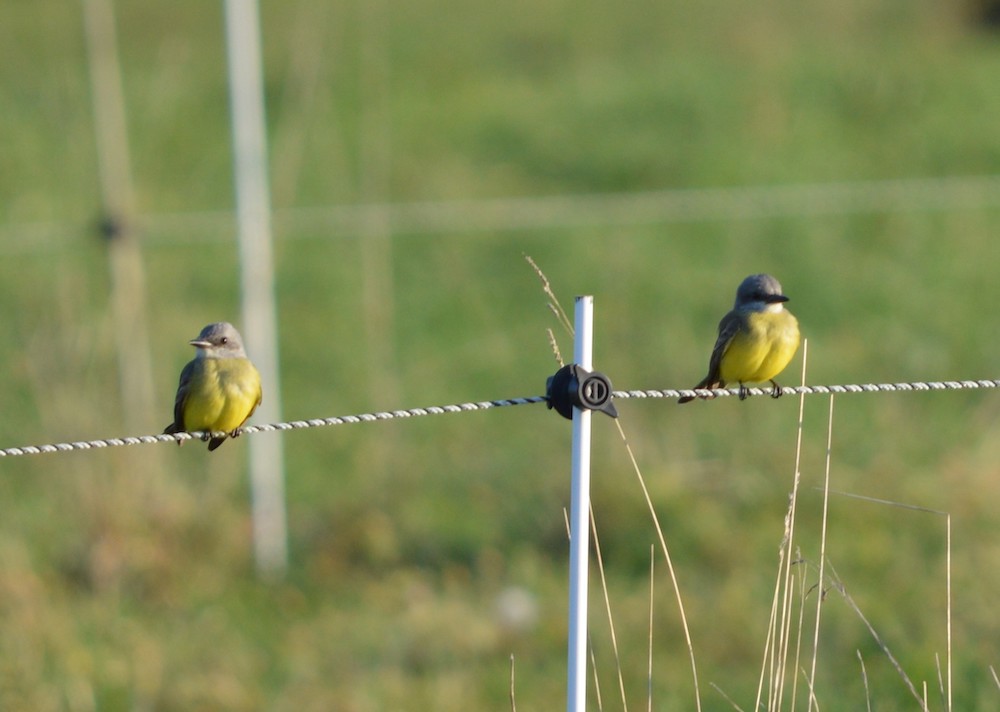
They had gathered to view a pair of tropical kingbirds found the night before by Aidan Perkins (in 2025, Mr. Perkins set the record for most bird species seen in Suffolk County in a single year: 319) and were celebrating the bird's first appearance in Suffolk County.
"So, the drinking is because this is a new county bird for you?" an onlooker asked Patricia Lindsay, who has been birding for decades. Give or take some taxonomic uncertainty, the kingbird might have been the 400th species she's seen in Suffolk County, a milestone not reached by any other birder in any other county in the state, other than her husband, Shai Mitra, who shares her record and was also present.
"Oh no, the drinking is because of Taylor Sturm," she said, joking about Mr. Sturm, a co-compiler of the Montauk Christmas Bird Count (set for Dec. 19), who stood nearby, watching the kingbirds through his birding scope.
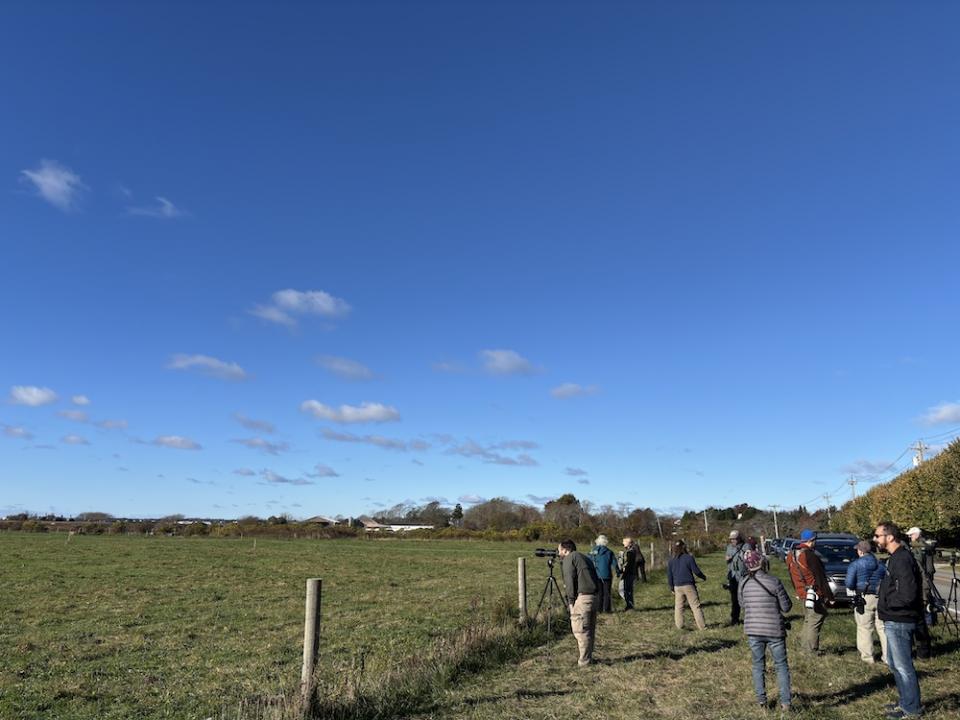
Mr. Mitra acted as the master of ceremonies in the road's right of way, telling birding stories, explaining the tropical kingbird's field marks, and handling questions from passers-by as Ms. Lindsay passed around cups.
It's unusual to see a single tropical kingbird on the South Fork, much less two. They stood out due to their bright yellow bellies, contrasting with gray wings and head, but also because of their active behavior. The field, festooned with fence wires, was perfect habitat, and they sallied and caught insects on the wing.
In the United States, the birds are only year-round residents of the very southern tip of Texas; the mass of their range is in South America, where they are abundant and by no means rare.
The species has appeared in New York State only twice before: in Dobbs Ferry in 2020 and on Staten Island in 2021.
An article in the New York State Ornithological Association's quarterly journal, The Kingbird, about the Staten Island bird and written by Richard Veit, Lisa Manne, and Anthony Ciancimino, explained the recent appearance of the species as "the result of an ongoing process of population growth, exploratory behavior, and colonization," driven in part by climate change.
"Thus, vagrants are not 'lost' or misoriented," they wrote. "The increasing spread of kingbirds through eastern North America represents the intentional searching by these birds for new habitat, driven by the increasing numbers of young birds being produced."
Mr. Mitra explained to the assembled birders that no one should assume that the kingbirds had drifted to Bridgehampton from their nearest territory, in this case, south Texas. "These could be sub-equatorial birds. If that's the case, these might be in spring right now with their hormones."
"They do look kind of hopped up," agreed Mr. Sturm.
Just then, the male mounted the female kingbird on an electrical wire and murmurs of approval swept through the crowd.
"Coitus" said one man, rapt, as he started through his binoculars.
"It appears they are copulating," said another.
"Hopefully, it's consensual," a woman added.
"They could both be males," mused a fourth onlooker.
A pair of women walked up with a small hypoallergenic mop of a dog in a red quilted coat at the end of a leash.
"What are you all looking at?" asked one.
"There are two very rare kingbirds in this field," Mr. Mitra said. "If you'd like, I can get them in my spotting scope for you."
"No, I'm good," the woman said as they continued west.
"That dog's coat is nicer than mine," said a 30-something female birder who was wrapped in a blanket covered in pictures of her cats.
Down the line of bird watchers, Ben Friedstein, 13, smiled broadly as he observed the bird. His father, Adam Friedstein, explained that they had just driven three hours to see it, from Toms River, N.J.
"I'm just a birder chaperone," he said. "Every weekend he wakes up, consults the rare bird alerts, and we drive. We were originally going to Jones Beach," where western kingbirds were spotted on Saturday, along with a mountain bluebird, "but we decided to come here first."
Serious photographer types lined the split-rail fence at the edge of the road's right of way, competing for the best shot, while a couple of "mammal guys" at the end of the long line joked around.
"Is that a Sloggett's ice rat?" said one, staring out into the field, referring to an African species.
"I'm going to head out to those old airfields to try and find a jumping mouse," said another. "No one else is checking."
"I was 'mothing' there the other night and got stopped by not one but two cops," added a third.
Talk moved from salamanders — "I need tiger and spotted," one man said; "It all depends on the rain," answered another — to other rare bird sightings — the Georgica Pond American flamingo of 2024, the Sagaponack Pond northern lapwing of 2025 — to a favorite topic, mistaken identities. "My boss told me he had a peacock in his yard. Turned out to be a northern flicker."
A birder even told a story about how a couple met at a wood sandpiper sighting and eventually got married.
And finally, discussion moved to all that has been lost and will be lost in the future, including a field just north, which for decades has been the Oceanaire Nurseries tree farm, but had recently been sold.
Meanwhile, the tropical kingbirds continued to cavort. Chasing each other around the field, from perch to perch. Local birds took turns posing with the randy duo. A mockingbird. A brown-headed cowbird. A Savannah sparrow. A European starling. Shutters clicked.
Multiple cars stopped to see what all the fuss was about.
One man pulled over and took a birder up on his offers to see the rarities though his scope. He had crammed his socked feet into a pair of flip-flops, despite the morning's cold. "I rollerblade in the parking lot at Sagg Main Beach," he explained. "I'm 62, it's a great workout." Impressed after his bird sighting, he left for his exercise.
After the gin had made the rounds, birders too began to depart. After all, there were other rare birds to be found, and since all had already driven east, multiple birding checklists were submitted to eBird from the East End on Sunday. However, none were quite as exciting as those featuring the tropical kingbirds.
As of Monday morning, the birds were still present in the same location.