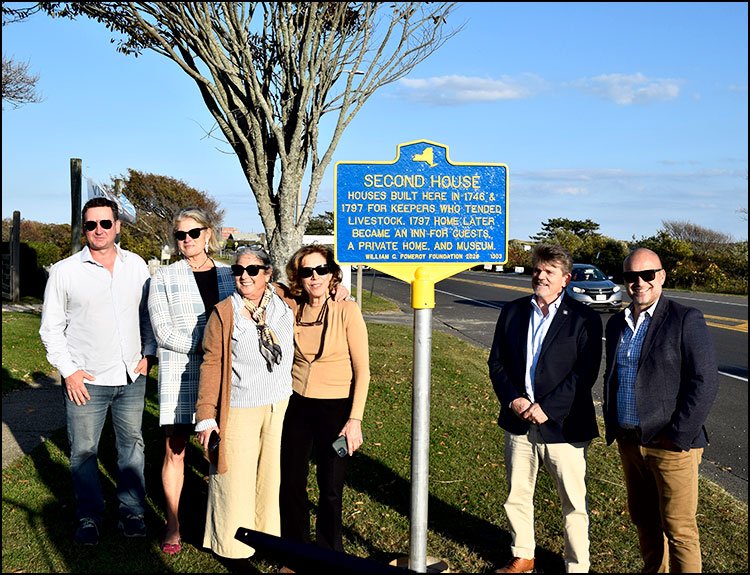
With members of the Montauk Historical Society and the East Hampton Town Board looking on, alongside County Legislator Ann Welker and Assemblyman Tommy John Schiavoni, a blue-and-gold cast-aluminum New York State historical marker was unveiled at Second House Museum in Montauk on Friday.
Originally built in 1746 and rebuilt in 1797 following a fire, Second House reopened last year following a yearslong, multiphase renovation that included foundational support; the removal of a 1912 addition as well as the front porch, dormers, cladding, siding, and some gables; new siding, roofing, and the restoration and replication of doors and windows; reconstruction of the structure’s historic porch, and interior renovations.
Second house was built to house the keeper who tended sheep to the west and cattle to the east when Montauk was pastureland. Its 1797 replacement happened after the town worthies allotted “three gallons of rum to raise the house at Fort Pond,” according to town trustee records. Further alterations were made to the structure in 1879, 1880, and 1912.
The town and the New York State Historical Trust bought the property in 1968 from the David Kennedy family, which had acquired it early in the 20th century and used it as a summer residence. Second House opened as a museum in 1969 under the historical society’s management.
The new sign at Second House, funded by a grant from the William G. Pomeroy Foundation, is just the second in the hamlet and the first in its downtown. A Pomeroy sign was installed at Culloden Point in 2023 to recognize the trials of the illegally enslaved Africans on La Amistad, who came ashore there following an 1839 mutiny aboard the schooner.
“Houses built here in 1746 & 1797 for keepers who tended livestock,” reads the Pomeroy sign. “1797 home later became an inn for guests, a private home, and museum.”
On Friday, Mia Certic, the historical society’s executive director, thanked the late Richard Gilmartin, a former town supervisor, for founding the Montauk Historical Society in 1962, and the town board for purchasing Second House. She recognized Robert Hefner, a historic-preservation consultant to the town who in 2016 prepared a report that recommended the structure be restored to its appearance circa 1886, when the last keeper employed by the proprietors of Montauk departed, and she thanked the former and current supervisors Peter Van Scoyoc and Kathee Burke-Gonzalez.
Also acknowledged were the livestock keepers and “their families who endured unbelievable hardship, especially during the Revolutionary War, the farm workers who came to East Hampton to keep the fences mended . . . the swells from New York City who came to hunt and fish and pick berries, the visitors who came here at the end of the Civil War to celebrate and write beautiful poetry about it, the journalists who came here to cover Camp Wikoff in the 1890s . . . tourists who came to relax . . . artists who came to paint our beautiful seascapes and landscapes. And finally, probably around 200,000 sheep over the years.”
Second House is one of the first structures motorists entering the town’s easternmost hamlet see. Coupled with the recent removal of utility poles on Montauk Highway near the intersection of Second House Road, “this is one of the most beautiful, iconic views in all of East Hampton,” Councilman David Lys said.
“Many things have changed since the 1700s,” he said, “but one of the things that hasn’t changed is the importance of Second House to the hamlet of Montauk. When you drive into Montauk, Second House has always been one of those bastions of the strength of Montauk and the beauty that is here.”
Mr. Schiavoni, on the eve of Tuesday’s midterm elections, connected Second House’s history to the present. The year of its reconstruction, 1797, “was an incredibly important year in the United States,” he said. “That was the year that we had the leader of a revolution, George Washington, actually step away from power. . . . In his place, this guy from Massachusetts, John Adams, became president. A smooth transfer of power.”
Through the years, “this building has been a witness to the growth of this community,” the assemblyman continued. “It is part of this community. I think it’s a testament of who we are on the East End by preserving our history with these buildings.”