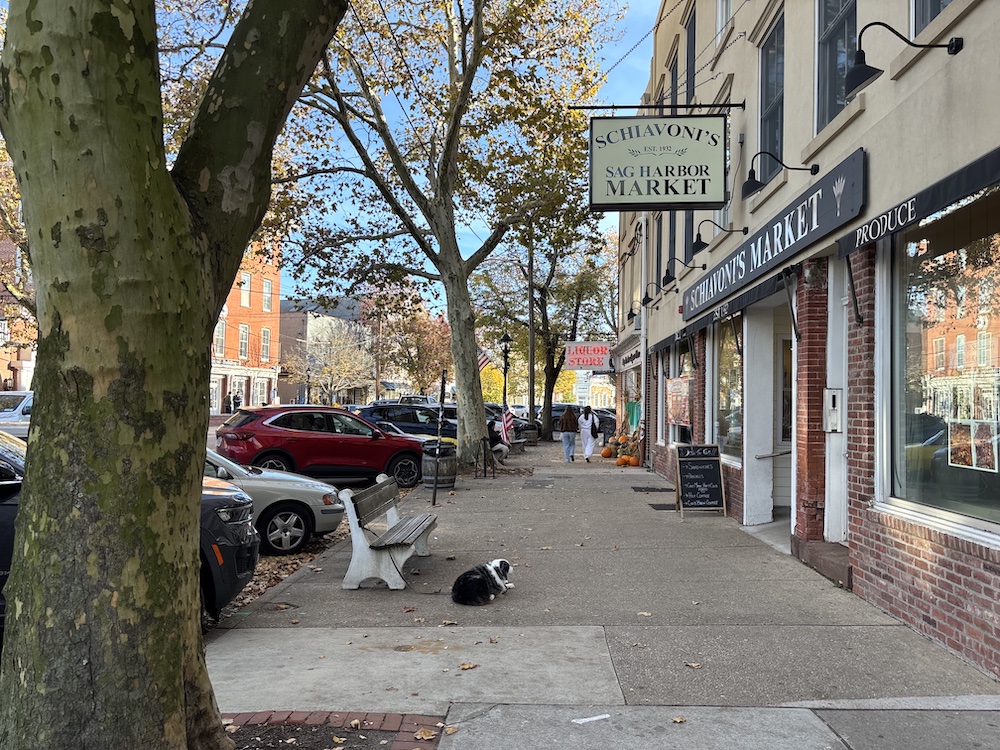
Perhaps only the legal filings surrounding the Steve Madden I.P.O. back in 1993 generated as much attention for the brand as its decision last fall to shroud the large display window at its shop on Sag Harbor’s Main Street in black shortly after it closed for the season.
Its “See you soon, Sag Harbor” message was seen as a slight to a village where winter closures are still more the exception than the norm.
When the retailer, worth several billion dollars, came to Main Street, it may have seemed like a good fit. Its founder had humble beginnings, selling his shoes from the trunk of his car on main drags all over the five boroughs.
But now, with 255 Steve Madden stores dotted all over the country, some residents say, the Steve Madden brand and formula retailers like it may not be the best fit for Sag Harbor.
Darkened windows in the off season are perhaps worse than the formula stores themselves, Aidan Corish, a village board member, said last week. “It’s really detrimental.”
Likewise, Rag and Bone, a trendy independent clothing company bought by Guess in 2024, now boasts more than 700 stores worldwide. Sag Harbor’s Rag and Bone store got the cold shoulder from residents when the name first appeared in a papered-up window on Main Street .
Madewell, a clothing company owned by J. Crew with 160 locations, took over the stationary store formerly known as the Ideal just south on Main Street. Its window message to residents last winter, while it prepared to open, was: “Hey Sag Harbor, the perfect jeans do exist.”
Spurred by the arrival of more retail chains and disappointment at how they were changing the face of the village, residents began to organize around a new path, one that might not include these so-called “formula stores.”
In June, members of Save Sag Harbor launched a petition on change.org that called for banning chain stores in the villages; 1,300 people signed it.
With this as the backdrop, Sag Harbor Village commissioned a study on what a “formula store” is and how the village could control them. Last Thursday, Inter-Science, a Southampton land planning service hired by the village, discussed the results of a months-long study and laid the village’s options on the table.
But, warned Rich Warren of Inter-Science, “change is always something people are nervous about.” As it stands, 38 of the nearly 200 businesses in the village are considered formula stores: 24 shops have four or more locations, nine have 10 or more locations, and five have 15 or more locations.
The options as Mr. Warren presented them are: Doing nothing and allowing any store complying with zoning; enacting a blanket ban; placing a maximum cap on the number of formula stores permitted; creating an exclusionary zone where formula stores would be banned, or creating a special-exception permit where each proposed store would have to be reviewed by the planning board.
Mr. Warren said he was leaning toward the exclusion zone method and floated Main Street as that zone. However, he said, it may not be foolproof. On Nantucket, the Massachusetts island that banned formula stores from an exclusion district, Roller Rabbit, a retailer with 14 boutiques across the country (including in East Hampton Village), closed, then reopened on on a nearby street, rebranded as the General Store by Roller Rabbit. The retailer was able to skirt around the law with a small name change and by selling items outside its own brand. Those loopholes may prove difficult to close in Sag Harbor, Mr. Warren warned.
Keith Green, who, with his then-son-in-law, Elie Tahari, opened the flagship store by that name at 1 Main Street in East Hampton 20 years ago, put things in perspective. “It’s not about making money,” he said of formula stores. “It’s a 3-D billboard!”
The Tahari brand has 600 storefronts around the world. In East Hampton, Tahari Capital eventually sold the building for $22 million to Bernard Arnault, the C.E.O. of LVMH, which owns luxury brands including Louis Vuitton, its current occupant.
Emerging as an unlikely voice against formula stores, Mr. Green urged the village board to do whatever it could to rein them in.
“Rent is nothing to them,” he said, “but it’s everything to a small business.”
“Let’s be clear — why is Madewell willing to pay what they’re paying? They’re using our village as a gateway,” he said after a woman in the audience said she had heard that retailer pays five figures a month in rent.
“Pull out all the stops. . . . Now is the moment,” Mr. Green told the board. He said that if an exclusion zone were to be enacted, it should extend to Bay Street, Long Island Avenue, and perhaps further.
Bob Weinstein, the co-director of Save Sag Harbor, urged the board to consider being as exclusive as possible. He had visited Nantucket to get a feel for their formula store rules. “It’s not like there’s a screen around the exclusion zone,” he said, adding that more areas should be considered.
A Bridge Street resident agreed, adding that large commercial properties along Long Island Avenue and Bay Street would become prime real estate for formula stores should Main Street become unavailable. That said, Jeanne Kane, the village’s deputy mayor, reminded the crowd gathered that the village still caps commercial businesses at 2,000 square feet. Any more than that requires planning board approval.
“Go under the assumption that everything is going to sell,” Mr. Green said, noting that when 1 Main Street in East Hampton Village sold in 2023 it was, at the time, the most expensive commercial sale per square foot in Long Island’s history.
Whatever legislation ends up being formally proposed, Mayor Tom Gardella agreed that it is important that the board act.
It would not be as simple as creating an exclusion zone, Mr. Warren said. It would also mean changing the village code to define what a formula store is in order to avoid a possible Roller Rabbit loophole and even involving the Building Department when changing from one permitted use to another.
Mr. Corish also wondered whether an existing law that prevents a pre-existing use from continuing after it stops operation for 18 months could be narrowed to prevent stores from closing seasonally.
Liz Vail, the board’s attorney, said she would have more information on the legal possibilities by the time the board meets again on Tuesday, when it will discuss its options at a work session.
“This is just the first step,” Mr. Warren said.