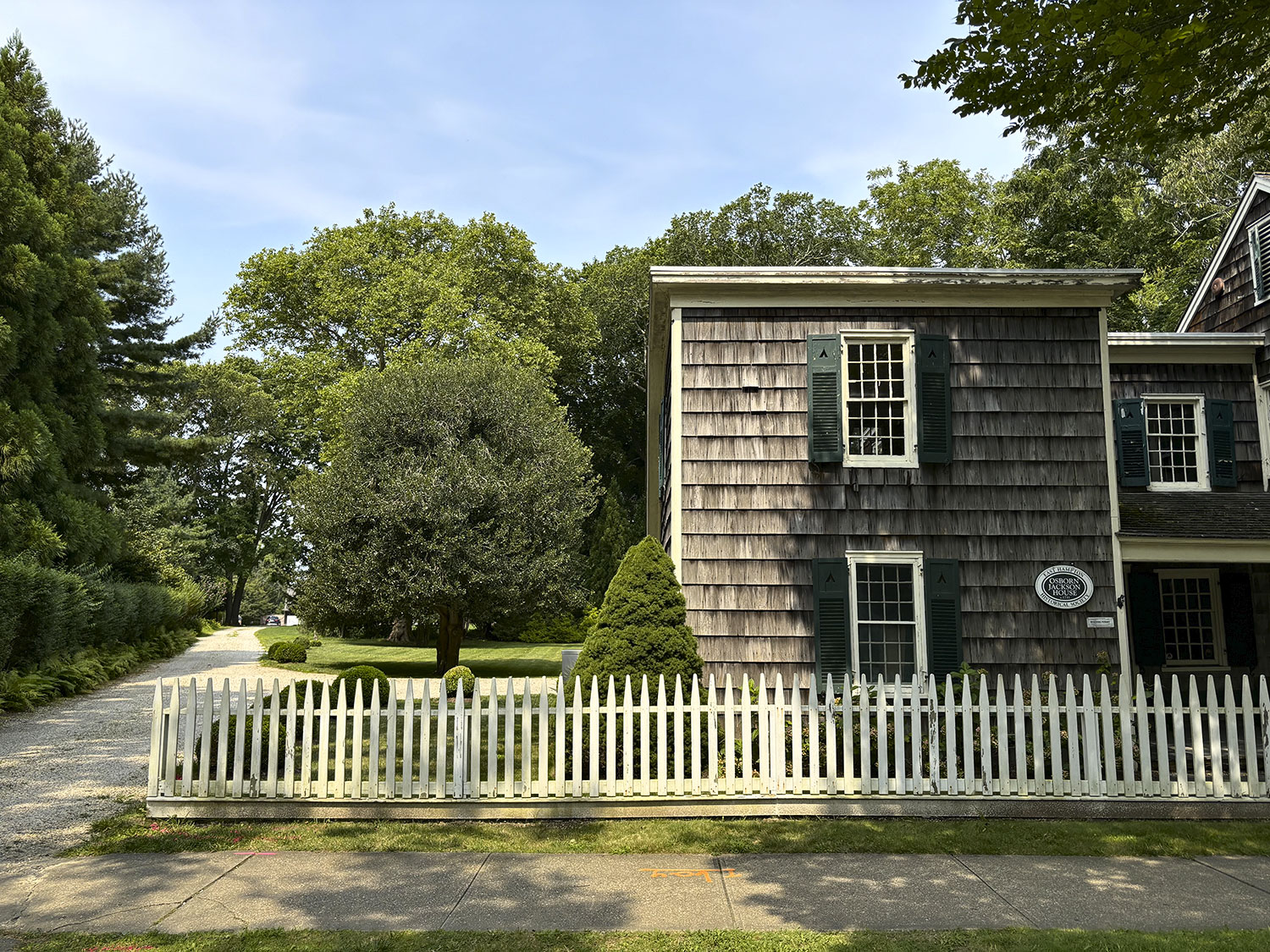
Three years ago, East Hampton Village approached the Cartier family, who own the residential property at 105 Main Street under a limited liability company called Three Acres Farm, to remove a 1977 restriction stating that an 18th-century house on their property, known as the Osborn-Jackson House, be used as a museum. Lionel and Patricia Jackson had given the house, built between 1716 and 1720, to the village that year, provided the village board agree to use it for that purpose.
The Cartiers, minus a few conditions that prevent anything from the house being sold, finally agreed, but in return asked that the village free them from easements dictating what could be built on their lot and what they could or couldn’t plant there.
On Friday, in a unanimous decision, the village board terminated the two easements at the house, which is on Main Street at No. 105. One easement has been with the land since 1976, a condition of a subdivision agreement from 1975. The other, which dealt mainly with vegetation, was more recent.
In addition to terminating the easements, the board renegotiated the use of the Osborn-Jackson House; it will no longer have to be a museum. “I would condemn it tomorrow if I could. It’s not safe,” Marcos Baladron, the village administrator, said by phone. It hasn’t been used as a museum for years, he said, and is now being used as storage space by the East Hampton Historical Society. It is not temperature-controlled, however, and a more appropriate storage facility is being built behind the Mulford Farmhouse on James Lane.
“We want [the Osborn-Jackson House] to be a village asset, to be used for something that’s wonderful,” said Mr. Baladron. “What could we use it for? Maybe that’s where village board meetings are held. Maybe a village department could use it. Maybe it could be used as offices. Maybe a welcome center or for the chamber of commerce. We really don’t have a plan, but we don’t want the restrictions either. The first step was removing the restriction of the deed that it could only be a museum.”
The Jacksons originally granted the 1975 easement to “maintain open space and to preserve the beauty and natural condition of lands in the village” in perpetuity. Douglas Dayton, then the village mayor, signed off on the paperwork. It was a large-lot easement, meaning that the parcel couldn’t be further subdivided.
Controversy erupted in 2012 when the Cartiers sought to build a second house on their lot, a request that seemed to contradict the terms of the easement. “No building or structures of any description shall be erected on the burdened premises except one family dwelling, one garage, one tennis court, one swimming pool, and one tool shed and such other accessory structures as may be permitted under the zoning ordinance for the Village of East Hampton,” read the easement.
The request was denied, the Cartiers sued, the village won, and the Cartiers appealed. In the end, a settlement was reached, one which, said Billy Hajek, the village planner, entitled the family to build a second dwelling at 105 Main Street.
That same settlement was responsible for the second easement. “No one understood the purpose or intent of that easement,” Mr. Hajek said this week. “Basically, it required a grassland, but there are large trees between the Osborn-Jackson House and the Cartier residence. They want to keep the trees that are there. They don’t want to open it up.”
The village board also agreed on Friday to close out a building permit issued to the Cartiers in November 2017. It had been left open, said Mr. Hajek, in part because the second easement was never executed and never recorded. “Technically, it didn’t really exist,” he said.
The village will also allow the Cartiers to install fencing and gates and plant “such vegetation, including such ornamental plantings and lawn, as it sees fit, on the property.”
Also at the meeting, the board noticed an upcoming public hearing, to be held on Sept. 20, to discuss legislation that would prohibit nightclubs in the historic district.