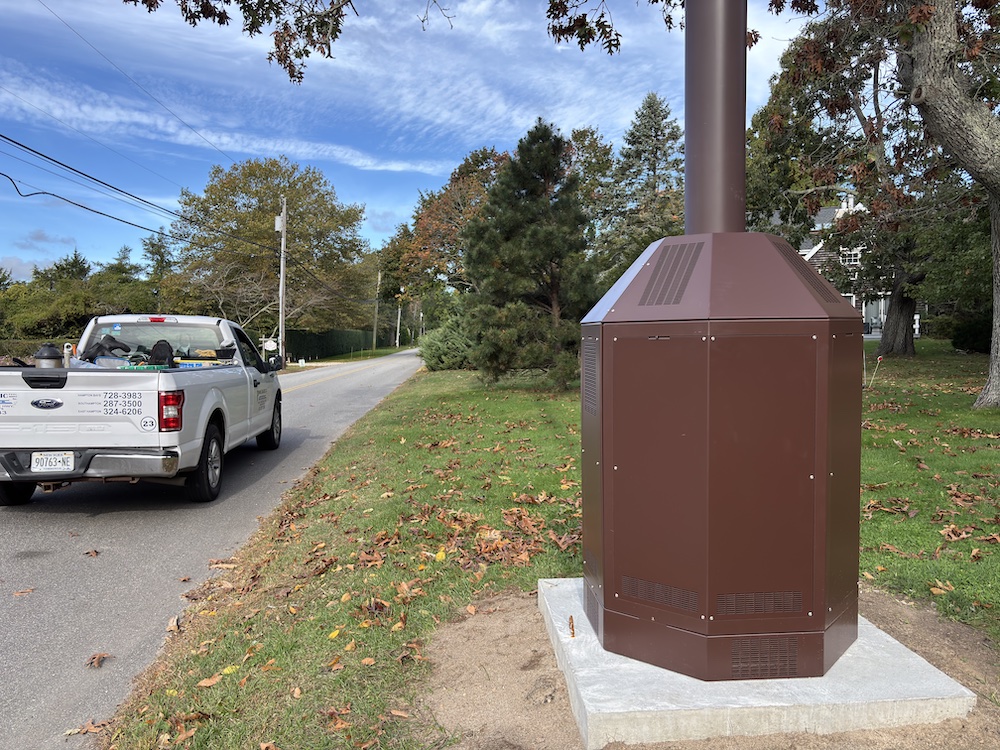
After a handful of “small cell” wireless poles that sprang up in Northwest Woods and Wainscott proved controversial, and with more than 150 more planned within a year, the East Hampton Town Board decided on Tuesday to change course.
While the problematic poles — which contain equipment to improve wireless coverage and service — are metal and of the “stealth” variety, the board seemed eager to move instead toward wooden poles, with the telecommunications equipment hung on the outside in plain sight.
“They’re not really small if you’re putting them in an area without any existing infrastructure,” admitted Elizabeth Herington-Smith, general manager of Cityscape Consultants, which advises the town on wireless decisions. “They’re small in comparison to large macro towers, but they’re not really small.”
The board decided to post a survey for town residents on its website, which Tina Vavilis LaGarenne, director of the Planning Department, said she would develop quickly with Cityscape. To implement the survey, the board would have to amend the contract under which Cityscape currently operates.
“Now, the community has had an opportunity to see them 3-D on the street,” said Councilwoman Cate Rogers. “I think it would be a good time to bring them in again and say, ‘Now that they’re here, what do you think?’ “
Until survey data is compiled and analyzed, wooden poles will be used on open applications.
“I do hear a majority of the board preferring wood, loud and clear,” said
Ms. Vavilis LaGarenne. She noted that there had been a “visceral” reaction to the metal poles.
“The cement base looks out of character for the community,” said Town Supervisor Kathee Burke-Gonzalez, a remark that led to a discussion of whether the concrete could be tinted. (Answer: It could.)
All told, the discussion lasted over an hour. The planning director showed the board pictures of poles already installed and the board offered critiques and discussed preferences.
When the town originally developed its wireless code, it used a survey to gauge the public’s design preference. Sixty-one percent of respondents (out of more than 500 people who participated) indicated that they liked the “stealth” poles. Most comments, though, reflected a desire for improved service, and a fear that public safety could be impacted by inconsistent wireless coverage.
Only Councilman Tom Flight, who announced at the meeting that he would serve just one more year on the board, showed a strong preference for the metal poles, which he called “critical infrastructure.” Metal, he said, is “more resilient.” If the poles are better screened, he suggested, complaints based on aesthetics could decrease.
“What’s the wind speed resilience of the wooden poles?” Mr. Flight asked.
“I can certainly get that information,” said Ms. Herington-Smith.
Councilman Ian Calder-Piedmonte said he did not have a strong opinion on the pole material, either way. Whether the poles were wooden or metal, he said, people may not appreciate a pole suddenly appearing at the edge of their lawn. For him, it was more about placement, screening, and matching a neighborhood’s existing conditions.
“The one in Wainscott, it’s hard to imagine that in a worse location,” he said, referring to a pole erected where Wainscott Stone Road meets Sayre’s Path.
To address the placement concern, Ms. Vavilis LaGarenne presented the board with draft code that would require small cell poles to be placed among massed trees. “Our code currently doesn’t require that,” she said, noting that the setting was stark for both the pole at the Wainscott intersection and another on Montauk Avenue in Northwest Woods that also had proved unpopular with neighboring residents.
The board seemed supportive, even though she warned them that placing the poles near trees might necessitate “heavy pruning” or perhaps even the loss of some trees.
For poles that could not be placed near tree masses, another section of draft code that the board seemed to like would require screening vegetation to be planted at the base of the poles. Ms. Herington-Smith said the shrubbery could allowed to grow tall, since “the antenna is where the signal is propagated.” Screening that covered the lower half of the pole should not affect service, she said.
“Could the screening be native?” asked Ms. Burke-Gonzalez.
“Yes,” said Ms. Vavilis LaGarenne. “It’s important that stuff like this is in our code, because if it’s not published in advance, it’s hard for us.” (The Federal Communications Commission has made it difficult for municipalities to regulate cellphone towers.)
“We are held to what’s in our code,” Ms. Vavilis LaGarenne emphasized. “Do we just want to say that the screening should be native?”