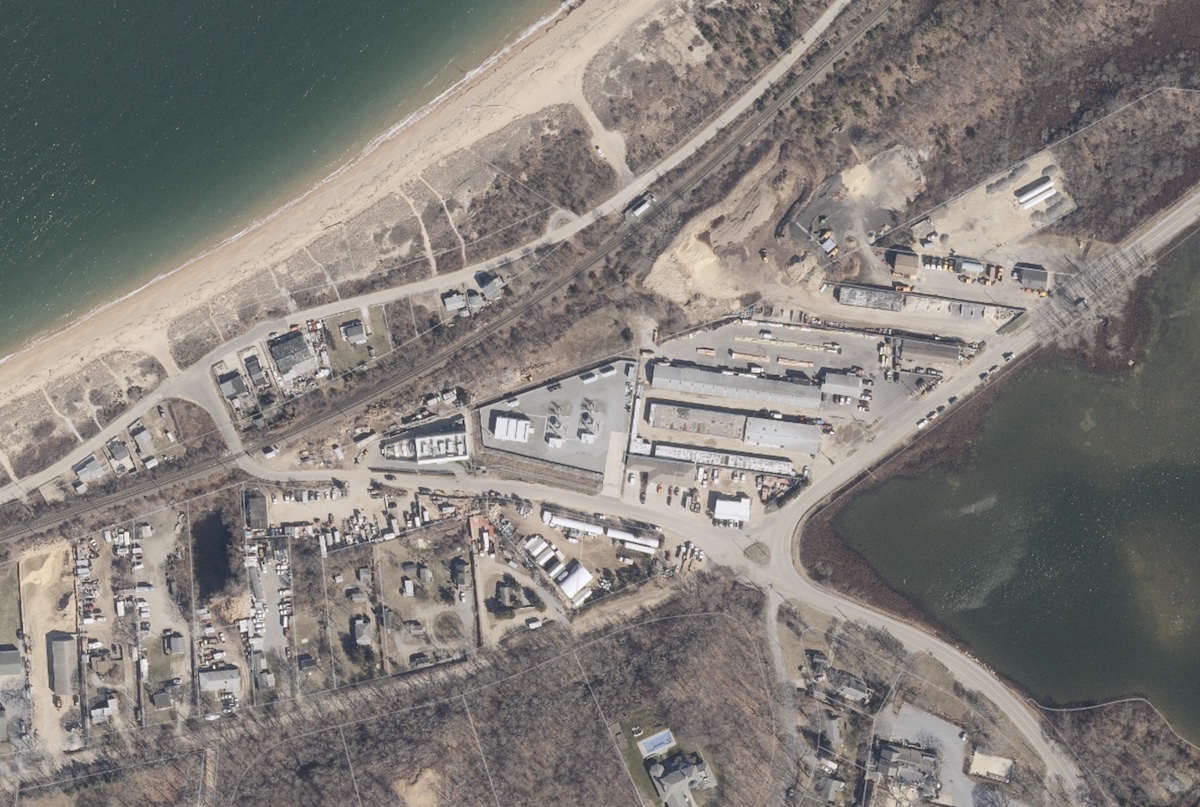
Summer began with a Suffolk County Water Authority lawsuit alleging that two of its wells had been contaminated by forever chemicals released after a fire at the East Hampton Energy Storage Center on Cove Hollow Road.
Summer closes with a stern letter from East Hampton Town Supervisor Kathee Burke-Gonzalez to NextEra Energy and National Grid regarding a similar energy storage plant at 10 North Shore Road in Montauk.
In it, she writes that the two facilities are “substantially the same,” a point detailed by The Star in a June 25 article.
“The two projects share the same corporate parent, the same executive sponsor, the same environmental consultant (TRC Environmental Corporation), the same design engineer (ECI Engineering Services, plans stamped and sealed by Glen A. Smith), the same lithium-ion chemistry, and the same approach to spill containment,” she wrote.
The town approved the facility, she said, based on representations made to the town planning board by TRC Environmental Corporation, specifically that no liquid in the facility’s batteries could spill, thus little containment was needed.
“Whether an intact cell leaks was never the concern at a facility of this kind,” Ms. Burke-Gonzalez wrote. “The concern, which has now manifested at your other facility 16 miles away, is that cells open under thermal runaway and that whatever is used to put the resulting fire out carries their contents into the ground. The distinction between a cell that cannot spill and a battery building that can discharge millions of gallons of contaminated water was available to you in 2017. It was not made [available] to the planning board.”
Should a similar fire occur at the Montauk storage plant, millions of gallons of tainted water would almost immediately infiltrate Fort Pond Bay and Fort Pond.
“The site plans limit spill containment to the transformers and inverters, and the oil containment detail sizes the basins to a fraction over the oil volume of individual pieces of equipment. Nothing else on this site would hold anything,” the town supervisor acknowledged in her letter.
She is not calling for the battery storage facility to immediately cease operations, however.
Instead, she’s giving NextEra 30 days to revise its emergency action and safety plan, and 60 days to “design and install engineering controls that capture and hold all fire water and all fire-related runoff,” among other demands.
If the town’s requests aren’t met, “all approvals, permits, or authorizations granted are void and of no effect” and it could either revoke or suspend NextEra’s site plan and special permit approval.
Ms. Burke-Gonzalez wrote a similar letter to NextEra and National Grid on July 31.
Two weeks later, on Aug. 14, she received a reply from Gary Morris, vice president of East Hampton Energy Storage Center, L.L.C.
In short, after writing that his company took the environment and safety seriously, he asked for more time.
“Specifically, we request that the town extend the deadlines set forth in its July 31 letter for an additional 30 days until September 30 and October 31, 2026, respectively,” he wrote. Doing so would allow his company to “facilitate a more productive and informed response.”
In a letter dated Aug. 21, the town agreed to the extended timelines.
The town also complained that it hasn’t been granted access to the site and reiterated that it expected NextEra to reimburse the town for expenses.
“The town sees no need to delay access, as access has already been granted to the State of New York Department of Environmental Conservation and the Suffolk County Department of Health Services,” Ms. Burke-Gonzalez wrote.
At least one local environmental organization was pleased with the town’s effort to hold NextEra accountable.
“Concerned Citizens of Montauk recognizes the global and local imperative of moving our energy production away from fossil fuels and toward renewables,” wrote Jessica James, president of its board. “We also recognize that it is imperative that we protect Montauk. Those two goals must not be in opposition. We applaud East Hampton Town for demanding that the Montauk battery storage facility comply with recapture strategies and other safety precautions that would mitigate any potential surface or groundwater contamination.”