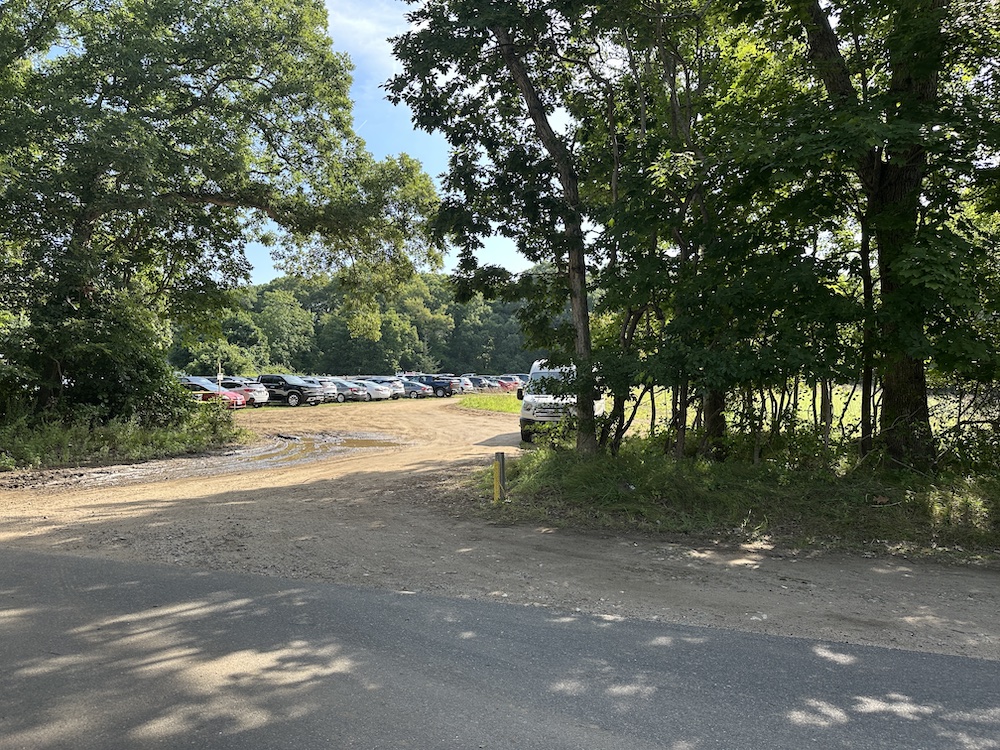
A plan that could yield up to 60 housing units on six acres owned by Calvary Baptist Church drew strong opposition even before it was submitted to the East Hampton Town Planning Department.
At last Thursday’s town board meeting, 10 residents spoke out against the nascent development project on Spinner Lane in East Hampton, adjacent to the church. Like another proposal at 350 Pantigo Road, it has been spearheaded by the duo of Kirby Marcantonio and his lawyer, Christopher Kelley.
“I’m here because of plans being discussed involving 48 apartments, 25 of those being three-bedroom units and 23 being two-bedroom units,” Zach VanDerBeek said at the meeting. “This current proposal has 48 apartments and 121 bedrooms.”
It was not immediately clear where Mr. VanDerBeek saw such specific plans. In an email, Mr. Marcantonio said, “there are no plans to share.” And Tina Vavilis LaGarenne, the town’s planning director, confirmed that “no formal application” had been submitted. However, she added that Mr. Kelley had “informally” emailed Eric Schantz, a principal planner, about the project.
In fact, the conversation seems to have begun a few years ago. A concerned citizen forwarded emails from the end of 2023 between the two, obtained at the time through a Freedom of Information Law request. They showed a discussion about the broader idea of creating a new work-force housing development use in town code along with an overlay district for work-force housing and potential code changes that would be needed.
For example, Mr. Kelley said at the time that a density of 12 units per acre would be necessary to make the developments economically feasible, with lease flexibility to allow for seasonal renters. Requiring variances would be the “death knell” of any future project, he warned.
In an email about the Calvary Baptist property, Ms. Vavilis LaGarenne wrote, “The Planning Department did not review that proposal or provide any detailed feedback. . . . This is because the proposal would require a rezoning. The Planning Department will not do a detailed review for a rezoning unless directed to do so by the town board.”
The parcel would need to be placed in the town’s affordable housing overlay district for the proposal to proceed.
“We have already had a version of this conversation,” continued Mr. VanDerBeek. “Kirby Marcantonio and Chris Kelley recently proposed a 79-unit housing development on Three Mile Harbor Road that required a zoning change in order to move forward. The community objected strongly. This town board declined to advance the necessary zoning change, and the project was ultimately withdrawn.”
“Now, the location has changed,” he added. “The unit count has changed. The housing framework has changed, but the overwhelming question remains the same. Should the town change its existing zoning laws to bring high-density houses to a location that the existing zoning, road work, and neighborhood pattern were never designed to support?”
Other comments focused on how a large-scale housing development, affordable or not, would be out of place in the residential neighborhood, and impacts on the Hook Pond watershed. There were specific concerns about traffic and safety at what residents characterized as an already dangerous intersection at Spinner Lane and Springs-Fireplace Road.
“If anyone doesn’t remember why the one-way street was formed,” said Bob Brody, speaking of Floyd Street, which intersects Spinner Lane, “it was formed because somebody had a fatal accident there.”
Mr. Marcantonio, who often leads his comments at town board meetings by saying he didn’t plan on speaking, and then speaking at length, didn’t argue specifics of the project, but instead focused on the townwide need for housing.
“They estimated in 1984 that in the next 10 years, 600 housing units would need to be created here to offset the upzoning of the town to three and five acres,” he said. “In the 42 years that we have been doing this, there have not been 600 units put into place by the town or by private individuals. In that original code, 16 different pieces of property were set aside for affordable housing. Not a single one of them ever got used.”
In a press release after the meeting, he acknowledged the public comments about “a project I am beginning to work on” and described the plans as “formulative” and “at the most elemental stage.” However, the same release showed that he had already worked out that two and three-bedroom townhouses “with full basement, porches, private patios, and all appliances” could be sold for between $650,000 and $750,000.
In a separate email he said doing so would yield a profit margin of 15 to 20 percent and that he was the “only developer of this project — no outside investors.”
“This is not a workforce project,” he wrote. “It is aimed to sell two and three-bedroom units directly to the public within the affordable housing code.” He added that the exact number of units “is still to be determined, pending engineering and septic analysis,” but that a wastewater treatment plant would be part of his submission.
Sam Lush, a Spinner Lane resident, took issue with Mr. Marcantonio’s profit motive.
“Leveraging the need for affordable housing should not be done for individual profit in my opinion,” he said, adding, “We’ve started a petition already on this.”
The petition, created by the Spinner Lane Action Group, expanded on Mr. Lush’s criticism. It had 132 signatures by Monday afternoon.
“The proposal would create a very small number of affordable housing units relatively to [the] size of the overall project,” it read. “Only 8 units will be classed as ‘affordable’ for income-qualified tenants/owners at the discretion of the not-for-profit. The remaining 40 units will be sold by the developers to employers for employer-owned housing. The 40 units will be sold to subsidize the 8 units, which will be retained by the not-for-profit, who will also receive a monthly stipend from the condominium association, as well as a capital contribution from the developers. This is presented as a philanthropic partnership but can only be classed as a commercial undertaking.”
In his email, Mr. Marcantonio countered: “They will all be affordable, 100 percent, they will all be sold to local essential workers, and 48 is not set in stone.”