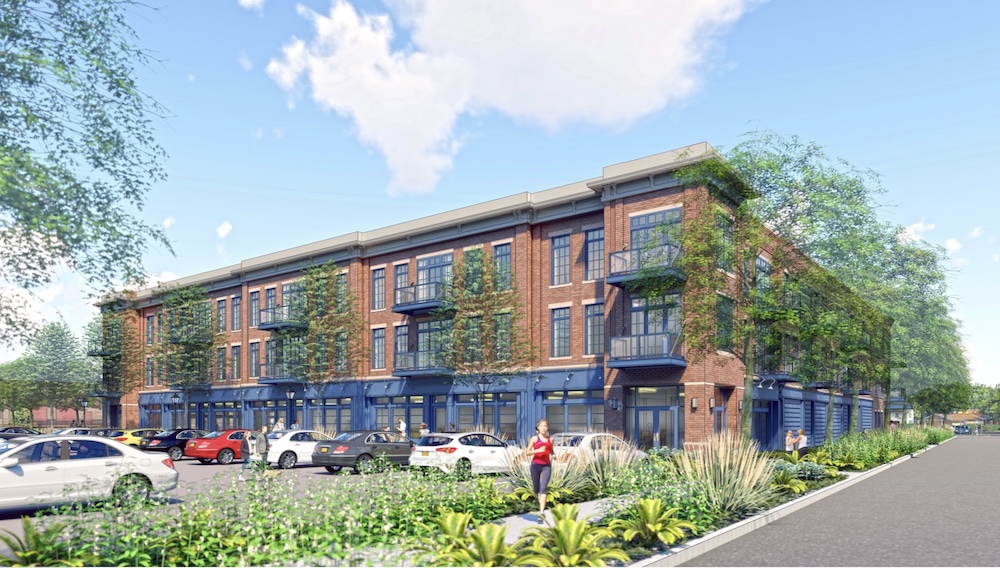
The environmental impact statement prepared by Adam Potter for his prosed three-story mixed-use building on Bridge Street in Sag Harbor was rejected by the Sag Harbor Village Planning Board on Tuesday night after parts of it were called “insufficient” by the board’s engineer.
The planning board gave the developer a month to provide answers to some 17 questions it had on the proposal. After that, the board will take over completing the environmental review itself, paving the way for a vote.
John Shaka, the board’s chairman, said the document submitted at the end of July was “not acceptable for adoption” but is close to being complete.
Mr. Potter, the owner of the lots at 5, 7, and 11 Bridge Street, wants to tear down the existing buildings at 7 and 11 Bridge Street to make way for a three-story, 81,000-square-foot building, with around 50,000 square feet devoted to housing. He is planning 28 units he could sell at market price and 20 affordable units. On the first floor, 8,500 square feet would be set aside for service-use commercial space. He has proposed 44 parking spaces at 7 and 11 Bridge Street.
The proposal requires several approvals from the planning board for those parcels, including a special exception approval to allow apartments in the office district and to build a structure larger than 3,500 square feet in the waterfront overlay district.
The property at 5 Bridge Street, known as the gas ball lot, does not fall under planning board review but is part of Mr. Potter’s application with the zoning board of appeals. He plans to use the lot, which is now used for municipal parking in an agreement with the village, as private parking for his development.
Last week, the Z.B.A. heard about a revised plan by Mr. Potter to eliminate six of the initial 12 variances requested on 7 and 11 Bridge Street. As of now, there are still nine variances requested for the parking lot and a request to repeal the building inspector’s determination from last year that the lot could not be used for parking without a primary structure on it.
The planning board has lead agency status, which means it is in charge of the State Environmental Quality Review process that is now underway, under which the environmental impact statement was prepared.
Significant questions arose from John Ellsworth, the engineering consultant from Nelson, Pope and Voorhees, an outside firm hired by the village. However, as Tiffany Scarlato, Mr. Potter’s attorney, pointed out, some of those questions simply could not be answered by them and would have to be answered by the state, which is spearheading a cleanup of the properties.
The laundry list of concerns ranges from groundwater impact, flood-proofing, traffic impacts, excavating plans, and details of the newly revised Z.B.A. plans.
“Don’t expect answers from us,” Ms. Scarlato said of those items surrounding the cleanup plan. She went on to say that she worries about the “inevitable rejection” of her revisions to the environmental impact statement if she cannot provide answers to some of those 17 questions.
She noted that she has not yet seen the memo, which was submitted to the board on Monday.
The New York State Department of Environmental Conservation and the Suffolk County Department of Health are reviewing Mr. Potter’s proposed cleanup plan for 7 and 11 Bridge Street and are holding a public hearing tonight at 6 at the Municipal Building. Public comments can be made until Sept. 5.
Extensive coal-tar pollution on the properties has triggered the need for a remediation plan for its removal, which would include dewatering and removing contaminated soil from the properties. The D.E.C. would oversee the work in what is known as a brownfields cleanup.
However, the D.E.C. notes that National Grid’s cleanup of 11 Bridge Street in the past included an environmental easement and other safeguards to protect from contamination.
The state says that tearing down the existing buildings would trigger the need for new controls to be put in place.
But, according to a D.E.C.-issued document, “the site does not pose a significant threat to public health or the environment.”
“Personally, I have a ton of questions for the D.E.C.,” Drew Harvey, a member of the planning board said. Namely, he pointed to an earlier decision by the agency to restrict residential development on the site, a decision that was apparently reversed.
Mr. Ellsworth said that as details emerge on the village’s sewer expansion project, it appears that the brownfields cleanup could be on the same schedule, which could create even more road closures and increased truck traffic.
However, Mr. Ellsworth called Mr. Potter’s timeline for the project “dubious,” saying that it lays out a very tight time frame to complete work.
In addition to voting to reject the environmental impact statement as presented, the board agreed to continue the conversation on Mr. Potter’s project at its September meeting after the public comment period for the D.E.C. cleanup plan is closed.