The East Hampton Village Board voted to accept a $12,000 donation from the East Hampton Village Foundation for the installation of yet another Flock Safety automated license plate reader, but it faced questioning from three people about privacy implications with respect to the controversial cameras that across the United States have been vandalized and, in some cases, removed by the municipalities that installed them.
The board also voted to appoint a Flock advisory task force comprising Mayor Jerry Larsen, Police Chief Jeffrey Erickson, Trustee Sandra Melendez, and Arthur Dunham, a village resident.
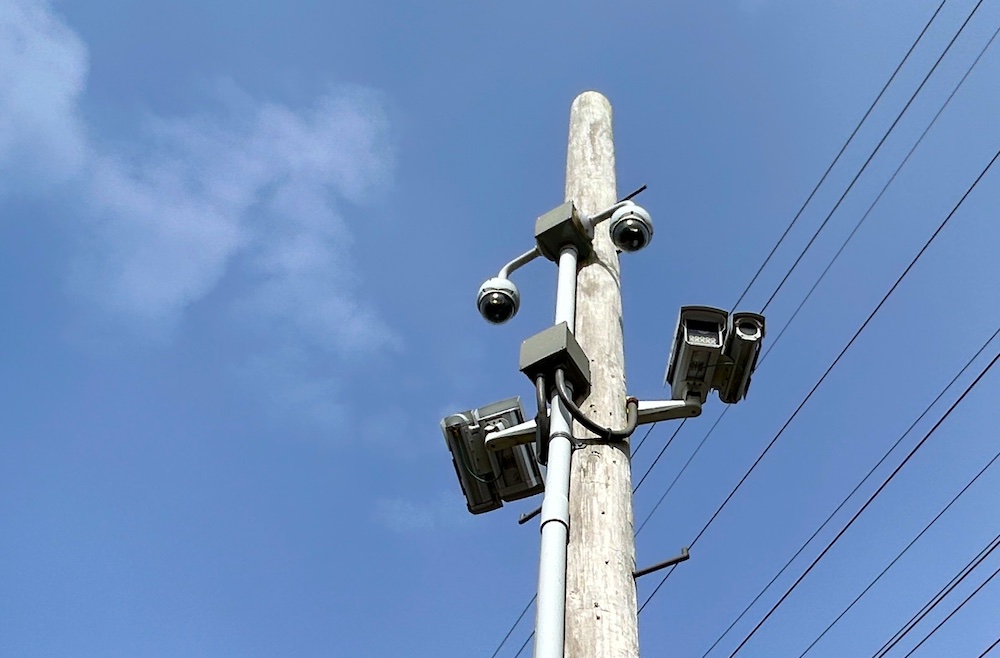
Flock Safety’s cameras operate across a cellular network, snapping still images of passing vehicles and using artificial intelligence to capture license plates as well as other attributes such as distinguishing markings. The data is instantly uploaded to a centralized cloud platform to form a searchable, nationwide investigative network.
A nationwide backlash to Flock cameras is growing. According to CNN, dozens of police officers have been accused of misusing the data, in some cases using it hundreds of times to track former romantic partners. CNN reported that the company has responded by shortening the time it stores data and adding safeguards to flag inappropriate use. In an interview with the news network, Flock’s chief executive officer apologized to those who felt they’d been victimized by his company’s product.
The cameras arrived in the village late in 2024, paid for with $30,000 from the foundation. They are installed on a subscription basis, at a cost of around $2,500 per camera per year, plus a one-time $250 installation fee.
There are now 10 Flock cameras under village jurisdiction and an additional four under Suffolk County Sheriff’s Office control, Mr. Larsen said on Monday. The newest camera is to be installed at 2 Gingerbread Lane, near the Y.M.C.A. East Hampton RECenter, the John Marshall Elementary School, and the village’s long-term parking lot.
On Friday, Detective Ed Reid listed several instances in which he said Flock cameras demonstrated their importance to policing. A person had reported to police that his vehicle had been hit in the Reutershan parking lot, he said, but thanks to the Flock cameras police were able to “realize that he actually hit another vehicle.” After another vehicle drove through a resident’s gate, “we were able to use Flock to get more information about the subject’s movement throughout the day,” he said.
In May, police received a report of a Nassau County man with dementia who was missing and reportedly driving to his family’s residence in the village. Village police contacted Southampton Town police, who “were able to initiate a traffic stop and reunite him with his family safely.”
These followed the December 2024 report of stolen merchandise from a retail store. “The security guard was able to get a good description of a vehicle with a sticker on the back,” the detective said. Police identified the vehicle, and “we were actually able to solve two cases out of that one, because he was also a suspect from several days earlier where he stole merchandise from another retailer.”
“The Flock cameras have been an invaluable tool for our department,” the detective said. “They’ve helped us solve more cases more efficiently and provided important leads to our investigators and officers. They allow us to quickly identify vehicles connected to criminal activity and also missing people. . . . Ultimately, they provide us with another valuable resource to protect our residents and keep this community safe.”
But residents of the village and East Hampton Town told the board that use of Flock cameras constitutes an invasion of privacy and perhaps violation of the Fourth Amendment to the Constitution, which protects people from unreasonable searches and seizures by the government.
In a 6-to-3 decision in June, the United States Supreme Court ruled that police conduct a Fourth Amendment search when they acquire a person’s fine-grained Google Location History via a geofence warrant, a search warrant that forces a tech company to disclose anonymized location data for every mobile device inside a virtual perimeter during a specific time frame. The court’s reasoning, Chris Ajemian, a town resident, told the board, “seems to apply straight to these cameras as well.”
“I’m troubled that this board is considering expanding a surveillance network rather than engaging the community more,” Mr. Ajemian said, suggesting the village buy its own equipment, “own the box, own the data, transmit it only to our local police station, and lock that database access” to safeguard it against misuse. “Our data sits in a venture capital firm’s cloud. Cops or any Flock customers all over this country can pull it up.” He asked board members if they would provide a comprehensive list of their whereabouts to an off-duty police officer in Georgia. “If you would feel uncomfortable doing that, I don’t think it’s fair to demand it of everyone. . . . What gives the Flock Safety network and this board the right to map everyone’s life, and how is that not a search?”
Everyone wants public safety, Gloris Frazee told the board, “but as we talk about expanding these cameras, especially right outside our elementary school and the Y.M.C.A., I keep hearing this phrase, ‘If you’re not doing anything wrong, you shouldn’t have anything to hide.’ . . . This might be where we lose our way. In a free town, being innocent shouldn’t mean your daily life gets logged, stored, and searchable. Privacy is not about hiding bad behavior. It’s about being able to drop your kids at school or head to the gym without feeling tracked.”
Michael Koegler, a resident of the town and vice chairman of the East Hampton Town Democratic Committee, gave the board a list of 14 questions regarding Flock camera policies and asked that they be addressed. “Does the department require reasonable suspicion, probable cause, a judicial warrant, or another specified justification before an officer can conduct a retrospective search of the database, and where is that policy formally documented?” reads one.
“I think these are fair questions,” Mr. Koegler told the board, “and I think these are questions that the residents of East Hampton deserve to have answers to.”
The town, the mayor said, uses Flock cameras, as does Sag Harbor Village. “Have you addressed this with the town board and Sag Harbor Village board as well?” he asked.
He had, Mr. Koegler said, but “I’m not here to talk about the town right now. I’m here to talk about what’s going on in the village.”
The long-term parking lot “has been a significant blind spot” for years, Marcos Baladron, the village administrator, said this week, “despite being surrounded by two schools, the Y.M.C.A., and the residential neighborhood on Pleasant Lane. Installing the Flock camera there is simply about closing that public-safety gap and giving the Police Department another tool to help protect children, families, residents, and visitors who heavily use this area of the village every day.”
The village recognizes that the powerful technology necessitates safeguards, he added, and previously adopted privacy protection legislation “to establish clear boundaries on how this technology can be used in our village.”
Mr. Larsen said this week that concerns about privacy are not valid. “If a certain law enforcement officer does something that is outside of the policy of the Police Department,” such as misusing a firearm, “that officer will be dealt with,” he said. If an officer was involved in a shooting that was not justified, for example, “would you take the guns away from every police officer? No, but you would deal with the person violating the policies or the law.” Through “extensive meetings with Flock, we’re comfortable that we have our system locked down very thoroughly,” he said. “It’s not just a free-for-all.”