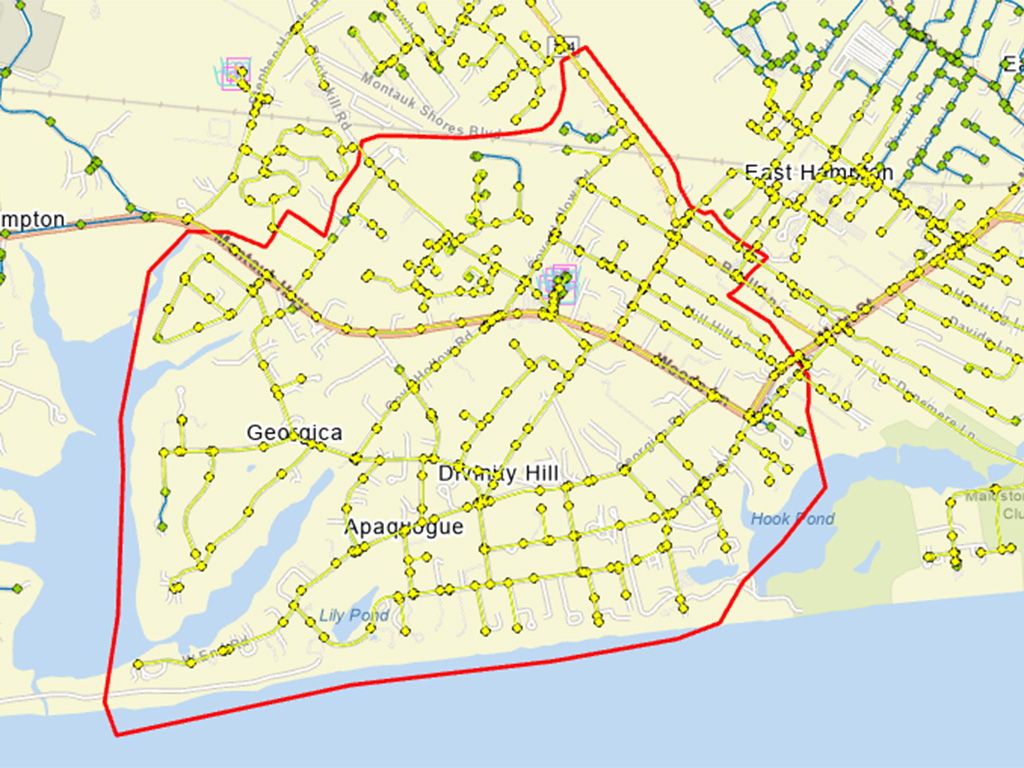
Anger and fear about a plume of contaminated water that has infiltrated and knocked three Suffolk County Water Authority drinking wells out of service (a fourth is available only for emergency use) drove 10 residents to press the East Hampton Town Board last Thursday for clarification about the local water supply.
Hydrologists with Suffolk County’s Bureau of Groundwater Investigation and Management seem confident that a 2023 fire at the NextEra East Hampton Energy Storage Center, still operating at 3 Cove Hollow Road, was responsible for releasing the chemicals, which were then transported from the facility via the 2.2 million gallons of water used to extinguish the fire. The runoff then settled and seeped into the area’s groundwater at the water authority’s wellfield roughly half a mile south of the storage center, near the Red Horse Market.
The New York State Department of Environmental Conservation has yet to publicly agree with the county’s conclusions.
Beyond the blame game, residents are simply worried about the current state of their water supply. Some called for a special meeting devoted solely to the topic.
The water authority filed a civil suit against the storage center, LG Chem, and LG Energy Solution on May 29.
At the end of July, it applied for a $36 million infrastructure grant from New York State to build a 5,000-square-foot, million-gallon concrete water storage tank at the wellfield to increase production capacity and add redundancy. The water authority lost 7 percent of its local capacity due to the contaminated wells.
“While I appreciate the question-and-answer page that you’ve added to the town’s website, I think it’d be a very good idea to hold a public meeting where there are people who are in a position to knowledgeably answer the questions of the public,” said David Douglas, a resident who lives only half a mile from the NextEra battery center.
It’s not clear what human health impacts are caused by PFPrA, the forever chemical that has seeped into the drinking water wells.
At a press conference held by Suffolk County Executive Ed Romaine two weeks ago, his health commissioner, Dr. Gregson Pigott, said science was “murky” on the topic. Last Thursday night, there was a growing call for a focus on those consequences.
“My primary concern remains ongoing medical monitoring for residents affected by the contamination incident,” said Sarah Douglas.
The conversation about the impact of the fire at the facility, which NextEra operates in conjunction with National Grid, thus far has centered on water quality. However, Ms. Douglas brought up another concern: toxic smoke.
“I don’t think that’s something that our first responders should be exposed to,” she said. “I don’t think that’s something that residents who have already been exposed to contaminated drinking water should be additionally exposed to.”
“These chemists knew, or should have known, that when lithium batteries are burned, the resulting chemical reaction creates hazardous forever chemicals,” said Coleen Kalbacher, whose mother has lived on Cove Hollow Road for 58 years. “Yet, amazingly, it was NextEra Energy, a co-owner facing massive liability exposure, that spearheaded this investigation. Their report to the D.E.C. convinced that body that neither groundwater testing nor remedial action was warranted.”
“This is the epitome of the fox guarding the hen house.”
She worried about her family’s health and called for the town board to establish a long-term health-monitoring fund and PFAS blood testing.
“I’m also requesting a formal epidemiologic study to map, track, and analyze the health symptoms of nearby residents,” she added. “We’ve learned that a number of our neighbors are now experiencing similar unexplained symptoms, perhaps pointing to a shared environmental exposure. If this is indeed the emergence of a disease cluster, it must be immediately tracked and documented. This board needs to act swiftly.”
Gerry Turza, the fire and E.M.S. administrator for East Hampton Village and the chairman of the Suffolk County Fire Rescue and Emergency Services Commission, read a letter from Mayor Jerry Larsen, who has called for operations at the facility to be suspended.
“Each day that the facility remains open exposes residents, on an ongoing basis, to an unreasonable risk of harm,” read Mr. Turza. “A pause in operations to allow environmental analysis that could have and should have been performed a decade ago is the only prudent and responsible course of action at this time. By contrast, failing to take such a reasonable precaution, and to place all of the relevant facts in full daylight, is reckless.”
When the facility went through planning board review in the winter of 2016, NextEra was tasked with identifying “best management practices to be taken to prevent and contain the release of potentially harmful substances (e.g., oil in the transformers) to groundwater or surface water in the event of a spill,” according to a Planning Department memo. “Through these measures, the project will not result in adverse impacts to groundwater or surface water resources,” it concluded.
Thomas Talmage, then the town engineer, in a memo to the planning board dated Jan. 5, 2017, said, “The planning board needs to decide if they want to require the planning board groundwater protection policy. The applicant’s emergency action and safety plan does guard against detection of possible threats. The groundwater protection policy protects the groundwater after a spill has occurred.” He recommended the board require the latter.
That policy, however, mainly dealt with constructing a building to prevent or contain spillage. It failed. It also made no mention of what to do should groundwater be affected by contamination.
Mr. Larsen says the planning board has the authority to suspend operations at the facility. “The town is assessing our legal rights and will take any appropriate action to protect our residents,” Patrick Derenze, the town’s public information officer, wrote on Tuesday.
After the fire, he said, the D.E.C. “took jurisdiction over the site and conducted an investigation. The town relies on their expertise. PFPrA was not identified at that time, and reliable laboratory analysis for PFPrA was not available until very recently. The supervisor was notified of the contamination on Friday, May 29, 2026, the same day the Suffolk County Water Authority filed their suit.”
The water authority, he said, “owns and operates the public water supply wells and is responsible for testing and managing those wells. Suffolk County Department of Health Services is responsible for testing private wells in the area of concern and has also conducted groundwater sampling. D.E.C., working with the State Department of Health and Suffolk County, is leading the environmental investigation into the contamination and its potential source or sources.”
Water quality was the theme during the entire public comment period last Thursday, which lasted longer than most. Residents expressed concerns about lead poisoning associated with the Maidstone Gun Club in Wainscott, potential runoff to Pussy’s Pond in Springs due to a proposed parking lot nearby, and they criticized town plans to build housing at 549 and 550 Wainscott Northwest Road, which sits in a water recharge overlay district.
However, important as those topics are, it was forever chemicals — now detected in 45 percent of tap water and 97 percent of blood samples, according to the United States Geological Survey and the National Institute of Environmental Health Sciences — that dominated the discussion.
“I’m going to try not to get into the weeds here,” said Sheryl Gold, who has lived on Wireless Road, just north of the contaminated water wells, for four decades.
On July 29, she received a response to a FOIL request made to the water authority about water quality results from nearby public water drinking wells that are still operating.
“It also showed low-level TFA, which is another small-chain PFAS, in seven of those wells,” she said. TFA (trifluoroacetic acid), is a byproduct of pesticides and is used in car air-conditioning, among other applications.
In fact, the United States Environmental Protection Agency is currently debating whether to monitor TFA. A 60-day public comment period closes Aug. 31.
“This supports the conclusion that the serious PFPrA contamination is presently localized while TFA has a broader regional presence,” said Ms. Gold.
“Residents still need a clearer public explanation of which wells are currently in service, how blending is being used, how treatment changes the raw water that reaches our taps, and making the test results for these wells available to all,” she continued. “The bottom line, we need more transparency, a plan for protecting our sole source of water, and outreach to all those whose health may be seriously affected by this latest PFAS contamination.”