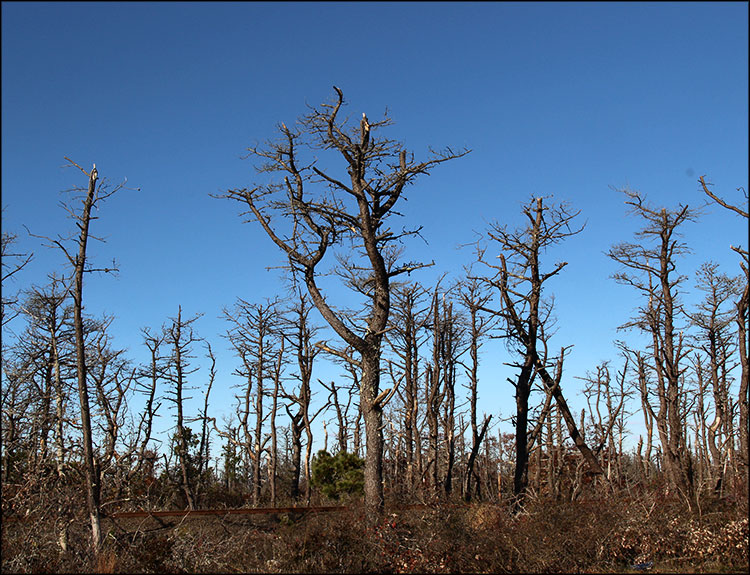
In light of what one official at a meeting on Monday night called an ecological disaster, representatives of the New York State Office of Parks, Recreation, and Historic Preservation tried to assuage fears that its response to the southern pine beetle scourge in Napeague and Montauk could create yet another disaster.
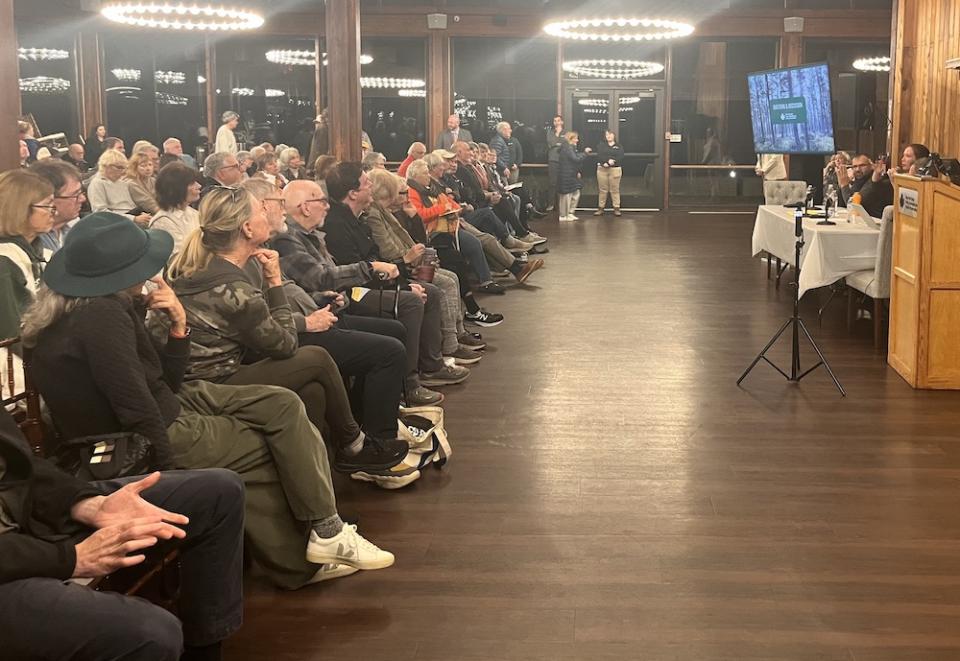
A standing-room-only crowd gathered on Monday at Montauk Downs to hear what the state plans to do next in the areas hardest hit by the pine beetle. After a public meeting in February, controlled burns over 51 acres began on felled trees that had been stacked into six-by-six-foot piles. In all, more than 5,600 trees were cut and piled for burning. Seventy-two of those piles were burned in partnership with the state’s Department of Environmental Conservation, and more land was cleared to create what are known as fire breaks, which create a no-growth zone around properties to protect against wildfire.
Since 2021, on its land in Napeague and Hither Hills State Parks, New York State has spent more than $3.3 million, cut more than 22,000 trees, installed two miles of fire breaks, and mowed 10 acres of understory.
Officials from the state said residents can expect more of the same in the coming year. An additional 28 acres will be cleared near the Montauk transfer station. In addition to the area near the transfer station, areas south of Montauk Highway, at Promised Land and near Cranberry Hole Road, will see more cutting. Those cut trees will be burned, chipped, or left in place as the agency sees fit.
Work has to be done between January and May because the pitch-pine forest is home to the long-eared bat, a federally endangered species.
While some residents fell short of blaming the state agency for how it responded to the 2021 destruction of the pitch pines in Napeague and Hither Hills State Parks, many did accuse other agencies of not doing their part to address the devastation caused by the beetles, which kill the trees they infest.
The state is only one of several public land owners in the areas most affected by the pine beetle; the dead trees that can be seen most clearly from the Napeague stretch are on land owned by the Metropolitan Transportation Agency and the state’s Department of Transportation, along with smaller rights-of-way owned by the Long Island Power Authority and PSEG. No representatives from any of those agencies attended the meeting this week.
Walter Burak, an ecologist and regional environmental steward for the state, said the state D.O.T. did cut some trees along the stretch, and that the M.T.A. had cut down some diseased trees near the train tracks but had not removed them. Parks, Recreation, and Historic Preservation is in talks with that agency, he said.
“We want the trees down before we have a fire,” a woman said from the crowd.
The highway itself works as fire protection, one of the panelists said. However, members of the audience recalled the Sunrise Fire in the pine barrens in 1995, when the fire jumped over Sunrise Highway from the north to the south side. They wondered if the same could happen on Napeague.
“We understand . . . and share your frustration,” Kara Hahn, the Parks Office’s deputy regional director for Long Island, said, adding, “We can’t just snap our fingers” and have other agencies work with the Parks Office.
“The people that have to be here aren’t here,” said Jack Perna, the retired Montauk School superintendent.
However, State Assemblyman Tommy John Schiavoni was there. He told the crowd he would be contacting those agencies with the hope of getting them involved. “I hear you loud and clear,” he told the audience. It was Mr. Schiavoni who had called the pine beetle destruction an “ecological disaster” earlier in the meeting.
The fragile ecological nature of the areas affected have to be considered, Ms. Hahn said. “Napeague is the epicenter” and the agency has to “balance safety . . . with the habitats we’re trying to protect.” Those other agencies “aren’t tree-management agencies,” Ms. Hahn said.
Another resident said all the agencies involved are “tripping over each other.”
Another called out, “This is death by bureaucracy!” The audience broke out in applause when he told the panel to “read the room,” adding, “Wildfire doesn’t care about endangered species.” He told the group to get the trees cleaned up, “so we don’t have a catastrophe.”
Mr. Burak told the crowd his department is “hamstrung.”
The fragility of the pitch-pine forest was exactly the concern of Matthew Steadman, who runs the Third House Nature Center. After the pine beetles ravaged the woods, he said, the agency came in and ravaged it again, bringing in heavy equipment to cut, pile, and chip what remained. Land left damaged by the equipment would be ripe for invasive species to move in and outcompete native pines, he argued.
Mr. Steadman acknowledged that much of what the parks agency has done has been necessary — the fire breaks, the cutting, the piles. Now, he said, let the park “regenerate itself.”
“Burn it and leave it,” someone else called out.
There are still no assurances that the pine beetles will not return, even with the Department of Environmental Conservation’s plans to make the forest a less habitable place for the rice-sized bugs. “The population has definitely crashed,” Becky Sibner, a forest-health specialist, said, but “we don’t know for sure.”
Ms. Sibner said healthy trees are cut along with understory plants to thin the tree canopy, making it less appealing to the beetle, which burrows under the bark and lays egg colonies. The beetles were so aggressive in the last few years that, in some places, damage moved 120 feet per day. Trees were dying within days and weeks. In all, 40,000 trees died in the Napeague and Hither Hills area, she said.
Last year, Gov. Kathy Hochul announced that the Parks, Recreation, and Historic Preservation Office had awarded a $2.2 million, three-year contract for forest management in areas that have experienced significant impact from the invasive species.
The Office of Parks, Recreation, and Historic Preservation has posted its response to the beetle infestation and future plans for Napeague and Hither Hills on the Hither Hills website, at bit.ly/4iQ7wfx.