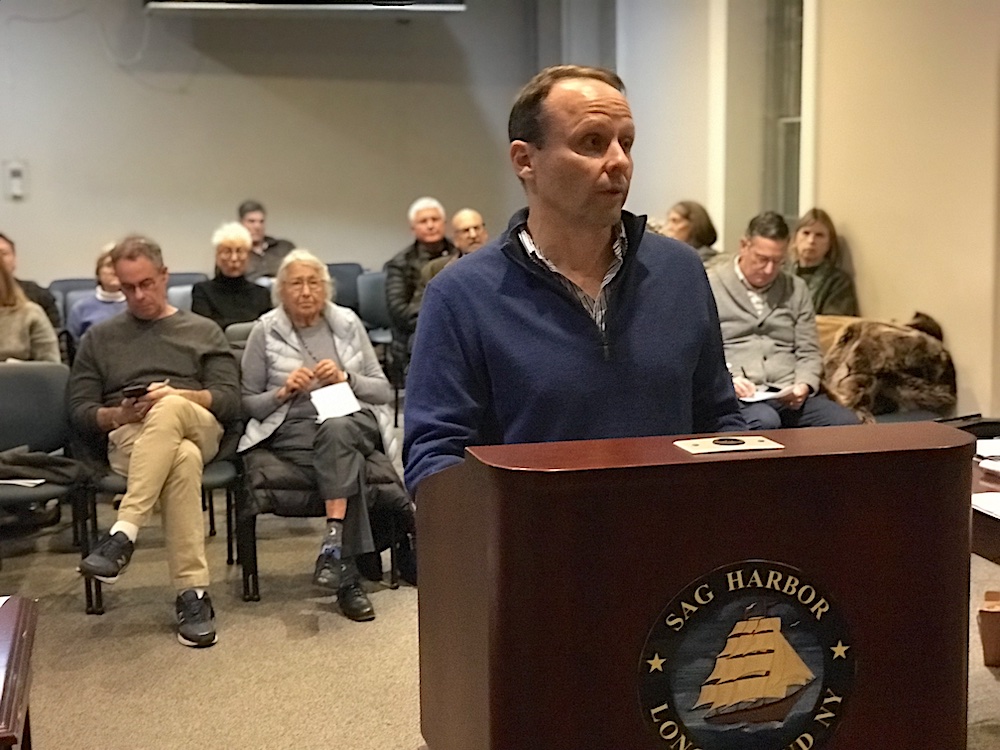
Adam Potter, the owner of the properties at 5 and 11 Bridge Street in Sag Harbor, has filed suit against seven village officials in connection with the proposed development of the lots, asking the courts to award him up to $25 million for actions he alleges impinged on his constitutional right to equal protection under the law.
Alex Kriegsman, Mr. Potter’s lawyer, said this week that his client is suing Ed Haye, Robert Plumb, and Jeanne Kane, all members of the village board; Val Florio, the chairman of the zoning board of appeals and Scott Baker, a member of the Z.B.A.; John Shaka, the chairman of the planning board; and John Ellsworth, a consultant hired by the village who works for Nelson Pope Voorhis, an engineering firm.
The suit claims the group is “motivated by the vigorous opposition of a local neighborhood group and personal animus against plaintiff and its managing member.” Although several initial investors, namely Conifer Realty and Smith & Henzy Advisory Group (both real estate development firms specializing in affordable housing), were involved in the early stages of the Bridge Street redevelopment, it has been reported that they both pulled out of the project in 2022.
Mr. Potter’s company, which owns 5, 7, and 11 Bridge Street, is planning to tear down the existing buildings at 7 and 11 Bridge Street to make way for a three-story, 81,000-square-foot building with around 50,000 square feet of apartments. He is planning 28 units to sell at market rate and 20 affordable units. On the first floor, 8,500 square feet would be set aside for service-use commercial space. Forty-four parking spaces have been proposed at 7 and 11 Bridge Street.
As for 5 Bridge Street, known locally as the gas ball lot, it is leased by Mr. Potter on a long-term basis from National Grid and is in turn subleased to the village for municipal parking. That property is slated to join numbers 7 and 11 for redevelopment.
In pursuit of these plans, Mr. Potter needs to obtain a special exception for the three-story building as well as numerous variances from the planning board and the Z.B.A.
The New York State Department of Environmental Conservation is additionally overseeing an environmental cleanup on numbers 7 and 11 Bridge Street, which have been contaminated with coal-tar pollution. As of Friday, when the lawsuit was filed, the state had officially closed the books on public comment in connection with a public hearing on the cleanup in August.
Mr. Potter, who would not comment on the lawsuit, said this week that he is expecting the state to issue its approval of his cleanup plan in short order. He told The Star in August that “we’re putting a shovel in the ground to remediate this year.”
The gas ball lot is a known Superfund site and not covered by the remediation plan. However, there is some theater surrounding that lot that Mr. Potter claims in the lawsuit has caused some of the animus that led to the filing.
This past summer, Mr. Potter shut the parking lot down unexpectedly and several disputes between him and the village came to light. In his lawsuit, Mr. Potter alleges the village, which had used the lot as a public parking lot since 2016 in a deal with National Grid, was outbid by him in a deal with the power company in 2021.
Court documents describe the actions against Mr. Potter as “stemming from the village’s failure to secure a long-term lease for a site . . . and its [Mr. Potter’s company’s] decision not to extend a long-term sublease to the village.”
Save Sag Harbor, a local civic organization, has come out strongly against Mr. Potter’s development plans. In a mailing it sent out in August and September, Save Sag Harbor said it is working with “legal, environmental, and historic preservation experts to challenge the proposal and protect the village.”
“It’s touted as ‘affordable housing,’ “ the missive says, “but its affordable units are crammed into a massive structure holding five times as many market-rate condos as zoning would allow.”
At the D.E.C. hearing in August, Save Sag Harbor was represented by Jeffrey Bragman, a local attorney.
The group is not named as defendants in the lawsuit but is named later in the document, where it is noted that Save Sag Harbor filed an Article 78 petition against the village in 2022 after officials enacted new laws that would allow high-density affordable housing in the business and office districts through a special permit. The courts ruled in favor of the group, and the village was forced to annul the laws.
These newly enacted laws prompted Mr. Potter to announce his plans to build the units in the first place, the lawsuit says.
On Tuesday, Mr. Kriegsman said that Save Sag Harbor has a “long history of having improper influence” in the village.
Mr. Potter said in his filing that the suit brought by Save Sag Harbor “directly and specifically targeted the project,” prompting a domino effect that resulted in the village board issuing a positive SEQRA declaration that triggered an extensive environmental review of the project. Eventually, Mr. Potter claims, the village board changed a law to require a pre-submission hearing that targeted only his properties.
He accuses Mr. Haye, Mr. Plumb, and Ms. Kane of “gerrymandering maps to target” those properties owned by him and his companies.
All three have declined to comment because of the ongoing litigation. What effect the suit will have on the ability of board members to speak on matters relating to the project is not yet clear. Liz Vail, the village’s attorney, did not respond to a request for clarification on the matter before press time.
However, village code does speak to specific reasons for members of appointed boards to recuse themselves: “If a member has engaged in active public advocacy, expressed pre-decisional communications, or demonstrated a fixed bias concerning an application prior to a hearing.”
“Defendants conspired, acted in concert and made every effort to hinder and obstruct the project, making plaintiff go to one village board after another and deliberately giving plaintiff the runaround. This coordinated course of conduct was not the product of independent, regulatory judgements, but rather reflected a common effort to thwart the project for improper personal and political reasons,” the lawsuit alleges.
As for the Z.B.A. members named in the suit, Mr. Potter claims they made judgements about the project before they had a chance to review the plans, as did Mr. Shaka and Mr. Ellsworth, he says.
Concerning the matter of why individuals are named in the suit and not the governing bodies themselves, Mr. Kriegsman pointed to the actions of the individuals rather than the boards entirely.
“They don’t like what he’s trying to do,” he said.
And while he acknowledged that he and Mr. Potter are open to the idea that some may not approve of the redevelopment, he pointed to an interoffice email revealed in the lawsuit which he claims indicates a larger scheme within the village to hinder Mr. Potter’s projects.
In the email, the village clerk, Saverina Chicka, writing to Ms. Vail, says “I thought you might want to see this one . . . I’ll write a 20-day letter,” in response to a request to view the Building Department’s files on the properties made by Mr. Potter.
This week, Mr. Kriegsman said that email shows “an understanding in the office that any application with Adam’s name on it should be treated differently.” He said that Building Department files are often viewable on the same day the request is made.
When reached this week, Mr. Plumb would not comment on whether those named in the suit have hired a lawyer to represent them.
For now, it appears to be business as usual for Mr. Potter, who is expected to make some small revisions to his plans for the gas ball lot, which includes an appeal of a building inspector’s determination on the nature of the use of the property. According to Tiffany Scarlato, his attorney, a revised application will be submitted to the Z.B.A. with some of the requested variances eliminated. On Tuesday night she asked the board to adjourn its scheduled conversation until next month.