
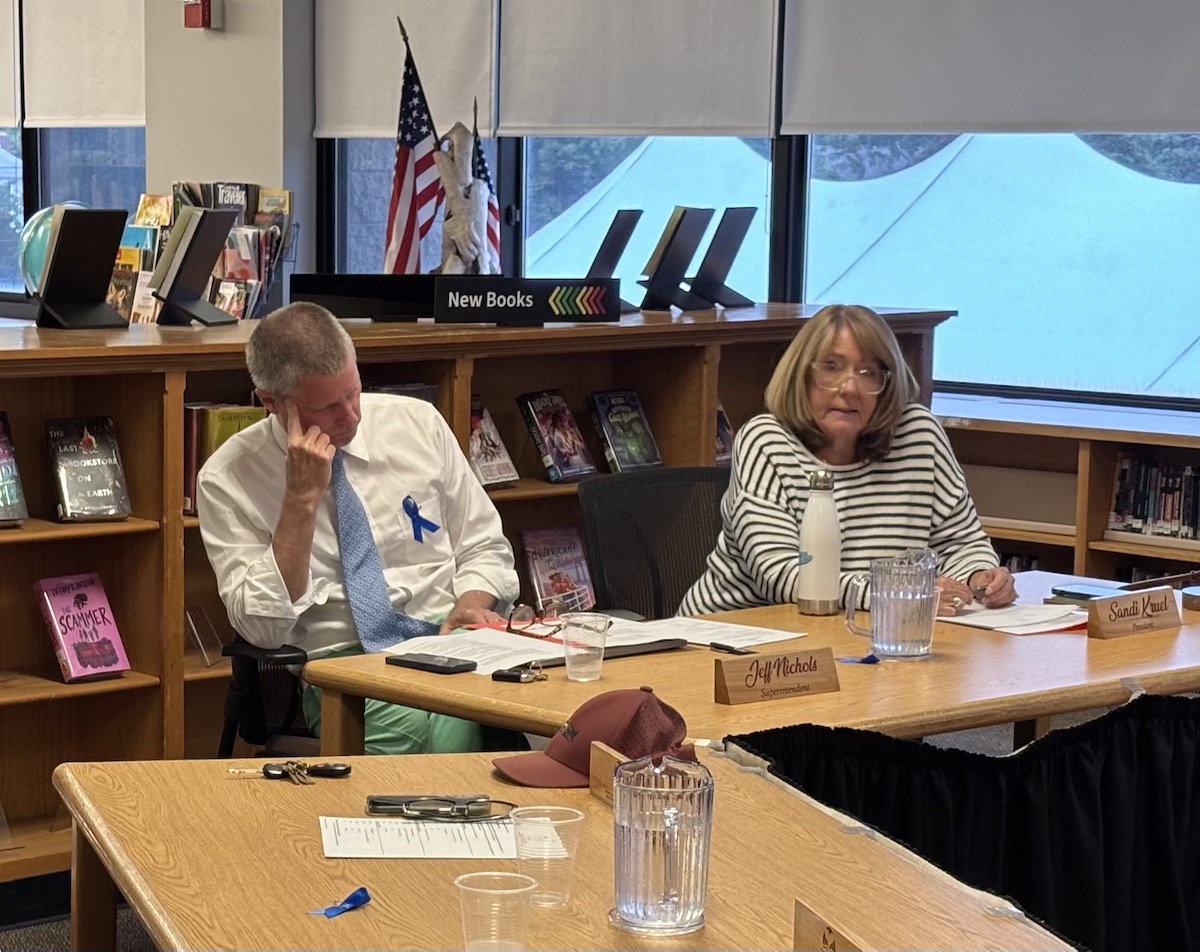
Jeff Nichols, the superintendent of the Sag Harbor School District, spent the majority of a special meeting of the school board Wednesday giving a lengthy explanation, and timeline, of the school's actions the day that Cesar Adrian Albarracin Guncay, a 12-year-old sixth grader in Pierson Middle School, died in a rafting accident while on an annual class trip to the Poconos on May 27.
It was the first meeting of the board since the tragedy, which has profoundly affected students, parents, and teachers alike, and has led some to question the school's communication and vetting protocols.
Mr. Nichols also took direct responsibility for approving the trip. "Usually, an adviser or teacher comes up with an idea, they propose it to the building principal, they do some due diligence, but ultimately it lands on my desk and it's the superintendent's decision to move forward," he said.
The school has a policy of one chaperone for every 10 students, he explained. "Within the trip, there are situations where the supervisory element is handed over to an entity that has expertise." In this situation, it was a rafting company, Whitewater Rafting Adventures.
There were 14 boats full of kids floating down the Lehigh River on the 27th, he confirmed. Previously, a co-owner of Whitewater Rafting Adventures confirmed to The Star that there were five guides on the trip, all on kayaks and not with the children on the rafts.
The rafting company reportedly knew about the fallen tree and the dangerous "strainer" situation it had created but failed to close off that section of the river or post guides ahead of the rafts to guide the children away from the threat. Ultimately nearly a third of the boats encountered the tree, which is where witnesses last saw Cesar when his boat capsized.
Mr. Nichols offered his thoughts before a public comment period to "provide some context" to help people understand "the environment that the school district was operating in, and the process and the considerations that we were wrestling with on that night."
Brittany Carriero, the school principal, received a call at 6 p.m. on May 27 from one of the chaperones, "at which time she was informed that one of our students was missing," Mr. Nichols said. She spoke with the owner of the rafting company, who "had very little information, other than to say the student was missing and there's an active investigation."
The Pennsylvania Fish and Boat Commission, through its communications director, released a statement the day after the tragedy that pinpointed the time Cesar's raft capsized, 5:30 p.m. The Carbon County coroner's office was called to the scene at 6:12 p.m., and Cesar was pronounced dead at 6:50.
Mr. Nichols said his immediate reaction when he learned that Cesar was missing was, "How could that happen?" But information was scant. Within 30 minutes of the call with Ms. Carriero, he said, the school's entire administrative team, as well as members of the board, the student psychologist, and others, convened in his office.
Over the next three hours, he said, he worked to get information. "Under no circumstances did I want to communicate to the school community information that we were receiving from students or chaperones, or anything that wasn't verified by the investigative agencies there. The worst thing that could happen would be to put information out that was not accurate."
Frustrated by the slow pace, he received help from Southampton Town and from Sag Harbor Village Police Chief Robert Drake, who served as his liaison to law enforcement authorities in Pennsylvania.
"We were wrestling with how to communicate with families," he admitted. They didn't receive confirmation that Cesar had drowned for over three hours. "We did communicate as soon as we could a statement to all of the parents that a student was missing," he said. "We were careful in that communication to state that we had communicated with the family of the student who was missing. So that people when reading that statement could realize that it wasn't their child because they would've been spoken to."
The school district didn't learn of Cesar's death until "around 9:45."
When they received that information, before telling all the parents, the school had to communicate with Cesar's family, where they had previously sent a team to let them know he was missing. So it wasn't until around 10:30 p.m. that the administration was able to put out a statement to the broader community.
"If I had to do this all over again, and hopefully I'll never have to do this again in my life, I would proceed again from a process perspective the same way. Make sure all the information communicated to the public was verified by the investigative agencies on the ground."
Since Cesar's death, Mr. Nichols said, the school has focused on three areas: supporting Cesar's family ("I met with them for two hours yesterday and we discussed many things"), supporting students and faculty (a "wellness space" had been visited by 146 students in grades six through 12), and continuing with the investigation (the superintendent said he has spoken with the eight chaperones and hoped to speak with at least two children on each of the 14 boats, "So I have a thorough sense of what happened on each boat").
"Obviously in this situation there are a lot of questions that people have asked about: 'Were the proper safety protocols followed?' and 'Who's responsible?' My only comment there is, I've got to let the investigation play out. It's an ongoing investigation."
"None of what I said is meant to minimize the feelings or questions that anybody may have tonight," he concluded.
Jason Dacuk, the head groundskeeper at the school, who has a child in the sixth grade, faulted the school for poor communication. "As a parent, I am angry, heartbroken, and profoundly troubled by the safety practices and communication failures of this district. Two recent events have shaken my trust," he said.
He spoke of several sixth-grade students who left the school dance early on May 15. "They walked out into the dark, unsupervised. Parents received no notification that our children had left school grounds early. This happened three and a half weeks ago, and it still has not been acknowledged or addressed," he said, calling it a "serious safety lapse."
Then he got into the rafting trip. "A child died. A tragedy beyond words. Yet hours passed before the district communicated anything about our children's well-being," he said. "In a crisis, silence is not caution, silence is harm. We should not be piecing together information from our children, from group chats, or from news outlets while we are waiting for the school to formulate a statement."
Michele Liot, Mr. Dacuk's wife, faulted the district for failing "to provide a dedicated platform for parents to discuss this trip."
She also said there were inadequate safety measures and that the risk had been misrepresented to parents. "A professional guide for each boat costs just $85. For 13 boats, the total would have been $1,105. Having a skilled river rafter present on each boat," she said, her voice breaking, "could have significantly altered the outcome and potentially prevented this tragedy."
"The stretch of river our children were on featured a known, potentially deadly, and hazardous obstruction in very fast, moving waters. Our children never should have been on that portion of the river," she said.
Another parent, Caitlin O'Connell-Diebold, said, "I don't disagree with a lot of what was said tonight," but she softened the blow. "I think the tragedy was an accident. And I think that everybody was trying to do their very best. Despite not having perfect information coming to us from the school, the community came together and we figured it out. When we let anger, which is a secondary emotion, when we let that lead, we lose the fact that the saddest thing about that night was that someone didn't come home. Someone's child didn't come home."