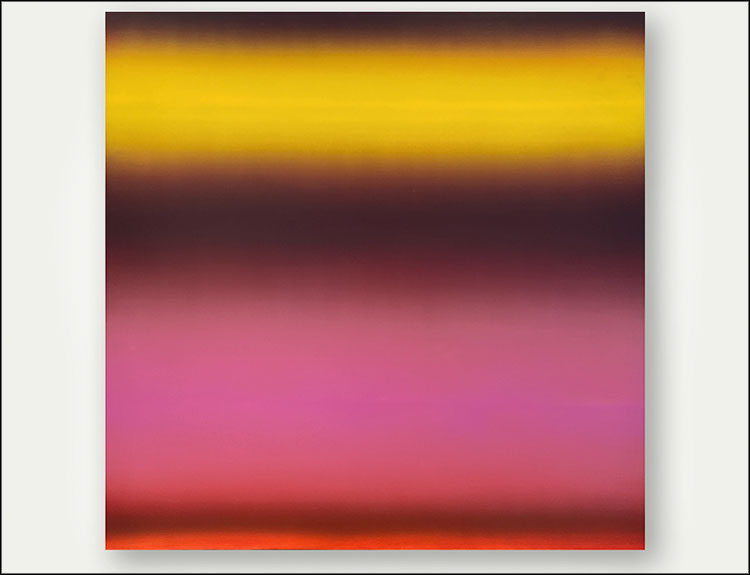
Two solo exhibitions by celebrated abstract painters who over 30 years were close friends and onetime partners will open Sunday at Guild Hall in East Hampton. “Ross Bleckner: Never the Less” and “Eric Freeman: The Volume of Color” will run through Oct. 25.
Bleckner, who divides his time between Springs and Manhattan, emerged as a leading artist in New York during the AIDS crisis of the 1980s, creating paintings that explore change, loss, memory, and the body. His practice engages with psychological, social, and political themes within a strong conceptual framework, according to the museum. Manhattan’s Guggenheim Museum staged a midcareer retrospective of his work in 1995.
“Never the Less” explores a lesser-known aspect of Bleckner’s process. He begins by making his own paint and testing it on black paper, where the brushwork often produces unusual results. From there, he creates a series of small canvases that gradually increase in scale, leading to the large paintings for which he is best known.
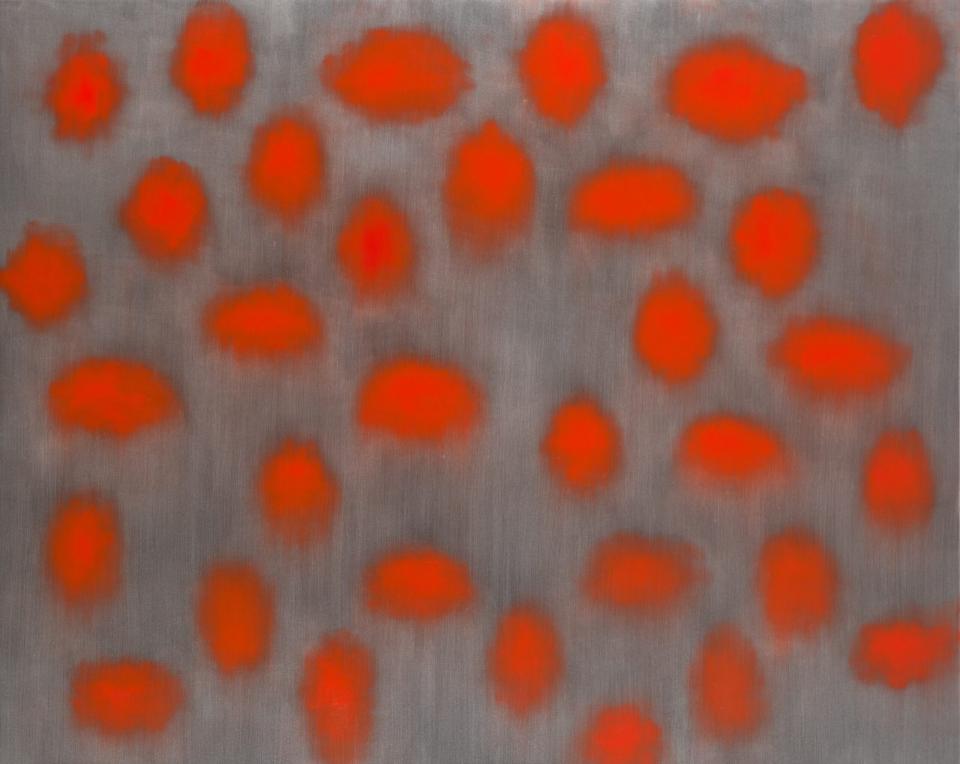 Ross Bleckner's oil painting "Throbbing Hearts" (2018).
The exhibition includes a selection of those rarely seen studies along with major large-scale paintings. While rooted in process, the smaller works stand on their own, and together with the larger paintings provide an expansive view of the artist’s progress over time.
The exhibition was organized by Melanie Crader, museum director and curator of visual arts, with support from Philippa Content, museum manager and registrar, and Claire Hunter, museum coordinator and curatorial associate.
“The Volume of Color” is the first significant institutional solo exhibition of Freeman’s work on the East End, where the artist lived for many years until his death in 2021.
Freeman’s abstractions transform color into planes of light and pigment, creating space rather than depicting it. Layers of varnish and saturated tone generate a visual depth that feels structural, at times architectural, according to Guild Hall, drawing viewers into the color fields.
Along with a selection of paintings, the show includes a group of furniture pieces designed by Freeman. Those works, some made with plywood, ebony, and rubber, suggest a three-dimensional take on Minimalism and continue the dialogue of his practice with the legacies of Agnes Martin, Donald Judd, Mark Rothko, and James Turrell.
As for Freeman’s paintings, perhaps Bleckner should have the last word: “They hum with vibrational energy that actually makes them seem sculptural,” he told James Salomon in Whitehot magazine. “He brought the light and mood that people are so moved by in a Rothko painting into contemporary discourse.”
“The Volume of Color” was co-curated by Nathan Dilworth, an artist, and Crader, with support from Content and Hunter.