Government Briefs 12.20.18

Government Briefs 12.20.18

By
Star Staff

Southampton Town

Sand Land Expansion Denied

The Sand Land industrial mine was denied its request to re-argue and renew its application to expand its mining operation on Middle Line Road in Noyac, another setback for the controversial plant that has been blamed for a wide range of pollutants in surface water and groundwater beneath the site.

The decision against Sand Land was rendered on Dec. 10 by the New York State Office of Hearings and Mediation Services, an independent office within the Department of Environmental Conservation. Sand Land unsuccessfully argued during the proceedings that its expansion request was permitted under Southampton Town code.

A study of water samples taken under court order at Sand Land by the Suffolk County Department of Health Services was released earlier this year. It confirmed for the first time the presence of contaminants in the water table there. The D.E.C. subsequently ruled that Sand Land must stop its mining and mulching operations and confine itself solely to remediation work at the 50-acre site. 

State Assemblyman Fred W. Thiele Jr. issued a statement hailing last week’s mediation services ruling as “a win for the environment and public health.” But, he added, “The real victory will come when Sand Land is closed permanently.”

Sand Land’s attorney, Brian Matthews of Matthews, Kirst & Cooley in East Hampton, did not return a request for comment. J.H.


New York State

Thiele to Chair Committees

Carl Heastie, the speaker of the New York State Assembly, has appointed Assemblyman Fred W. Thiele Jr. chairman of the assembly’s standing committee on local governments, among others. 

According to Mr. Thiele’s office, the committee considers “legislative needs” of “counties, cities, towns, villages, school districts, fire districts, and other special districts and local agencies” with regard to open space, transportation, housing, local land-use, water quality improvement projects, and the Peconic Bay region septic replacement loan program, among other things.

“Local governments directly impact the daily lives of residents, from roadways and schools to public water, law enforcement, and fire protection,” Mr. Thiele said in a release. “It is the level of governance closest to the people, who have placed their trust in local officials to maintain the community’s well-being.” 

Mr. Thiele knows of what he speaks. Prior to his long and continuing tenure in the assembly, he was a Southampton Town attorney, Southampton Town supervisor, and Suffolk County legislator. More recently, he also was the Sag Harbor Village attorney.

Mr. Thiele has been chairman of the assembly small business and its libraries and educational technologies committees. He sits on its ways and means, environmental conservation, transportation, and oversight analysis and investigation committees.


 Recharging the Parrish

The Parrish Art Museum in Water Mill will benefit from an economic development and discount power program called ReCharge NY, according to an announcement from Assemblyman Fred W. Thiele. In exchange for low-cost clean energy, the museum leaders have committed to retaining 44 jobs at the museum and creating six new ones, while investing $125,000 in capital improvements.

The announcement is part of the latest round of the New York Power Authority’s ReCharge NY power allocations, which look to create more than 520 new jobs and result in capital investments of more than $400 million throughout the state, Mr. Thiele said.

“As a premier, year-round arts and cultural institution for the East End community, the Parrish runs extensive and costly programming in its 34,400-square-foot facility. The museum will greatly benefit from a reduction in energy costs,” Mr. Thiele said in a release. 

Terrie Sultan, the museum’s director, said she was “thrilled to be a part of this essential program that not only provides us with clean energy, but helps us keep our operating costs low and ensures that we can create and maintain employment opportunities for the many members of our community who work together to make Long Island a star in the firmament of New York State.”


A Peconic Bay Heritage Area

Gov. Andrew M. Cuomo has signed legislation designating the Peconic Bay region — which includes the Towns of East Hampton, Southampton, Shelter Island, Riverhead, and Southold — as a New York State Heritage Area.

The heritage area program is overseen by the state’s Office of Parks, Recreation, and Historic Preservation and recognizes places “where unique qualities of geography, history, and culture create a distinctive identity,” according to a joint statement from Assemblyman Thiele and State Senator Kenneth P. LaValle, who sponsored the Peconic Bay legislation. 

The Peconic Bay region will become one of 20 heritage areas in the state, each representing one or more important themes in New York’s history: labor and industry, immigration and migration, defense, the natural environment, and reform movements. “This allows the community itself to be the ‘park,’ dedicated to the preservation of its unique cultural heritage through programs such as ethnic festivals, waterfront walks, lively theater, provocative exhibits, and neighborhood walking tours,” according to the lawmakers. 

The state-local partnerships encouraged by the program give communities access to new state funding and grant opportunities “to promote the preservation, restoration, and enhancement of the resources that make each heritage area so unique and essential.”

A Suit Over Seismic Blasts

A Suit Over Seismic Blasts

By
Christopher Walsh

Multiple environmental groups have filed a lawsuit against the federal government following news that the Trump administration has allowed five companies to conduct seismic surveys for oil and gas deposits under the Atlantic Ocean floor.

The lawsuit, filed in South Carolina on Tuesday, claims that the National Marine Fisheries Service violated the Marine Mammal Protection Act, the Endangered Species Act, and the National Environmental Policy Act when it issued Incidental Harassment Authorizations in late November, which would allow the companies to harm or harass marine mammals, including the critically endangered right whale, while conducting seismic air gun blasting in an area stretching from Cape May, N.J., to Cape Canaveral, Fla. 

Seismic surveying is the first step toward offshore drilling for oil and gas. The Bureau of Ocean Energy Management must grant permits to the companies before they can conduct such surveys. 

The Surfrider Foundation, Oceana, the Natural Resources Defense Council, the Southern Environmental Law Center, Earthjustice, the Center for Biological Diversity, the Coastal Conservation League, and the Sierra Club are among the groups suing the federal government. 

Seismic air guns emit loud blasts on a recurring basis, 10 seconds apart for 24 hours a day, often for weeks at a time, according to the environmental group Greenpeace. The sonic blasts penetrate through the ocean and miles into the seafloor and can harm whales, dolphins, sea turtles, and fish. They can result in temporary and permanent hearing loss, habitat abandonment, disruption of mating and feeding, beachings, and death, according to Greenpeace. 

Opposition to the plan has come from the governors of New York, Connecticut, Rhode Island, Massachusetts, New Jersey, New Hampshire, Florida, Georgia, South Carolina, North Carolina, Virginia, Maryland, and Delaware; more than 240 state municipalities on the East Coast; an alliance representing more than 42,000 businesses and 500,000 fishing families; all three East Coast fishery management councils, and commercial and recreational fishing interests including the Southeastern Fisheries Association, the Snook and Gamefish Foundation, the Fisheries Survival Fund, the Southern Shrimp Alliance, the Billfish Foundation, and the International Game Fish Association.

A Legislative ‘Leap’ on Carbon

A Legislative ‘Leap’ on Carbon

It might not alleviate traffic congestion, but a proposed carbon tax could significantly reduce the emissions that come with it.
Durell Godfrey
Energy Innovation Act would put fees on emissions and boost alternatives
By
Christopher Walsh

Amid increasingly ominous warnings about catastrophic climate change, President Trump’s dismissal of his own government’s conclusions, and his administration’s moves to expand the extraction and use of fossil fuels, a bipartisan group of congressmen has introduced legislation that would apply a nationwide price on carbon emissions and return the revenue to households each month. 

The Energy Innovation and Carbon Dividend Act offers “a monumental leap forward in the way America responds to the real threat of climate change,” according to its lead sponsor, Representative Ted Deutch of Florida’s 22nd District, and is intended to lower carbon dioxide and other greenhouse gas emissions by at least 40 percent below 2015 levels in the first 12 years and by 90 percent by 2050. It would assess a fee on all oil, gas, and coal used in the United States based on the greenhouse gas emissions they produce, boosting alternative energy sources such as solar, wind, and nuclear energy. The fee would start at $15 per ton of carbon dioxide, or CO2, and increase at $10 per ton annually. 

Money raised by the fee would be allocated equally and returned to people as a monthly “carbon dividend.” Proponents say such an approach would create more than two million new jobs, lower health care costs, spur energy innovation, and encourage consumer spending. Economists and climate scientists alike advocate this approach to climate change, according to Citizens Climate Lobby, a nonpartisan advocacy group that for several years has pushed the federal government to enact such a plan. 

The Energy Innovation and Carbon Dividend Act was introduced against the backdrop of the Fourth National Climate Assessment, the impact of which the Trump administration sought to minimize, releasing it in the afternoon on the day after Thanksgiving, or Black Friday. Its conclusions are grim: more frequent and intense extreme weather events including drought and heavy downpours, declines in surface water quality, stress on water supplies, health risks from wildfire and ground-level ozone pollution, increased exposure to water and food-borne diseases, more heat-related deaths, increased severity of allergic illnesses, an altered geographic range and distribution of disease-carrying insects and pests including ticks and mosquitoes, declining crop yields, and growing losses to infrastructure and property. 

Of particular relevance to the South Fork are rising ocean temperatures and ocean acidification and their impact on fisheries, sea level rise, coastal erosion, and higher storm surge. 

The act also comes on the heels of Hurricane Florence, which left an estimated $22 billion in damage in the Carolinas in September, and California’s worst-ever wildfire season. Worse, global carbon emissions are expected to reach an all-time high in 2018, rising around 2.7 percent over 2017, which itself saw a 1.6-percent increase over the previous year. 

In introducing the legislation, Mr. Deutch, whose district spans from Boca Raton to Fort Lauderdale on his state’s Atlantic coastline, was joined by Representatives Francis Rooney and Charlie Crist, also of Florida, Representative Brian Fitzpatrick of Pennsylvania, and Representative John Delaney of Maryland. Representative Dave Trott of Michigan later joined as a co-sponsor. 

In a conference call with journalists last Thursday, Mr. Deutch said that the Energy Innovation and Carbon Dividend Act “offers the perfect response” to rising emissions by putting a price on them. “If we don’t act now, we are nearing a point of no return with the environment, health, the economy,” he said. Climate change is a complex and difficult challenge, he said, “but we cannot be the generation that allows climate change to simply become a runaway train that we refuse to do anything about. We’ve got to put on the brakes. That’s what this legislation will start to do.” 

The legislation was introduced at the end of the 115th Congress, Mr. Deutch said, “to show going into what will be a newly bipartisan Congress with a Democratic House and Republican Senate . . . that this is the direction we need to go. . . . The reason we wanted to do this now, as this Congress wraps, was to show that even in a highly partisan Congress, there is bipartisan support, and we intend to build on that in the new Congress.” He said he had spoken with Senator Sheldon Whitehouse, Democrat of Rhode Island, about building support in that chamber. 

Investments in alternative energy should happen concurrent with a fee on carbon emissions, Mr. Deutch said. “These are all really important and need to be part of a broader approach.” 

A spokeswoman for Representative Lee Zeldin of New York’s First Congressional District said in an email on Monday that the congressman is reviewing the legislation, its specific effect on the district, and the input of relevant stakeholders. “In the past, the congressman has supported the extensions of both the renewable energy production tax credit and investment tax credit, both of which promote the development of solar and wind energy on Long Island and nationwide,” she said. Mr. Zeldin, a member of the bipartisan Climate Solutions Caucus, has voted to extend the renewable energy production tax credit through the end of 2019, and the investment tax credit through 2019 for qualifying solar projects, she said. 

Mr. Deutch said the bill could succeed despite voters’ recent rejection, for the second time, of similar legislation in Washington State. “My understanding from conversations I’ve had with colleagues from Washington is that there was growing support for that until the last days before the election, when some of the largest polluters spent massive amounts of money to convince people to oppose it,” he told The Star. “One of the reasons it’s so important to have bipartisan support, and support around the country, is to push back against false ads, the lies that we fully expect to come from those who wish to continue polluting as they have done.” 

In fact, he said, large segments of the business community support a fee on CO2 emissions. “I know from my South Florida experience, where sea level rise is such a critical concern, the business community understands this is an issue we have to tackle, and we have to do it together.”

Climate Change Looms Large in Montauk Future

Climate Change Looms Large in Montauk Future

Sea level rise prompted a recommendation by consultants to the Town of East Hampton for a managed retreat from the ocean shoreline at Montauk’s downtown.
Doug Kuntz
Coastal retreat and shift in downtown center
By
Christopher Walsh

The last of five hearings for East Hampton Town’s hamlet studies, this one focusing on Montauk, drew a standing-room crowd to Town Hall last Thursday. 

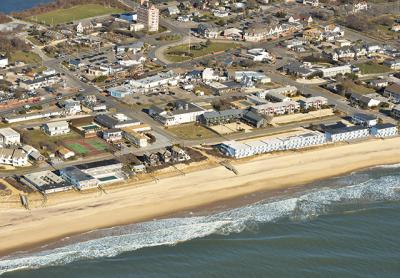
The expected impacts of climate change loomed over the proceedings, as residents debated the long-range recommendation for a planned retreat from the Atlantic Ocean shoreline in Montauk’s downtown — where the beach along “motel row” is badly eroded by northeasters — and migration to what is at present lightly developed, higher ground inland. 

The consultants engaged by the town to conduct the hamlet studies have recommended a multiphase approach to a retreat from the ocean in Montauk, proposing acquisition by the town of flood-prone land between Fort Pond and the ocean, incentivizing motel and resorts’ relocation inland through purchase and transfer of development rights. They foresee a new resort and mixed-use corridor along Essex Street, gradually shifting the downtown’s center toward its intersection with Montauk Highway, which would be elevated between Fort Pond and the ocean. 

Ongoing erosion, and repeated exposure of the geotextile sandbags installed by the Army Corps of Engineers in 2015, a widely reviled emergency stabilization measure pending implementation of the corps’s long-awaited Fire Island to Montauk Point Reformulation Plan, led some frustrated residents of the hamlet to at once applaud the board for its foresight and criticize a perceived lack of specificity or timeline for action. 

A retreat plan “will be the next step,” Laura Tooman, president of Concerned Citizens of Montauk, told the board, but will take time and require code changes. “We need all players at the table starting today,” she said, “because it’s going to take a long time.” Along with retreat from the shoreline, “we need to simultaneously do additional things to ensure we protect water quality and our beach and dune system. C.C.O.M. is ready to help tackle this difficult endeavor.” 

Alison Branco, director of coastal programs for the Nature Conservancy, said that the town has been a leader on energy efficiency and other efforts to slow climate change. “Position yourself as a leader in adapting as well,” she urged. “There are many details to work out as we develop complicated financial and legal mechanisms” that would ensure that all stakeholders are treated equitably. The process will not be quick, she said, but “Montauk does not have the luxury of time. Planned retreat is the only solution.” 

The Montauk Beach Preservation Committee, which Ms. Tooman chairs, is studying the creation of an erosion control district for Montauk’s downtown, for which the board authorized a bond issue to fund a map, plan, and report on its feasibility. Responses to a request for proposals are due next Thursday, but some residents did not wait to criticize the idea. Representing the advocacy organization Defend H2O, Carl Irace said that beach renourishment is “an unsuitable solution” in the face of rising seas. “This is not fair to the public and not good fiscal policy, as sure as it is not good environmental policy,” he said. 

Andrew Brosnan, chairman of the Surfrider Foundation’s Eastern Long Island chapter, said that a managed retreat is one of the most encouraging recommendations among the hamlet study’s proposals, but added that the Army Corps’ emergency stabilization project had exacerbated erosion at the downtown beach. “Now we have beachfront motels that don’t have a beach six to eight months of the year. The beach is then trucked in, in the spring,” at taxpayer expense. “The idea of creating a special taxing district to address this has some merit,” he said, “although unless it is limited to those properties adjacent to the project, it unfairly burdens property owners in the downtown.” 

Thomas Muse agreed, likening an erosion control district to adding insult to injury, following installation of the geotextile sandbags on the downtown beach. “Take away half the beach by the Army Corps, then ask us to pay for it,” he said of those within such a district. “It seems amazing to me, to be looking to spread the liability the town and county have assumed . . . among a tax district that hasn’t been invented yet,” a plan he called meanspirited.

Retreating from the front row is the only way, Mr. Irace said. “There is no way to avoid the inevitable and the fact that this will only end one day,” the oceanfront buildings abandoned voluntarily, by people, or violently, by nature, the latter with attendant “disruption, loss of property, or worse.” 

Kevin McAllister, Defend H2O’s founder and president, urged the town to acquire oceanfront properties with the community preservation fund. Increasing density landward of the ocean “goes hand in glove with a sewer district” for downtown, he said, which “will be inevitable given coastal inundation.” 

“It may come down to tough love,” Mr. McAllister said, should oceanfront business owners balk at relocating. “I urge you to be prepared. Inevitably, we have to move back.”

But Alan Axelowitz, who is from Huntington but owns co-op units along motel row, said that the plan is unfair, that the beach preservation committee and the Army Corps should be given an opportunity to control erosion. 

Krae Van Sickle of Springs said that winter northeasters, coupled with the June-through-November hurricane season “make the region susceptible to storms pretty much all year round.” He suggested relocation of critical structures and services, like a transportation hub, a microgrid, and the I.G.A. supermarket, to vacant lands around the firehouse, the Montauk Playhouse Community Center, the Montauk Manor, and the Long Island Rail Road station. 

After nearly 20 members of the public had spoken, Supervisor Peter Van Scoyoc summarized the hamlet study process. “I see a broad, diverse group of people concerned about their community,” he said. “Having your input is crucial for us as decision makers to decide how to move forward.” Montauk’s hamlet study is “an outline and vision statement” that will inform the comprehensive plan once it is adopted and incorporated into it. “There is a great deal of work and planning that still has to take place to discuss every one of the topics.”

He said that the hearing should be closed so that the board could move to the planning phase as soon as possible. Councilwoman Sylvia Overby agreed, but Councilwoman Kathee Burke-Gonzalez and Councilmen David Lys and Jeff Bragman all said that the record should be held open for 30 days to allow additional public comment on each of the studies. 

The hamlet study process began almost three years ago with a series of walking tours and public sessions, called charettes. The consultants, Peter Flinker of Dodson and Flinker, a Massachusetts consulting firm, and Lisa Liquori of Fine Arts and Sciences, a former town planning director, held a series of presentations, soliciting and incorporating comments made in response to their findings. Their reports were revised and presented again, and public hearings for Wainscott, East Hampton, Amagansett, Springs, and Montauk were held at separate meetings of the board. 

A review under the State Environmental Quality Review Act will follow, and the plan will be sent to the Suffolk County Planning Commission for review before adoption and incorporation into the town’s comprehensive plan.

Airing Out Oyster Program

Airing Out Oyster Program

David E. Rattray
By
Christopher Walsh

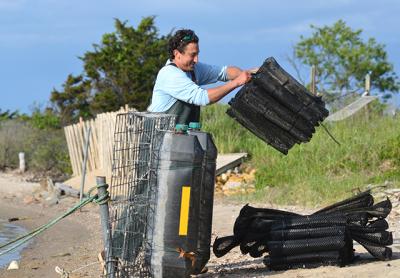
An informational session about the Suffolk County Aquaculture lease program, under which 10-acre parcels are leased for private, commercial shellfish cultivation, will be held at Town Hall next month, the East Hampton Town Trustees announced at their meeting on Monday. 

John Aldred of the trustees told his colleagues that county officials have agreed to his request that they give a presentation and accept comment on the program, which the county has implemented in Peconic Bay and Gardiner’s Bay. The presentation is scheduled for Jan. 9 at 6 p.m. 

The program was established after New York State ceded title to approximately 100,000 acres of bottomlands to Suffolk County in 2004, and authorized the county to implement an aquaculture lease program for the region. The program was adopted in 2009, and a 10-year review will assess legal and administrative requirements governing its operation and recommend changes. 

A 10-year advisory group was established to obtain public official and stakeholder interest group involvement. Mr. Aldred, representing the trustees, is a member of that group, as is Barley Dunne, the director of the town’s shellfish hatchery, who represents the town. 

In East Hampton, the program has been controversial. Members of the Devon Yacht Club in Amagansett and residents who live along Gardiner’s Bay were unhappy about the changing seascape brought about by the appearance of oyster farms offshore. Early this year, an attorney for the yacht club filed a lawsuit in State Supreme Court seeking to bar leaseholders situated near the club from undertaking or continuing any action related to oyster farming at lease sites granted by the Aquaculture Lease Board in July 2017, or engaging in any other activity that would interfere with sailing. The Aquaculture Lease Board, the county’s planning department and its director, the Amagansett Oyster Co., individual leaseholders, the town, and the State Department of Environmental Conservation were all named in the suit. 

One of the program’s lessees had informed the club that he was going to build out a lease site 1,000 feet from the end of the club’s pier. Lease sites approved last year were concentrated and mostly contiguous, rendering a few hundred acres off limits to Devon’s more than 300 member families, an attorney for the club said. 

Hence, “we’ll reach out to the boating community, the recreational water-use community, the fishing community, anybody that we can think of that has an interest in the bay,” Mr. Aldred told his colleagues, to alert them to the Jan. 9 informational meeting. “The county will give a short presentation, then open the floor for feedback, whoever wants to weigh in on this in East Hampton, so there’s no question that this hasn’t been brought to the attention of local interests.” 

“I wanted to make sure that feedback from East Hampton got in there early in the process,” Mr. Aldred said, “so that any concerns could be put on the table and addressed throughout the course of the review.” 

“We should make sure Devon Yacht Club gets special notification,” Bill Taylor said, to laughter. 

In other news from the meeting, the trustees voted to support a ban on the intentional release of balloons in the town, as they had indicated they would do at their previous meeting, on Nov. 26.

The move followed a presentation at that meeting by Colleen Henn, the clean water coordinator of the Surfrider Foundation’s Eastern Long Island Chapter, in which she read startling statistics as to the volume and type of debris collected during organized cleanups of the shoreline this year. She had asked that the trustees urge the town board to follow the lead of several coastal municipalities in New Jersey and in New Shoreham, on Block Island, by banning the intentional release of balloons. 

Under Suffolk County law, a person can release 25 balloons in a 24-hour period. Release of helium-filled balloons remains popular at celebrations such as weddings, birthday parties, and graduations, but marine animals can mistake them for jellyfish and ingest them, blocking the digestive tract and causing a slow and painful starvation. Wildlife can also become entangled in balloons’ ribbons or strings, another cause of mortality. 

On Monday, Susan McGraw Keber read the resolution stating that the trustees, in conjunction with the Surfrider Foundation, support a ban on the intentional release of balloons, and her colleagues voted unanimously in favor. “We can never get rid of them,” she said of Mylar and latex balloons. “They are not recyclable. This is a start in the right direction.” 

After the meeting, Ms. McGraw Keber said that she would meet with the town’s recycling and litter committee. Councilwoman Sylvia Overby, the town board’s liaison to that committee, “is already on board,” Ms. McGraw Keber said. Written and oral testimony urging a ban would be directed to the town board, which would decide whether or not to schedule a vote to enact such a ban, she said. “If they do, it’s one step ahead.” 

Assemblyman Fred W. Thiele Jr. and County Legislator Bridget Fleming are also supportive of a ban, Ms. McGraw Keber said. “They really want to see this move outside of just East Hampton,” she said. “Fred said he wants to take it to the state.”

New Plan for Water Cistern

New Plan for Water Cistern

By
Star Staff

After a plan for a water cistern on high ground in Amagansett ran into opposition from neighbors last spring, the Suffolk County Water Authority regrouped and will now hold a public hearing on a new concept on Monday at 6 p.m. in the East Hampton Library. 

The proposal is for a 900,000-gallon partially underground concrete tank on an existing water authority site on Cross Highway off Cranberry Hole Road in the Devon Colony. The tank would extend no higher than 10 feet above the ground; the previous concept was for one that would be 35 feet high and 90 feet in diameter.

Lys Gets 71.4 Percent

Lys Gets 71.4 Percent

David Lys
David Lys
Carissa Katz
By
Christopher Walsh

East Hampton Town Councilman David Lys, who won election to the town board in his own right on Nov. 6 after being appointed to the seat in January, earned an overwhelming 71.4 percent of the vote, according to the final results released this week by the Suffolk County Board of Elections.

In the final tally, which includes those who voted by absentee ballot or affidavit, Mr. Lys, running on the Democratic/Unity Party and Working Families Party tickets, won 7,912 votes to the 3,164 votes cast for his Republican and Conservative Party challenger, Manny Vilar. The board of elections’ unofficial tally on election night had Mr. Lys winning 6,177 votes to Mr. Vilar’s 2,728 votes, or a 69.3 to 30.7 percent. 

Mr. Vilar was elected chairman of the East Hampton Town Republican Committee last Thursday. That election is covered separately in this issue. 

Perry Gershon, an East Hampton resident who lost a bid to unseat Representative Lee Zeldin in last month’s election, closed the gap in the final results but still fell short. In the board of elections’ official tally, Mr. Gershon, running on the Democratic and Working Families Party ballots, picked up an additional 12,196 votes to finish with 127,991, or 47.4 percent of the vote. 

Mr. Zeldin, who was elected to a third term, gained 8,108 in the final tally, finishing with 139,027 votes, or 51.5 percent, down 1 percent from the election night tally. He appeared on the Republican, Conservative, Independence, and Reform Party ballots. His official margin of victory was far smaller than that of his 2016 re-election campaign, in which he defeated former Southampton Town Supervisor Anna Throne-Holst by 16 percentage points. 

Kate Browning, a former Suffolk County legislator who finished second among five candidates in the Dem­ocratic primary election, appeared on the Women’s Equality ballot despite having thrown her support to Mr. Gershon. She won 2,988 votes, or 1.1 percent, up from 2,756 in the unofficial total.  

When the 116th Congress is sworn in on Jan. 3, Mr. Zeldin will be in the minority for the first time, Democrats having taken control of the House of Representatives by gaining around 40 seats in the midterm elections. (The outcome of the race in North Carolina’s Ninth District is still pending the outcome of an investigation into fraud.)

In other races, State Senator Kenneth P. LaValle, on the Republican, Conservative, Independence, and Reform Party tickets, won re-election with 71,017 votes, or 56.9 percent, to the 53,790 won by his Democratic Party challenger, Gregory-John Fischer, according to the official results. Assemblyman Fred W. Thiele was also re-elected. In the final tally, he won 31,961 votes, or 61.57 percent, to Patrick O’Connor’s 19,953 votes. Mr. Thiele ran on the Democratic, Working Families, Independence, Women’s Equality, and Reform tickets. Mr. O’Connor was the Republican and Conservative Parties’ candidate.

Urge Lake Montauk Cleanup

Urge Lake Montauk Cleanup

David E. Rattray
By
Christopher Walsh

Immediate steps should be taken and community preservation fund money allocated to alleviate runoff of contaminated water into Lake Montauk and the Atlantic Ocean in Montauk’s downtown, the East Hampton Town Board was told at its work session on Tuesday. 

Christopher Clapp of the town’s water quality technical advisory committee told the board that the committee recommends six high-priority actions deemed most feasible to achieve measurable improvements in Lake Montauk, where the Surfrider Foundation’s Eastern Long Island Chapter and Concerned Citizens of Montauk routinely measure dangerously high levels of bacteria. 

Three proposed projects would be at the southernmost part of the lake, at the road end of South Lake Drive, which was once a bathing beach and the site of children’s swimming lessons. There, “we know we have bacterial contamination of some sort,” Mr. Clapp said, “suspected from septic systems but probably due to stormwater runoff as well.” 

Mr. Clapp recommended construction of a wetland on the north side of Montauk Highway opposite Caswell Road to catch and filter stormwater before it flows into the lake. “The idea is to slow it down, let the plants and soils treat the water before it continues on,” he told the board. 

Permeable pavement at the parking area there, and a regraded pavement, would pitch stormwater runoff into a pervious bioswale in the lot’s center to catch sediment and bacterial contamination before it enters the lake at the road end. A permeable reactive barrier, a device comprising trench boxes filled with ground woodchips or another reactive substance that intercepts groundwater as it seeps into a water body, was also recommended at the southernmost part of the lake to alleviate stresses from failing septic systems. A permeable reactive barrier has demonstrated an 85-percent reduction in nitrogen seepage at Pussy’s Pond in Springs. 

“We’ll be looking at some engineering and porewater investigation of this south end . . . to try and find where the hot spot of groundwater contamination might be so that we can intercept that and begin to treat some of that water before it enters the saline waters and surface waters of South Lake,” Mr. Clapp said. “We think this may be a good opportunity to intercept a lot of the flow that’s coming from the Ditch Plains area by way of groundwater.” 

Similar projects are recommended along West Lake Drive and on Star Island. Permeable pavement is recommended at the boat launch at both places to reduce runoff from their respective parking lots. Bioswales and rain gardens were recommended at the intersection of West Lake Drive and Flamingo Road and the triangles formed by West Lake Drive, Star Island Road, and North Fernwood Drive, “where we’ll be relying upon those swales, the soils, and the plants to strip a lot of the nutrients, bacterial contamination out of the water before it enters either the groundwater or the surface waters,” Mr. Clapp said. A permeable reactive barrier was also recommended at the end of Duryea Avenue. 

Both areas of Lake Montauk, Supervisor Peter Van Scoyoc noted, “are adjacent to extremely densely developed areas, with the idea that septics are contributing” to water contamination. 

A permeable reactive barrier “isn’t worth the effort in a lightly populated area,” Mr. Clapp said. “In order to make a permeable reactive barrier worth the effort, you want to identify where the highest-strength plume of contaminated groundwater is and at what depth it sits so you can engineer the product to fit the right spot. . . . This is the first step in engineering of the project.” 

Additionally, the water quality committee recommends an engineering study to map the drainage area around the pipe that collects stormwater runoff from an upland subdivision near Surfside Place at the eastern edge of Montauk’s downtown. C.C.O.M. and the Surfrider Foundation have measured high bacteria counts at the pipe’s outlet on the beach. 

Antimicrobial-coated stormwater filters in catch basins upgradient of the outlet pipe “should, in the short term, be able to drastically cut down the amount of bacterial contamination that’s coming out at the end of the pipe,” Mr. Clapp said. “It’s not to say it can strip everything, but the data that the company that makes these things has shown the committee have shown a drastic decrease in microbial as well as viral contamination in the water that passes through them.” 

Before Mr. Clapp’s presentation, Laura Tooman, president of C.C.O.M., told the board that the group is supportive of the water quality committee’s recommendations. C.C.O.M.’s water quality data at South Lake Drive, which consistently exceed the federal Environmental Protection Agency’s standards for public health, demonstrate the need for action, she said. “I wanted to provide scientific data you need to show that there is a problem and something needs to be done. This is an instance where we know we have a problem, we have the resources to fix the problem, and, hopefully, we have the political will to fix the problem.”

A Push for Offshore Oil

A Push for Offshore Oil

Zeldin breaks with Trump over exploration here
By
Christopher Walsh

A recent move by the Trump administration could lead the way to oil and gas exploration and extraction off the Atlantic coast. 

The Washington Post reported on Friday that the National Marine Fisheries Service, a division of the National Oceanic and Atmospheric Administration, has approved five requests that will allow companies to conduct seismic surveys. The “incidental take” authorizations allow companies conducting such surveys — geophysical companies working on behalf of oil and gas corporations, The Post reported — to harm marine life as long as it is unintentional. 

Such surveys would be conducted using seismic air guns, which emit loud blasts on a recurring basis, 10 seconds apart for 24 hours a day, often for weeks at a time, according to the environmental group Greenpeace. The sonic blasts, or “pings,” penetrate through the ocean and miles into the seafloor and can harm whales, dolphins, sea turtles, and fish. They can result in temporary and permanent hearing loss, habitat abandonment, disruption of mating and feeding, beachings, and death, according to Greenpeace. 

On Tuesday, Representative Lee Zeldin, who is generally supportive of the administration, and dozens of his colleagues in the House of Representatives wrote to Ryan Zinke, the secretary of the Interior Department, and Wilbur Ross, the Commerce Department secretary, to “strongly oppose” the incidental-take permits and exploration off the Atlantic shoreline. 

Seismic air guns “can disturb, harm, and potentially kill not only marine mammals but also a wide range of marine life that support coastal economies from Florida to Maine,” the letter said. “Offshore oil and gas exploration and development, the first step of which is seismic air gun testing, puts at risk coastal economies based on fishing, tourism, and recreation. Numerous studies show the detrimental impacts seismic air gun blasting has on fisheries and marine mammals, thereby affecting the catch anglers bring dockside and the revenue generated by related businesses.”

The letter cites a 2014 study of North Carolina’s coast by NOAA, the University of North Carolina at Chapel Hill, and Duke University that found that the abundance of reef fish declined by 78 percent during evening hours, when fish were most plentiful on the three previous days when seismic surveys did not take place. “The tertiary effects of this trickle down to fishing businesses, restaurants, and the visitors that flock to our coastal communities,” the letter said.

The members of Congress said that constituents, including business owners, elected officials, and coastal residents, have contacted them to register their opposition to oil and gas exploration and drilling in the Atlantic or eastern Gulf of Mexico. “Local chambers of commerce, tourism and restaurant associations, and an alliance representing over 43,000 businesses and 500,000 commercial fishing families strongly oppose offshore oil and gas exploration and drilling,” they wrote. 

The letter further complained that coastal communities impacted by drilling would not have access to data obtained from seismic surveys, as they are proprietary to the oil and gas industry. Even members of Congress would not have access, according to the letter. 

In December 2016, weeks before he left office, President Barack Obama announced a permanent ban on offshore oil and gas drilling from Virginia to Maine, and along much of Alaska’s coast. The East Hampton Town Board passed a memorializing resolution in August in support of a continued ban. 

“As I understand it, testing at this point is going to be taking place around Delaware [and southward],” said Town Supervisor Peter Van Scoyoc, “but I think that given the deleterious effects of that on sea life, in addition to the fact that we need to be exploring alternatives to fossil fuels rather than further development of that industry, it’s a double insult.” 

The Trump administration’s move to promote oil and gas extraction, and to revive the coal industry, coincides with the declining costs of clean energy generation, primarily solar and wind power. Orsted U.S. Offshore Wind, formerly Deepwater Wind, plans a 15-turbine South Fork Wind Farm for a site approximately 35 miles off Montauk, and has several other offshore installations planned. 

Mr. Zeldin “is an advocate for clean and green energy,” Katie Vincentz, a spokeswoman for the congressman, said in an email on Monday, “and understands that there is a lot to take into account with any project on Long Island, including the possible adverse impact on our local fisheries. Any green energy proposal will not be viable if it devastates the waterways which have been the hallmark of our community for generations.”

Commercial fishermen are almost uniformly against the South Fork Wind Farm, fearing a detrimental impact on their livelihood. But Gary Cobb, an opponent of the wind farm who has publicly represented East Hampton’s baymen throughout Deepwater Wind/Orsted U.S. Offshore Wind’s proceedings as it seeks approvals from federal, state, and local regulators, said in an email yesterday that “there is absolutely zero difference between pinging the [ocean] bottom for offshore oil/gas and pinging the bottom for offshore wind.” 

Bonnie Brady, executive director of the Long Island Commercial Fishing Association, did not respond to an email seeking comment.

New Leader Only One of G.O.P.’s Challenges

New Leader Only One of G.O.P.’s Challenges

By
Christopher Walsh

With the resignation and subsequent arraignment of Amos Goodman, the now-former chairman of the East Hampton Town Republican Committee, the party must seek a new leader. 

Kyle Ballou, the committee’s secretary, said last month that he and other committee officials had sent a letter to Mr. Goodman asking for his resignation after learning of an investigation by the Public Integrity Bureau of the Suffolk County District Attorney’s office. That investigation burst into public view on Tuesday night when the Suffolk County District Attorney’s office announced fraud-related charges against Mr. Goodman and Pat Mansir related to signatures gathered on nominating petitions ahead of last month’s election. A separate story appears on the front page of today’s paper.

The committee’s vice chairman, Michael Jordan, is now its acting chairman. Mr. Jordan said on Tuesday, before the district attorney’s announcement, that the committee will move to elect a new leader in the new year, but he will not seek the position. 

“What you need is someone that will be very active on the committee,” he said. “We need younger people. Frankly, both parties here have a lot of elderly people in them. I’m not inclined to devote the amount of time that would be needed for someone who’s going to be actively running the party — preferably, someone who’s not as long in the tooth as I am,” said Mr. Jordan, who is 70 and retired. 

In a town in which Republicans are greatly outnumbered by Democrats — there are 3,739 registered Republicans in East Hampton versus 8,122 registered Democrats, according to the Suffolk County Board of Elections — a Republican candidate’s path to electoral victory is narrow. A 5-to-0 Democratic supermajority sits on the town board, although David Lys, who was appointed to the board and won election last month, changed his party affiliation from Republican to Democratic shortly before his appointment. In 2017, the Republicans’ candidates for supervisor and councilman — Manny Vilar, Paul Giardina, and Jerry Larsen — were defeated by substantial margins, and just two of nine Republican candidates were elected to the town trustees. 

“In terms of registration, our party is very much outgunned,” Carole Campolo, the committee’s former vice chairwoman, said on Monday. “Whoever’s going to run the party needs to decide how to proceed, given all the challenges it faces. That doesn’t mean the party should give up; the party has a really good message and needs to get it out there. The people that will run will have to make choices as to how to do that.” 

The message, said Ms. Campolo, a former deputy executive director of the New York City Campaign Finance Board, is “We stand for the taxpayers, for lower taxes, and for efficient government.” None of these, she said, are evident at the local level. “As a former Democrat, I think that Democratic policies are so contradictory to what is good for the middle class, it’s astounding to me that they get as many votes as they do. I think the Republicans stand for the working man in this town.” 

Fewer regulations and environmentalism are not mutually exclusive, Ms. Campolo said. “You can be for the environment, very much so, without some of the extraordinary things homeowners are asked to do — spending money on surveys, lawyers, an architect, just to get a piece of a deck put on.” East Hampton Republicans, she said, are “trying to mitigate hardships on homeowners while maintaining high environmental standards.” 

Finding and fielding candidates who can win elections in East Hampton will top next year’s agenda, Mr. Jordan said, once the committee’s new leader has been chosen. “Certainly, the Republican committee has its challenges in East Hampton, with demographics. It will be a challenge, and one reason we need someone younger who will devote time, effort, and energy. Hopefully that’s what we’ll do. . . . Once we have the committee lineup, we’ll go forward and discuss what our plan for the future will be.”