Wainscott Water Main Project Wraps Up

Wainscott Water Main Project Wraps Up

To provide public water after numerous private wells were discovered to be contaminated.
By
Christopher Walsh

The Suffolk County Water Authority and the Town of East Hampton announced on Friday the imminent completion of the installation of approximately 45,000 feet of water main in Wainscott, an effort to provide public water to the hamlet after numerous private wells were discovered to be contaminated with perfluorinated chemicals. 

The announcement closely followed word from the town board of its intention to commence litigation against more than a dozen manufacturers of firefighting foam and other products, suspected culprits in the chemical contamination, as well as East Hampton Village and the Bridgehampton Fire District, “to help offset the costs that we’ve incurred to remediate these chemical contaminations,” Councilman Jeff Bragman said at the town board’s meeting last Thursday. 

The final 1,000 feet of water main are to be installed during the first week of January, four months after installation began on Windsor Lane in the hamlet, in the largest water main project undertaken by the water authority in almost 20 years. 

Private service lines are being installed to connect the plumbing of participating residences and businesses to the new water main. To date, 124 properties have been hooked up to public water out of the approximately 520 in the project area, which encompasses much of the hamlet south of East Hampton Airport. 

Ductile iron water main, known for its durability, between 6 and 16 inches in diameter was installed. Copper and high-density polyethylene service lines connecting the water main to each impacted residence will continue to be installed in the coming weeks, along with meters and meter vaults, among other project elements. Existing private wells will be disconnected from the internal plumbing of houses within the project area to prevent the possibility of cross-contamination with the public water system. 

Supervisor Peter Van Scoyoc said earlier this month that the contamination represented a major challenge to the town board this year. “We responded very quickly to those concerns,” he said on Dec. 17. “In order to ensure public confidence in drinking water, we worked very closely with the Suffolk County Water Authority and the State and County Health Departments, put together a task force to work on this issue, and committed to bringing safe drinking water to Wainscott, first and foremost. That’s been a success.” 

The Suffolk County Department of Health Services confirmed the presence of perfluorooctane sulfonate, or PFOS, and perfluorooctanoic acid, or PFOA, in more than 150 private wells in the impacted area, with some showing amounts over the health advisory level of 70 parts per trillion, in October 2017. The chemicals have been linked to cancers, thyroid problems, and serious complications of pregnancy. 

Following the detection of the chemicals in Wainscott, the town board declared a state of emergency, and then established a water supply district, paving the way for the water main installation project. As interim measures, the town provided bottled water free of charge to property owners and offered rebates for the installation of point-of-entry water treatment systems to those whose wells were found to be contaminated.

Seeking to recoup the costs of treating tainted water in its wells, one year ago the water authority filed suit against companies that manufactured and sold products containing the contaminants. Separately, a Southampton lawyer took the town and several chemical manufacturers to court over the contamination. 

Last Thursday, Mr. Bragman, the town board’s liaison to the Wainscott Citizens Advisory Committee, announced new litigation against companies including the 3M Company, Tyco Fire Products, Chemguard, and more than a dozen others, in addition to East Hampton Village and the Bridgehampton Fire District. 

Mr. Bragman could not be reached yesterday. East Hampton Village Mayor Paul F. Rickenbach Jr. said that he was aware of the town’s action. “We use that firefighting foam in question during various drills,” he said. “We have yet to see the paperwork vis-à-vis a lawsuit, but are aware that it had been initiated. Once we receive it, we’ll digest it and act accordingly.”

Seek Larval Sampling Staff

Seek Larval Sampling Staff

The program will start in June and continue through August
By
Christopher Walsh

The East Hampton Town Trustees have put out a call for applicants to assist in next year’s mosquito larval sampling program in the 190 acres of marshland surrounding Accabonac Harbor. It is to be the third year of a pilot project jointly conducted by the trustees with the Suffolk County Department of Public Works’ vector control division, the Nature Conservancy, and the town’s Natural Resources and Planning Departments.

The program will start in June and continue through August. Participants will be compensated. Those interested in applying have been asked to send a brief bio and résumé with their contact information to Susan McGraw Keber at [email protected].

Last summer, Ms. McGraw Keber and John Aldred of the trustees oversaw some 6,000 samples taken over the county’s 11-week spraying season. Samplers sent data to the Nature Conservancy, which consolidated the information and forwarded it to the vector control division. Tom Iwanejko, the director of vector control, and his staff reviewed it and issued directives to the county’s helicopter pilots to alter spray patterns accordingly.

The program identified “hot spots” of mosquito breeding at the upper end of the marsh. Consequently, application of methoprene, a mosquito larvicide, was reduced from a 195-acre spray area that went right to surface waters to a 95-acre area, and the county saved an estimated $18,000 from the reduced application. On four weeks during the 11-week season, no spraying at all took place. 

The volunteers and trustees also discovered physical characteristics of the wetlands, such as a sunken boat that was harboring breeding larvae. The trustees dismantled and removed it, eliminating one breeding hot spot.

The 2019 effort will serve to identify and confirm such breeding spots and the altered marsh conditions that foster them. The eventual goal is to work toward returning these altered marsh areas to a more natural state that discourages larval mosquito development and furthers elimination of the use of pesticides. 

Mosquitoes can carry West Nile virus, Eastern equine encephalitis, and other diseases. There were no reported cases of such diseases in East Hampton this year. 

On Dec. 19, the county’s commissioner of health services, Dr. James Tomarken, reported three additional cases of West Nile virus, bringing the total to 11 in 2018. Each of the three is a resident of the Town of Brookhaven and each is over 50 years old. One had become ill in September, and the other two in October. The other reported cases this year were also in Brookhaven as well as the Towns of Southold, Islip, Huntington, Smithtown, and Babylon.

East Hampton Town Plans Two Big Purchases

East Hampton Town Plans Two Big Purchases

Suggestions for the C.D.C.H. building include day care, classes and lectures, as well as community groups.
Durell Godfrey
By
Christopher Walsh

At its final meeting of 2018 last Thursday, the East Hampton Town Board authorized a bond resolution for the purchase of the former Child Development Center of the Hamptons building on Stephen Hand’s Path and voted to schedule a hearing on the proposed acquisition of property on Route 114 in Sag Harbor for affordable housing. 

The four-acre property is owned by the Triune Baptist Church. The town hopes to purchase the parcel for $900,000, and would construct 20 to 30 units of affordable housing there. Triune Baptist Church acquired the land in 1993 but fell short in its effort to raise the money to construct a church at the site. A hearing is planned.

The property is adjacent to cottages owned by the Sag Harbor Community Housing Trust, and there is potential for the sites to be developed in conjunction with one another. The hearing is scheduled for Jan. 17. 

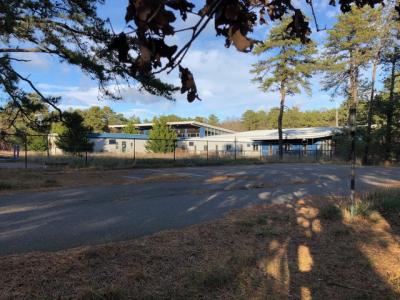
The purchase price for the 22,000-square-foot C.D.C.H. building, empty since the school closed in 2016, is $800,000, less than a third of a recent $2.6 million appraisal. (The town already owns the underlying land.)

The building is to be used as a community center, with one or more nonprofit-organization tenants responsible for its management. Such a move would align with the town’s policy to secure public-private partnerships with not-for-profit groups for unused buildings, in part to defray management and maintenance costs. 

Possible uses discussed at the board’s  meeting include a day care center and space for education, lectures, performances, and senior citizens services. A number of community groups and organizations might ultimately use the space as well. The board is expected to issue requests for proposals in the new year. 

A report prepared by Drew Bennett, a consulting engineer, identified more than $400,000 in potential future repairs to the 22,000-square-foot metal structure. 

In another vote last Thursday, the board resolved to retain L.K. McLean Associates to provide engineering services in preparation of a bid package for demolition of the old Town Hall building on the Pantigo Road, East Hampton Town Hall campus. L.K. McLean Associates is to provide assistance to the town in soliciting bids and reviewing submissions as well as make recommendations to the town. The town will pay a maximum of $7,960 for the services. 

At the meeting’s conclusion, Supervisor Peter Van Scoyoc thanked his colleagues on the board for what he said was a very productive year. “We’ve gotten a great deal of work done that’s benefited our community,” he said. “We have a great deal of work that’s in process that we still need to complete and look forward to doing so in the coming year. But I really appreciate all of your support, your help, and input in this effort, working closely together to get good things done.” 

The board will hold its annual organizational meeting next Thursday at 10 a.m. at Town Hall.

Carbon Act Now in Senate

Carbon Act Now in Senate

The legislation would apply a nationwide price on carbon emissions and return the revenue to households each month
By
Christopher Walsh

One month after the Energy Innovation and Carbon Dividend Act was introduced in the House of Representatives, Senators Chris Coons, Democrat of Delaware, and Jeff Flake, a retiring Republican of Arizona, followed suit in the Senate. 

The legislation, which would apply a nationwide price on carbon emissions and return the revenue to households each month, is expected to be reintroduced in the House and Senate in 2019. 

The incoming House of Representatives will have a Democratic majority, Democrats having gained 40 seats in the midterm elections last month. In the Senate, Republicans increased their majority and will hold 53 of the chamber’s 100 seats. 

“Republicans need to get serious about climate change,” Senator Flake wrote on Twitter on Dec. 19. “That’s why I introduced a revenue-neutral carbon tax bill in the House several years ago. Today, Chris Coons and I have introduced a bipartisan, revenue-neutral carbon tax bill that provides an honest path to clean energy.” 

In a statement, Senator Coons said, “Putting an economy-wide price on carbon and other greenhouse gases is a comprehensive way to reduce emissions, spur innovation, and create jobs. I am proud to introduce this legislation with my good friend Jeff Flake.”

Since its introduction by five co-sponsors in the House, five more representatives have signed on, most recently Dan Lipinski of Illinois and Scott Peters of California.

Affordable Housing on the Front Burner

Affordable Housing on the Front Burner

Parcel on 114 offers possibility of 30 new units
By
Christopher Walsh

East Hampton Town is set to buy a 4.2-acre parcel off Route 114 just outside Sag Harbor to build 20 to 30 units of affordable housing, and that is just one of a number of projects afoot to alleviate a critical shortage here. 

The East Hampton Town Board will schedule a Jan. 17 public hearing at its meeting tonight on the purchase of the property from the congregation of the Triune Baptist Church, which secured the land in 1993 but fell short in its effort to raise the money to construct a church on the property. 

The proposed purchase price is $900,000. The property is adjacent to cottages owned by the Sag Harbor Community Housing Trust, according to the Supervisor Peter Van Scoyoc’s office, and there is potential for the sites to be developed in conjunction with one another.

In an interview on Monday, Mr. Van Scoyoc referred to the acquisition, the location of which had yet to be disclosed, in recapping the town board’s efforts to create affordable housing for residents struggling to pay market rate for rental housing in the town. “I think we’ve made strides on affordable housing,” he said, referring to the 12-unit Manor House project on Accabonac Road in East Hampton, which he said would be completed this month, and a 38-unit development at 531 Montauk Highway in Amagansett that is expected to be completed and occupied by the end of 2020. “That is fully funded now, has received permits, and is moving forward,” he said. The Manor House apartments will be offered for sale, and the units in Amagansett will be rented. 

The town is also eyeing “a couple of additional affordable housing properties for acquisition,” apart from the Triune Baptist Church property, Mr. Van Scoyoc said on Monday. 

The flurry of activity follows a long fallow period, as the outgoing chairman of the town’s community housing opportunity fund advisory board and director of community housing and development conceded at the town board’s Dec. 11 work session. There, Job Potter and Tom Ruhle, the housing director, said that the board must be mindful that a housing project’s timeline from conception to completion can span as many as eight years. “It really puts pressure to keep adding projects, keep buying land, keep things in the pipeline,” Mr. Potter said. 

Mr. Potter stressed the importance of acquiring vacant land for housing development. “As a committee, we’re not privy to executive session material,” he told the board. “There may be ongoing acquisition efforts.” Mr. Van Scoyoc confirmed that observation this week in disclosing the public hearing to be scheduled tonight. 

The town’s record in creating affordable housing over the last decade “may be disheartening,” Mr. Potter had told the board, but the next 10 years “I think are going to be much better.” Patience is essential, he said, “because some of this stuff takes a long time.” Creating affordable housing is among the town’s most difficult challenges, he said, given the complex grant process and resistance to new development from neighbors. “It takes hammering away,” he said. 

“We know there’s more to be done,” Mr. Van Scoyoc said on Monday. “We’re going to try and keep getting projects into the pipeline . . . and there had been a gap of roughly a decade since a town board had taken on a new project. We’re pleased to be pushing that effort forward again and actually getting some units created and completed.”

Perry Gershon Eyes Another Run

Perry Gershon Eyes Another Run

Perry Gershon and is family on their way to vote in East Hampton on Election Day. Mr. Gershon said his family would support a second campaign, should he decide to run again for Congress.
Durell Godfrey
By
Christopher Walsh

Perry Gershon, who lost a bid to unseat Representative Lee Zeldin in last month’s midterm elections, is contemplating a second campaign to represent New York’s First Congressional District, he told The Star last week. 

“I’m giving it strong consideration,” he said on Friday. If he is the Democratic Party’s 2020 nominee, “I certainly go in with a lot more name recognition, and a group of people who already believe in me and what I could do.” In last month’s loss to Mr. Zeldin, he said, “We showed that New York 1 is a competitive district.”

His campaign was, in part, “an uphill battle to convince people the district was winnable,” he said. “You won’t have that problem the next time.”

Mr. Zeldin won a third consecutive congressional campaign with 51.5 percent to his challenger’s 47.4 percent, but Mr. Gershon, who lives in East Hampton, pointed to the 128,000 votes he received as evidence that he, or another Democrat, could reclaim the district. His vote total, he said, dwarfed the 94,000 Mr. Zeldin received in his 2014 election, when he unseated the six-term Democratic incumbent, Tim Bishop, and Mr. Zeldin’s 4.1-percent margin of victory this year was far narrower than his 16-point win over former Southampton Town Supervisor Anna Throne-Holst in 2016. “We showed a great ability to close that gap,” he said.

“There’s been a lot of Democratic energy here, but it just wasn’t quite enough to get the job done this time around,” Mr. Gershon, who spent 25 years in commercial real estate, said. “Whether that means I should run again myself or whether that opens the field for the next candidate, time will tell.” Whoever the Democrats’ nominee is, “it’s a race that I think will have much better national attention, because the gap was so much better.” 

Mr. Gershon’s wife, Lisa, and two sons have said that they would support a second campaign, he said last week. 

The Perry Gershon NY-1 Facebook page remains active, with regular posts about political developments and current events. The former candidate has used the platform to criticize Mr. Zeldin, in the last week calling out the congressman on inaction over the murder of the journalist Jamal Khashoggi, apparently directed by the government of Saudi Arabia, and calling on him to join Dem­ocrats in maintaining health insurance coverage for those with pre-existing conditions. The latter post, on Saturday, followed the declaration by a Texas judge that the Affordable Care Act was unconstitutional. 

Nationally, Democrats fared well in House races, picking up some 40 seats and reclaiming a majority. While President Trump is unpopular, Democrats won with messaging that stressed health care, and Mr. Gershon predicted that the issue would remain prominent in 2020. “The health care system in America is broken, and it’s unlikely that it’s fixed with divided government and Trump in the White House,” he said. “I think you’re going to see a Democratic vision and a Republican . . . I don’t know what will emerge. The Republicans failed to define their vision of health care, and I think the Democrats now in control of the House have the opportunity to set agendas.” 

The environment, he said, will only grow in importance, particularly as climate change impacts coastal districts like New York’s First. “The Trump people are showing no mercy in terms of where their vision lies,” promoting fossil fuels above all others, he said. “They’re actually encouraging people to burn more oil. I think that’s going to be a campaign issue here.”

“I’m disappointed personally,” he said of losing to Mr. Zeldin. “I invested a lot of time, energy, and money in the race, and it would have been nice to win, and it would have been good for the people of New York 1 who wanted to see a Democrat in there, but sometimes it takes two cycles to get the job done.” Mr. Zeldin himself needed two campaigns to win election to Congress, his 2014 election following a 16-point loss to Mr. Bishop in 2008. “Whether it’s me or the next person,” Mr. Gershon said, “we’re supposed to build on what we have, and this was a successful race. We made great strides.” 

The race, he said in its immediate aftermath, was exhausting. “The driving was probably the hardest part of it,” he said on Friday. “I spent so much time in the car — as a candidate from East Hampton, that just makes it a little taxing. But it’s critical to spend time at the other side of the district. I did it in this campaign and I’d certainly do it again.” A week’s vacation “to clear my head” was rejuvenating. 

Some of the negative messaging by Mr. Zeldin’s campaign was “as expected,” he said, but some was “disturbing.” After Mr. Gershon’s Democratic primary win, his opponent quickly labeled the former New York City resident “Park Avenue Perry,” portraying him as an outsider to the district. Mr. Gershon built a house in East Hampton in 1999 and became a year-round resident last year. 

Mr. Zeldin’s campaign also accused Mr. Gershon of investing in offshore oil despite his proclaimed environmentalism. The investment, Mr. Gershon said, is in a Louisiana port that transfers oil from offshore tankers to a refinery and not in offshore drilling. “The blatant lies about investments I didn’t make, I found disturbing,” he said. “It’s one thing to bring something up. But when you keep bringing up something that’s completely false and is proven, and put it on television, I found that offensive.”

The new Democratic majority in the House, he said, should prioritize policy and “show the Democratic Party can unite on issues they promised to deliver on.” But the truth about Russian interference in the 2016 presidential election, and any collusion with the Trump campaign, should also be exposed, “not just for the sake of impeachment, but to make sure it doesn’t happen again. If the voters know what happened, let them decide if it’s okay or not.”

Despite coming up short, “I took a lot of solace in the fact that the Democratic Party reclaimed the House,” Mr. Gershon said, “and that they won the State Senate.” His campaign and that of Liuba Grechen Shirley, a Democrat who waged an unsuccessful campaign to unseat Representative Peter King in New York’s Second District, helped drive Democratic turnout, he said, allowing Democrats to win control of the State Senate. “We also helped siphon resources the Republicans could have deployed in other races,” notably New York’s 11th and 19th Congressional Districts, in which Republican incumbents were defeated. The Republicans “spent a fortune on me in the last week.” 

His race was not a failure, rather incomplete, Mr. Gershon said. “We did a whole lot of good.”

East Hampton Town Set to Buy C.D.C.H. Building

East Hampton Town Set to Buy C.D.C.H. Building

Doug Kuntz
By
Christopher Walsh

The East Hampton Town Board plans a vote tonight to authorize a bond resolution for the purchase of the building on Stephen Hand’s Path that housed the Child Development Center of the Hamptons. 

In a discussion at a meeting on Tuesday, board members and residents proposed a range of uses for the building, but the intention is for it to serve as a community center, with one or more nonprofit-organization tenants responsible for the building’s management. Such a move would align with the town’s policy to secure public-private partnerships with not-for-profit groups for unused buildings, in part to defray management and maintenance costs. 

“The building lends itself to broad ­uses,” Supervisor Peter Van Scoyoc said, suggesting as one possibility a day care center, given the existing playground and classrooms used by C.D.C.H. He also pointed to “a need for a community meeting space for education purposes, lectures, performances. This structure,” he said, “really lends itself quite well to meeting all of those various needs.” The modular structure can be assembled in various configurations, he said. There are a “number of community groups and organizations which could utilize the space. . . . I do agree it’s better to have an organization that could independently manage that building for the greatest public benefit.”

Councilman Jeff Bragman said that the town should not rule out operation of a portion of the building. He 

recalled remarks made by Mary Ella Moeller and David Gruber, during the public comment portion of the meeting, encouraging the inclusion of services for senior citizens and a place where they can integrate with the wider community. “Our 2016 engineering report said it was a perfect building for a senior center,” Mr. Bragman said. (Consideration had been given to move the town’s senior citizens center into the building from its location on Springs-Fireplace Road in East Hampton, but the proposal was abandoned and the town is planning to construct a new senior citizens center at its current location.)

Mr. Bragman also echoed a suggestion by Councilman David Lys that the board look to the Montauk Playhouse Community Center as a model for the former C.D.C.H. site. Mr. Lys also suggested allocation of space to serve as an incubator for resident-established small businesses, and wondered aloud if the board should examine the building’s use as a shelter during emergencies.  

In the New Year, the town could issue requests for proposals, Michael Sendlenski, the town attorney, told the board, with one for use of the space and another for its management, if the board chooses.

Last month, Mr. Sendlenski explained to the board that the town could reach an agreement to cancel the lease it signed with the C.D.C.H., initially set for 30 years and scheduled to expire in 2032, and purchase the building for $800,000, less than a third of a recent $2.6 million appraisal. 

On Tuesday, Len Bernard, the town’s budget officer, said that the bonds would likely have to be taxable, which will slightly increase the yearly debt service, from $45,000 for nontaxable bonds to $48,000. The board would vote to authorize the bond issue now but not actually borrow the money until August. The money to acquire the building would be advanced from the general fund, he said, and would likely be available around the end of January. 

The 22,000-square-foot structure is deemed a Class B building, Mr. Bernard said, meaning it is of lesser value than the highest quality Class A designation given a new structure in a desirable location but greater than the Class C label given an old building in a less desirable area. 

The metal structure is around 17 years old, Mr. Van Scoyoc said, and a report prepared by Drew Bennett, a consulting engineer, identified more than $400,000 in potential future repairs. 

The C.D.C.H. opened as a charter school in 2001. It provided regular and special education programs, drawing students from local school districts, which paid tuition until it closed in 2016.

New Stickers Will Be Needed

New Stickers Will Be Needed

By
Christopher Walsh

The East Hampton Town Board and Town Trustees have agreed to require residents to obtain new permit stickers for parking and driving on beaches. The new permits, which will be free to town residents, will be valid for five years. A public hearing will be scheduled for early in the new year before the board formally votes to change the town code. 

Current resident stickers issued for parking and driving on beaches never expire. Members of the town board and trustees, mindful that more than 30,000 such permits have been issued — a number that exceeds the population of the town — worried that many vehicles bearing current permits were subsequently sold to nonresidents, allowing “those who aren’t privileged and entitled to park in our parking lots and drive on our beaches to utilize them,” Supervisor Peter Van Scoyoc said at the town board’s Dec. 11 work session. “That’s been an ongoing problem.” 

“This makes sense to do,” Bill Taylor, a deputy clerk of the trustees, said at that body’s Dec. 10 meeting. “One new permit, it’s good for five years.”

“I think it’s good to have an accurate count of vehicles on the beach,” said Rick Drew, the trustees’ other deputy clerk. “To really understand usage on the beach is important, and to retire some of the old stickers so people that don’t have a valid sticker aren’t using resources of our residents without being properly documented.” 

Some previous trustees, and members of the advocacy group Citizens for Access Rights, had questioned the need for new permits. The trustees’ Dec. 10 vote to support the plan was unanimous, however.  

New, color-coded permits will become available sometime next year, become mandatory in 2020, and expire in 2025, Mr. Van Scoyoc said. Permits effective in 2025 would be available in 2024, he said. “That would alleviate some congestion in the clerk’s office,” from which the permits would be distributed. 

“We’re not talking about limiting them in any way,” Mr. Van Scoyoc said of new permits. “But it’s important that those using those stickers are in fact entitled to be driving on the beach.” The town will make an announcement when the new stickers are available, he said.

Parking Issues at T.J. Maxx

Parking Issues at T.J. Maxx

By
Jamie Bufalino

A last-minute change in the site plan for the proposed 17,000-square-foot expansion of T.J. Maxx, a chain store in Bridgehampton Commons, was unveiled at a Southampton Town Planning Board public hearing last Thursday. The board closed the hearing, but will hold the record open for 30 days for written comments.  

The site plan, from Kimco Realty, the owner of the shopping center, calls for extending the rear of T.J. Maxx, which is the easternmost building, to make room for Marshalls, another discount retail store owned by TJX Companies.

Although an additional 85 parking spaces would be required under the town code for such an expansion, the board had previously granted Kimco a parking waiver, allowing it to set aside land for future parking rather than develop spaces at once. 

The company had planned to enter into a “cross-access” easement with Marders Nursery, its neighbor, which would allow part of the Marders property to be used for parking if the need arose. But on Thursday, Timothy McCulley, Kimco’s lawyer, said the site plan had been reworked by an engineer so that the 97 parking spaces would fit on Bridgehampton Commons.

Pamela Harwood, the chairwoman of the Bridgehampton Citizens Advisory Committee and the only member of the public to voice opposition to the site plan, said the revised parking sounded good in theory, but she wanted more time to study the changes.

She objected to the company’s plan to prevent right-hand turns at the exit from the parking lot onto Snake Hollow Road. Since the nearby intersection of Snake Hollow and Montauk Highway does not have a traffic signal, the board had encouraged Kimco to put up signs deterring left turns.

Describing the inability to make a right turn as “a great inconvenience to residents and bad for businesses,” Ms. Harwood said people liked to combine trips to the shopping center with stops at BNB Bank, English Country Antiques, and the gas station at the intersection, all of which are to the right of Bridgehampton Commons on Snake Hollow Road. 

Dennis Finnerty, the board chairman, agreed that preventing right turns at the exit would be problematic and said he was leaning toward keeping the hearing open so the public had time to examine the “significant changes” made on the site plan, but after hearing contrary opinions from board members, he agreed to close the hearing while leaving the comment period open until Jan. 13.

Charging Stations Yes, Branding No

Charging Stations Yes, Branding No

By
Christopher Walsh

Electric-vehicle charging stations will be installed in the Town of East Hampton, the town board was told this month, and five more electric vehicles will soon be added to the town’s fleet, but the number and type of charging stations that could be added will have to be negotiated.

Kim Shaw, the director of the town’s Natural Resources Department, told the board on Tuesday and on Dec. 11 that the town is a recipient of a $100,000 award from the New York State Energy Research and Development Authority’s Clean Energy Communities program, with which it is purchasing five Nissan Leaf electric cars. “Our commitment back to the state was to install charging stations,” for which a site at the Town Hall campus has been earmarked, she said, “and also to install stations throughout the community.” Charging stations at Town Hall would be available to both the town’s fleet and to the public.

Along with six charging stations at Town Hall, the municipal parking lot north of Amagansett’s Main Street is a potential site for four others, Ms. Shaw said, while the parking lot on South Euclid Avenue in downtown Montauk and the town-owned portion of the parking lot at Amagansett’s Long Island Rail Road station could also see installations in the future.

East Hampton Village installed a public charging station in its long-term parking lot in October. That installation was funded by a $16,000 grant from the State Department of Environmental Conservation’s Zero Emission Vehicle program, Becky Molinaro Hansen, the village administrator, said yesterday.

Lauren Steinberg, an environmental analyst in the Natural Resources Department, accompanied Ms. Shaw to the Dec. 11 meeting. Multiple car manufacturers have or will soon introduce fully electric vehicles, she said, as the industry moves to phase out combustion engine-only cars. Charging stations accessible by the public will become increasingly important, she said.

On Tuesday, Linda James, chairwoman of the town’s energy sustainability and resiliency committee, read a list of manufacturers offering electric vehicles that “runs the alphabet” from Aston Martin to Volvo. The list was part of a larger statement supporting the town’s “consideration of creating public electric vehicle charging stations directly and through public-private partnership.”

That latter path to wider proliferation of charging stations was received with less enthusiasm by the board, however. Last summer, representatives of Tesla Motors, which, one official said, enjoyed more than 50-percent market share in the electric-vehicle category, made a pitch to the board for a charging station to be situated in the municipal lot at Kirk Park in Montauk. The board was interested, but with reservations.

The California company has again approached the town to propose multiple charging stations, Ms. Shaw said on Tuesday, most of which would be dedicated to Tesla models.

“I’m not supportive of dedicated spaces on town property,” Supervisor Peter Van Scoyoc said flatly.

Councilman Jeff Bragman, mindful of the branding and advertising that would be included on Tesla’s charging stations, said, “I don’t want to corporatize our landscape. These are mini-billboards. . . . We’ve got Chevys, all sorts of other [electric] cars ordinary people buy.” Tesla’s Model S starts at $78,000, but its newer Model 3 has a base price of $46,000. A federal tax credit of $7,500, which expires on Dec. 31, and other incentives lower an electric car’s cost, however.

Tesla has a “Supercharger” station at Cafe Crust on County Road 39 in Southampton, and the company’s website lists a “target opening in 2019” at an unspecified site in East Hampton.

Councilwoman Sylvia Overby had asked the Tesla representatives in July why the company sought to situate a charging station in the town’s easternmost hamlet. Primarily, it was because congestion is better avoided with a single large installation than with distributed smaller sites, was the reply. On Tuesday, she again questioned why Tesla’s charging stations would not be situated in a location more convenient to the entire community and “not have somebody have to go all the way through every hamlet we have” to Montauk.

The supervisor repeated that a Tesla-specific charging station “is going to be a nonstarter, for me, in a public space. I don’t have an objection to having a public-private partnership in this case, where they supply charging that the general public can use nonspecific to their brand.” The board wants to encourage the transition to electric cars, he said, which will require charging infrastructure throughout the town.