Exploring Energy Choices

Exploring Energy Choices

By
Johnette Howard

The Town of Southampton could benefit from a community choice aggregation, or C.C.A., energy program like one Westchester County was first to establish in New York State. But any aggregation on Long Island would face some regulatory challenges that Westchester’s innovative program did not, according to an expert who helped Westchester launch its program in 2016. (New York is only the seventh state in the country to allow C.C.A.s.]

One major challenge is that the Long Island Power Authority, is exempt from the regulations governing C.C.A.s, which were established by the state’s Public Utilities Commission, said Glenn Weinberg, a consultant and former program director for Westchester Power, who spoke at a Sag Harbor forum on Saturday sponsored by the Southampton Democratic Club.


‘In the end, we need a reliable entity that’s capable of delivering enrgy that’s both greener and lower cost.’

— Bridget Fleming


Creating a C.C.A. would allow Southampton consumers to seek energy from sources or suppliers other than PSEG Long Island, which manages the grid on LIPA’s behalf — conceivably at better rates — and perhaps to also band together with consumers in neighboring towns, like East Hampton, to gain more leverage. LIPA would have to cooperate because energy is delivered over its transmission lines, regardless of who the supplier is.

John Bouvier, a Southampton Town councilman, has formally proposed a local law allowing the town to investigate a C.C.A., and Suffolk County Legislator Bridget Fleming, who was in attendance Saturday, agreed that where LIPA stands on the issue is one of the many details that need to be examined.

Both lawmakers strongly support studying whether a C.C.A. would work in this region. They also are seeking more public comment on the idea. The conversation about C.C.A.s is scheduled to continue at the Southampton Town Board meeting on Jan. 22 at the Hampton Bays Senior Center, starting at 6 p.m. 

Mr. Bouvier said one reason he advocates pursuing a C.C.A. is it could give Southampton “a seat at the negotiating table” and access to data it currently can’t get. As an example, he said the town believes it has reduced energy consumption through actions already  taken, but “LIPA is telling us we’re raising our energy consumption.”

“So how do we make decisions without access to even that kind of basic information?” Mr. Bouvier asked. “Right now what happens is, it becomes almost an adversarial relationship, particularly with LIPA. And that’s a problem. So how we are taken more seriously and dealt with, that is important.”

Mr. Weinberg said Westchester’s C.C.A. had indeed delivered that kind of clout because “the county was able to go to its energy suppliers and say, ‘This is what we want,’ rather than be told ‘like it or lump it,’ which is what the old model used to be.” 

Ms. Fleming said she supports C.C.A.s as a way for East End communities to have a greater say in pursuing alternative energy and confronting challenges like the effects of climate change and reducing their carbon footprint. 

“I think C.C.A.s are an extremely exciting idea, but we have to go into it  clear eyed and do our homework,” Ms. Fleming said. “In the end, we need a reliable entity that’s capable of delivering energy that’s both greener and lower cost. That’s the goal. And we have to figure out what recipe works here on Long Island, with the complicated regulatory structure and unique challenges we have. . . . But there’s got to be some savings just by having competition introduced.”

Westchester’s example suggests that is true, Mr. Weinberg and Lynn Arthur, a  consultant and energy chairwoman of Southampton Town’s sustainability committee, said. Millions of dollars in annual savings are indeed possible here, Ms. Arthur said, and the more towns and villages that joined Southampton in a C.C.A., the more negotiating leverage the new entity could conceivably have.  

Linda James of East Hampton Town’s energy sustainability committee said the town has been studying the Westchester model since it began and is now monitoring Southampton’s efforts. But, she said, no one on the East Hampton Town Board has formally proposed pursuing a C.C.A. “We’re proceeding a bit more deliberately for now,” Ms. James said Saturday after hearing Mr. Weinberg speak.

Once a decision is made to go forward with a C.C.A., Mr. Weinberg said the next step would be appointing a C.C.A. administrator to organize the effort, identify available suppliers, and then draw up a contract and solicit bids.

Mr. Bouvier noted that adopting the Southampton law he has proposed would not commit the town to launching a C.C.A. but would only trigger deeper exploration of the idea. “I firmly believe a C.C.A. has great potential,” he said.

On Water and Weather Woes

On Water and Weather Woes

Kathy Cunningham and Sam Kramer were sworn in as officers of the East Hampton Town Planning Board last Thursday.
Christopher Walsh
By
Christopher Walsh

“Coastal erosion and sea level rise will continue to be a topic of focus for the coming year,” Supervisor Peter Van Scoyoc said at the first East Hampton Town Board meeting of 2019 last Thursday, noting the four northeasters last March and resulting erosion and damage to the Army Corps of Engineers’ beach stabilization project in downtown Montauk. “These weather events are predicted to continue to increase in frequency and severity, and will require innovative solutions and funding to minimize future losses,” he said. 

The establishment of an erosion control district for downtown Montauk is being studied. It would fund a sand-only beach replenishment project as an interim step while the town awaits the Fire Island to Montauk Point reformulation project. Later in the meeting, the board named 10 members to the Montauk Beach Preservation Committee, which was established last year to explore the creation of such a district and funding mechanisms. 

“Protecting and improving water quality was and continues to be a top priority,” Mr. Van Scoyoc said, referring to contamination in Wainscott and harmful algal blooms in multiple waterways. The Suffolk County Water Authority is completing installation of 45,000 feet of water main in Wainscott, potentially serving more than 520 residences, he said, and wastewater regulations and installation of low-nitrogen septic systems in 2018 represent initial efforts to address degraded waterways. 

Expanded shellfish production will result from the town’s acquisition of land adjacent to its aquaculture facility on Three Mile Harbor, at which operations will be consolidated, the supervisor said.

Mr. Van Scoyoc recounted the town’s progress toward achieving its energy needs through renewable sources, including the South Fork’s first megawatt-scale solar installation, which came online off Accabonac Road in East Hampton late last year, and ongoing negotiations with Orsted U.S. Offshore Wind for an easement to land the transmission cable for its proposed South Fork Wind Farm, to be situated some 35 miles off Montauk. 

“We are also working with the New York Power Authority to install rooftop solar panels on several municipally owned buildings,” he said, and the town has incentivized rooftop solar by offering reduced prices on purchase and installation.

The Energize East Hampton solar and energy savings program was launched last year, offering one-stop shopping for free or discounted solar and energy efficiency projects, including free smart thermostats, pool pump rebates, and free commercial lighting efficiency upgrades. The town is also adding electric vehicles and charging stations to further reduce the use of fossil fuels. 

The hamlet studies, for which public hearings were held in the fall, will be adopted early this year, Mr. Van Scoyoc said, and will help guide future development and redevelopment. 

Affordable housing remains in critically short supply, he said, but the 12-unit Manor House condominiums will be occupied early this year, and ground is expected to be broken on the 37-unit Gansett Meadows project at 531 Montauk Highway in Amagansett in April. The board will hold a public hearing next Thursday on the purchase of a four-acre parcel off Route 114 for another 20 to 30-unit project. 

“While I am pleased with the progress we have made this year, there is clearly more to do,” Mr. Van Scoyoc said. “So let us get on with it. And getting on with it means having David Lys sworn in, in the annual David Lys swearing-in process.” 

It was a joking reference to the councilman, who was appointed to the board to fill the seat Mr. Van Scoyoc vacated upon his election as supervisor last January, won election in November, and will have to stand for re-election this fall, should he seek to continue. 

Mr. Lys, who was elected with 71 percent of the vote, stood before Town Clerk Carole Brennan for the swearing-in. 

Three new members of the planning board were among the others sworn in at the meeting. Sam Kramer, who was vice chairman of the town’s zoning board of appeals, was appointed to the planning board for a seven-year term, and was also appointed its chairman. Louis Cortese was appointed to fill the unexpired term of Patti Leber, who had resigned, and Sharon McCobb was appointed to fill the unexpired term of Job Potter, who had also resigned. 

Mr. Cortese’s term expires on Dec. 31, 2022, and Ms. McCobb’s on Dec. 31, 2020. Kathy Cunningham is the planning board’s vice chairwoman. 

Nancy Keeshan, a Montauk resident who served on the planning board for eight years, was not reappointed. “I enjoyed looking out for Montauk, and wish the new board members a lot of luck,” she said on Monday. “They have someone representing Montauk,” she said of Mr. Cortese, who is a member of the hamlet’s citizens advisory committee, “so that’s good. Montauk being well looked after — that’s the idea.” 

John Whelan and Tim Brenneman were reappointed to the zoning board of appeals. Mr. Whelan is the chairman. Roy Dalene is its vice chairman.

Trustees Elect New Deputy Clerk

Trustees Elect New Deputy Clerk

By
Christopher Walsh

The East Hampton Town Trustees elected a new deputy clerk at their organizational meeting on Monday. Jim Grimes, who was elected to the nine-member body in 2015 and re-elected two years later, was nominated to be one of the trustees’ two deputy clerks. Brian Byrnes made the nomination, which was seconded by Rick Drew, a deputy clerk who was also nominated. Bill Taylor, the other deputy clerk, was nominated for that role by Susan McGraw Keber. Susan Vorpahl nominated Mr. Drew. 

A vote by paper ballot followed. Mr. Grimes received seven votes, Mr. Taylor five, and Mr. Drew four. Mr. Grimes and Mr. Taylor will serve as deputies to Francis Bock, who was re-elected clerk, or presiding officer. The clerk’s annual salary is $23,201. Deputy clerks are paid $18,934. Each of the other six trustees is paid $8,060 per year. 

In other news from the meeting, the group set the annual lease for trustee-owned parcels at Lazy Point in Amagansett at $1,786 per year, representing a 2-percent increase over last year.

Waking Up to the Reality of Climate Change

Waking Up to the Reality of Climate Change

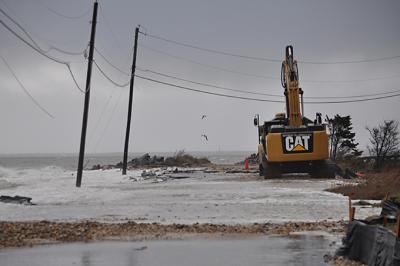
Gerard Drive in Springs was overtopped by waves and undermined during a November storm. Damage due to high storm tides has increased in recent years due to sea level rise.
David E. Rattray
Storms, flooding, pests; it’s not just a theory
By
Christopher Walsh

It was an opinion piece, but the headline of David Leonhardt’s New York Times essay of Sunday sounded definitive: “The Story of 2018 Was Climate Change.” 


“Extreme weather in 2018 was a raging, howling signal of climate change,” The Washington Post wrote on Monday, citing record rainfall, flooding, temperatures, and wildfires around the world, as well as extreme storms. 

NBC’s “Meet the Press” devoted its entire program on Sunday to discussions about climate change, and pointedly did not include voices from the tiny minority of climate scientists who deny its existence. 

“The story of climate change in 2018 was complicated — overwhelmingly bad, yet with two reasons for hope,” Mr. Leonhardt wrote. “The bad and the good were connected, too: Thanks to the changing weather, more Americans seem to be waking up to the problem.” 

Two weeks before Mr. Leonhardt’s column was published, East Hampton Town Supervisor Peter Van Scoyoc made the same observation. “The science on global warming was actually put to bed in 1979, just for people to understand how long it takes to get a concept to take hold,” he said. (“Carbon Dioxide and Climate: A Scientific Assessment,” published that year by the National Academy of Sciences, concluded that rising CO2 levels in the atmosphere would cause warmer air temperature in the troposphere, and found “no reason to doubt that climate change will result” from that rising concentration, “and no reason to believe that those changes will be negligible.”)

Four decades later, the concept “is taking hold now,” Mr. Van Scoyoc said. “People are starting to understand it, and they’re also seeing the changes in their own neighborhoods.”

Though the South Fork has been spared a hurricane in recent years, the signs of a warming world are difficult to miss in East Hampton. “I see it every day,” the supervisor, who lives in Northwest Woods, said. “I see the devastation of the [southern] pine beetles on my property. I see the eroding beaches — and it’s not just Montauk; in fact, there’s probably too much focus on Montauk.” In Springs, “Gerard Drive is continually getting washed out, not even by large storms. You go along up in the bay and see beaches there that have basically disappeared now. The water’s coming up, and the storms are getting worse.” 

“I’ve noticed, inside Lake Montauk, the beaches are less wide, shorter,” Ed Michels, the town’s chief harbormaster, said last month. Among the myriad responsibilities of the Marine Patrol Department, which he leads, is maintenance of docks and launch ramps. “The pilings that, at high tide, used to still [have] plenty of pole left are now getting too short,” he said. “We’re going to have to start changing pilings” because of sea level rise. 

Hurricane Sandy, in 2012, was an extreme event. Today, however, “for regular northeasters, we have water over the dock at the head of the harbor,” Mr. Michels said of Three Mile Harbor. “The water level has been higher, absolutely. Higher tides are higher. That’s a bit of a concern for us,” not least the prospect of floating docks surging over pilings, he said, or seawater inundating the dock-mounted electricity supply pedestals common at boat slips. “It wreaks havoc.” 

“We have some big marine infrastructure projects going — the jetty at Three Mile Harbor, the jetty at the Sammy’s Beach breakwater,” and, in 2019, “a long stretch at head of the harbor,” Mr. Michels said. Some years ago, he recalled, a small length of bulkhead there was patched with sheathing to extend its life. “Now we’re ready to start working on that, but I’m being told by our engineers that it’s below grade now.” 

“We’ve made it part of our priorities, when we redo any bulkheads, to raise the level by at least a foot,” said Mark Mendelman, vice president of Seacoast Enterprises Associates, which operates four marinas and two boat yards on Three Mile Harbor. “If we can, we try to go higher. We’re definitely seeing more evidence” of sea level rise, he said, including “the frequency at which we get water in the parking lot, water coming up over the bulkheads.”

“We had four serious northeasters last year,” said Bill Taylor, the town’s waterways management supervisor and a town trustee. “We’re getting bigger rains. I think the commercial dock was under water once already. These things that happened every 15 years are happening every year now.” 

Fish species are migrating northward, Mr. Taylor said. “Yes, it’s really happening: Look at lobsters. They used to be all over here. They didn’t really die off, they just moved north. In Maine, Massachusetts, there’s a bounty on them. They’re moving up in Canada.” 

“Fish vote with their fins,” he said. “They swim to where the water temperature is right. As far as global change, we’re in the most premier fishing spot, practically, in the world. When you’re in the best spot, change is not your friend.”

There may be multiple factors in play, said Rebecca Young, a nurse at the Tick-Borne Disease Resource Center at Stony Brook Southampton Hospital, but a warmer climate means that ticks are more active during the winter. “I see more tick bites throughout the year than there used to be,” she said yesterday. Ms. Young fielded more than 1,000 calls about tick-borne illnesses last year, she said, and more people were admitted to the hospital, “not with Lyme disease necessarily, but maybe with co-infections,” as the deer tick can carry several diseases, including babesiosis. “It seems like it’s increasing: more tick bites, more antibiotics distributed . . . and more people admitted to the hospital with infections.”

“Tide gauge and satellite measures of water level document that global [sea level rise] acceleration is occurring and that the Atlantic Coast between Boston and Cape Hatteras is a ‘hot spot,’ ” according to “Anthropocene Survival of Southern New England’s Salt Marshes,” published in 2016. “While relative sea level has been rising since the Last Glacial Maximum,” around 20,000 years ago, “rates of [sea level rise] for the U.S. Northeast and Mid-Atlantic region are accelerating significantly faster than rates for the U.S. Pacific and Gulf Coasts.” 

“At the height of glaciation, sea level was about 100 meters lower than today,” said Scott Warren, the Tempel professor of botany emeritus at Connecticut College in New London and a co-author of the study. Initially, as glaciers melted, it rose one-half to one centimeter per year on average, he said, slowing to around one millimeter per year around 4,000 years ago. “Probably in the mid-1800s it began to speed up again,” from around one millimeter to between 2 and 2.5 millimeters. Though causality is uncertain, “It certainly is coincident with the first stirrings of CO2-induced climate change,” he said. 

Then, “between 1980 and 1990 it began to accelerate. Let’s say the mid-1980s to now — 30 to 35 years — it’s been going up double again, about four to five millimeters per year, and shows no sign of going down. We know that at least part of the sea level rise is due to thermal expansion of the top 100 meters of the ocean. Warmer water is bigger water: Things expand when they get hot.” Melting of terrestrial glaciers is also responsible, he said, as is the melting of the Greenland and Antarctic ice sheets. 

Even if the steep reductions in CO2 emissions urged in the Intergovernmental Panel on Climate Change’s October 2018 report were to begin immediately, “There’s a lot of global warming baked in to what we have done already,” Mr. Warren said. “There’s a lot more heat in the ocean than we thought. That’s probably going to accelerate the melting, or the movement, of some of the Antarctic glaciers. It certainly is accelerating the melting of the Greenland ice sheet. This is not going to slow down for a while.”

Inevitably, he said, as sea level rises, “salt water is going to push farther into brackish and freshwater marshes. Certainly in a place like Long Island, that has the potential to raise significant problems in groundwater.” 

Long Island, Mr. Warren predicted, will experience nuisance flooding such as that routinely occurring in Miami Beach. “I don’t know the exact topographic details of the roads, but some of them aren’t very high above sea level. Sound Avenue,” on the North Shore, “surely isn’t. I’d be concerned if I had a septic system close to the shore. . . . People with lawns right down to the edge of the water are going to find they’re mowing salt-marsh hay, or some wet stuff,” he said. “It’s not going to be so nice.”  

In October, President Trump reversed his position on climate change, to a point, acknowledging that the climate is changing but adding that “it’ll change back again.” In fact, Mr. Van Scoyoc said, present patterns will not change. “It’s going to be like this for years to come,” he said. Nonetheless, he is optimistic. “I do think we have the capacity as human beings to figure out how to solve some of these problems and adapt,” he said. “What kind of world do you want to have to adapt to, though? We have it pretty wonderful right now. We need to keep that perspective.”

Tags Environment Climate Change

Supervisor Takes Stock, Looks Ahead to 2019

Supervisor Takes Stock, Looks Ahead to 2019

East Hampton Town Supervisor Peter Van Scoyoc said that the town board made good progress on a number of difficult challenges in 2018.
Durell Godfrey
Water quality, climate change, and affordable housing topped the agenda and are likely to remain there
By
Christopher Walsh

East Hampton Town Supervisor Peter Van Scoyoc looked back on his first year at the helm of the town board with a strong measure of satisfaction and plans to continue working on multiple fronts in 2019. 

Efforts to address and mitigate myriad impacts of climate change, water contamination, and affordable housing occupied much of the board’s attention in 2018, and are certain to demand more of it in the new year and beyond. 

One year into his two-year term, Mr. Van Scoyoc would not comment, in an interview last month, as to his plans to seek re-election, preferring to wait until after the New Year to make any announcement. Two of his colleagues, Councilwoman Sylvia Overby and Councilman David Lys, are also up for re-election in November. They, along with Councilwoman Kathee Burke-Gonzalez and Councilman Jeff Bragman, make up the town board’s present 5-0 Democratic supermajority. 

“There’s always something that will pop up to surprise you,” Mr. Van Scoyoc said, “but for the most part I think we’ve had a very successful year.” The town faces a number of challenges, he said, “which I think we’ve made good progress on addressing, both short term and long term.” 

The year was brand new when a “bomb cyclone” dumped snow across the South Fork. “I guess it should have been foreshadowing — a state of emergency declared within the first couple of days being in office,” Mr. Van Scoyoc said. “Of course, one never knows how the weather is going to be in any given year, but we certainly had a very strong storm season, a number of northeasters — four in three weeks in March.” 

Erosion was substantial. The geotextile bags installed by the Army Corps of Engineers at the ocean beach in downtown Montauk in 2015 were once again exposed and the beach considerably narrowed. “That’s an issue that’s not going away,” the supervisor said. “It’s one that’s been around for some time as well,” but Hurricane Sandy, in 2012, “really lowered the elevation of that beach quite a bit.” 

“We rose to that challenge,” he said, “and met the short-term demands of making sure there was nice, white beach for the summer season.” 

Short-term weather events aside, the long-term impacts of climate change will inevitably force a reckoning, not least in coastal communities. The Army Corps apparently plans to provide significantly less sand to replenish Montauk’s downtown ocean beach, in its decades-in-the-making Fire Island to Montauk Point Reformulation Plan, than town officials had hoped, prompting last year’s establishment of the Montauk Beach Preservation Committee, which is exploring creation of an erosion control district and its funding mechanisms. 

Parallel to that exploration is the Montauk hamlet study, part of the examination of each hamlet to be incorporated into the town’s comprehensive plan. A key component of its recommendations is a planned retreat from downtown Montauk’s ocean shoreline. “There is a vision about what to do in Montauk long term,” the supervisor said. An erosion control district would “help bridge that transition from development right on the edge to pulling back.” 

In a public hearing last month, some Montauk residents criticized the plan. Those against it, Mr. Van Scoyoc said, “are worried that creation of an erosion control district will just delay the inevitable. That is kind of the purpose of the next step, to give us time to make that transition without it being highly disruptive. If you got a big storm — which can still happen in any given year — you could lose that whole front row” of oceanfront resorts on South Emerson Avenue. “Either we’re going to adapt or nature is going to help us adapt,” he said. “It’s going to force our hand.”

The district “should be tailored as narrowly as possible so that those who have the most at risk and gain the most monetary benefit are also the ones who pay the most for replenishment,” he said. “I think that’s only fair.” 

In 2018, the town board continued the course set in 2014 with its Climate Action Plan, a goal to meet all of its energy needs through renewable sources. The first megawatt-scale solar farm on the South Fork, at the former brush dump on Accabonac Road in East Hampton, has come online. Parallel to that, “We’ve encouraged rooftop solar on residential and commercial properties by aggregating and offering 20 to 30 percent below market cost of rooftop solar,” Mr. Van Scoyoc said. “As part of the Energize East Hampton effort, we’ve encouraged people to change their pool pumps out with significant rebates for that equipment, helping to shave power demand.” 

Public participation “has been good,” he said, and is gaining momentum. “People are understanding that not only is it just really good for the environment, but it’s really good for their bottom line. People can hedge the costs of future energy increases, and reduce their bills and have more spending money in their pockets.” 

The town’s initial goal of achieving 

its electricity needs through renewable sources by 2020 cannot be met, he conceded, given that the South Fork Wind Farm, a proposed 15-turbine installation to be situated approximately 35 miles from Montauk, will not be operational before late in 2022. “That would probably be the soonest that we would meet our 100 percent renewable energy goal.” 

The larger aspiration, to meet the equivalent of 100 percent of economy-wide energy use with renewable sources by 2030, including electricity, heating, and transportation, “is a little more difficult to get at,” the supervisor said. “With regard to the fuel side, we have been encouraging the expansion of electric-car charging stations.” The town has installed charging stations, is planning more, and is entertaining proposals from Tesla Motors to augment that infrastructure, and “the town itself is in the process of changing out some of its automobile fleet with electric cars.” Five Nissan Leaf electric cars will imminently replace various town departments’ gas-powered vehicles. 

Water contamination remains a front-burner issue. In addition to the Suffolk County Water Authority’s recent installation of approximately 45,000 feet of water main after the discovery of perfluorinated chemicals in many private wells around East Hampton Airport in Wainscott, several waterways experienced harmful algal blooms in 2018, as in previous years. Nitrogen loading from aging septic systems is a primary culprit. 

“We would all hope that the 360,000 septic systems in Suffolk County be upgraded as quickly as possible,” Mr. Van Scoyoc said. “On a per capita basis, East Hampton leads the county, which I don’t think should be surprising: We also have the most restrictive waste codes in the county. We require upgraded systems on all new construction and substantial renovation and reconstruction.” 

He referred to the County Legislature’s vote to expand the scope of the 2017 Residential Septic Incentive Program, which happened one day after the interview, and for which the town board signed a letter of support. The program offers grants for the installation of innovative and alternative onsite wastewater treatment systems. Its expansion “would increase the number of people who are eligible for that grant, and have an additional amount of $5,000 for those who qualify as low income. It also would make rental properties eligible, and others.” 

The supervisor admitted to a need for “a lot of public relations work to promote” septic system replacement and its modest economic impact, given available incentives, as well as the environmental benefit. “Getting people more conscious about disposal of that waste and how they can improve it is an ongoing effort.” Several property owners around Georgica Pond, as well as along Hog Creek and Accabonac Harbor, have installed or are in the process of installing low-nitrogen systems, he said. “Those are priority areas in terms of seeing the most immediate improvements in surface waters.”

A parallel goal for 2019, he said, is to expand the town’s aquaculture infrastructure, expanding the program under which residents grow filter-feeding bivalves in town waterways, “which really makes a huge impact on habitat restoration and water quality, not to mention an economic impact as well, in terms of fisheries.”

Affordable housing remains scarce, but Mr. Van Scoyoc pointed to the imminent completion of the 12-unit Manor Houses on Accabonac Road in East Hampton and the Jan. 17 public hearing on the town’s acquisition of a site off Route 114 just outside Sag Harbor, at which 20 to 30 units could be built. Another 38 units are slated for occupancy by the end of 2020, at 531 Montauk Highway in Amagansett. “We know there’s more to do,” Mr. Van Scoyoc said, “but you have to get the work into the pipeline. We’re also looking at a couple of other, additional affordable housing properties for acquisition.”

Along with that effort, continued build-out of rooftop solar systems on residential and commercial buildings, and a further transition of the town’s vehicle fleet to electric models, Mr. Van Scoyoc wished for “some more headway on having safer, saner modes of transportation around town” through improved public transportation and more bicycle and pedestrian paths. “I’d really like to see a recreational bike path joining hamlets,” he said. “It would alleviate traffic. We’re an outdoor community, particularly in the summertime. Many people would take advantage of riding bikes if they felt safe. We’re going to try and figure out how we can start working on that.”

Revisiting the Shellfish Program

Revisiting the Shellfish Program

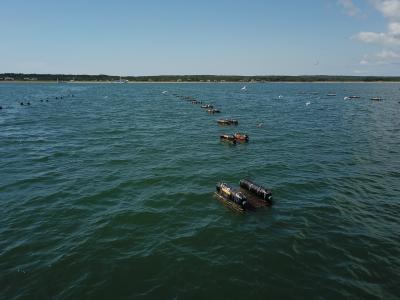
Oyster boxes in Gardiner’s Bay
Photo by Clayton Sachs
By
Christopher Walsh

The East Hampton Town Trustees will hold a special informational session on a 10-year review of the Suffolk County Aquaculture Lease Program, which has proven controversial in East Hampton, on Wednesday at 6 p.m. The public has been invited to attend the meeting, which will be held at Town Hall, and offer comment. It will be televised on LTV. 

The aquaculture lease program provides access to marine space for private, commercial shellfish aquaculture. The county developed it for publicly owned underwater lands in Peconic Bay and Gardiner’s Bay. Participants lease 10-acre plots, for a period of 10 years, for cultivating shellfish. 

Wednesday’s meeting is to include a history of shellfish aquaculture in Peconic and Gardiner’s Bays; the development of the existing shellfish aquaculture lease program, its administration, and current status; lease program maps and online information available to the public; contemporary aquaculture practices in the bays, and an overview of the lease program review process. East Hampton residents have been encouraged to comment on the program as part of the 10-year review. 

The program was established after New York State ceded title to approximately 100,000 acres of bottomlands to the county in 2004 and authorized the implementation of an aquaculture lease program for the region. The program was adopted in 2009, and the 10-year review will assess legal and administrative requirements governing its operation and recommend changes. 

A 10-year advisory group was established to obtain public official and stakeholder interest group involvement. John Aldred, representing the trustees, is a member of that group, as is Barley Dunne, the director of the town’s shellfish hatchery, who represents the town. 

The changing seascape brought about by the appearance of oyster farms offshore irritated members of the Devon Yacht Club in Amagansett and residents who live along Gardiner’s Bay. Early last year, an attorney for the yacht club filed a lawsuit in State Supreme Court seeking to bar leaseholders situated near the club from undertaking or continuing any action related to oyster farming at lease sites granted by the Aquaculture Lease Board in July 2017, or engaging in any other activity that would interfere with sailing. The Aquaculture Lease Board, the county’s Planning Department and its director, the Amagansett Oyster Co., individual leaseholders, the town, and the State Department of Environmental Conservation, which regulates and issues permits for shellfish cultivation, were all named in the suit. 

One of the program’s lessees had informed the club that they were going to build out a lease site 1,000 feet from the end of the club’s pier. Lease sites approved in 2017 were concentrated and mostly contiguous, rendering a few hundred acres off limits to Devon’s more than 300 member families, an attorney for the club said. 

The dispute, and shorefront residents’ surprise at the changing seascape, prompted Mr. Aldred to call for an informational session to be held in East Hampton, so that stakeholders’ opinions and concerns would be addressed throughout the course of the review. 

In the meantime, the trustees will resume business with a brief organizational meeting at their Bluff Road, Amagansett, office on Monday at 6:30 p.m. Their next regular meeting will be on Jan. 28.

Shutdown Hardly Felt Here

Shutdown Hardly Felt Here

By
Isabella Harford

The federal government remains shut down, as Democrats and Republicans continue to disagree over a controversial budget proposal for improved border security. As both parties continue to deliberate, the shutdown has wrought havoc on a national level, with several major departments ceasing to function as millions of federal employees have been furloughed. The implications of the federal shutdown on a national level are pertinent, however, it appears to have had minimal effects on the East End of Long Island so far.

Federally funded and operated facilities appear to be functioning as normal through the shutdown. The Northport Veterans Medical Center has continued to run its normal hours, as the Department of Veteran Affairs secured its funding before the government shutdown. 

The National Wildlife Refuge System has released a notice stating, “where public access to refuge lands does not require the presence of a federal employee [. . .] activities on refuge lands will be allowed.” Residents and visitors can still enjoy the scenic coastal area. However, the National Wildlife Refuge System does emphasize “entry onto refuge system property during this period [. . .] is at the visitor’s sole risk.” 

For some, a far more imminent fear may have arisen surrounding the potential effects of the shutdown on Section 8 housing, which is a federally funded program. However, the Department of Housing and Urban Development has prepared for short-term shutdowns by creating a contingency plan that has allowed the department to calculate and pre-load funds onto its electronic system up until the end of February. While tech support for the electronic program is currently unavailable, there is nothing to suggest the pre-loaded funds will not arrive. Tom Ruhle, director of housing for the Town of East Hampton, used the words “unchartered water” when discussing the potential effects of a prolonged government shutdown. However, Mr. Ruhle suggested everything should continue to function as normal for now. 

In a letter last week, Mathew W. Sibley, rear admiral of the Coast Guard, wrote that “While all Coast Guard military members continue to report for duty in service of our country during this partial shutdown, they do so without pay until an appropriation is passed by Congress,” a situation that could have an impact on members of the Coast Guard stationed in Montauk, most specifically junior members, as many may be unable to cover their monthly financial obligations. There is also a Coast Guard station in Shinnecock. The Montauk station covers operations for Gardiner’s Bay, Napeague Bay, Block Island Sound, the South Shore of Long Island, and along coastal Connecticut. 

However, on Friday night, the official  blog for the Coast Guard work force published a post stating, “the administration, the Department of Homeland Security, and the Coast Guard have identified a way to pay our military workforce on December 31, 2018.” The one-time emergency paycheck means local guardsmen will not be affected in the short term by the government shutdown.

To Expand Septic Program

To Expand Septic Program

By
Christopher Walsh

The Suffolk County Legislature voted on Dec. 18 to amend the Residential Septic Incentive Program, a grant assistance program for the installation of innovative and alternative wastewater treatment systems, to expand the pool of those eligible to participate in it. 

The five-year, $75-million program was established in 2017 to encourage property owners to replace conventional septic systems with new models in order to reduce nitrogen seepage into waterways. Excessive nitrogen contamination is a primary culprit in the harmful algal blooms that have fouled several waterways on the South Fork and across Long Island. 

“The overall goal is to broaden the range of eligible properties to make sure those dollars get out the door,” Legislator Bridget Fleming said. “It’s very, very important.”

The East Hampton Town Board signed a letter of support for the program’s expansion, Supervisor Peter Van Scoyoc said last month. 

Accessory dwellings, whether part of a property’s primary residence or a detached structure, are now eligible, as are multifamily dwellings. Along with individuals, firms, partnerships, corporations, trusts, or other legal entities are also now eligible under the expansion. In addition to property owners, tenants are now eligible to take part. 

The maximum grant has also been increased. Applicants are now eligible for a grant of up to $15,000, up from $11,000, and up to $20,000 for applicants deemed low or moderate income, as determined by area median income according to the federal Department of Housing and Urban Development. 

The county received and allocated just over $10 million in state funding for grants to eligible property owners, out of the $15 million for the program’s first year, “which indicates what a strong program it is,” Ms. Fleming said on Monday. “Kudos to East Hampton Town and Supervisor Van Scoyoc for their leadership, because I think 55 percent of grants that have been awarded to date have gone to my district,” which comprises the Towns of Southampton, East Hampton, and Shelter Island, as well as parts of Brookhaven. “All of East Hampton’s support for environmental issues, and certainly clean water issues, has been huge.”

Separately, the Town of East Hampton offers rebates, through the community preservation fund’s water quality improvement fund, to property owners who upgrade to an approved low-nitrogen septic system. Those with an annual income less than $500,000 are eligible for a rebate of up to $10,000, up to $16,000 if the property is within the water protection district.

State Encourages Electric Cars

State Encourages Electric Cars

By
Isabella Harford

A statewide initiative has begun to encourage the use of electric vehicles and increase charging hubs. The initiative includes additional public fast-charger networks across the state,  regulatory actions to lower residential charging rates, and rebates of up to $2,000 for the purchase or lease of a new electric car from a participating dealer. 

High speed charging hubs will be installed along major traffic corridors as well as the John F. Kennedy Airport taxi-hold lot. Two fast chargers also will be installed in Islip and Freeport. The chargers will give travelers between Montauk and New York City the ability to charge their cars in fewer than 20 minutes. Construction of the fast chargers is to begin in the spring. 

The Public Service Commission has also acted to allow residents options to charge  vehicles during off-peak times for standard rates. 

Through its Drive Clean Rebate, over 40 different electric car models are available under the rebate program with more than $15 million already approved in rebates for New Yorkers. 

 State Assemblyman Michael Cusick, the chairman of the Committee on Energy, said in a release, “Less than 2 percent of cars sold in the United States last year were electric. It’s important for government to lay the foundation for future success in this sector in an effort to reduce pollution and spur investment.” 

The  initiative will help reach Gov. Andrew M. Cuomo’s clean energy and climate goals and the state’s target of reducing carbon emissions by 40 percent from 1990 levels by 2030.

Government Briefs 01.03.19

Government Briefs 01.03.19

By
Christopher Walsh

East Hampton Town

Committee Opposes Wind Cable

The Wainscott Citizens Advisory Committee has taken a formal stand against Orsted U.S. Offshore Wind’s plan to land a cable from its proposed South Fork Wind Farm at the ocean beach at the end of Beach Lane in that hamlet. 

In a Dec. 24 letter to the East Hampton Town Board, Barry Frankel and Susan Macy of the committee cite “grave concerns among residents and property owners,” such as changes in Orsted U.S. Offshore Wind’s plan allowing an increase from 90 to 130 megawatts of electricity to travel underground through the hamlet to the Long Island Power Authority’s East Hampton substation; the size of the transition vault to be buried at the Beach Lane road end, and a “lack of convincing scientifically-based studies easing concerns with regard to beach erosion, cable damage and/or exposure,” and the electromagnetic frequency emanating from it. Orsted U.S. has previously been known as Deepwater Wind in The Star.

More than 1,000 residents, property owners, business owners, and renters have signed a petition objecting to the Beach Lane landing, the letter notes. Members of the C.A.C. also feel that Orsted “has not been straightforward about the scale of the project and its impacts on Beach Lane and throughout the local community,” the letter says. 

In its application to the New York State Public Service Commission, Orsted listed Beach Lane as the transmission cable’s preferred landing site, but included state-owned land at Hither Hills State Park on Napeague as an alternative. The Wainscott C.A.C.’s letter urges the town board to insist on the latter site. 

Orsted U.S. Offshore Wind has offered a community benefits package worth more than $8 million to the town in exchange for whatever easement and lease the town board and trustees deem necessary to grant for the company’s plans at Beach Lane