Tonight’s the Night (Or Is It?)

Tonight’s the Night (Or Is It?)
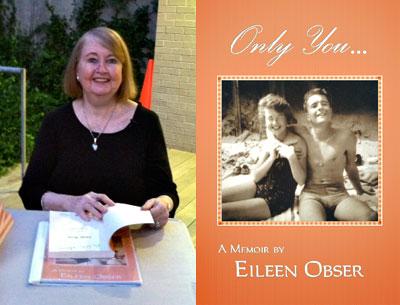
Eileen Obser at a reading at the Hampton Library in Bridgehampton.
By Rita Plush

“Only You”

Eileen Obser

Oak Tree Press, $14.95

Eileen Obser, freelance writer, editor, and teacher, has written a book about sex.

Now that I’ve gotten your attention, “Only You” is a memoir about her experience as a 1950s teen bride in Queens, unable to give her young husband, Billy, what he clearly wants and expects on their wedding night. And every night thereafter — daytimes too — though it’s not for her lack of trying.

She’s scared and he’s persistent. “What’s the matter with you, anyway?” he asks after his honeymoon advances fail to arouse her.

Worried that something is wrong with her, but intuiting that her mother would not be the one to ask — months before, she had told her young daughter that she was relieved her husband “doesn’t bother me anymore” and “finally leaves me alone” — she bears her burden silently, too humiliated even to share her secret with a beloved aunt.

Sometimes “trying,” other times putting Billy off with “later,” often faking sleep to avoid sex, always dreading the night, Ms. Obser finds herself with nowhere to turn.

Using song titles of the era as chapter headings, Ms. Obser evokes Lindy Hops, a candy store crowd, and good middle-class Catholic girls not “doing it” till they marry — marriage being a ticket out of her parents’ house, with their quarrels and constant bickering about money, of which there never seems to be enough.

A ticket out of one problem, maybe, but an express train to another — her handsome husband is possessive and could be crude and obnoxious. The intimacy she believes sex will bring eludes her.

Wondering if she would feel differently “with another guy,” she remembers Augie Vrondis, her “biggest teen crush,” and a dance contest they won.

“We moved dreamlike, possessed. Round and round, back and forth, swinging, swaying. Come close, get wrapped up in each other’s arms, soooo close, then separate. Do it again.” A joy in movement.

Her emotional pain and desire for more in her marriage made clear, Ms. Obser again recalls better times, and in one of the book’s livelier scenes — I often found the narrative lacked momentum, with sundry details about what characters said and wore slowing it down — she tracks back to her father, Albert Kirchner, previously drawn as humorless and stingy, now mimicking Edward R. Murrow interviewing a celebrity.

“It’s good to see you, Ed,” my father said, taking him to our bay window and pushing aside the limp, off-white curtains. “As you can see, we have quite a view from here,” and his hand swept . . . a view of the tops of more houses, a few trees, the railroad tracks and a cemetery to the left. . . . “This is a little something from our art collection,” he said, pointing to a faded, stained Currier & Ives print that had hung there for as long as I could remember.

. . . He kept it up, showing “Ed” all our family treasures — ashtrays, beer glasses, the inside of our coat closet, stains on the rug, until my mother, Buddy [her cousin], and I laughed so hard our stomachs ached.

A year and a half into her marriage and still a virgin, Ms. Obser takes matters into her own hands.

She consults with her priest. She sees a doctor, telling him of “the stomach spasms, dull aches and heartburn” that plague her when it’s time for bed. A simple surgical procedure solves the physical side of her problem. She can “do it.” But in an odd turn of events, now that she’s willing and able, Billy has other ideas. Annulment is what he’s thinking; he’s found someone else.

“Cast aside, rejected by [her] husband,” the ending of her marriage feels like “the death of all thoughts of love and happiness.” But Ms. Obser rallies. She gets a job, her own apartment, and takes college courses — she’d wanted to go to college for a long time, but Billy wouldn’t allow it, and she had “no idea how to even begin to accomplish such things.”

“In just a few years,” the ending paragraph tells the reader, Ms. Obser “would have a new man” in her life. One whom she would marry and with whom she would have children. I would have welcomed more about this new man, the circumstances under which they met, and how he differed from Billy.

Not skittish about discussing the complications in her early marriage, Ms. Obser takes on the dicey subject of sexual dysfunction — a word unknown at the time — in a forthright and honest manner, not blaming herself or Billy, but fixing the end of her marriage to the notion that the “kids,” as she calls the two of them, were “perhaps too young and ill-informed to make a marriage work.”

Rita Plush is the author of “Lily Steps Out,” a novel, and “Alterations,” a book of short stories. She lives in Queens and East Hampton.

Eileen Obser lives in East Hampton.

Ah, Pushcart in the Afternoon

Ah, Pushcart in the Afternoon

At the East Hampton Library
By
Baylis Greene

All in the family, sort of, the Springs and Pushcart Press families: Linda Coleman, whose memoir, “Radical Descent,” is newly published by Pushcart, and Bill Henderson, the press’s founder, both of whom live in the hamlet, will join up for a two-for-one reading and book chat on Saturday at 1 p.m. at the East Hampton Library.

Mr. Henderson will have new work on hand, too — “Cathedral: An Illness and a Healing.” Just out from W.W. Norton, it relays the experiences of “an aging man,” he writes, “who builds a holy place in his backyard. It involves bugs, lousy weather, cancer, and spiritual waverings.” In other words, it is in some ways a follow-up to two of his previous books, “Tower: Faith, Vertigo, and Amateur Construction,” which detailed his building efforts on his property in Maine, and “Simple Gifts: One Man’s Search for Grace,” a personal look at great hymns of the Protestant tradition.

Ms. Coleman’s book, subtitled “The Cultivation of an American Revolutionary,” chronicles her troubled “descent” from a privileged background into the life of an early 1970s leftist radical, to the point of facilitating violence. Now an ordained Zen Buddhist monk, she has taught memoir writing to incarcerated women and works as a nurse.  


Radical Descent . . . Into What?

Radical Descent . . . Into What?

Linda Coleman
Linda Coleman
Ann Fuller
By Ted Rall

“Radical Descent”
Linda Coleman
Pushcart, $18

At first glance, Linda Coleman’s “Radical Descent: The Cultivation of an American Revolutionary” looks like another entry in a familiar genre: confessions of a late-1960s, early-1970s radical leftist.

You know the story. Twenty-something baby boomer out to change the world, right the wrongs, save the planet, end the (Vietnam) war, and emancipate the poor realizes that marching for peace won’t do the trick when the cops have more guns and are willing to use them and tear gas against you and your fellow hippies.

I’ve made the argument myself: Political and economic elites, people who have more power and money than the rest of us, 1-percenters in the parlance of the late, not so great, Occupy Wall Street movement, will never relinquish their prerogatives or their privileges or their cash just because we ask politely or because it’s the right thing to do. Theirs is a system, gangster capitalism, that is unspeakably violent, militaristic, and brutal in every way; it only stands to reason that adhering to strictly nonviolent tactics will not, cannot, and indeed never has worked in effecting radical, revolutionary change.

The kind of progress that Linda Coleman and her comrades in groups like the Weather Underground and Students for a Democratic Society sought was wholesale change on the scale — though not necessarily executed the same way or with the same desired results — of the uprisings that toppled the governments of France in 1793, Russia in 1917, and China in 1949. Under this radical vision, those who are rich will no longer be rich, those who are poor will no longer be poor, those who are in charge will no longer be in charge, those who are not in charge will be in charge.

Ms. Coleman is a member of the last American generation whose left included a significant number of activists who craved revolution, real revolution, and came to the conclusion that violence would be necessary in order to effect it.

Ms. Coleman’s political awakening, though percolating for years beforehand, occurs at a leftist bookstore in Portland, Me. “Every day that passes I learn more about the way power works in this country, what color you have to be, what sex, what class or religion to have a place at the table, the dining room table. Otherwise, you eat in the kitchen. You eat leftovers if you eat at all. Every day my commitment to become a revolutionary deepens.”

She decides to act. She joins an obscure revolutionary cell. Like many of her comrades, Ms. Coleman is bourgeois. And she feels guilty about it.

And weak. Referring to Che’s classic appeal to the revolutionary to love, “I thought about how there was something . . . lacking in me, something I had to change. To be revolutionary, I couldn’t just love, I had to let the hate in too.”

Much of “Radical Descent” is dedicated to Ms. Coleman’s failed attempts to mimic the hardened men with whom she falls in, a group of criminals who rob banks in the name of the revolution but in truth lead no movement, have no connection to the masses, and commit the most grievous sin someone who seeks to emancipate the human race can possibly commit: Rather than follow the people, they run off half cocked, doing whatever the hell they feel like while wrapping their crimes in the veneer of radical action.

When I read or watch accounts of small groups like the Weather Underground and the Red Army Faction, I am usually frustrated by the absence of basic Marxist analysis at the time, or even now.

No one can jump-start a revolution. Revolutionary situations require a witches’ brew of state oppression, economic despair, and bourgeois sympathy triggered by self-interested frustration with their own inability to advance their station in society, among other factors. The fact that none of those basic conditions existed in the late 1960s or the early 1970s in the United States, when leftist radicals were robbing banks and hijacking planes and blowing up draft offices, ought to have been obvious to anyone who had cracked open a copy of anything by Mao or Lenin.

Anyway, didn’t any of these people ever look behind and see that nobody was following them? After the big S.D.S. split of 1968 and the failure of the uprisings at Columbia University and in Paris and Tokyo, the students who led those movements splintered off into the work force to become cogs in the corporate machine, buy cars, and finally buy houses in the suburbs where they settled to raise their families.

Demographic and political realities of the time, and the failure to assess them, were the real errors of the 1970s radical left. To Ms. Coleman, however, the mistakes were personal. Men in the movement abused and even raped women. The money from bank robberies and from her trust fund — her comrades kept asking for donations — vanished into who knows what. They were, well, jerks.

A book should be judged by the intent of its author, but this otherwise well-written book doesn’t seem to exist to deliver a coherent message. It’s a memoir, a window into a time and a movement, and about as brilliant a description of an idealistic young woman’s confusion as I’ve ever read. But there’s too much personal narrative, not enough politics — and I don’t care to re-enact anyone else’s confusion.

In the end, the feds nail Ms. Coleman. Threatened with prison unless she betrays her former comrades, she testifies against them. “I’d go to jail. For as long as it took. At least I would have a righteous foot to stand on when I got out, if I got out. Had I been alone, I’m certain that’s exactly what I would’ve done. But I wasn’t alone. I was newly married. And then I was pregnant, and that changed everything. . . . There was no choice left at all.”

Having not had cops up my ass, perhaps I shouldn’t judge Ms. Coleman’s caving. But that’s what leftists do: We judge. Ms. Coleman wrote that Nelson Rockefeller deserved to die for policies that sent countless young men and women to jail, and here I will write that Ms. Coleman lied when she said she had no choice. She made her choice, it was an active decision, and she ought not to back away from it. It makes her sound too much like the naive young girl who walked into that bookstore in Maine decades earlier — and if a narrative needs anything, even one by a radical naif, it needs character development.


Ted Rall is a syndicated political cartoonist, columnist, and war correspondent. His books include “The Anti-American Manifesto” (2010) and, most recently, “After We Kill You, We Will Welcome You Back as Honored Guests: Unembedded in Afghanistan.” He will appear at BookHampton in East Hampton on Oct. 26 at 11 a.m.

Linda Coleman lives in Springs. She will give a reading at the East Hampton Library on Oct. 18 at 1 p.m.

Book Markers: 10.09.14

Book Markers: 10.09.14

Local book news
By
Star Staff

New Prize for Comic Fiction

Writers, you have until the end of the month to get your submissions in for the new Robert Reeves $1,000 Prize in Comic Fiction, courtesy of Stony Brook Southampton and judged by the college’s Daniel Menaker, a former fiction editor at The New Yorker. Stories of up to 5,000 words can be sent to The Southampton Review. The fee is $15.

“We won’t even try to tell you what we’re looking for,” a release said. “The comic impulse is so widely and variously expressed in fiction that it resists definition.”

In addition to a grand, the winner, announced by Jan. 15, will be hailed at the Manhattan launch of the Review’s spring 2015 issue, in which the winning story will appear. Others making the final cut may be published in the Review’s online version. The prize’s namesake, by the way, is the founder of the M.F.A. program in creative writing and literature at the college and the author of the comic novels “Doubting Thomas” and “Peeping Thomas.”

Gail Sheehy at BookHampton

The new BookHampton shop on Hampton Road in Southampton — smaller, tighter, somehow more browser-friendly than the old Main Street one — is already worth a visit, never mind when a writer of some renown is cracking the spine of a new book inside. That’ll be the case on Sunday at 2 p.m., when Gail Sheehy visits to read from “Daring: My Passages,” which traces her formative years, her famous work for New York magazine in the heyday of the 1970s and the publication of the best-selling “Passages,” and on up to later life and the difficulties of handling the death of her husband, the influential magazine editor Clay Felker.

Ms. Sheehy will also read at BookHampton’s Main Street, East Hampton, shop, on Saturday at 4 p.m.

And on a corrective note, Ms. Sheehy pointed out that in a Sept. 25 review of “Daring” in these pages it was inaccurately stated that she had a “lifelong” problem with alcohol. That problem surfaced only at the end of Mr. Felker’s life.

Victor Rugg’s “Everything Is”

Now for something completely different: a story of “what happens when an emissary from the bliss comes to earth to help save it from the greed and neglect of those who would exploit it.”

So says the jacket copy of Victor Rugg’s new self-published novel, “Everything Is,” which goes on to tout “an earthly conflict” that “rises to become an otherworldly experience that is in equal parts terrifying and enchant­ing.” This “head trip of a book” mixes Indiana Jones and Bernie Madoff.

Intrigued? You can find out more on Saturday starting at noon at the East Hampton Library, as Mr. Rugg, an East Hamptoner, photographer, founder of a graphics company, and former adjunct professor at L.I.U., reads from and discusses his work.

Adventures in Neverland

Adventures in Neverland

Patricia Beard
Patricia Beard
By Stephanie Wade

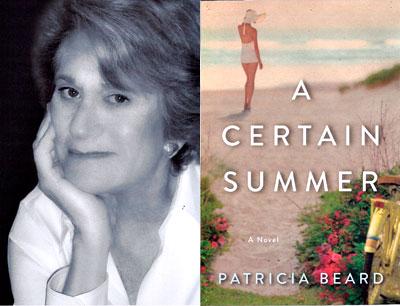
“A Certain Summer”

Patricia Beard

Gallery Books, $16

When a few days of Indian summer appear on the East End this autumn, pick up Patricia Beard’s debut novel, “A Certain Summer,” pack a picnic, and enjoy an afternoon of quiet beach reading.

Both Ms. Beard’s novel and a beach day in early autumn evoke another era — a slower time, a period of different manners and relationships — and both bring the past to life in such a way that a different future seems possible. Equal parts novel of manners, historical fiction, and quiet examination of social mores, “A Certain Summer” weaves important questions about class, gender, trauma, and family through its seemingly simple narrative as artfully as an experienced hostess arranges the seating at a dinner table so that conversations flow among acquaintances as well as friends.

Set in 1948 on Wauregan, an imaginary summer colony on an island off Long Island, “A Certain Summer” offers all of the delights of a beach read — a suspenseful plot, an array of sympathetic characters, and a setting so lovingly rendered that readers may feel they have escaped to the beach even if they are on the Jitney or weathering a northeaster. Nosy readers (such as me) will probably question which of Long Island’s outer islands inspired the novel’s setting. Stumped, my best guess is that Wauregan is a mash-up of Fire Island (because of its proximity to New York City) and Shelter Island (because of its size and aesthetics).

Most of the book is told from the perspective of Helen, whose husband, Arthur, was reported missing amid his work as a spy in World War II. Helen and her son, Jack, still hope for Arthur’s return three years after the war has ended.

The plot revolves around the circumstances surrounding Arthur’s disappearance, especially in relationship to Helen’s status as a married woman whose husband is absent. Not quite a widow, Helen begins to feel desire for other men after seven years apart from her still-beloved husband. While much of the narrative reads like a romance, Ms. Beard bucks the conventions of “they lived happily every after” by multiplying the possibilities available to our heroine and by situating her story in a context that clearly depicts the difficulties of married life as well as the advantages women gained during the war, when they exercised autonomy, freedom, and confidence.

“A Certain Summer” also questions conventions of masculinity, most overtly in its representations of the effects of war on the male characters. Ms. Beard employs a 21st-century understanding of post-traumatic stress disorder yet remains true to the world of the mid-20th century. In this way, she allows readers to see the physical and emotional damage caused both by war and by a world that did not have a complete grasp of this damage.

Initially, I was troubled by the novel’s seemingly one-sided representation of postwar anti-Japanese sentiments, conveyed via the language used by some characters and via the recollections of Peter, one of Helen’s romantic interests, who spends the summer with his grandfather at Wauregan, having returned from service in Japan, where he experienced and witnessed torture. Eventually, Ms. Beard balances Peter’s memories of brutality with his commitment to a new aesthetic, one that he learned to admire in Japan.

Here, as in her depiction of gender roles, Ms. Beard demonstrates an astute sensitivity to cultural politics atypical of the genre of summer fiction: Peter is changed by the violence of Japanese soldiers, and yet his future hopes are rooted in his desire to bring a new “way of living” to the United States, a way of living that he learned about in Japan.

In many ways, the world that Ms. Beard conjures is an adult, albeit inverted, Neverland, where joy is rooted in adherence to rules and customs rather than their dismissal, as in J.M. Barrie’s classic. But Ms. Beard shows that even magical retreats like Wauregan are subject to the vicissitudes of the modern world. In the end, in fact, it seems that Wauregan’s magic prevails in its very ability to change in a way that stays true to its origins, or, even more precisely, that magic prevails as Wauregan learns it must change to stay true to its origins.

Stephanie Wade is assistant professor and director of writing at Unity College in Maine. She spends summers in East Hampton.

Patricia Beard’s previous books include “After the Ball: Gilded Age Secrets, Boardroom Betrayals, and the Party That Ignited the Great Wall Street Scandal of 1905.” She is a summertime resident of Fishers Island.

Book Markers: 10.02.14

Book Markers: 10.02.14

Local book news
By
Star Staff

Secrets of Disney Animation

John Canemaker, who won a 2005 Oscar for his animated short “The Moon and the Son,” an imagined conversation with his father, will venture into “the Secrets of Walt Disney’s Movie Magic,” according to his new book’s subtitle, through one Herman Schultheis next Thursday at the Hampton Library in Bridgehampton.

The book’s title, “The Lost Notebook,” refers to a document kept by Schultheis, who worked for the Walt Disney Studio in the 1930s. Discovered in a forgotten drawer in 1990, it has been called “a covert scrapbook of special effects wizardry, capturing in photographs and text the dazzling, behind-the-scenes ingenuity of early Disney films.” Mr. Canemaker’s book explores its revelations as well as the complicated life of Schultheis, who walked into a Guatemalan jungle and was never heard from again.

Mr. Canemaker, an animation historian and professor at New York University, where he helped found the animation program, lives part time in Bridgehampton. His presentation starts at 7 p.m. In the meantime, he can be caught on Turner Classic Movies on Monday at 8 p.m., when he will co-host a showing of 10 animated films by the cartoonist Winsor McCay of “Little Nemo” fame.

For the Lit of It

Concerned about the future of small-fry literary journals and the fate of the indie bookstore? Funky Canio’s Books in Sag Harbor is offering a chance for you to put a $25 admission fee where your lit-loving mouth is Saturday with a fund-raiser twice over and a doubling up of poets reading. Rosalind Brenner and Pamela Kallimanis will read from their work starting at 5 p.m., the beneficiaries being Canio’s itself, naturally, and the Tupelo Press of North Adams, Mass., a nonprofit publisher of literary fiction, poetry, and creative nonfiction.

Ms. Brenner, who lives in Springs, is going so far as to take part in the press’s 30/30 Project and write 30 poems in 30 days. More about the project is at tupelopress.com. And, finally, an email promises “refreshments and fun” Saturday.

The Return of Obser

It’s become a tradition, hasn’t it? Eileen Obser, your friendly neighborhood writing coach over the last couple of decades, is back at it at the Hampton Library in Bridgehampton, offering a class in the crafting of memoirs and personal essays. It starts Tuesday from 5:30 to 7:30 p.m. and runs for five consecutive Tuesdays until Nov. 4. All levels of ability will be welcomed, and the cost is $65. Sign-up is by phone with the library.

The East Hamptoner, no stranger to these pages with her own memoir and “Guestwords” pieces, also is recently out with a book, “Only You,” chronicling her young adulthood in the late 1950s and early 1960s in the then-more-charming borough of Queens.

In the Thick of It

In the Thick of It

Gail Sheehy
Gail Sheehy
Gasper Tringale
By Phyllis Raphael

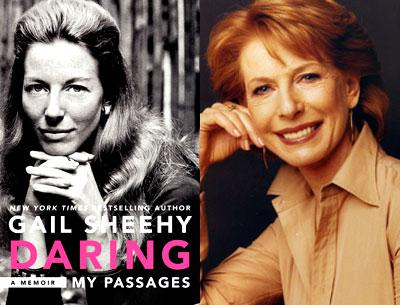
“Daring: My Passages”

Gail Sheehy

William Morrow, $29.99

Just as I was finishing Gail Sheehy’s “Daring: My Passages,” I noticed the headline of a story on the New York Times business page: “After a Year Under Bezos, Last Graham to Leave Post.” Katharine Weymouth, the granddaughter of Katharine Graham, the longtime Washington Post publisher, was stepping down. Her departure would bring down the curtain on 80 years of the Graham family’s connection to the prestigious newspaper that reported Watergate.

I mention this not only because the event marks the end of a certain kind of family relationship to print journalism that Ms. Sheehy portrays vividly in her compelling “memoir,” but also because Katharine Graham figures prominently among the dynamic characters who populate her pages — along with Mikhail Gorbachev, Margaret Thatcher, Anwar Sadat, David Frost, Tom Wolfe, Gloria Steinem, Geraldine Ferraro, Edie Beale, Hillary Clinton, Henry Kissinger, and Rupert Murdoch (hiss).

I could go on, but let’s get to Clay Felker, the innovative, obsessive, charismatic editor of New York magazine whom she falls in love with and weds after an on again, off again courtship that dates from Bobby Kennedy’s campaign for the presidency (they share their first kiss over the piece she’s written about Kennedy) to Mr. Felker’s proposal 16 years later. Their story doesn’t end there but threads its way through their marriage and Mr. Felker’s eventual poignant death from cancer.

If you are of a certain age and most likely of urban persuasion this book will resonate with you. Its familiarity captivates. You may have put the late ’60s and ’70s behind you, but Ms. Sheehy brings those days back again — a memory refresher so alive and abundant with detail you’ll live it again in a heartbeat. “Remember how avidly we read New York magazine?” a friend reminded me.

Remember Tom Wolfe’s article on “Radical Chic,” Leonard and Felicia Bernstein’s party for the Black Panthers? Recall “Click” by Jane O’Reilly — the moment of recognition when a woman becomes a feminist? How about the early days of “women’s lib,” the dinner party debates over gender roles, the birth of NOW, Betty Friedan’s National Organization of Women, the genesis of Ms. magazine (the first issue was an insert in New York magazine)? And there was the development of “New Journalism” — the art of telling a news story using the techniques of the fiction writer — dialogue, description, imagery, inner monologue. Under Mr. Felker New York magazine pioneered that writing style along with tantalizing graphics, political and social gossip, and thought-mongering articles designed to make you question your own lifestyle.

Gail Sheehy (the name Sheehy belonged to her first husband, a student in Rochester whom she supported through medical school) came to that maelstrom first as a reporter in the women’s department of The New York Herald Tribune. In what she describes as “the longest walk of her life,” she gathered up her nerve one day, left the female precincts (unheard of), and made her way through the male bastion of the newspaper (past Tom Wolfe and Jimmy Breslin clacking away at their typewriters) to pitch a story on group houses on Fire Island to the editor of the Sunday supplement — Clay Felker.

Her boldness paid off — he not only took her story but ultimately took her on as a writer when he left the Tribune to start New York magazine. He also encouraged her to write “Love Sounds of a Wife.” Her first book, it detailed in disguised form the end of her marriage to her first husband, who had been unfaithful.

On her own, with a child, a little girl, she took only child support and made her way as a single mother.

She wrote for Cosmopolitan. She wrote for New York magazine. She wrote about culture and specifically about the culture of women and couples. Inspired by Margaret Mead, with whom she studied under a fellowship at Columbia, she wrote a series on the “Fractured Family,” “Bachelor Mothers,” and women who were choosing to be “Childless by Choice.” “Can Couples Survive?” she asked in another article. She wrote about prostitution, embedding herself in the life to do it. In hot pants and go-go boots she went out on the street and cultivated doormen and hookers. She wrote about Edie Beale and her mother and Grey Gardens in East Hampton, the derelict mansion where those relatives of Jacqueline Kennedy Onassis lived with an army of cats.

Ms. Sheehy’s breakthrough came of course with “Passages,” her exploration of the developmental channels that men and women must navigate on their way to personal change and growth. An assignment in 1972 to cover the women involved in the Irish civil rights movement took her to Northern Ireland, where one sunny afternoon after a peaceful demonstration she watched a young man alongside her have his head ripped apart by a bullet. That look into the face of death on “Bloody Sunday” sent her spiraling into a breakdown. She questioned her place in the world.

“Passages” came out of the upheaval. The book — offering readers a window into self-knowledge — was a wild success. It spent three years on the best-seller list and changed Ms. Sheehy’s life, establishing her as a celebrity author and making her a very rich woman.

“Daring: My Passages” is a big book — 460 pages, and that’s not counting the acknowledgments or the index. Some of the most moving writing is devoted to the romance with Mr. Felker. In his iconic essay about New York, E.B. White writes of the three New Yorks: the city of the native who is born here, the city of the commuter, and the city of the man or woman who comes from somewhere else “in quest of something.” Of these three, the greatest is the last, he tells us. For that city “accounts for New York’s high-strung disposition, its poetical deportment, its dedication to the arts, and its incomparable achievements.”

Clay Felker, from Webster Groves, Mo., was a banner citizen of the third city. He culled the essence of Manhattan and funneled it into New York magazine, a publication that at once spoke to its time, created a distinctly Manhattan persona, and predicted the direction in which the city was headed. Ms. Sheehy, when she fell for him, was an innocent, she tells us, living on the Lower East Side (he had an East 57th Street duplex), trying to catch up with each month’s bills, get her daughter to school, make her deadlines. Early on she sewed her own dresses.

Moving in with him and being his lover and his hostess was more than she could add to the mix. And Mr. Felker adored not only the city, but its women as well. She left — but not forever. Their connection endured, even as her career rose and his plummeted. She was with him through Rupert Murdoch’s devastating, and for Mr. Felker heartbreaking, takeover of New York magazine, and at his side when he died of cancer.

“Daring: My Passages” is billed as a memoir and by some lights I suppose you might call it that, though it would be more accurate to call it biography or history. Ms. Sheehy is an accomplished journalist, meticulous and often passionate. The book is a thorough remembrance of her life . . . her entire life. And she’s had a big life. Along the way she adopted a Cambodian refugee, collected a batch of awards, and rubbed elbows with heads of state. I’m betting that what she didn’t recall or record she researched.

But a true memoir is more minute in scope and explores an issue or question central to the writer’s existence. Often, though not always, it offers a kernel of insight or resolution, something the reader can take away — even if it’s only an image.

It might have been illuminating to understand the sources of Ms. Sheehy’s supersized ambition and tenacity, the persistent will that built her career. In this context I harkened back to an early chapter; whenever she lost a swim meet, her father made her pull off a switch from their forsythia bush and swatted her soundly across her legs.

As an adult there seems to be no problem she can’t solve with an action. During his final illness, with a feeding tube in his abdomen, she takes the depressed Mr. Felker to Paris and persuades a high-end bistro to puree a French meal, which she pours into him as she eats. At the end of his life, when she begins to drink heavily, she lands in A.A. and, after a few spills, sobers up.

This is a life that bursts with solutions. Therapists, psychologists, doctors, psychiatrists, dear friends, meditation experts, and A.A. at the ready to offer fixes. None of these resources take her to an inner life. The inner landscape isn’t where she’s traveling, but problem solvers like Ms. Sheehy lead exciting lives, lives worth reading about. I’d say go for it.

Phyllis Raphael, formerly of Amagansett, is the author of the memoir “Off the King’s Road: Lost and Found in London,” now available as an e-book from Roadswell Editions.

Gail Sheehy had a house in East Hampton for many years and now lives in Sag Harbor.

The Real War Horse

The Real War Horse

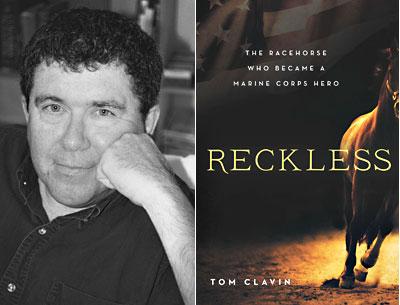
“Reckless” by Tom Clavin
New American Library, $28.95
By Amy Phillips Penn

Reckless. What a name for a Mongol racehorse turned honorary U.S. Marine with two Purples Hearts, a Bronze Star, and an insatiable appetite for poker chips and beer. No way to treat a filly, you say . . . but then again, Reckless became a legend with a happy ending, no spoilers need apply.

“Reckless: The Racehorse Who Became a Marine Corps Hero” by Tom Clavin has it all: from an incessant repetition of nauseating-meets-devastating images of the Korean War to a Marine platoon with a leader who knows the worth of a horse in the entourage, one possessing a sixth sense for detecting an approaching enemy by the wafting scent of garlic and rice.

Reckless, the chestnut filly, weighed in at 900 pounds, measured a feminine 14 hands, dazzled in a fiery red coat highlighted with white stockings, and had racing genes that could have made her a champion.

Her Korean name was Ah-Chim-Hai (Flame-of-the-Morning), a star and a haiku in the making if ever there was one. But then another life in paradise was shattered by a call to duty that no horse, or any other being, would want to embrace.

War raged. Her soulful, poetic name was changed to Reckless, a tribute to the recoilless rifles that her platoon was armed with. Reckless had been drafted for $250.

Her first owner, Kim Huk Moon, had fallen in love with the filly’s mother, who died. He raised the filly reluctantly at first, but, overwhelmed by the loss of her dam, gave her up. Then, no more tears: The grown filly brought joy and renewal with her pronounced re-entrance.

“One morning, Kim arrived at Sinseul-dong and saw Flame — since she was the spitting image of her mother, everyone there simply called her that — in the center field of the track with several other young horses. Suddenly, she broke away from them at a gallop. To the young man, it seemed that his beloved Ah-Chim-Hai had come back to life, but with three instead of four stockings. Kim knew of the Buddhist teachings of reincarnation, and there could be no better evidence of it than the new Flame.”

In the course of fate, dharma, and destiny, however, an American Marine was thinking about a horse.

“The god of war had a sense of humor, all right. . . . Chinese troops fell like bowling pins. The slaughter became so senseless that even their usually merciless Communist commissars allowed them to retreat. . . .”

“It was that hot August night, as he idly heard the sounds of the fight still going on . . . that Pedersen [the second lieutenant in charge of the platoon] first had the idea of finding a horse. . . .”

“She was part stallion, but in every other respect she was a Mongol mare,” a breed “little changed from the time of Genghis Khan, whose hordes rode them to create by his death in 1227 the largest empire the world had known. . . .”

Reckless’s arrival at the camp was beyond welcome. She would learn to carry artillery and wounded men for miles. Her admirable spirit made her a Marine in her own right, while shrapnel wounds carved an imprint onto her weary being.

Any reader who isn’t bionic will fall in love with Reckless, her mythological dedication to duty on the front lines of battle, her playfulness, her historical breeding, and her soldiering on to the amazement of even the most jaded of human warriors.

Reckless adjusted to Marine life smoothly. Off-duty she wandered as she chose, slept near her fellow Marines, and shared their beer and breakfast. She learned to navigate holes in the ground where artillery had blown the landscape into a reminder that war raged on, and how to recognize barbed wire and communication wires and maneuver around them.

She played games with her trainers, dancing, and then pretended to be fierce when it was time to go off for her daily work lesson. A piece of candy persuaded her to get on with her day. Hoofing into a poker game, Reckless helped herself to a mouthful of poker chips, wondering what kind of candy they were.

Reckless became a co-Marine and a boost to the morale of her platoon. Pedersen “observed when some of the sergeants played poker . . . how their faces lit up when the horse’s name was mentioned. These tough Marines became kids again.”

White stockings aside, “Reckless” has all the markings of a horse story meant for the big screen.

—

A former summer resident of East Hampton, Amy Phillips Penn is the author of “Diosa: One Mare’s Odyssey on Planet Earth.” She is working on a book about Elaine’s, the legendary Manhattan restaurant, for Skyhorse Publishing, and writes a weekly column for NewYorkNatives.com.

Tom Clavin’s previous books include “The DiMaggios” and “That Old Black Magic: Louis Prima, Keely Smith, and the Golden Age of Las Vegas.” He lives in Sag Harbor.

Pulitzer Winner at Writers Speak

Pulitzer Winner at Writers Speak

By
Star Staff

The Writers Speak series of readings returns to the Stony Brook Southampton campus Wednesday with Vijay Seshadri, who won the 2014 Pulitzer Prize in poetry for his collection “3 Sections.” Mr. Seshadri’s poems have appeared in The Paris Review, Poetry magazine, and The New Yorker, as well as in four editions of The Best American Poetry anthology. He teaches creative writing at Sarah Lawrence College.

The reading starts at 7 p.m. in the Radio Lounge, upstairs in Chancellors Hall, to be preceded at 6 by an open house held by the M.F.A. program in creative writing and literature.

The series also brings Nahid Rachlin and Elena Gorokhova on Oct. 8, Alissa Nutting on Oct. 22, Julia Fierro on Oct. 29, Joydeep Roy-Bhattacharya on Nov. 5, and, on Nov. 12, Brian Morton interviewed by the college’s Daniel Menaker, a former fiction editor at The New Yorker. Students in the M.F.A. program will read from their work on Dec. 3.


Court Cases That Mattered

Court Cases That Mattered

James D. Zirin
James D. Zirin
Julie Skarratt
By Sidney B. Silverman

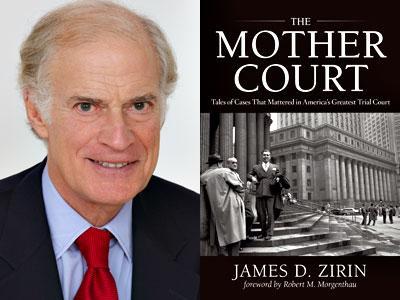
“The Mother Court”

James D. Zirin

American Bar Association, $29.95

What do bishops, celebrities, politicians, generals, professional athletes, Holocaust victims, drug addicts, and just plain folks have in common? All of them have chosen the memoir as the literary vehicle to lay bare their inner lives.

The craze began in 371 A.D., when St. Augustine, a Patristic Catholic and a bishop in his church, haunted by a boyhood misdeed — the theft of two pears from a neighbor’s tree — sought expiation by confessing that sin and others in a memoir aptly titled “Confessions.”

This summer, hundreds of East Hampton residents lined Main Street to gain admission to BookHampton, where on a hot Saturday afternoon, Hillary Clinton read from and signed her memoir “Hard Choices.” (The price of admission: the purchase of the book.)

A memoir bears certain similarities to an autobiography. In both, the narrators are the authors and the tale is told from their point of view. The two have an important difference, however. An autobiography is a documented chronicle of the author’s life; a memoir is a slice of life requiring no more documentation than a good memory. Because of the lesser demands on the memoirist, what started as a trickle 2,000 years ago has evolved into a tsunami.

The reaction of critics and readers to memoirs has not always been favorable. They have accused memoirists of having inflated egos, being afflicted with narcissism, and seeking to place a halo over their sinning heads. Sigmund Freud declined to write his, contending that to do so he would have to offend friends and enemies or shield them through acts of mendacity.

James Frey, in his memoir “A Million Little Pieces,” circumvented Freud’s dictum. Mr. Frey, a drug addict and alcoholic at age 23, wrote about his rehabilitation. In lieu of indiscretions and mendacity, he invented events and circumstances. His book soared to the top of The New York Times nonfiction best-seller list. When the fraud was revealed, sales increased (and The Times, inexplicably, continued to list the book as nonfiction).

James D. Zirin’s “The Mother Court: Tales of Cases That Mattered in America’s Greatest Trial Court,” is a memoir that avoids ego-tooting, narcissism, and mendacity. Mr. Zirin, a top-notch trial lawyer, focuses on the litigation skills of his contemporaries, not on his own. In a chapter probably unprecedented in the annals of legal writing, he rates his favorite judges, not only by naming them, but by showing why they deserve commendation. In another stark departure, he excoriates other judges by describing their lapses in judicial temperament, intelligence, or both.

Like judges, there are good lawyers and bad ones. An effective lawyer will make his case attractive and understandable to the court or jury. Mr. Zirin is a good lawyer and a good writer. He guides us through a thicket of nine troublesome areas that, over the past 60 years, confronted the U.S. District Court for the Southern District of New York, which he calls “The Mother Court.” Hence the title.

He first discusses the espionage case against Julius and Ethel Rosenberg, presided over by Judge Irving Kaufman, criticizing Judge Kaufman’s conduct of the Rosenbergs’ trial and the death sentence he imposed upon them. Subsequently discovered evidence has revealed that Ethel was innocent, and that the information passed by Julius to the Soviets was innocuous. Mr. Zirin points out the obvious: Once the Rosenbergs were electrocuted, there was no way to correct the errors.

In discussing pornography, another of the troublesome issues, he turns a spotlight on the banning of James Joyce’s novel “Ulysses.” The story is told in a series of anecdotes and quotations from the decision upholding the right of the publisher to distribute the book.

(One small quibble: When Bloom peeps at Gerty’s bloomers, she is on Sandymount Beach, not, as Mr. Zirin says, on the “street.” A small distraction from a fine exposition of the serious issues surrounding censorship.)

The author provides an insider’s view of the epic battle between the Nixon administration and The New York Times over the publication of the Pentagon Papers. Mr. Zirin, a confidant of the trial judge, Murray Gurfein, calls his decision in favor of The Times an exemplar of the blindness of justice. Judge Gurfein was appointed to the federal bench by Nixon, and his first case was that of the Pentagon Papers. It was unlikely that a judge newly appointed by a sitting president would deny the injunction sought by the government. If that assessment were made, though, it was done without considering Judge Gurfein’s intellectual independence. He scrutinized the Pentagon Papers, concluded national security issues were not involved, and denied the injunction.

Mr. Zirin discusses four libel cases, two of which involved actions by generals against the media. By coincidence, both cases were tried at the same time in the Southern District.

My favorite chapter discusses the campaign against Roy Cohn, who was counsel to Senator Joe McCarthy in the infamous Army-McCarthy hearings of the early 1950s. I knew Cohn had been prosecuted for federal crimes, but I did not know that during a brief period in the 1960s, he was indicted three times and acquitted three times. Mr. Zirin, an assistant U.S. attorney at the time, relates his office’s defeats and Cohn’s triumphs with disarming fairness, crediting Cohn for effective but devious legal stratagems.

Other cases covered include prosecutions against corrupt public officials, the Mafia, accountants, and terrorists.

Although the author purports to pay homage to his eponymous hero, the court, what emerges is his own passion for the law. The book is a love story; Mr. Zirin’s love of the law.

I was a trial lawyer for 43 years during most of the time covered in this book. I referred to the “Mother Court” as the Southern District. I heard the court’s other name for the first time when I picked up this book. Although we called the court by different names, all of the judges and most of the lawyers referred to by Mr. Zirin, I also knew. He got them right.

I have been retired for almost 15 years. For most of those years, I have not thought about the Southern District. Mr. Zirin escorted me back through time, for which I thank him. I enjoyed his book. So will lawyers and laymen, especially those who lived through the turbulent times of the latter half of the 20th century.

James D. Zirin has a house in East Hampton. He is the host of the cable TV show “Conversations in the Digital Age.” This is his first book.

Sidney B. Silverman, a resident of Amagansett, has written his own memoirs and four novels. The most recent, “The Wall, the Mount, and the Mystery of the Red Heifer,” will soon be published.