Five Hometown Artisans Help Make Shopping a Pleasure

Five Hometown Artisans Help Make Shopping a Pleasure

By
Johnette HowardPhotos by Durell Godfrey

The search for perfect holiday gifts can test your imagination, shopping stamina, and, above all, patience. But if you live on the East End and are interested in what artisans who live here do for a  living, it is possible to find gifts that are well made, original, not exorbitantly priced, and relevant to the life of the person you’re shopping for. 

As these five suggestions show, when something is made with the right combination of skill and inspiration, the line between what is artisanal and what is art gets blurred.

Build Your Own Surf & Skate Boards

Brian Schopfer, the shop manager of Grain New York Surfboards in Amagansett, had an adventure-filled life before coming to the South Fork. He taught sailing, crewed on a boat in a transatlantic race through the heart of Hurricane Gustav in 2002, and more recently spent 10 years as a property manager and woodworker at a Rhode Island vineyard with his wife and children.

In 2013, Mr. Schopfer’s life changed when he and his brother-in-law, Patrick Fleury, visited Grain’s original Maine location and took part in a surfboard-building workshop, which they began offering on Indian Wells Highway, Amagansett, in 2015.

All of Grain’s boards are made from scratch, using sustainably harvested northern white cedar from Maine. A skateboard session lasts two to three hours, and costs between $140 and $175. The workshops run three or four days, cost $2,200 and include all materials as well as instruction and two meals a day. No prior experience is necessary. Boards can be finished either pristine or decorated, and ready to ride.

Mr. Schopfer, a surfer, says one of the best perks of his job is joining his workshop students for a maiden run on their surfboards. Smiling, he said, “It’s so much fun to see somebody catch a wave on a board they built themselves.”

Grain Surfboards NY, www.grainsurfboards.com, 11 Indian Wells Highway, Amagansett. 631-267-9283.

The MTK Poster Company

Alison Seiffer’s illustrations have appeared in  The New York Times, The Wall Street Journal, and The New Yorker since she began her career in the mid-1980s. Her idea for the MTK Poster Company started after she volunteered to illustrate the poster for the annual Rell Sun Surf contest at Ditch Plain, Montauk. 

The feedback was so good, Ms. Seiffer expanded, offering three or four drawings each year for sale as prints, most of them beach and fishing scenes drawn from Montauk, where she lived for 25 years. She now makes signed giclée prints of her artwork in limited editions of 500 at her current home studio in Springs. The prints come in four sizes, framed or unframed, and prices range from $75 for an 11-by-17-inch piece to $700 for a 30-by-45-inch framed poster.

“I think what I like about doing images out here is there’s just so much to do between the fauna and the animals, the fish and the wildlife, the water, the sky, and the lifestyle. There’s just a lot of things to think about and reflect upon and use as inspiration,” Ms. Seiffer said. You can view her work and contact her at mtkposter.com.

D.I.Y. Oysters . . . and more 

Kim Gatti was already making all-natural soaps, lotions, and other products for her Montauk Soap Company before she and a friend, Jessie Lavin, opened the Montauk General Store in February. 

They wanted to showcase artisanal wares like the products Ms. Gatti makes, as well as jewelry, food, and unusual items like the $17.95 oyster-shucking block the store features from Two’s Company, a family-owned New York business that’s been around for 40 years. It’s a tool that can help you keep all 10 of your fingers if you open oysters yourself or, like Ms. Gatti, harvest them from local waters. (Asked where she goes in Montauk to gather oysters, Ms. Gatti laughed and said, “I can’t tell you that!”)

In addition to the oyster shucker, the Montauk General Store sells Blake’s Mother’s baked goods and organic free-trade coffee at its in-store coffee bar, jewelry made by an artist in Sag Harbor, local cheeses, charcuterie, and a vast assortment of toys, gifts, and other items. Ms. Gatti estimates half the store’s inventory is locally made.

“We basically just wanted to be a place where nice, handcrafted products by artists could be promoted — and it’s affordable,” she said.

Montauk General Store, mtkgeneralstore.com, 699 Main Street, Montauk. 631-688-0900.

Sylvester & Co. 

Lynda Sylvester has run her eponymous, constantly evolving “modern general store” on Main Street in Sag Harbor for over 30 years. But what fewer people may know is in addition to the curated product lines she sells, Ms. Sylvester is an artist with a deep background in product design. One of her latest creations is a line of four digitally printed scarves made with a touch of Merino wool for a superior feel.

Two of the scarves – “What a Difference” and “Paris at Night” — are collages of photographs Ms. Sylvester took. “Midcentury” is  made from a pastel and graphite drawing she did. “The Last Empress” is a reproduction of an antique Chinese document. “The original print has got reds and greens and gold and a very traditional palette, but I took all the color out of it to make it more modern – and it’s stunning,” Ms. Sylvester said.

The scarves sell for $60 each at Sylvester & Co., www.sylvesterandco.com, 103 Main Street, Sag Harbor.

One-of-a-Kind Children’s Sweaters

Susan Seitz-Kulick deconstructs used sweaters and “upcycles” them into whimsical, originally conceived garments for newborns to 10-year-olds. She starts by taking used cashmere or wool sweaters, boiling them, and then placing them in the dryer until the fabric is matted — a process called felting. 

She then cuts the fabric into the components of a sweater — two fronts and a back panel, two sleeves, a neck band — and begins mixing and matching the pieces into one-of-a-kind combinations that she augments with hand-stitched embroidery, distinctive buttons, scraps of trim, and bits of ephemera. Ms. Seitz-Kulick finishes each sweater with a finger puppet tucked into a front pocket, and tags it with a name taken from movies. “Breakfast at Tiffany’s” is a girl’s black sweater with a delicate pearl collar. “Caddyshack” is a boy’s argyle sweater.

Recently, Ms. Seitz-Kulick began receiving commissions for children’s sweaters for special occasions such as christenings and birthdays, sometimes using clothing that belonged to a  grandmother or parents. “Once the children outgrow these sweaters, a lot of people will put them in shadowboxes and save them,” Ms. Seitz-Kulick said, adding that they become instant family heirlooms.

Susan Seitz-Kulick’s sweaters are on sale for $125 each at Nellie’s of Amagansett, 230 Main Street, or by contacting her on Facebook. Custom sweaters are $175.

Migrateful Over the Holidays

Migrateful Over the Holidays

Friends from nine countries and four continents gathered in Amagansett to celebrate all that they have in common. Below, Anne Kothari, who was born in Thailand, helped Jack Botero with his Colombian rice and beans.
Food is a tangible, physical reminder of who we are
By
Judy D’MelloPhotos by Durell Godfrey

So farewell then, multiculturalism. It seems you’ve been dumped, alongside pet rocks and fondue sets, as yet another 1970s fad. 

“Shall we kill it off?” somebody had probably asked. 

“Yes, let’s do that,” the orange-haired man who sits in the Oval Office had probably replied. “Who needs multiculturalism when we can make America more insular, less vibrant, and downright uncongenial.”

We are indeed at an unprecedented juncture in America. If there was ever a time for people to bridge their differences, not just to bond over their similarities, it is now. So, on a recent blustery Saturday evening, in an Amagansett house that is owned by a Thai and Indian couple, and was designed by an Iranian architect, 10 peripatetic East End friends from India, Thailand, Iran, Denmark, Japan, South Africa, Colombia, Staten Island, and Connecticut — came together to taste one another’s foods, tell their stories, and to recognize that diversity is part of the reason America is still a great place to live. In this strange disembodied age, food is a tangible, physical reminder of who we are.

Anne Kothari, the host on this occasion, was born in Bangkok, Thailand. Once the first runner up of the Miss Thailand beauty pageant, which launched her acting career in that country, she met her husband, Afsheen, there in 1995. Mr. Kothari was born in India and raised in Hong Kong. For over 20 years, the couple have lived full time in New York, where Mr. Kothari runs his family’s gemstone business. They have been coming to Amagansett since 1999, when they built a traditional house in the woods. Their sons, one a junior in college and the other a high school senior, grew up spending summers here. 

In 2016, the Kotharis decided to go modern and hired Maziar Behrooz, the Iranian-born architect who owns MB Architecture, with offices in East Hampton and Chelsea, to design their minimalist home on an Amagansett lane.

“I’ll tell you why I chose Maz,” said Mr. Kothari, in charming British English diction with a postcolonial lilt. “He’s simply the best architect out here.”

Mr. Behrooz came to the United States in 1976, when he applied, unbeknownst to his parents, to a boarding school in Massachusetts, and was accepted. 

“I showed my parents the acceptance letter and told them that I wanted to go because the school had tennis and skiing!” he said with a laugh.

He went on to study at Tulane University and then Cornell. In 1996, he opened his architecture firm in East Hampton, which he jokingly called, at first, a “nonprofit business.” Although trained in modern architecture. Mr. Behrooz said that in the ’90s, there was virtually no demand for modern structures here. 

“Even I was too afraid then to build modern,” he said, describing his first house on Georgica Pond as a hybrid: shingled exterior, Shaker touches, and modern on the inside.

Mr. Behrooz has not returned to Iran since 2001; his parents now live in New York and his sister in Frankfurt, Germany. His last trip back to his birthplace was bittersweet, he said, with smells and tastes reminding him of his childhood and the place he left behind. 

For our multicultural feast, he made a steaming dish of javaher polow, an aromatic treasure of basmati rice, saffron, cranberries, and blanched almonds. It is also aptly known as jeweled rice, as it arrives on a table golden and glistening, dotted with those gem-colored fruits, and laced with butter, which produces a crisp “tah dig,” or crust, at the bottom of the pan.

Ask any international transplant about the “tastes of home‚“ and it is clear that it’s always something physical — to be felt, consumed, and savored — something visceral, which reminds them where they came from.

There was Ms. Kothari’s sticky rice and spicy Larb Moo, one of the most popular Thai street foods. It’s a wonderful combination of minced pork, lime juice, chili flakes, fish sauce, and herbs to give it a refreshing touch. 

Nikki Butler, a South African married to a Chilean, who lives full-time in East Hampton, brought her mother’s “tried and tested” gammon recipe. This is a smoked hind leg of pig, which comes into its own with a sweet, spicy marinade of ginger beer, anise, and cloves, is cooked in a cast- iron pan, and then wrapped in a duvet overnight, where it continues to develop. She also produced a plate of Afrikaner koeksister, a deep-fried dessert, similar to a doughnut 

Gitte Pedersen-Botero is a Danish cancer researcher who lives in Montauk, where she and her husband Jack Botero, of Colombian heritage, have raised three children. She arrived in New York in 1992 and said she doesn’t miss Denmark. “I never miss anything as long as I’m around people I love.”

For the feast, her husband paid tribute to his Latino roots with a Colombian-style Pernil Asado, a big pork leg marinated in onion, garlic, scallions, and spices, then slow roasted for hours. His wife made Aebleskiver - a Danish dessert, like small doughnut holes, cooked in a cast-iron pan and served with powdered sugar.

Japanese home-style food was offered by Shino Moffitt, who has spent a life yo-yo-ing around the globe. Born in Japan, she arrived in America with her family when she was 3 months old, returned to Japan for high school, came back to America for college (she attended the University of Michigan), then headed back to Tokyo to work for Goldman Sachs, where she met her husband, Al, who is from Staten Island. They married in 2003 at the Wolffer Estate Vineyard in Sagaponack, and although they continued hopscotching around the world, Mr. Moffitt presented his wife with a house in Amagansett as a first anniversary gift. 

“The job can take us anywhere,” Ms. Moffitt said, “but this house is our home. We come here year round, we’re here all summer long, and always celebrate the holidays here.”

Nimono, or eggplant stewed and braised in soy sauce, sake, mirin, dashi, sugar, and salt, was accompanied by Goma ae, green beans in a sesame sauce, and a sweet, stewed pumpkin dish. 

I, like Mr. Kothari, was born in India (but raised in London) and my contribution that night was Lamb Raan, a spiced leg of lamb marinated for two days, then roasted and sprinkled with rose water at the very end. Also, from my childhood kitchen, a spicy cabbage and kale dish, cooked with turmeric, cumin, mustard seeds, and fragrant curry leaves. As if to underscore the point of this dinner, the vegetables came from Three Sons Farms in Amagansett, owned and operated by Steven Marzo, who splits his year between Hong Kong and Amagansett.

And so we sat like culinary magpies that evening, our appetites open-minded, and our plates ever happy to receive something new. Each platter was one person’s allegorical attempt to remake and restore, to remind each other of things that make us happy, to feed our frustrations of the current times, to satiate, to soothe, to make it bread-and-butter better.

And for us to remember that, wherever we came from, America was always our Ithaca: a place we all hoped would be our journey’s end.

Cozy Refuge in an Old Sag Harbor Factory

Cozy Refuge in an Old Sag Harbor Factory

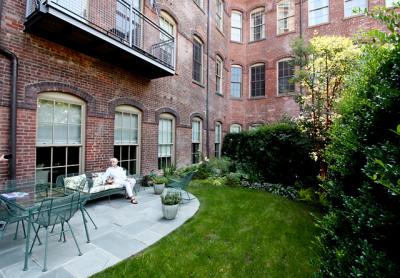
Barbara Toll has two gardens, a large one, between two sides of the Watchcase factory, and a smaller one on the opposite side of her apartment.
"I wanted to create as many private spaces in this apartment as I could."
By
Jamie BufalinoPhotos by Durell Godfrey

When Barbara Toll, an art adviser and former gallery owner, sold her Sag Harbor house and moved into a two-bedroom condominium in the Watchcase factory in 2015, she was eager to give up the maintenance responsibilities that come with homeownership, but she wanted to retain some of the aspects of her former, beloved home. 

“In my house, there were lots of places you could go to read and be separate from guests, so I wanted to create as many private spaces in this apartment as I could,” she said. 

With more than 3,000 square feet of indoor and outdoor space, the ground-floor condominium in the Watchcase provided ample room to section off areas for alone time. The expansive kitchen-dining-living area, which has brick walls and 11-foot ceilings, offered a gallery-like setting for Ms. Toll’s art collection. It also features a vestige of the building’s origin in 1881 as the Bulova Watchcase Factory. “This arch, I’ve been told, was the workers’ entrance from the street,” she said, pointing to a heavy, curved piece of wood that frames one window.

Ms. Toll chose a large Leonardo Drew sculpture made of wood, found objects, and jersey fabric as a dramatic backdrop for the main living area, which has two restored Warren McArthur sofas from the 1930s. She said they “were designed to be porch furniture. Most of the upholstery in here is indoor-outdoor fabric. The idea was to keep the upkeep as simple as possible.” 

While making decisions about furnishings, Ms. Toll held firmly to a belief that the pieces had to be creative, but not at the expense of being practical. “I like design, and I like things to look functional. I don’t think there should be a conflict,” she said. 

For the kitchen, Ms. Toll commissioned Martino Gamper, a London artist and furniture maker, to create a hutch from recycled linoleum. “I wanted to have one thing that’s spectacular,” she said. Mr. Gamper’s initial rendering was insufficiently utilitarian, Ms. Toll said. “I really wanted it not to be sculpture.”  The compromise is an eye-catching work of craftsmanship that has easy-to-open drawers and ample storage. 

Finding the right dining table proved to be a challenge. After rejecting farmhouse-style options, she decided on an asymmetrical piece reminiscent of a paddleboard. “I knew I needed something very gutsy,” Ms. Toll said of her choice, which is a reproduction of a table by Charlotte Perriand, a French architect and designer. “This was a great solution.” 

A reading nook is built into a more private living area, one that contains a workstation and a television. “When I designed it, I thought of a railroad sleeping car,” she said. A plush cushion in the curtained alcove also allows it to serve as a separate sleeping space, and, in an artistic touch, Ms. Toll has covered the walls in fabric created by Hella Jongerius, a Dutch industrial designer. 

The one resident that is not always keen on being on his own in the apartment is Ms. Toll’s Norwich terrier, Sport. In her master bedroom, with its minimalist décor, the dog bed is strategically positioned on the floor. “I don’t know how I figured this out, but he needs it to touch my bed. He has this bed in three colors in three homes and it’s in exactly the same position.”

The perks of living in the Watchcase building, Ms. Toll said, include proximity to shopping in the village and a concierge desk where she can ask for help. “One night, I couldn’t open a bottle of wine, and I could run out and find somebody to do it for me,” she said

Ms. Toll owns a loft in New York City but enjoys using her Sag Harbor retreat throughout the year. “In the summer it’s a refuge from the sun, and in the winter it’s cozy.”

‘Aging in Place’: An East End Phenomenon

‘Aging in Place’: An East End Phenomenon

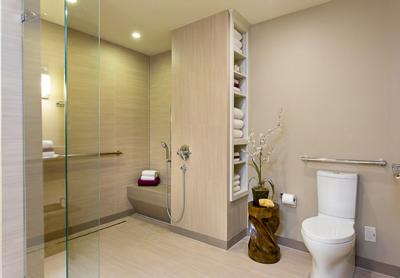
This model bathroom for aging-in-place has grab bars and an open, curbless shower with a sturdy seat and a hand-held shower head. (The plant stand was put in place by the unknown photographer.)
"Everyone is living longer," so say hello to Universal Design.
By
Johnette Howard

Universal Design, the design of products and environments suitable for everyone, from children to the elderly, is a term increasingly heard on the East End, where retirees continue to swell the population. Put simply, it is intentionally planning houses and public spaces to meet changing needs, design that allows “aging in place.” And it is happening here.

“Everyone is living longer, and it’s a reality that we haven’t really dealt with a lot here in the United States,” said the architect Andrew Reyniak, a Sagaponack resident whose firm, ARPAC, is based in New York City.

 “One of the sad things is Universal Design often gets cleaved off from design in general, and unfortunately, the only way that Universal Design usually enters a designer’s experience is through the Americans With Disabilities Act, and things that are built into code requirements. So you get these architects in school who say, ‘Oh, man, you mean I have to learn to deal with A.D.A. requirements?’ They fail to realize that Universal Design does not have to look like a handicapped room at a hotel where everything is oversized,” he said. 

Among the many good reasons to consider Universal Design is the data on the nation we have become, and the East End in particular. “It’s worth noting that Universal Design in America is not just driven by age or orthopedic disability — it’s increasingly driven by obesity issues as well. . . . People who require design features such as double-wide seating or lower beds because they’re obese,” Mr. Reyniak said.

A recent AARP study found that 89 percent of people 50 or older want to remain in their own homes indefinitely, and many are already preparing to age in place, even if it’s confined to retrofits such as adding a first-floor master suite.

Nick Martin of Martin Architects in Sagaponack said even when age is not yet a consideration, aging-in-place planning is appropriate. “What I’ve been noticing is there are a number of people in the 30 to 50-year-old zone who have moved their offices out here and are making their second home their primary residence now, and that’s been happening out here for about a dozen years,” he said.

When correctly done, Universal Design does not sacrifice aesthetics, whether people are challenged by hearing, sight, or mobility. Specifications such as curbless shower entrances and pullout cabinet drawers are helpful for children as well as the elderly, as are safety features such as non-slip floors, levers to open doors and cabinets rather than knobs, and wider hallways and doorways. A hand-held showerhead on a slide bar might replace one that is wall-mounted. 

  Barbara Feldman, an East Hampton interior designer, said that years ago, when she first began migrating from working on large health facilities to residences and made “Aging in Place/Universal Design” a specialty, many of her clients were rarely interested.

 “The way it does come out is in what things they ask me for,” Ms. Feldman said. “They want to make their homes places they can stay in as they get older. They want design that can adapt to them rather than force them to adapt to the design. They’re describing exactly what aging in place is.”

“I always believed that the environment has an impact on the healing ability, and even on just maintaining your health. People just feel better at home. They don’t want to go somewhere else. It’s emotional. It’s psychological. Even if you don’t have a challenge now, someday you probably will. It often has nothing to do with age. It could just be surgery, a broken leg, the unexpected. That’s why I tell people, ‘Universal Design is something that makes sense for everybody.’ It’s a win-win for all.”

Smoke ’Em If You Got ’Em

Smoke ’Em If You Got ’Em

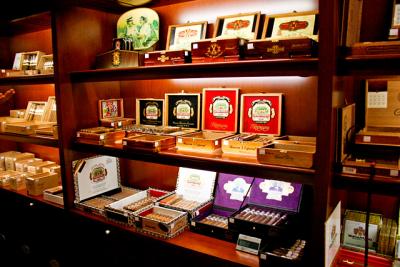
Cigars, whether inexpensive or high end, are stored in a climate-controlled room.
“It’s important to note they’re not just any cigars."
By
Johnette Howard Photos by Durell Godfrey

Customers come from near and far and at this point the general manager of London Jewelers in East Hampton can often spot them the minute they walk in. They are almost always men, and when they look at the cases of glittering jewelry and watches and rings, they suddenly seem unsure they’re in the right place. Then, with a quick glance, they see “Humidor” in big letters on a glass door to the right and shelves of cigars inside a climate-controlled, walk-in room. 


Ed Dressler, the general manager, is effusive about the cigars London Jewelers carries. “It’s important to note they’re not just any cigars. They’re a Who’s Who,” he said, mentioning Ashton, Arturo Fuente, Davidoff, Camacho, Padron, and Dominican-made Cohibas.

There are cigars called Churchills because they resemble the long-lasting ones Winston loved to smoke. There are cigars with literary names meant as homage to famous writers. There are hard-to-find Opus Xs, the “Holy Grail of cigars‚” Mr. Dressler said, which are special because only a limited number are made each year, and London Jewelers is on the allotment list, with perhaps three boxes every four months.There is also a new brand made by the Hamptons Cigar Company, with a logo that spells out the word “Hampton” in nautical flags.

“I always ask guys when they come in, especially the first time, ‘How did you hear about us?’ and today it’s usually Google or word of mouth,” Mr. Dressler said. “There haven’t been any other walk-in humidors on the East End since we opened in 1996. We’re it. We’re lucky to be able to say these cigars are the best of the best. And we price them the way they should be. I keep the prices in here not just reasonable, but almost cheap.”

 The prices range from under $10 per cigar (or “stick”) to a high of $50. They’re sold individually, in gift packs, or by the box.

Mr. Dressler said in addition to the London Jewelers selection, customers come in “because they know the cigars are stored in perfect conditions that are hard to replicate at home. To wit: The humidor is always kept at 71 degrees, and 71 percent humidity. A mister occasionally emits little puffs of steam. The top and bottom walls of the room have rows of cedar-lined cigar “keeps‚” small personal storage lockers with discreet brass nameplates for some of the store’s most loyal clientele. Asked to name a few, he said Steven Spielberg, Alec Baldwin, Billy Joel, and the former National Hockey League star Pat LaFontaine.

Because Mr. Dressler orders all the stock, it is easy for him to help customers make selections, he said. He also is adept at explaining the particulars of the different cigars and how to smoke them. He can tell stories about how cigars are made: There’s the filler, the binder, and, on many cigars, a wrap called Connecticut Shade, a large-leaf tobacco that is grown under cheesecloth in the Connecticut River valley around Windsor.

 Mr. Dressler said he was happy to educate a newbie client on the proper way to cut a cigar or the recommended way to light one, which, he said, is to hold the flame under it until it lights rather than straight on.

According to Mr. Dressler, it’s also good to know cigars are meant to be puffed, not inhaled all the way. They’re also meant to be smoked in one sitting, which is why some cigars are described by how long they take to finish, not just their flavor.

And, like wine, the descriptions and reviews of cigars can be complex as well as imaginative. The website for Cigar Aficionado magazine describes its 2017 Cigar of the Year, the Arturo Fuente Don Carlos Eye of the Shark, as having a “range of baking spices and citrus notes‚“ as “intonations of nuts and leather unfold before a warm, lingering finish of cedar and cider.” The Padron Serie 1926 No. 2 marries power and grace, from its earthy core to its rich coffee-bean character, accented by a sweet, underlying woodiness and a black tea finish.

Phil Paroff, an East Hampton resident and regular London Jewelers customer, knows such descriptions exist, but he said with a laugh, “I do not have what you’d call a discerning palate. Oaky or buttery, I don’t know. I just know what cigars I like, and I don’t like.” 

Mr. Paroff said he first tried cigars in the early 1990s when he shared a summer house with a friend. “I like smoking cigars because it’s relaxing,” he said. “I was a type A personality before I retired, and back then it was especially nice for me,” he said. “You sit down for 40 minutes or whatever it takes to smoke your cigar, and do nothing. I get a nice cigar, I go outside, and I can sit there and watch the world go by.”

Fleurarium: A Gift for a Fishy Fellow

Fleurarium: A Gift for a Fishy Fellow

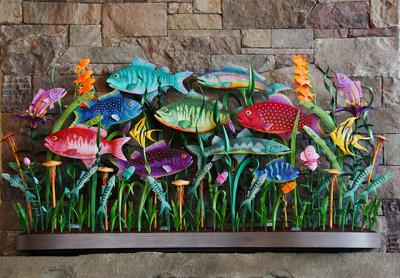
James Grashow describes his sculpture as a cross between a garden and an aquarium.
They even named their cats for fish: Marlin and Minnow.
By
Isabel CarmichaelPhotos by Durell Godfrey

What she could possibly give her husband as a 25th wedding anniversary present was on Yusi Gurrera’s mind about a year and a half ago when she came up with a perfect solution. She would ask a friend who is a sculptor, James Grashow, who lives in Connecticut, to create something that would epitomize her husband’s main interest — fish.

Her husband is Joe Gurrera, who bought a small neighborhood fish shop called Citarella, which had been in operation since about 1912, on the Upper West Side of Manhattan, in 1983 and turned it into a multimillion-dollar business.

Mr. Gurrera was already in the fish business. He owned Lockwood and Winant, a wholesale seafood company in the Bronx, which had been in operation for more than 100 years. And he owned Meat Without Feet, as well, another wholesale fish supplier in the Bronx that sells to restaurants and hotels. The couple even named their cats for fish: Marlin and Minnow.

James Grashow sculpts in wood and cardboard and also does woodcuts. He calls what he came up with as a present for Mr. Gurrera a fleurarium, a cross between an aquarium and a garden (fleur is French for flower). He carved every piece from wood, even small wavy bits of sea grass reaching upward and tiny fragments at the bottom that look like soil. He also crossed jellyfish and mushrooms, naming them jellyrooms and painted varying colors behind the fish scales to produce subtle contrast. The finished product included groupers, snappers, and rainbow trout, all in crazy colors.

At the Gurrera home, the sculpture dominates the fireplace mantel. Mr. Grashow not only painted the base of the sculpture the same color as the stone mantelpiece, but built a slim black platform for it to effect a floating aspect.

The work includes flowers that seem to be metamorphosing into small eel-like creatures and very small fish that look like minnows, which are easy to overlook, as is a lone cricket on the seabed.

Using a pun, there was a potential catch: It did not seem likely that Mr. Grashow would be able to finish the sculpture in time for the Gurreras’ anniversary. The solution was a small-scale model as a placeholder.

“I didn’t want to be empty-handed on our anniversary,” Mrs. Gurrera said. “After all, my gift from him was to go to Lapland to see the aurora borealis. We stayed in glass igloos . . . and made our way through Scandinavia. We met with our seafood farmers in Norway and visited every food hall along the way . . . yum!”

In a nice turn of events, Mr. Gurrera was working on a book that has just been published, “Joe Knows Fish: Taking the Intimidation Out of Cooking Seafood.” Apparently it took him as long to write as it took Mr. Grashow to make the sculpture.

The Gurreras were at home, on their hard-to-find property in Bridgehampton, when Mr. Grashow and his wife, Guzzy, and a few friends drove up in a white van with signs on it that read: “Fleurarium.”

House Tour Offers Glimpses of Hidden Southampton

House Tour Offers Glimpses of Hidden Southampton

Linden, an 18,000-square-foot residence on 10 acres, was designed by the architect of the old Parrish Art Museum on Job’s Lane.
Tom Edmonds
Each year’s tour offers a sampling of summer colony styles
By
Jennifer Landes

The Southampton Historical Museum will hold its annual Insider’s View house tour and benefit on Saturday from 1 to 4 p.m. Just shy of a decade old, the tour has become synonymous with access to some of the most famous and curiosity-inducing domiciles in Southampton.

Each year’s tour offers a sampling of summer colony styles, from a sprawling oceanfront pile to an intimate village cottage, with a building of historical or architectural significance in addition to everything in between.

The tour is self-guided and includes one of the museum’s properties, the Thomas Halsey Homestead, and St. Andrew’s Dune Church. After the tour, participants have been invited to a reception at 4:30 at the museum’s Rogers Mansion on Meeting House Lane.

Linden, designed by Grosvenor Atterbury, an early-20th-century summer resident of Southampton and the designer of the old Parrish Art Museum on Job’s Lane, is an 18,000-square-foot residence set on 10 acres. A grand hall and living area show off the building’s original millwork and tremendous fireplaces. The park-like property boasts mature trees, flowering shrubs, evergreens, rose gardens with both indoor and outdoor pools, and tennis and paddle courts.

The tour also includes the house that Capt. E. Halsey called home after his last whaling trip in 1848. It offers evidence of a historic dwelling being adapted to suit modern lifestyles while preserving its antique charm. A new light-filled and spacious wing offsets the cozy spaces of the older structure.

In the same tradition is Three Chimneys, a traditional 1927 village house. Updated in a way that respected its original details, the house has a pool, built-in cabinetry, and a pantry. The interior is bright and sunny, furnished with custom designer furnishings and antiques with a pastel and beachy palette.

A South Fork house tour would be poor indeed without at least one knockout waterfront residence. This year, a gabled house on Lake Agawam has a soft-gray exterior and a traditional pebbled drive leading to the house and the lake beyond. The decor revolves around family living, with plenty of outdoor seating and a game room within its otherwise tailored interior. 

The owners of a retreat in the woods took their modest house and renovated it to bring light and space inside by adding square footage, raising the master bedroom’s ceiling, and adding beams to the family room. The furnishings include an Art Deco chair and a stunning capiz-shell ceiling fixture. The grounds were leveled and planted to add a pool and outdoor lounge area surrounded by tall evergreens.

A well-edited selection of houses should always include one that’s a bit over the top. What the museum is calling a “pink charmer” seems to fulfill this role, with flights of whimsy not for the faint of heart. The two-story foyer features huge palm leaf wallpaper and a bespoke ceramic fireplace surround designed to match the wallpaper’s swag border. A grand living room and sunroom have references to roses and other flowers that surround the pool with its glamorous cabana.

Advance tickets, which can be purchased on the historical society’s website, are $95, or $110 on the day of the tour. They can be picked up or purchased at the Thomas Halsey Homestead at 249 South Main Street beginning at 10:30 a.m.

A Fisherman Turned Organic Landlubber

A Fisherman Turned Organic Landlubber

Jason Norris took his daughter Isla Rose along when he visited a client’s property in Clearwater Beach, Springs.
Durell Godfrey
On the final Friday of a notably cold and wet April, he could be found alone in the spritzing rain
By
Baylis Greene

Jason Norris may have a landscaping crew at his command, but that doesn’t mean he sits behind some particleboard desk, plastic hunk of phone pressed to his ear, staring into the half-distance as he lines up the next property for his Norris Organics guys to attack with spinning blades, shovels, rakes, and enough bags of mulch to dam a small river.

No, on the final Friday of a notably cold and wet April, he could be found alone in the spritzing rain, walking behind a mechanized overseeder across a throbbingly green lawn in his care off Crestview Lane in Sagaponack. To his right, the well-appointed estate. To his left, a view that not all that long ago gave onto dunes and beach grass now showed a phalanx of huge three-story houses, a veritable mountain range of wealth in defiance of the wild and encroaching Atlantic beyond.

Despite the long stretch of lousy weather, it’s been a busy spring, Mr. Norris’s crew of five spreading out across the South Fork, from Southampton to Montauk, six days a week on missions of, in his words, full property maintenance. 

“I’m one of the few NOFA-accredited organic landscapers,” he said of the Northeast Organic Farming Association, through which he completed a five-day program of study. So what does that mean, exactly, down in the dirt? For one thing, he said in the course of a brief chat under the shelter of a carport, the roar of the ocean a constant in the distance, “We re-incorporate all leaves — we use them in the mulch as part of our organic treatments.”

For another, while he tries to get all his clients to compost, “We make our own compost tea, an organic fertilizer. It’s a liquid with fish enzymes and molasses. It’s got a beneficial living bacteria that helps with grubs and helps with fungal disease.” Squid juice is one ingredient.

More broadly, “Three hundred and fifty million pounds of fertilizer go on lawns every year in the U.S.,” he pointed out, “but here, the toxin-free properties are some of the nicest properties in the Hamptons. The lack of synthetics does not affect the aesthetic look.” 

He used to surround himself with a different kind of green — the briny depths — on commercial fishing trips out of Montauk. “We’d go for tuna and swordfish for 30 to 50 days at a time, to the Grand Banks, all over.”

“It’s great to do when you’re young, but it’s rough, man.” After 22 years, “I couldn’t handle the lifestyle anymore. It was just too much on the brain and body.” 

His path to becoming a professional landlubber went through the doyenne of environmentally conscious landscape design hereabouts, Edwina von Gal, the founder of the Perfect Earth Project. Back when he was a one-man operation with a push mower and a pickup, she asked him if he wanted to mow her lawn, and she went on to introduce him around to acquaintances in need of a landscaper. He still maintains her property in Springs. “She’s been a real mentor to me,” he said. 

With long blond hair and a genial earnestness, like a Chip (“Fixer Upper”) Gaines who went into a somewhat less lucrative vocation, he’s 47 now, married, and has two young children. “They were a main reason for switching jobs,” he said. He started Norris Organics in 2014, “and it’s really blown up.” 

Now he lives a quiet, normal life in Springs. He even keeps bees in his backyard. In the off-season he’ll do some tree work, in the deep winter snowplowing and removal.

“One thing about organic landscapers, we’re not in competition with each other. We don’t want every house on the block to be a client. We just want every house on the block to be organic.”

Dishing on Design: Daring, Yes, but Not Precious

Dishing on Design: Daring, Yes, but Not Precious

Fern Mallis, right, led a discussion of daring and dramatic design and so much more with, from left, Jason Oliver Nixon, John Loecke, and Joe Nahem at this year's Architectural Digest Design Show at Pier 94 in New York City.
Jennifer Landes
A panel about daring design and other topics
By
Jennifer Landes

At the recent Architectural Digest Design Show in Manhattan, a panel about daring design turned into a more free-form discussion of trends, clients, art, backgrounds, and big budgets, much to the delight of the crowd of practicing and aspiring designers assembled in the fair’s auditorium on Pier 94.

The participants were three designers who are no strangers to the South Fork, and Fern Mallis, the force behind New York’s Fashion Week for many years and a sought-after interviewer and author with a popular series at the 92nd Street Y, who also has a bungalow retreat on Big Fresh Pond in Southampton. 

The panel featured John Loecke and Jason Oliver Nixon of Madcap Cottage design of New York and North Carolina, whose first professional project was a cottage on Meeting House Lane in Southampton, and Joe Nahem, who has a house on Further Lane that was part of last year’s East Hampton Historical Society house tour.

Asked about a daring design detail, Mr. Nahem spoke about the residence off Main Street that he designed for Robert Downey Jr. and Susan Downey. In a late-19th-century house, he suggested, and they agreed to, a sunken living room and a fireplace with a wraparound ceramic wall by Peter Lane. “It was great to see the material and then blow it up to 20 times its size,” Mr. Nahem said.

Mr. Loecke and Mr. Nixon are working on a 40,000-square-foot Georgetown “newish-build” mansion that they are decking out in Robert Adam-style neo-classical plaster architectural details and inlaid floors with different patterns. “We want it to look like the great country houses of England,” Mr. Loecke said.

While not dishing on their clients, they answered Ms. Mallis’s questions with candor, including their most expensive jobs — $10 million and $12 million with construction — and how they persuade clients that their prized piece of artwork might not work with the couch they picked out for the room.

“Most people want their home to feel like someone lives there and is not a museum. It’s a challenge to balance that,” Mr. Nahem said. “You don’t want it to feel like you are in a gallery or can’t watch TV and eat popcorn on the couch.”

While they can often travel around the country or around the world in search of objects for their design projects, Mr. Nahem said, “It’s not glamorous at all. I tell interns all of the time, we’re not riding on private jets or the back of limos, mostly we’re riding the subway with a lampshade. We’re basically two steps above a body shop in Queens.”

In their younger days, they were often accumulating, but now are trying to keep their inventory of furniture and objects spare. “We’re more selective now,” Mr. Nixon said. “We don’t want to have an inventory of stuff we’re beholden to.”

Mr. Nahem said he buys when he sees something he has a specific use for or “when I see something I don’t want another designer to get, I’ll buy it.”

As to the internet, all three said it has changed things for them. “Clients used to come with pages ripped out of magazines and we had to figure out what they wanted . . . . Now with Pinterest they come to us with 7,200 pins and we have to say the opposite, ‘What is it you really like?’ ” Mr. Nahem said.

Like most designers, Mr. Nixon said they had a strong presence on Instagram. “We get a lot of business from it, and most of our current clients.” Tracing the general interest in design back to the first publication of Domino magazine, Mr. Nixon said there has been a clear democratization of design “where good design is available to all. It started with Martha Stewart at Kmart” and has continued, including with their own products now selling at Steinmart and on the Home Shopping Network. “Our sheets at home are from HSN. We’re not going to sell a product I wouldn’t use in my own home. If I find something at Ikea or Pottery Barn that works in a design, you bet I’m going to use it!”

Design at Promised Land: Wind Was the Key

Design at Promised Land: Wind Was the Key

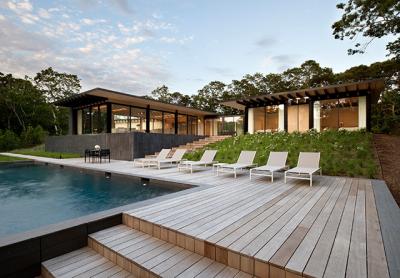
A glass walkway connects the H-shaped house in the Amagansett dunes near Gardiner’s Bay.
The owners — a married couple with two children — are kite boarders, windsurfers, and sailing enthusiasts
By
Jamie Bufalino

When Paul Masi and his colleagues at Bates Masi and Architects in Sag Harbor design a house, they focus first on its key elements. “We try to understand what the essence of it is,” Mr. Masi said. “We know that it’s going to be a pretty house, but it needs to be more than that. It needs to be meaningful to the occupants and also in its relationship to the landscape.”

For this house of more than 4,000 square-feet in Promised Land, Amagansett, the key element turned out to be the wind. 

The owners — a married couple with two children — are kite boarders, windsurfers, and sailing enthusiasts. “That was something that made me think, ‘Okay, how can this house be a part of why they are here?’ ” recalled Mr. Masi, who had originally met his clients by happenstance in the early 2000s when they spotted him in the midst of physically building his own house. “I had my tool belt on, they walked in the house and said, ‘Wow, this is amazing, do you know who the architect is?’ ”

Nearly 20 years later, Mr. Masi ushered the couple into a striking home of their own: an H-shaped structure with bedrooms on one side, an open kitchen and living/dining area on the other, and an all-glass walkway connecting them. Sliding glass doors throughout make for seamless indoor-outdoor living. 

During the design process, Mr. Masi let his clients’ favorite pastimes inspire him. “If you’re a kiteboarder or if you surf or do any of those sports, you’re really in tune with what’s happening with the weather — the direction of the wind, the speed of the wind, what the tides are,” Mr. Masi said. He immediately ordered weather data for the property. As it turned out, the wind largely emanated from the west, so Mr. Masi designed the house on an east-west axis. This positioning allows the breeze to interact with the structure, he said, providing its residents with tactile, visual, and even olfactory awareness of its presence. 

Vents were placed in the ceiling beams to provide air flow. A thin-profile roof was designed with large overhangs, to trap the wind and direct it through the vents. “It’s the same concept as an umbrella — you know, how when you open an umbrella it really captures the wind.” Mr. Masi explained.

A reflecting pool was put in adjacent to the glass walkway. “Water is such a good medium to register the wind,” Mr. Masi said. A quick glance would tell the residents just how windy it was: “If there’s no wind, the reflecting pool is just a sheet of glass.” Aromatic plants such as lavender and mint were placed on the windward side of the property, so that when the house’s doors are open and the breeze kicks up, the space is redolent with their scents. 

The house does not feature exotic materials from far-flung places. “Most everything is made of natural materials,” Mr. Masi said. “We were looking to use materials that were readily available and that weren’t intensive on the environment —you know, shipping it from God knows where. They are very commonplace materials, but we were creative with them to give the house its own unique character.”

The predominance of glass in the house, which is nestled between bushes on a narrow clearing, allows panoramic views of shrubbery, grass, and sky “As you travel through the house,” he said, “you are never looking at a wall, you’re looking at a window that’s connecting you to the landscape. You’re always sort of walking towards the outdoors. And when the doors are all open, it feels like you’re in a pavilion and really immersed in nature.”