Botany And Birding

Botany And Birding

December 5, 1996
By
Star Staff

The East Hampton Trails Preservation Society has winter botany on the agenda for Saturday at 3 p.m. Mike Bottini will lead a hike and identify the trees, shrubs, and grasses of the Stony Hill forest on the northwest side of Amagansett. The event is co-sponsored by the Group for the South Fork. Hikers are asked to meet on Red Dirt Road, about 200 yards east of the intersection with Accabonac Road.

On Sunday, the Group plans to bring hikers to a variety of locations on the East End to view sea birds, including scoters, common eiders, gannets, purple sandpipers, cormorants, and tundra swans. Steve Biasetti will lead the pack. Those interested have been asked to contact the Group at its Bridgehampton offices for time and place.

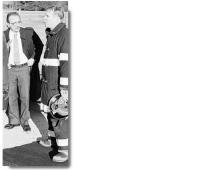
On Wednesday beginning at 10 a.m., the Trails Society's Richard Lupoletti is scheduled to lead a hike through the stately beech trees and American holly of the Point Woods forest of Montauk State Park. He suggests that hikers dress warmly and meet at the road to Camp Hero off Montauk Highway, one mile east of Deep Hollow Ranch.

Randy Tate, the Nature Conservancy's new director of Stewardship Operations, is scheduled to lead a hike along the beach between Shinnecock Bay and the ocean in search of sea birds on Saturday beginning at 9 a.m. Hikers have been asked to contact the East Hampton office of the conservancy for registration and directions.

Sea birds will also be the focus of a cruise on Saturday from Greenport, sponsored by the Cornell Cooperative Extension Service. John Turner, a naturalist and educator, will guide birders aboard the 100-foot Sunbeam Express on a four-hour sail in Gardiner's Bay and Block Island Sound. The Express will sail at 10 a.m. and return at 2 p.m.

Eider, scoters, bufflehead, mergansers, gannets, and alcids are in the area, as well as the occasional harbor seal. The cost is $30 for adults and $15 for children 12 and under. Advance registration and payment are required by calling the Extension Service's marine center in Southold.
Creature Feature: Have A Happy And Pet-Safe Holiday

Creature Feature: Have A Happy And Pet-Safe Holiday

By Elizabeth Schaffner | December 5, 1996

'Tis the season to be jolly . . . and very, very busy. For most of us humans, the hustle, bustle, and hyper-sociability of the holidays are a welcome distraction from the darkest days of winter, but to our pets these festive weeks are often, at the very least, stressful and, at worst, hazardous.

Boring as it may sound, animals like a routine. Experts state that a change from a pet's usual daily routine is an invitation to trouble. Unfortunately during these busy weeks finding time for the usual activities is often impossible.

All too often owners attempt to make up for spending less time with their pets during frenzied holiday preparations by indulging them in other ways. Feeling guilty about neglecting them, we attempt to include them in the festivities by sending some of our holiday meals their way.

Hold The Trimmings

Big mistake, says Dr. Claude Grosjean of Southampton's Olde Towne Animal Hospital. Any sudden change in an animal's diet can result in gastroenteritis, or worse.

"Unfortunately, what people usually give their animals are the trimmings, skin from poultry and fats from meats. These are highly fatty and fatty foods can cause pancreatis," he warns. A potentially life-threatening condition, pancreatis is most likely to strike middle-aged, overweight pets; dogs are more susceptible than cats.

Bones pose hazards as well. "The general rule is never feed chicken and pork bones," says Dr. Barry Browning of the South Fork Animal Hospital. "They splinter easily and can lodge inside the pet." This rule applies to feeding bones to cats as well as dogs. Even "safe" bones, such as beef bones, can take their toll, by causing the dog to have loose stools.

No Chocolate!

One of the very favorite indulgences of human beings, chocolates, is a very definite no-no for dogs. Chocolate contains theobromine, a substance toxic to dogs. (There have been no documented cases of chocolate toxicity in cats. But whether it is because cats are immune to the effects of theobromine or because cats don't like the taste of chocolates so therefore don't gorge on it, the reason is not yet clear.)

Unsweetened baking chocolate, chocolate in its purest form, is far more toxic than milk chocolate and should always be kept well out of Fido's range. But even milk chocolate can cause problems. As can powdered cocoa, which Georgina Walker of East Hampton discovered to her horror when her dog Tess underwent a dramatic personality change after chewing her way into a can of Hershey's milk chocolate mix.

"She just went berserk!" states her owner. The normally sweet and responsive dog leaped out of her yard and ran wildly about the neighborhood. She failed to recognize her owners when they tracked her down and had to be confined to a small, darkened room until she regained her senses.

Self-Service

Dr. Dale Tarr of the East Hampton Veterinary Group explains that the theobromine in chocolate affects dogs as a stimulant. In fact, he relates, it also has an energizing effect on horses and at one time was the performance enhancer of choice at racetracks. (It's since been banned.) The antidote is Valium, which Tess quite obviously could have used!

Even if you sternly withhold excess treats, remember that many animals, canine animals in particular, will take matters into their own paws. Having survived thousands of years as scavengers, dogs don't see why they should stop now. Uncovered garbage cans and food left on counters are fair game for canines. (Cats, as hunters, rarely deign to raid the trash.)

"Dogs will eat anything," states Dr. Browning. Indeed they will; veterinarians have had to surgically remove such indigestible items as carving knives from the bellies of greedy canines.

Decorative Hazards

The holidays hold decorative as well as culinary hazards. Poinsettias are poisonous enough to cause death, but Dr. Tarr says reassuringly that an animal would have to consume close to one pound of leaves in order to obtain a lethal dose, "and that," he points out, "is a lot of poinsettia plants."

Holly berries and mistletoe are other traditional decorations of the season which can prove dangerous to pets. Fortunately, due to their bitter taste, animals don't relish them, but keeping them well out of reach is advised. As with poinsettias, the animal would have to consume quite a lot to become seriously ill, but even an exploratory nibble can result in discomfort, vomiting, and diarrhea. Safest of all, substitute silk or plastic versions.

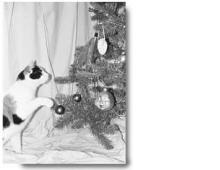
Decorated Christmas trees can pose a threat. "Owners should utilize their common sense about allowing pets near the tree," advises Dr. Grosjean. Playful, hyperactive pets and young animals should not be left unattended around Christmas trees.

The Trouble With Tinsel

Trees decorated with lights present an array of electric cords which could spell trouble for puppies and older dogs that enjoy chewing on foreign objects. Unplug the tree when you can't supervise.

It is the seemingly innocuous tinsel or angel's hair that can provide the most holiday grief for pets. Some animals, particularly cats, have a peculiar desire to devour the stuff. Dr. Tarr warns that this can lead to considerable problems, explaining that the tinsel can saw through the animal's intestines as the intestines attempt to pass it.

Some species should never be allowed loose near a Christmas tree. "A ferret and a Christmas tree? That would be one hell of a mess!" muses Dr. Grosjean. With their highly inquisitive natures, their tendency to climb into things, and their irrepressible need to chew on everything that intrigues them, ferrets (and innocent bystanders) would be in considerable jeopardy around a Christmas tree.

Some Comforts Of Home

Parrot species are another creature that should enjoy the Christmas tree from afar, advises Dr. Grosjean. Shiny objects are irresistible to these birds, and, apart from broken shards of ornaments presenting a danger, many ornaments, particularly older ones, are painted with lead paints that could be toxic.

If all of the above is irrelevant because you are planning to travel during the holidays, remember that animals need to have current vaccinations to be accepted at boarding facilities. Bringing along an adequate supply of the pet's usual food can help reduce some of its stress.

"Boarding reservations are at a premium now," says Dr. Grosjean. Many local boarding facilities, such as Edge of the Pond Kennels, are already completely booked for the holiday season. Beth McManus of Kitty Care, a cat boarding facility, has some space left but it is likely to be taken up quickly. The pet sitter Patrice Gleasner of Perfect Pet Care says she's getting busier as the Christmas holidays approach. The time to make your reservation is now!

Santa Comes To Town

Santa Comes To Town

December 5, 1996
By
Star Staff

East Hamptoners young and old will welcome Santa to town on Saturday at the annual Santa Parade, sponsored by the Chamber of Commerce. The parade will begin at Guild Hall and continue down Main Street to Newtown Lane and the railroad station.

Floats, bands, church associations, scout troops, and fraternal and civic organizations will march - not to mention the man of honor, who usually makes an appearance in some sort of snappy vehicle. Awards will be given for best floats and best marching groups.

Participants will begin lining up at 9 a.m., and the parade will begin at 10 a.m. sharp. Afterward, Santa will greet children at the East Hampton Cinema and hear their Christmas wishes. A movie, "Balto," will be shown courtesy of The East Hampton Independent at 11:15 a.m.

From 11 a.m. to 3 p.m., Santa will visit the Gardiner Brown House in East Hampton to pose with children for photos. The Ladies Village Improvement Society is sponsoring the session, and the photos will cost $6.

North Haven Bridge Hearing

North Haven Bridge Hearing

Rick Murphy | December 5, 1996

Mayor Pierce Hance had a succinct message for those who attended Tuesday's Sag Harbor Village Board meeting: See you next Wednesday.

That is the day the State Department of Transportation will host a public hearing to hear comments about its plan to replace the Sag Harbor-North Haven Bridge.

"There is broad support for maintaining the bridge as is," Mr. Hance said. "It will be standing room only, I hope."

The D.O.T. has issued a report outlining several different options for replacing the bridge. These include building an expanse parallel to the current span, either to the north or the south (and tearing down the current bridge once the new one is completed), and building in the same location.

Move Bridge?

Moving the bridge north or south has the advantage of allowing the existing span to be used while the new one is being built. However, such a move is widely opposed by residents because it would require the sacrifice of existing parkland and wetlands.

Whatever the location, the new span would be about 13 feet wider than the existing one to meet current D.O.T. requirements and to provide wider shoulders for bikers. Moreover, the D.O.T. wants to build a span that could accommodate increased speed limits of 45 to 50 miles per hour - though it says the speed limit wouldn't necessarily be raised from the current 30 miles per hour.

A two-village task force chaired by Gayle Pickering recommended that a new bridge be constructed where the current one is - by tearing half of it down at a time - and that the current 30-mile-per-hour speed limit be retained. That seems to be the general sentiment of Sag Harbor and North Haven residents.

Rerouting Traffic

Under such a plan, traffic would be rerouted to Brick Kiln and Noyac Roads during the construction time, estimated to be as much as two years. However, access over the bridge for emergency vehicles would be permitted.

The possibility of raising the speed limit has been roundly opposed by the Village Board. Mr. Hance expressed concern about endangering pedestrian traffic to and from Long Wharf at the foot of the bridge.

The hearing will be held at 7 p.m. in the Pierson High School auditorium.


North Haven: 'Give Us Your Deer'

North Haven: 'Give Us Your Deer'

December 5, 1996
By
Carissa Katz

Following a "60 Minutes" segment about deer in the Northeast, which aired on Nov. 24 and focused mainly on North Haven's problems, the village has received scores of letters on the subject.

People from around the country have offered solutions to the dilemma, the North Haven Village Board noted at its meeting Tuesday night.

Some even offered their towns as new homes for the North Haven deer.

One grinch from Arizona, however, suggested the village require everyone to get big bumpers on their car and raise the speed limit to 75 miles per hour.

Three More Months

The board decided Tuesday to extend the deer-hunting season an additional three months until March 31. So-called "nuisance deer permits" will be issued through that date.

The resolution passed by a 3-2 vote. Patricia Frankemolle and Vincent Mauceri voted against it.

The board also decided, without Ms. Frankemolle and Mr. Mauceri's votes, to proceed with a survey of the economic impact of deer on the village. The survey polls residents about deer-related accidents, Lyme disease, and property damage.

Robert Reiser, who heads the board's deer management committee, said a preliminary survey of 20 households appeared to show damages amounting to over $5,300 per family.

Deer Damage Survey

The study, conducted by students at Southampton College, will eventually include 200 families and will cost the village $2,700. "It's something we need to have in our arsenal of defense as a village," Mr. Reiser said.

Some village residents, however, did not think spending the money was a good idea, nor did they agree with the dollar amounts reported in the preliminary survey.

At last month's Village Board meeting, Mayor Robert Ratcliffe and some residents had suggested the deer committee ask hunters to use shotguns instead of bows and arrows.

Bow and arrow hunting can leave a deer seriously injured, but it may not die for several hours or days. Shotgun hunting, they argued, would be more humane.

Bows And Arrows

Mr. Reiser said Tuesday "the committee felt that was an attempt to locate hunters by the noise of the guns" and then to harass them. Bows and arrows alone will continue to be used, he said.

Hunters have donated 10 deer to a group called Hunters Helping the Hungry, Mr. Reiser told the board, and were to donate another 10 animals to the Sag Harbor Presbyterian Church food pantry yesterday.

Following the meeting, Kelly Patton, who wore a lion mask to last month's Village Board meeting (incorrectly referred to as a deer mask in a previous report), proposed the village create a "deer park," where the animals could roam freely and be appreciated, once the herd was reduced.

Deer Park?

"We have to cull the herd, that has to be done," she acknowledged, but suggested that if some land were set aside for the deer, it might help the community reach a truce on the issue.

"It sounds really strange to the people on North Haven, but someday the white-tailed deer will be endangered," Ms. Patton said.

Trustees said the concept sounded good in theory, but asked where the village would get the land and how the animals could be confined to the one area.


Obituaries: Dan Flavin, 63

Obituaries: Dan Flavin, 63

Sheridan Sansegundo | December 5, 1996

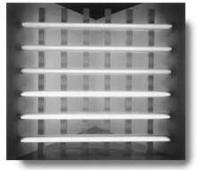
Dan Flavin, whose radical fluorescent light sculptures are familiar to museum-goers worldwide, died at Central Suffolk Hospital on Friday of complications from diabetes. The artist, who lived on Beach Lane in Wainscott, was 63.

His minimalist works - he was perhaps the first artist to construct sculptures using electric light - arose from his Abstract Expressionist background, using simple construction, large scale, and saturated color.

While Mr. Flavin's work has mainly been exhibited in major museums and galleries, since 1983 East Enders have had a chance to see it on permanent display in Bridgehampton, at the branch of the Dia Art Foundation on Corwith Avenue. The gallery, a former firehouse and originally known as the Dan Flavin Art Institute, is open during the summer and mounts other exhibits in addition to Mr. Flavin's work.

It is an institution that has had its shares of ups and downs and personality conflicts, given Mr. Flavin's somewhat litigious nature, but also, thanks to Dia's resources, mounted many exhibits of a specificity and range beyond the reach of many East End galleries.

The critic John Russell, writing in 1985, enthused both over this little-known gallery and over Mr. Flavin's work. "The fluorescent light has a soft enveloping glow, quite unlike the needley, pinched aggressive quality of neon . . . but there is no sentimentality, either. Flavin uses candy colors, but he leaves out the sugar substitute. . . . The pieces have no corporeal substance. Switched off, they are as inert as a broken phonograph. Switched on, they lead a charmed life, doubling back and forth between dream and reality. . . . In its radiant, uncombative way, his institute has a unique experience to offer."

While his art may not have been combative, Mr. Flavin himself was more so. He was described by some who knew him as both irascibly brilliant and tediously labyrinthine. But all agreed with Annie Solomon, speaking from Florida, who said he was always warmly generous in defense of other artists whom he admired - not just other minimalists like Donald Judd, but those whose work was far removed from his, like James Brooks and Syd Solomon.

He regularly fired off letters to The Star - trashing lectures by Tom Wolfe and Kirk Varnedoe, George Bush's presidential campaign, the lack of parking on Beach Lane, Henry Geldzahler's curatorship of the Bridgehampton Dia, and, memorably, questioning the artistic merit of certain prominent local artists. This last, as did many of his letters, engendered a barrage of spluttering, irate replies - which was possibly why he wrote them in the first place.

Daniel Nicholas Flavin was born on April 1, 1933, in New York City, a twin son of Daniel N. Flavin and the former Viola Bernzott. He grew up in Queens, where he attended a seminary before moving on to study art history at the New School for Social Research and Columbia University. During the Korean War he served with the Air Weather Service of the U.S. Air Force.

After supporting his art by working as a guard at the Museum of Natural History and the Museum of Modern Art and as a messenger for the Guggenheim Museum, he had his first exhibit in 1961, at the Judson Gallery in Greenwich Village. Mr. Flavin first showed his light sculptures at the Green Gallery on 57th Street three years later and was with the Leo Castelli Gallery for many years before moving to the Pace Gallery.

His 1961 marriage to Sonia Severdija ended in divorce. He was married in 1992 to Tracy Harris, who survives him, in a dramatic ceremony in the rotunda of the Guggenheim, which was mounting its second major exhibit of his work at the time.

In addition to his wife, Mr. Flavin leaves a son, Stephen Conor Flavin. His twin brother died in 1962.

A private service will be held on Dec. 12, with burial in Wainscott Cemetery.

Memorial contributions have been suggested for the American Diabetes Foundation.


Star Wins National Awards

Star Wins National Awards

By Josh Lawrence | December 5, 1996

The East Hampton Star shone brightly in this year's Suburban Newspapers of America competition, winning top awards for its coverage of the environment, business, education, arts, and this summer's T.W.A. disaster, among other honors.

The Star took home nine awards in all in the national contest, including first-place honors for breaking news, environmental reporting, and best editorial pages. The awards also included two second-place honors, three third-place awards, and an honorable mention.

A total of 904 publishers of weekly newspapers throughout North America competed in this year's contest. The Star is judged against weeklies in the 10,000-to-20,000 circulation range.

T.W.A. Coverage

Judges were particularly impressed with The Star's team coverage of the T.W.A. Flight 800 crash. A four-page special section bannered by Russell Drumm's first-person account of the Coast Guard rescue effort, with striking photographs taken the night the plane went down, won first place in the breaking-news category.

The section also won a second-place award in the category of in-depth reporting. And Mr. Drumm's cover photo of an exhausted Coast Guardsman earned a third prize for best news photo.

The Star's ongoing coverage of beach-erosion issues was rewarded with a blue ribbon for best environmental reporting. A series of articles by Mr. Drumm and Michelle Napoli looked at erosion from environmental, legal, and long-range planning perspectives.

The paper won the S.N.A.'s first prize for environmental reporting last year as well.

Tops In Editorial

For the seventh time in the last 12 years, The Star's editorial pages were judged tops in the field. The section contains a wide range of features, including letters to the editor, editorials, the "Guestwords"and"Relay" columns, and the paper's regular columnists, Jack Graves, Helen S. Rattray, and Val Schaffner.

"It gives me tremendous satisfaction to have won so many first prizes for our editorial pages," said Mrs. Rattray, The Star's editor and president. "We're being recognized for providing an excellent community forum for the expression of opinions."

The paper was ranked second this year for its educational coverage and business-and-economic reporting, based on the strengths of three consecutive issues.

Arts And Photography

The Star's arts coverage was also recognized, winning third place for best entertainment/lifestyle section. The arts section has won consistently in this category.

Photography also got a nod. An honorable mention was awarded for sports photojournalism. Shots by Edwin Gifford of rugby, roller hockey, and baseball in action were submitted.

The East Hampton and Southampton Independents, which now compete in the same circulation category as the Star, also made a showing, taking home a number of photography awards among other honors. Jerry Della Femina's weekly feature "Jerry's Ink" took first prize for best column writing.


Gas Leak At Marshall

Gas Leak At Marshall

By Susan Rosenbaum | December 5, 1996

If ever there was a smooth evacuation, East Hampton School District officials said this week, it was at the John Marshall Elementary School Tuesday afternoon - the whole operation completed "in a heartbeat."

It all began with a midafternoon accident "not uncommon at construction sites," officials said. A backhoe digging a drain line in a parking area 100 yards or so from the school cracked an old steel gas line, and it sprang a leak.

Workmen alerted the school's principal, the fire alarm was sounded, and 360 students and roughly 40 faculty and staff moved out of the building through a rear exit in "45 seconds," Thomas Lamorgese, the interim principal, told the East Hampton School Board Tuesday evening.

School Was Ready

The school had been prepared for such a possibility, noted Jim Dunlop, Chief of the East Hampton Fire Department, who was quickly on the scene.

In light of continuing construction at John Marshall, the Fire Department had approved an evacuation plan for the facility the week before school opened in September.

Mr. Lamorgese, who stressed that fire safety was a priority, said he had conducted several fire drills during the term, bringing evacuation time down from two minutes to less than a minute.

Service Shut Off

Dispatchers notified the Long Island Lighting Company, which arrived within 15 minutes to shut off the gas service to the school.

Firefighters attempted to close off the gas, but "were worried about breaking the line," said Mr. Dunlop. They opted instead to defer to the utility company.

"LILCO," he added, "is good about getting to gas leaks."

Though passers-by reported smell ing gas several blocks away, there was "never any danger to the school," said Jim Terry of Terry Construction of Riverhead, the subcontracting firm whose workman hit the line.

Gas lines generally are marked with tape so that workmen avoid them when using excavation equipment. But, Mr. Terry said, there were "some discrepancies" in the markings at the John Marshall site, which he said was "fairly typical with old utility lines."

Police and fire officials cordoned off the area until it was deemed safe to return.

Students were moved to the Learning Center, which houses the East Hampton Day Care Center, where they were dismissed.

Kindergarteners, who are normally bused back to John Marshall from their temporary digs on Meadow Lane by dismissal time, were instead transported to the Learning Center, where parents were directed to pick them up.

Service Restored

LILCO replaced a portion of the damaged steel pipe with plastic pipe, April Dubison, a utility spokeswoman, confirmed yesterday.

Service was restored by 7 p.m. Tuesday, and school was in session, problem-free, yesterday morning, Mr. Lamorgese reported.

"The kids thought it was a great adventure," Denise Simmons, the John Marshall Parent Teacher Association president, told the School Board Tuesday evening.

"It's too bad it had to happen," said Noel McStay, the East Hampton District Superintendent, yesterday. But the incident showed "how everyone really came together," he said.


Election '96: The Final Tally Is In

Election '96: The Final Tally Is In

Julia C. Mead | December 5, 1996

If it had been up to the voters in East Hampton Town, Nora Bredes would be going to work on Capitol Hill in January.

According to the Suffolk County Board of Elections, across the entire First Congressional District, from Montauk to Smithtown, the Republican incumbent, Congressman Michael P. Forbes, had a nearly 10 percent lead over his Democratic challenger. Not so in East Hampton, where County Legislator Bredes took almost 53 percent of the 9,204 votes cast, compared to Mr. Forbes's 47 percent.

A recount of the Nov. 5 results showed that this year's Congressional race played out much like the 1994 gubernatorial one, when a virtually unknown Republican, George Pataki, drove the longtime Democratic incumbent, Mario Cuomo, out of office by an overwhelming margin.

In East Hampton, though, Governor Pataki lost.

Thirty-One For Salzman

"If it walks like a duck and looks like a duck, then it must be a duck. If you forget the voter registration rolls, then East Hampton is primarily a Democrat town, the only Democrat town on the East End," said Lona Rubenstein, a campaign strategist who works mostly for Republican candidates.

There are 13,698 registered voters in East Hampton, 4,921 of them Republicans and 4,397 Democrats; the remainder are registered with smaller parties or are unaffiliated. Just 31 of them cast write-in votes for Lorna Salzman, the last-minute candidate of the Peconic Green Party in the Congressional race.

The Greens decided not to endorse Ms. Bredes after she declined to support an immediate shutdown of two small nuclear reactors at the Brookhaven National Laboratory.

Thiele's Territory

Ms. Rubenstein, who worked this year for Assemblyman Fred W. Thiele Jr., a Republican with a history of crossover support, noted that the Second Election District, on the East Hampton side of Sag Harbor, voted mostly for Mr. Thiele but that his Democratic opponent, a political newcomer, fared far better there than in most other districts.

Melissa Arch Walton, Mr. Thiele's opponent, lives on the Shinnecock Reservation. "Did she do so well there because she is a woman, a woman of color, or a Democrat?" wondered Ms. Rubenstein.

Mr. Thiele was born and raised in Sag Harbor and now lives in Noyac. A longtime Republican who served as standard-bearer of the fusion Southampton Party for years, he has always done well in the Second District, which includes Eastville and adjacent neighborhoods that are predominantly black and predominantly Democratic.

Springs Liked Walton

Ms. Walton took 39 percent to Mr. Thiele's 58 percent there, compared to their overall 31-to-62 percent finish. Her margin of loss was even smaller in the 15th district in Springs, where there are a large number of female voters and more Democrats than Republicans.

There, she took 42 percent compared to Mr. Thiele's 54 percent.

Two minor candidates, Michael J. Bradley of the Right to Life Party and Margaret A. Eckart of the Conservative Party, garnered 5 percent and slightly less than 3 percent respectively.

Nowhere in East Hampton was this year's dominance by the Democratic Party more obvious than in the Town Trustee race. Harold Bennett, the Democratic candidate, was the unexpected winner and will take office in January as a one-man minority on a Republican-controlled board.

Town Trustees

The same thing happened when Tom Lester was elected the sole Democrat in 1991, when the board had been controlled by Republicans for years.

Analysts have credited Stuart Vorpahl Jr., the Independence Party candidate, with helping Mr. Bennett defeat Gregg de Waal, who, as the G.O.P. candidate, was considered the favorite.

Mr. Vorpahl, for example, took 262 votes in Montauk's four heavily Republican districts, where Mr. de Waal had been expected to win big.

Mr. de Waal instead took just 216 votes more than Mr. Bennett in that hamlet and went into the Democratically controlled districts elsewhere in town without the ammunition that Montauk usually represents for his party, said Christopher Kelley, the town Democratic leader.

Vote For President

In East Hampton, the Clinton-Gore ticket won by an almost 2 to 1 margin with 56 percent of the votes, compared to 31 percent for the Republican team.

The 11th District, on the northern end of East Hampton Village, has never been considered a Democratic stronghold, although it has voted for Democratic candidates in the last two elections, Mr. Kelley said. This year, 439 voters went for President Clinton, while 225 voted for the Republican candidate, Bob Dole.

Sag Harbor's Second District, the most Democratic of any in town, tallied an unsurprising 412 to 83 in favor of the Clinton-Gore team. Surprisingly, Montauk's 10th District, the most heavily Republican in town, also went for Mr. Clinton, though by a much slimmer margin of 247 to 231.

Across East Hampton, the votes for Ross Perot came to 1,049, or about 11 percent, consistent with the national percentage.

The overall voter turnout for the Presidential race in East Hampton was 70 percent of those registered, considerably higher than nationally.

It dropped off just a little for each of the races that followed across the ballot. About 61 percent of the voters chose a Trustee.

"You can't get a high turnout like that and get a low Republican turnout. Some Republicans were voting for Perot in protest and plenty of them voted for Clinton," observed Mr. Kelley.


Tuition Talks Illegal?

Tuition Talks Illegal?

By Susan Rosenbaum | December 5, 1996

Two years of on-again, off-again talks are stalled again among the school districts in East Hampton Town over the contracts under which districts pay East Hampton to educate their middle and high school students.

Most of the school boards' discussions about tuition, or arguments as the case may be, have taken place in closed-door sessions. Members of the boards say they have been advised to meet privately by their attorneys. However, the executive director of the State Committee on Open Government said the law did not allow closed, or executive, sessions in this situation. He is expected to send the districts a written opinion soon at the request of The Star.

The talks involve contracts signed in 1992 by the Springs, Amagansett, Montauk, Wainscott, and Saga ponack School Districts with East Hampton.

Nothing Paid

East Hampton has been anxious to extend the agreements, most of which end in 1999, to June 2001 in anticipation of a $5.3-million expansion and renovation of its high school, which was approved last night by public referendum. Sagaponack and, to some extent, Sag Harbor, are the only districts outside the town that send some of their students to East Hampton schools.

At a meeting of the East Hampton School Board Tuesday night, it was reported that Sagaponack was the only district that had paid anything so far on this year's tuition bills. Board members noted that the first bills had gone out unusually late, on Oct. 31, and added that by Dec. 1 the district had received $89,000 in tuition, as compared to $600,000 last year.

In the past, in response to reporters' questions, members of several districts' boards have recounted tuition-related discussions held behind closed doors. Others have been tight-lipped, as members of the East Hampton School Board were after an executive session in June when tuition "came up suddenly," according to one member.

BOCES Plan

A major decision was made at that session - to hike tuition by 6 percent for this academic year.

An exception to the practice of keeping a lid on what has gone on at tuition meetings was an announcement in October by the Eastern Suffolk Board of Cooperative Educational Services of the provisions in a tuition agreement it had proposed.

The BOCES proposal found acceptance in East Hampton, but Springs outlined a counteroffer in a confidential letter to that district on Nov. 1, and Montauk and Amagansett voted to postpone their decisions until a reorganization study of the four districts is completed in the spring. The talks have been stalled ever since. The reorganization study is being done with an eye toward equalizing the costs of education among the town's school districts by consolidation or by establishing a central high school district.

Opposing Views

"It's preposterous" to suggest that we should "discuss money matters - what we should and should not propose" - in public, said Reginald Cornelia, the president of the Springs School Board, which is disputing the 6-percent hike. "It's just not a practicable way to do things."

Mr. Cornelia acknowledged that board members "talk about [tuition] over coffee" - though he did not specify where or whether a majority of board members was present. He had "no idea how many times we've discussed this in executive session."

The Open Meetings Law has eight provisions for closed, or executive, sessions. They include collective negotiations pursuant to the Civil Service Law, which governs teachers or custodial unions. The law also allows closed-door talks on proposed, pending, or current litigation - but not the possibility or mere "threat" of litigation.

"If meetings were closed every time lawsuits were threatened," said Robert Freeman of the state open government committee "there would be no point to the Open Meetings Law." The executive session can be used only to discuss specific litigation strategy, he added.

Attorneys' Blessings

William Silver, the Springs Superintendent, said that Susan Janece of Payne Wood & Littlejohn, a Bridgehampton and Melville law firm, had advised the board it "can do this in executive session." Dr. Silver said, however, that the board would "reconsider" if supplied with a written legal opinion to the contrary.

Of Mr. Freeman, Noel McStay, the East Hampton School Superintendent said, "He thinks everything should be open."

Polling An Issue

Sharon Bacon, the East Hampton Board president, said its tuition discussions in executive session had the blessing of Robert Sapir, the board's attorney, "ever since I've been here." During some sessions, Ms. Bacon said, Michael Tracey, the vice president, and Claudia Maietta, another board member, had reported on talks they had held with board members of other districts.

Mr. Tracey, a former board president, recalled that about a year ago the matter of discussing tuition in public came up. Since then, he said, board members have been reviewing various tuition proposals "disseminated through interoffice mail." The board's will is then determined by polling its members by phone, he said. Decisions reached by polling rather than at public meetings also are considered a violation of state law.

Mr. Sapir of the Melville firm of Cooper, Sapir & Cohen, explained that he had advised the board that their tuition discussions were "an exception" to the Open Meetings Law because it was a "real matter involving the real possibility of litigation."

He said both Springs and East Hampton formally agreed to "hold off filing suit" during negotiations.

"Ripe For Litigation"

In his opinion, "these discussions are actually 'settlement' discussions to try to resolve a legal matter," which he characterized as "ripe for litigation."

During Jack Perna's two-year tenure as Montauk School District Superintendent, tuition also has been discussed in executive session. "I don't know why," our attorney advised us to meet this way, said Mr. Perna this week, - "perhaps because it's a large amount of money in a contractual agreement." The board's attorney is Bill Mullen of Huntington.

In Amagansett, George Eichhorn, the School Board president since July 1, said he planned to "call Albany" to get the word firsthand that tuition talks have to be held in public. "Normally in the past," he acknowledged, such "talks took place in executive session."

Mr. Eichhorn was reluctant to make the change, saying, "We've never tried to cover anything, but anytime you have to talk about finances, it doesn't make sense to reveal your bargaining position."