Cellular Towers, Necessary Evils?

Cellular Towers, Necessary Evils?

February 6, 1997
By
Editorial

Technology has cut millions of people free from the wires and cables of the communications industry, but it also has unleashed an escalating demand for facilities. Some threaten to change the face of the landscape.

Representatives of Bell Atlantic NYNEX Mobile appeared before the East Hampton Town Planning Board recently to describe a proposed 100-foot radio tower here, but before the discussion was more than half an hour along it became apparent that wasn't all they wanted. Over the next three years, NYNEX plans to seek at least two more such towers, which the company says are needed to improve its cellular phone service.

Nor is NYNEX the only game in town - just one of the first. There will be competitors knocking on the door in the months ahead, and each player will bring in its own bats and balls. One Planning Board member, Job Potter, foresaw a series of "100 and 150-foot towers popping up around town."

Responding to board members' concerns, NYNEX maintained that its towers were a necessary evil. The Federal Communications Commission, said a company attorney, "obliges" cellular service suppliers to "provide seamless service."

The F.C.C. does not, of course, oblige a municipality to put the interests of wireless phone users over those of the environment, at least it didn't the last time we looked.

However hideous a network of towers is to contemplate, there may be something of a silver lining here. Some in the industry predict these communications towers will be superseded in the not-too-distant future by unobtrusive alternatives such as satellite bases. If that is the case, the current proposal and those expected to follow warrant study rather than defiance, even if outside consultants have to be hired to help local officials make judgments about the requirements of cellular technology.

There is little in the master plan to guide the town in deciding whether there is a place here for such towers. Should there be just one? Four? Eight? Where should they go, and when does the door close? Can they be given temporary permission, under the condition that they come down when and if they become obsolete? Or will they become treasured relics, like the sole remaining radio tower on Napeague or the water tower on the Bell Estate in Amagansett?

These are legitimate questions. They deserve considered answers.
Perfect Purchase

Perfect Purchase

February 6, 1997
By
Editorial

The 25-acre parcel the East Hampton Town Board contemplates buying at the head of Three Mile Harbor is eminently suited for public ownership.

In addition to the Soak Hides dreen, the land boasts another small stream and magnificent old oaks. Its ambience is park-like, its harbor views lovely, and it often attracts such fine creatures of the wild as egrets and great blue herons. Not the least of its attributes is that the land is rich in Native American artifacts, although there is evidence of considerable digging there over the years.

A hearing will be held on the purchase at 10:30 a.m. tomorrow, and the price - under $27,000 an acre - sounds right. We say: "Go for it."

Rehab Center Planned

Rehab Center Planned

Susan Rosenbaum | January 30, 1997

The diligent souls who have been showing up for regular exercise at Body Tech, the Amagansett fitness center, have been warned,  Southampton Hospital, which took over the facility last April, will move out in March. The hospital will take the fitness equipment with it to a new building on the Montauk Highway in East Hampton, across from the Cook Agency, but the new facility will be a rehabilitation center rather than a health club.

According to plans submitted Jan. 22 to the East Hampton Town Planning Board, the hospital intends to turn the 3,400-square-foot building into a physical therapy and rehabilitation center similar to one it runs in Westhampton Beach. It is making the move through S.H.A. Properties Inc., the for-profit subsidiary of the South amp ton Hospital Association.

Design Plans

Dr. John J. Ferry Jr., the hospital's president, explained that a physician's prescription will be required to exercise there, by appointment and with supervision, and no memberships will be sold. "The losers will be those who want nonsupervised fitness" workouts, he added.

The center will include a traction room, weight-lifting area, physical therapy department, small waiting room, and showers, said Barbara Feldman of Avatar East, the East Hampton architect designing the interior.

Patients, generally, will be those who have had surgery or suffered an injury and who need continuing exercise following a course of physical therapy. Others, eligible for "phase three" cardiac rehab, will have had open-heart surgery or a heart attack, or are considered at high risk for heart disease, but do not need a physician on site during exercise.

Use Change

Health insurance companies are "slow" to cover post-physical therapy personal training, said Dr. Ferry. However, some, including Aetna U.S. Healthcare, have begun to offer patients in other states a specific annual stipend toward exercise as preventive medicine.

"It sounds like something that is legally workable," said Job Potter, a Planning Board member. The hospital will need a special permit to convert the building's use from retail to "semipublic," he said, and approval from the Building Department and the County Health Department.

Richard Balnis, a physical therapist with offices at 300 Pantigo Place, said the hospital "had approached" him to work at the rehab, but added that he was "comfortable where I am" and liked his autonomy.

Future Plans

The new rehab will have 16 parking spaces toward the rear, enough to accommodate five employees and as many as six to eight patients who may be passing through at any given time. The site is "maxed out," however, said Mr. Potter, noting that there is no room for expansion.

The hospital expects to sign a three-year lease with a three-year renewal option with the building's owner, Harvey Bennett.

The building is just east of a row of buildings that accommodates FizzEd, an exercise and dance studio which engendered vocal opposition when it opened regarding parking and traffic.

The hospital has been considering building its own 18,000-square-foot facility on land it owns on Pantigo Place but is not ready to proceed yet, said Dr. Ferry. Eventually the hospital hopes to rent out physician's offices and have a rehab as large as 9,000 square feet on that property.


New Lots In Northwest

New Lots In Northwest

Josh Lawrence | January 30, 1997

Northwest Woods is being primed for a new wave of pioneers. The East Hampton Town Planning Board granted final approval to one large subdivision last week and is just a step away from stamping approval on another twice its size.

When the ink dries, 50 new house lots will be on the market for development, covering 113 acres of what is now contiguous forest. Another 170 acres will be left undeveloped.

The Planning Board signed the final approval for Grassy Hollow Estates at its meeting Jan. 22. The cluster subdivision will create 16 new lots on 91 acres to the southwest of Alewife Brook and Hand's Creek to Ely Brook Roads.

Cluster Model

Meanwhile, the map of the 190-acre Northwest Estates has come back from the County Planning Commission and is awaiting final approval from the board. Only a few questions over roadway clearing remain before the 34 new lots are carved out.

Planners have touted both subdivisions as "model" cluster plans that preserve a significant block of forest. Review of the two plans was coordinated so that the preserved areas of both could be linked. As a result, 170 acres of contiguous privately owned land will remain untouched.

As for the lots, brokers agree they won't take long to sell. "It's a very desirable area right now. Prices are up and builders are looking for prime lots," said Frank Newbold, a partner in Braverman Newbold Brennan. Spec-house builders have been some of the main buyers in the area.

Selling Well

"Builders are doing good quality work and their houses are selling quickly," Mr. Newbold said. "It's really rocking and rolling up there."

Depending on size, topography, and other factors, the Grassy Hollow and Northwest Estates lots, averaging two acres, could fetch between $125,000 and $185,000, Mr. Newbold said.

The County Planning Commission approved the Northwest Estates plan Jan. 8, but raised several concerns. They included emergency vehicle access, ownership of the reserved areas, wetland protection, and the location of a road entrance. The Planning Board last week ruled that most of the concerns were already addressed and the board overrode the county's conditions.

Once the final road plans are agreed to and approved by the Town Highway Superintendent, the subdivision will be ready for final approval.


Creature Feature: Born To Be Wild(cats)

Creature Feature: Born To Be Wild(cats)

Elizabeth Schaffner | January 30, 1997

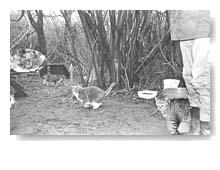
As he's been doing for the past 11 years, Herb Fischer of Montauk feeds the cats at 8:30 every morning. They are awaiting him and, with the aptly named Underfoot, a tiger- striped female, weaving perilously around his feet, the cats escort him to their feeding stations. But the cats that Mr. Fischer feeds so faithfully do not belong to him; they are feral cats that belong to no one.

Cats are now the most popular pet in the United States. There are an estimated 64 million of them living in American homes. Sadly, the estimate of the number of cats without homes - feral cats - is almost as high. Some experts place it at just under 60 million.

Some of these feral cats can be found on the East End. Helena Curtis of the Animal Rescue Fund of the Hamptons said, "It's a very difficult problem. In my opinion it goes back to individual people not spaying or neutering their pets."

Too Wild For ARF

Louise Nielsen of Montauk, who has been involved in feral cat issues for over 20 years, says with some despair that, despite the considerable and commendable efforts on the part of ARF to make low-cost spaying and neutering available to cat owners, the feral cat problem continues unabated.

"I know people find it very frustrating when they call ARF to tell us that there are feral cats in their backyards and find out that we aren't able to take them," said Ms. Curtis. But ARF is unable to take on a true feral (as opposed to an abandoned or lost house cat) for a number of reasons, she explained.

Feral cats are extremely wild. As they have never been handled or confined, they react with considerable ferocity when such liberties are attempted. A cat bite is a serious matter. "Cat bites are very toxic. We worry a lot more about cat bites than dog bites," said Ms. Curtis.

Short Life Spans

With the exception of very young kittens, feral cats are not adoptable. Though the occasional adult can be tamed, it is a long, time-consuming endeavor that most prospective pet owners have no interest in. If ARF were to take these animals, the vast majority of them would spend the remainder of their lives in cages. Not a solution anyone would prescribe, least of all the cats.

Some people choose to romanticize these animals. They see them as the essence of independence, reverting to a wild state that is somehow more honorable than the life of a house cat.

But cats are domestic animals, however much they may appear to insist otherwise! And a closer look at the "independent" life of a feral cat reveals a bleak picture. Experts estimate the average life span of a feral cat to be three years. Many die before they're a year old.

Deromanticized Reality

"I don't think people would romanticize them if they saw kittens, their eyes stuck shut with mucus, sputtering and spitting from respiratory infections or distemper," said Ms. Curtis sharply.

Cats are domestic animals, however much they may appear to insist otherwise. A closer look at the "independent" life of a feral cat reveals a bleak picture.

Respiratory infections and distemper are just two of the many health hazards that afflict feral cats. Dr. Mark Davis of the South Fork Animal Hospital, who has dealt with hundreds of feral cats while participating in the ARF spaying and neutering programs, estimates that fully 50 percent of these animals are infected with the feline leukemia virus.

This virus is the agent of the most prevalent of fatal infectious diseases in American domestic cats. It is easily spread among feral cats and also to any house cats they come in contact with. Fortunately, there is a preventive vaccine for FeLV, which pet cats that have access to the outdoors and may be exposed to infected animals should receive.

New Disease

Feline immunodeficiency virus is a relatively new disease that has been inexorably gaining ground among feral cats. F.I.V. is a blood-transmitted disease mainly found among tom cats who are more directly combative than female ferals. There is no vaccine for F.I.V., and pet cats that war with feral toms are likely to become infected.

Dr. Davis talked sorrowfully of his own pet cat who become infected while defending himself as "the new kitty on the block." Fortunately, F.I.V. has a long incubation period of eight to 10 years, so a cat infected in middle age can usually live out its normal life span without suffering any ill effects.

Though F.I.V. is similar to H.I.V. and causes a disease in cats similar to AIDS in humans, current research shows that it does not present a health hazard to humans.

Not Unsociable

Rabies, however, definitely is a health hazard to humans. Though feral cats are considered to be a weak link in the rabies chain, cats now surpass dogs in the number of rabies cases reported annually in the United States.

Though no cases of rabies have been reported in Suffolk County for more than 50 years, Dr. Davis said, "It's such a serious disease that you have to be concerned." Experts advise people who handle feral cats on a routine basis to have a pre-exposure rabies vaccine. And, of course, all pet cats and dogs should be vaccinated.

Feral cats confound the popular perception of cats as solitary, unsociable creatures. When sufficient food resources exist, the cats will form stable communities consisting primarily of females and their female offspring.

Cat Colonies

Researchers of feral cat colonies report that females are never observed migrating outside of their colony to join other colonies as males are frequently observed doing. The females have been seen to communally nurse kittens, and to one another their behavior is generally amicable and sometimes downright affectionate. But not so to any strange females who attempt to approach the colony; they are repulsed quite fiercely.

Social arrangements among tom cats are more freeform. A detailed study of free-ranging cats that Swedish ethologist Dr. O. Liberg did in 1980 indicated that toms have four categories of social standing:

breeders - dominant adults who monopolize breeding females, a position that all other tom cats aspire to;

challengers - 2 to 3-year-olds aggressively vying with the breeders for access to females;

outcasts - young emigrant males avoiding all contact with other cats; and

adolescent novices - who still remain with their birth colony but are coming under increasingly frequent attack from the breeders.

Obviously, toms fight a great deal. Apart from spreading F.I.V. among themselves, they are frequently covered with abscesses from infected battle wounds. Dr. Davis described some of these warriors that have been brought into his clinic as "exploding" with abscesses.

Cat colonies will form around any reliable food source. Restaurants, delis, picnic grounds, and the backyards of those unwary enough to feed their pet cats out of doors. Feral cats are highly intelligent and extremely desperate animals - if there is food, they will come.

As a child I observed a feral colony that was founded upon a rather unique food source. While visiting the outdoor enclosures of the bears in the Central Park Zoo, my father, younger brother, and I were astonished to see a gray-striped cat slip through the bars of the polar bear's cage and snatch a hunk of fish from right under the bear's nose.

"Bear's Cats"

The zookeeper to whom we rushed with the astonishing news of this sighting was entirely unimpressed but did kindly direct us to look behind the bears' cages to see where the "bears' cats" lived.

There we discovered, to our great delight, a cat shantytown consisting of about 12 small houses erected just outside the bars of the enclosures. Though the cats eventually received supplementary feeding from the keepers and other kindly souls, the original draw to that site had been what they could steal from under the noses of bears.

Feral cats have their human supporters - an estimated 20 million people in this country take part in sustaining these animals to some extent or another. They also have their detractors, and with good reason.

Noise, Odor, Disease

Breeding colonies of feral cats are extremely noisy. The mating calls of the females and the screams of battling males disturb many a good night's sleep. When there are many tomcats in an area, their urine-spraying tendency can become a highly odiferous nuisance. And there is no doubt that they are vectors of disease.

But what has become the most controversial and emotionally charged concern is the issue of cats preying on wildlife, songbirds being the particular concern.

Worldwide, it is certainly true that the predation of cats has resulted in the extinction of many native species. However, these extinctions have occurred on islands that had no or few native predatory mammals; the unfortunate resident animals had no defenses against the invading felines. Since American native species have evolved alongside predatory animals, most researchers feel that feral cats have little effect on overall populations.

The declining number of songbirds is due to the destructiveness of humans, not cats. Cats are chiefly predators of small mammals. Analyses of the stomach contents of feral cats killed by cars indicate that birds form only a small part of their diet.

Don't Blame Them

However, though cats are not the bird-annihilating demons that some environmentalists paint them as, they are contributing some stress, however minor, to already depleted bird populations.

In 1916 Edward Howe Forbush, the state ornithologist of Massachusetts, wrote that it is "our duty to . . . eliminate the vagrant or feral cat as we would a wolf." Though wolves are now regarded in a more kindly light, at least by those who regard them from afar, many still espouse Forbush's solution for feral cats.

Endless Cycle

However, trap and kill policies are not only "unacceptable in this community," as Ms. Curtis put it, but they have been proven time and time again to be highly ineffective and extremely expensive.

It is difficult to trap all members of a breeding colony, and even if that is accomplished there is always a new supply of feral cats (and always will be as long as people continue to neglect the basic health care of their pets by not spaying or neutering them) to move into the newly vacated site and begin the cycle all over again.

The only solution to the heart-rending problem of feral cats is not a quick fix but one that requires time and diligence. Studies have shown that when the cats are trapped and then neutered or spayed, much of their objectionable behavior such as noisy fighting (with the attendant spread of F.I.V.), spraying, and, of course, multiplying in number are eliminated.

Devoted Caregiver

The colony that Mr. Fischer dedicates himself to are all spayed and neutered. It was no small task to accomplish this, but Mr. Fischer is very devoted to the cats.

"They are my hobby. Some people play golf - I take care of these cats," he said. It took patience as well as knowledge of the individual animals for him to accomplish the goal of neutering the entire colony.

"I'd have to sit there and watch and wait for the right cat to get into the trap," he recalls. In addition to their surgeries, the cats received vaccinations for rabies and distemper and had their ears notched so they could be easily identified as having already been treated.

Louise Nielsen was the guardian of a colony that resided at the Montauk dump. When she first undertook their care, the cats numbered around 30. After spaying and neutering, the colony slowly dwindled to nonexistence. Mr. Fischer's colony has decreased slowly in number as well; the original 19 cats now number 14.

Spaying and neutering programs are now advocated nationwide as the only workable, humane solution. One of the major stumbling blocks is lack of funding for this work. Cats, alas, fall between the funding cracks as far as state and Federal programs are concerned. Concerned individuals and organizations such as ARF are forced to take up the slack.

Another obstacle to successful implementation of spaying and neutering programs is the actions of well-intentioned cat feeders. Trapping the cats cannot be accomplished when alternative sources of food are being offered.

To leave a supply of food for a hungry animal may appear kind, but it is only serving to perpetuate the problem. As Mr. Fischer observed, "You can't feed a group of breeding cats and not expect their numbers to increase threefold or fourfold in a couple of years."

Deeper Commitment

In the case of feral cats, it would seem that kindness involves a far deeper commitment to their welfare than just simply supplying food.

Readers who are interested in participating in or supporting ARF's upcoming low-cost spaying and neutering campaign can contact the organization at its East Hampton offices. Information on feral cats and what can be done for them can be had from: The Feral Cat Coalition, 9528 Mirmar Road, San Diego, Calif. 92126, or Alley Cat Allies, P.O. Box 397, Mount Ranier, Md. 20712.

Online Fish Market

Online Fish Market

January 30, 1997
By
Russell Drumm

A computerized marketing system said to be revolutionizing the fish business in New England was an attention-getter during the Long Island Fishermen's Forum on Jan. 17.

The Buyers and Sellers Exchange, known by its acronym, BASE, operates from Homer's Wharf in New Bedford, Mass. Richard Canastra, a spokesman, told fishermen that their New England counterparts were seeing higher prices for their product, the latest price information, and more marketing opportunities, all thanks to an online system linking fishermen, buyers, and buyers' representatives who check on the quality of a catch at display auctions. A similar system is used throughout Europe.

Computer Bidding

He asked fishermen to consider BASE as an alternative to dealing with New York's Fulton Fish Market.

Mr. Canastra visited the forum at the request of Robert Link, president of Mariculture Technologies Inc., the company that plans to grow summer flounder (fluke) on 200 acres of leased bottomland off of Plum Island. Mr. Link said he would use BASE to market his farmed fish.

The vast majority of fish caught by Long Island's market fishermen are sent to New York City's Fulton Market on consignment - that is, the final price is not known until after the fish is shipped.

More Buyers

Like the Fulton Market, BASE requires that a catch be shipped to a designated facility to be displayed, inspected for quality, and bid on. Unlike the Fulton Market, the BASE system includes many more buyers bidding on a catch via computer. Agents hired by individual buyers, or groups of seafood customers, recommend bids based on firsthand inspections.

Using their personal computers, fishermen are able to learn "what's being hailed," i.e., what fish are being sold, and how many boats have landed the same species. Price trends can be determined in this way.

BASE can also arrange deals with fishermen for future catches, finding customers willing to pay in advance for a certain amount of fish to be delivered at a later date. Mr. Canastra said it was possible for fishermen to be paid daily and that the efficiency of the system enabled the market to pass along more money to the fishermen. BASE charges four cents per pound for the service.

Better Records

Fishermen said that when "daytripping," they could wait no later than 7 p.m. to decide where to ship their fish. Not a problem, Mr. Canastra said, adding that the price could be decided before shipping.

He admitted that the logistics and cost of shipping from Long Island was an unknown. "If there's enough volume, we could set up a big cooler to hold the display auction on Long Island," he suggested.

An extra benefit was improved record-keeping. Fishermen received a hard copy receipt of their transaction and were able to access their landing histories at any time. "The permanent data base saves time and money," Mr. Canastra said. And, he added, the system was being viewed favorably by the Federal agents who collect landing data.

Better Records

Mr. Link, a longtime fish dealer before entering the mariculture business, told fishermen, "I've traveled all over the country selling dead fish. New York is an enigma. You guys are getting the worst deal all the time. You've got the commodity, you should get more money," he said.


Report Taxfree Spree

Report Taxfree Spree

Stephen J. Kotz | January 30, 1997

Local merchants, many of whom were trying to move out merchandise with winter clearance sales during a traditionally slow retail period, said they were pleased with the results of the one-week suspension of sales tax that ended Friday and would like to see the experiment repeated.

"It was very successful for us," said Tom Steele, an owner of Above the Potatoes at the corner of Main Street and Newtown Lane in East Hampton. "People really enjoyed not having to pay the sales tax. We saw a significant rise in sales."

Although the state and county are again collecting sales taxes, Mr. Steele said the store would continue its "tax-free zone" promotion through Sunday by giving customers an extra 8.25-percent discount on the men's and women's clothing it sells.

"We had bigger sales than we usually do at this time of the year," said Sal LaCarrubba, an owner of LaCarrubba's clothing store on Main Street in Amagansett. "We had a storewide 25 percent off sale on top of the 8.25 percent. People really took advantage of it."

"I was surprised how few people knew there was no sales tax," said Jennie Voorhees, a clerk at Punch, a women's and children's store on Newtown Lane. "Once they found out, they were happily surprised." The store was "definitely busier than usual," she added, "especially during the first couple of days."

"From everything I've heard, it was overwhelmingly successful," said State Assemblyman Fred W. Thiele Jr. "Certainly consumers liked it and businesses liked it."

There have already been calls to offer another tax-free week, perhaps in late August or just after Labor Day to spur sales of back-to-school clothing. Mr. Thiele said he thought "the chances are excellent" the state will approve it.

The tax suspension, which started Jan. 18, is expected to cost Suffolk County about $1.6 million in revenue, and County Legislator George Guldi said he doubted it would be possible to offer it again this year.

"About all this rhetoric of doing it again: We projected our budget based on 51 weeks of sales tax revenue back in October," he said. "If we are going to do another week, we'll have to make that up somewhere, and I don't know where it will come from."

Nonetheless, Mr. Guldi said he took advantage of the savings. "I bought shirts," he said.

Although Mr. Thiele said he would support a permanent repeal of the sales tax on clothing "if it got to the floor" of the Assembly, he added that he thought that would be highly unlikely. "Because of the budget constraints of local governments, the counties in particular, I think it would be very difficult to get a complete and permanent repeal" of the tax, he said.

While talk of tax cuts is a perennial political issue, Mr. Thiele said, "school tax relief rates higher than sales tax relief for most people."

Mr. LaCarrubba said he would welcome a repeal. "It would definitely make a difference," he said. "It would stimulate sales and keep people from taking bus trips to Pennsylvania" to shop.

Mr. Steele agreed that repealing the tax would help business. "All the people who are driving to New Jersey or using mail order catalogues to save on sales tax would drop those dollars in New York State," he said. "It would lead to more income, more taxes, and more jobs."

He said he was confident the state would see the wisdom of getting rid of the tax and even offered a symbolic carrot to Governor Pataki. "If they were to drop it altogether, I'd wash the Governor's car every week for a year," he said.


Urge Probe Of Lab

Urge Probe Of Lab

Karl Grossman | January 30, 1997

United States Representative Michael Forbes and Senator Alfonse D'Amato, declaring that they were "fed up" by contamination of groundwater at the Brookhaven National Laboratory, called last week for investigations by the Federal Department of Energy and the Environmental Protection Agency into lab operations following the finding of high levels of radioactive tritium less than 100 feet from B.N.L.'s main nuclear reactor.

"While we have been informed by the lab that drinking water has not been affected," they wrote in a letter to Acting U.S. Secretary of Energy Charles B. Curtis, "it is part of a pattern with respect to groundwater contamination that has continued to exist at the lab over the past year. Quite frankly, we are fed up."

Lack Of Confidence

"We are not confident that Brookhaven National Laboratory has an adequate handle on the health and environmental sensitivities of the surrounding residential neighborhoods. This recent incident raises questions as to whether there is further contamination elsewhere at the lab and the lab's ability to detect and/or prevent such contamination."

"We believe that a full-scale, top-to-bottom review of the operations at Brookhaven National Laboratory needs to be undertaken by officials at the highest levels within the Department of Energy," they went on. "In addition, we believe that the High Flux Beam Reactor -- which is being investigated as a possible source of contamination -- should remain shut down until it is proven that it is not the source of this latest groundwater contamination."

Ongoing Problem

In a letter to the E.P.A. Administrator, Carol M. Browner, the Congressman and Senator wrote that "this is the third time in one year that B.N.L. has indicated significant groundwater problems emanating from the site. Obviously, something is very wrong. Due to the repeated and ongoing contamination problems, we urge you to send a senior official from the E.P.A. to B.N.L. to find out exactly what has occurred and insure that every step is taken to protect the health and safety of the surrounding residents and on site workers."

In a letter of response which Mr. Forbes made available, Mr. Curtis said that a D.O.E. "team" is being formed "to conduct a health and safety review to investigate the source of the tritium contamination and insure that the appropriate mitigative and corrective actions are identified and implemented as quickly as possible."

Reactor Still Shut

He also said that "the High Flux Beam Reactor, a possible source of the contamination. . . will remain shut down until the situation is satisfactorily understood and resolved by the Department of Energy and Brookhaven National Laboratory."

Suffolk Legislator Michael Caracciolo, a Wading River Republican whose district includes the lab, last week also called for the continued shutdown of the High Flux Beam Reactor at the lab. Mr. Caracciolo said that he was especially concerned about the tritium moving with the groundwater to houses near the lab. "I want the laboratory to get a handle on this," he said. "Then and only then should they be permitted to reopen the facility."

According to a lab press release, tritium beyond the E.P.A. and New York State drinking water standard was found in a test well near the High Flux Beam Reactor.


Cowboy Vs. Bayman Showdown

Cowboy Vs. Bayman Showdown

January 30, 1997
By
Russell Drumm

There's a miniature range war brewin' down Montauk way over bottomland owned by Rick Gibbs, the Crabby Cowboy, as he's known in those parts. Actually, the Crabby Cowboy is the name Mr. Gibbs has given his East Lake Drive resort and restaurant, formerly the Blue Moon.

At least one bayman thinks the Crabby Cowboy name fits. Mr. Gibbs has chased him off the five acres of bottomland be bought last year along with five upland acres.

The property contains boat slips, a restaurant, a number of resort accommodations, and, if Mr. Gibbs's plan works out, a clam ranch that will supply his restaurant for part of the season. He said on Monday he had already paid $100 to the state for an aquaculture permit.

Don't Fence Him Out

Don't fence me out, says Anthony Sosinski, a bayman who concentrates much of his digging in Lake Montauk. Mr. Sosinski claims Mr. Gibbs lacks the right to keep him from digging clams, and also believes the Cowboy will be hard-pressed to get state permission to grow clams for his patrons' consumption.

After researching town records in the East Hampton Library, Mr. Sosinski made his argument during a Town Board work session last month. He told the board Mr. Gibbs was not the only owner of private bottom to chase clammers away.

"Since I have been shellfishing in Lake Montauk, there have been disputes about who owns what. The town owns some of the lake, and the residents own some. The problem is, we, as shellfishermen, don't know who owns what."

Who Owns The Clams?

"There have been incidents," said Mr. Sosinski, "where the landowner has taken the shellfish out of people's trucks, because they say they own the clams because they come from their land."

The clammer said his research had shown this was not the case - that in 1983, the town initiated a program to stock Lake Montauk with clams. "They were for all the residents." He said state law saw clams as a common resource.

On this point, Bill Hastback, a shellfish specialist with the State Department of Environmental Conservation, agrees, at least in part.

Common Property. . .

"An individual private bottom-owner does not have clear ownership of the resource," he said, citing a legal precedent set five years ago when a similar dispute arose in Asharoken, in the Town of Huntington.

State Supreme Court Justice Peter Cohalan ruled then that because free-floating shellfish larvae settled heedless of property lines, mature shellfish were common property, just like free-moving finfish and scallops.

Stuart Heath, another Lake Montauk bayman, said this week that few property owners seemed to know the law. He fears that local police, who are sometimes called by property owners to chase away baymen, may not be familiar with it either.

"This is not a hobby. It has a direct effect on my income if I'm ordered out of an area," Mr. Heath said.

. . .With One Exception

The exception to the law, Mr. Hastback said, is when a bottomland owner gets permits for the "on-bottom culture" of shellfish and actively engages in their farming and marketing, as Mr. Gibbs intends.

While Mr. Gibbs has applied for his permit, he has not received it, and technically cannot keep people from clamming until he does.

According to Debbie Barnes, who handles bottom-culture permits for the D.E.C., one drawback in Mr. Gibbs's plan is that his property is in an area closed to shellfishing from May to November.

'On-Bottom Culture'

Not a problem, Mr. Gibbs said. "I plan to be open year-round. I have a resort property and a restaurant, and I'll have clams and steamers I can harvest and sell in the restaurant. It will help pay the property taxes each year."

"I would rather do that than fight the town to make this place larger," he added.

He intends to put horses on his five acres, too, he said, "instead of 10 more units," and instead of trying to squeeze more boats into his small marina. He has applied to the Town Zoning Board to put a corral on the property.

"I want it to be part of East Lake," said Mr. Gibbs, "not a club. The place will close early. I believe in building to suit the land. The spawn from my clams will go throughout the lake. I want to give back to the lake."

Clam Ranch

Greg Rivara, an aquaculture specialist with the Cornell Cooperative Extension Service, said he had met with Mr. Gibbs and believed the clam ranch was technically feasible.

"Five acres is enough to support a cottage industry," Mr. Rivara said this week. "He's not going to get the Fourth of July because of the closure, but the price of clams at Christmas is just as high."

Both Mr. Rivara and Ms. Barnes said the proposed farm's proximity to the Crabby Cowboy's own marina, and to Gone Fishing Marina next door, did not preclude the farm as long as the harvesting took place outside the closed season.

Dredging Disruption

Bayman and would-be clam-rancher alike are concerned about continued dredging in the area, which could disrupt shellfish beds and bury the resource.

Mr. Rivara, however, said approv ed dredging projects included safeguards such as "silt curtains" that keep nearby shellfish from being buried.

Mr. Sosinski said on Tuesday he was not giving up on his effort to keep Lake Montauk an open range for commercial shellfishermen. He said he knew of the proposed farm, but there were other arguments to make.

Before 1852, the right to fish in Great Pond, as the lake was known, was a common right, he said, guaranteed by the Dongan Patent of 1686.

Bayman Cites History

The right remained after the breakaway, and after Arthur Benson's purchase of Montauk in 1879, Mr. Sosinski contends, because that purchase did not include land below the low-tide line. Therefore, the bottom remained common land, just as in the rest of East Hampton's harbors and bays, which Town Trustees have owned and managed since colonial times.

Furthermore, said Mr. Sosinski, when the lake was opened to Block Island Sound in the mid-1920s, "it became Federal tidal waters," and after the inlet was dredged in 1936 "to qualify for Federal construction [funds], the town and the county agreed to provide certain public rights in the use of the water."

Shellfishing is one of the rights, Mr. Sosinski said.

Town Councilwoman Nancy Mc Caffrey said the Town Board was unlikely to take up the question unless and until Mr. Sosinski files a complaint with the town attorney's office.


Plan Tower Network

Plan Tower Network

By Josh Lawrence | January 30, 1997

"You guys aren't wired, are you?" the East Hampton Town Planning Board member Gary Swanander asked representatives of Bell Atlantic NYNEX Mobile as they prepared their pitch last week for a new 100-foot-high radio tower in East Hampton.

The joke was a reference to Southampton Town's recent bribery scandal, involving a much larger tower in Noyac.

Though the NYNEX tower would be less than a third the size of the proposed Vertical Broadcasting Inc. tower in Noyac, the application could still stir up some static in East Hampton.

NYNEX representatives revealed to the Planning Board that at least three 100 to 150-foot towers may be needed here for the company to bolster its cellular phone service.

At Least Two Others

The tower now before the board would be built near the intersection of Route 114 and Cove Hollow Road. The site, on Hardscrabble Court, is currently home to East Hampton Self-Storage.

Pressed by members, NYNEX Mobile representatives acknowledged this was not the only visit they planned to make to the Planning Board. To complete its relay network in East Hampton, NYNEX is eyeing at least two more sites in the next three years: in the area of Barcelona Neck off Route 114, and near Three Mile Harbor and Camp Blue Bay in Springs.

Planning Board members made it clear they were uncomfortable reviewing an application without knowing the company's master plan. Several members even hinted the town may need to develop a policy on communications towers.

All At Once

"We're all busy people," said Mr. Swanander. "If you have a master plan, why not submit it and put them in all at once?" He suggested the representatives work with planners to find the most suitable sites.

Howard Pachman, an attorney representing NYNEX, told the board he "would be happy" to submit a master plan.

NYNEX is only one of several companies in the cellular service market, the board noted. Each company needs its own network of sites to provide service, though not all would necessarily involve towers.

"I kind of freak out when I hear you talk about Camp Blue Bay and Three Mile Harbor or Northwest Creek, and 100 and 150-foot towers popping up around town," said Job Potter, a Planning Board member. "I think the town, from a policy standpoint, really needs to understand what's coming."

"I'm not personally convinced that top-quality cellular service is a necessity for all of East Hampton," Mr. Potter added. "But that's a judgment call."

No Seams

"It's not what the town believes is good service," responded Mr. Pachman. "We're obliged under the public service law to provide seamless service. The F.C.C. sets the standards."

"We have our standards too," answered Pat Mansir, the Planning Board's chairwoman. "We'll work on ours and you work on yours."

In design, the proposed structure is a hexagonal steel tower, tapering in diameter from four feet at the base to 28 inches at the top. Two triangular platforms rest near the top, each sporting nine antennae. The tower is in one piece, rather than a four-legged, metal-frame structure.

A metal equipment building would be constructed at the base and the site would be surrounded by a fence.

Tighter Networks

NYNEX has relay sites at two locations in East Hampton now: at the "antenna farm" near the Montauk recycling center and at the Cablevision tower site on Springs-Fireplace Road.

A radio frequency engineer for the company told the board that service is "very bad" on Route 114 and in parts of East Hampton Village. The Hardscrabble site would provide coverage over a roughly two-mile radius, stretching north to the high point of Route 114, west to the East Hampton Airport, and east to the Springs-Fireplace Road site.

The need for tighter networks, said the engineer, relates to the changes in cellular technology. As car phones with powerful car-mounted antennae are replaced by portable cellular phones, the range allowed between "cell sites" shrinks.

"The rings of service were much wider before," said the engineer. "Now these sites are getting smaller."

The Planning Board chose not to delve into the specifics of the site plan last week. Mr. Potter did raise a concern over the visibility of the tower from neighboring houses, however.

"Part Of Now"

James Mangano, another board member, said there were "a lot worse locations in town we could put this," adding that "cellular is here. It's not part of the future; it's part of now."

A question remains whether the tower would be subject to the town's pyramid law. The law, which restricts the height of structures based on their distance from property lines, would prevent the tower on the proposed site.

Lisa Liquori, the town planning director, agreed this week the application will need to be reviewed in context.

"We may be taking a comprehensive look at this," she said. "It seemed like an innocuous little application when we first got it, but the more they talked, I could see people's jaws dropping!"