
Sontag, Wilson Do Ibsen, 'Hamlet'

Sontag, Wilson Do Ibsen, 'Hamlet'

Patsy Southgate | August 14, 1997

Under a new free-form tent called the Mistral Pavilion, a joint benefit was held Saturday for Jack Lenor Larsen's LongHouse Foundation and Robert Wilson's Watermill Center. LongHouse's magnificent gardens were the setting for the event.

The tent, designed by the late Bill Moss, brought to mind the silvery flamboyance of the Sydney, Australia, opera house, its billowing-sail shapes shading the audience from the glow of the setting sun.

It would be hard to imagine a more architecturally aesthetic, or horticulturally haute, setting, or, for that matter, a loftier literary program. As if to affix an intellectually correct seal of approval on the proceedings, there was Salman Rushdie listening intently in the second row.

In English And Italian

Scenes from Susan Sontag's adaptation of Henrik Ibsen's "The Lady From the Sea," a work-in-progress, were read, first in English by Ms. Sontag, then in Italian by the French actress Dominique Sanda, star of the Oscar-winning film "The Garden of the Finzi-Continis."

Next, Mr. Wilson performed his 1995 adaptation of Shakespeare's "Hamlet," a monologue he conceived and directs. He plays Hamlet mostly but occasionally also seems to be Gertrude; this was not entirely clear.

Before the performance Ms. Sontag said Ms. Sanda had chosen the Ibsen play, and that Mr. Wilson had told her to change it.

"I can't stand that kind of Ping-Pong," she said he said, meaning the back-and-forth of the realistic psychological conflicts that are the great Norwegian dramatist's hallmarks.

Mermaid Talk

What Ms. Sontag has wrought in the two short scenes she presented is a hauntingly simple, heartbreaking portrait of a woman in a landlocked marriage challenged by a call to freedom from a former lover in the sea, known only as the Foreigner.

In some sense a mermaid, a sort of Ondine in "A Doll's House," the heroine speaks a monologue in what Ms. Sontag described as "mermaid talk." As she read it in English, the emotional impact was palpable.

Then the gorgeous Ms. Sanda, in a simple ecru pants suit (Chanel?) and gold earrings, her hair pulled back severely, told us in a high little voice that she would be reading, not performing, the scenes, in Italian, as the play was to have its world premiere in Ferrara next spring.

Beautiful Theater

It would next go to French-speaking Switzerland, she said, where she would perform in her native language, and then, it is hoped, come to America.

Her performance voice, moving from gentle and sad to a full-throated, powerful, and almost brutal anger, even in Italian was mysteriously comprehensible and utterly moving, in one of the most beautifully controlled theatrical moments this reviewer has ever seen.

Ms. Sontag and Ms. Sanda perform miracles.

Another Matter

Mr. Wilson's "Hamlet" was quite another matter. Using vocal sounds ranging from a bellow to a whisper and passing through the bark, the groan, the squeak, the gargle, the giggle, and the shriek, he sounded more like a stand-up comic than a tragedian.

Dressed in black, he used various black and white props - a white dagger, a white cross; a black quill pen, a pair of black socks, and at one point even donned a black hood resembling the bags we see criminals wear on TV on the perp walk from the courtroom to the squad car.

He looked quite silly, and lacked their undeniable dramatic impact.

Nevertheless, despite the irritating solipsism of his performance, and perhaps more for distinguished past productions such as "Einstein on the Beach"and "The Life and Times of Sigmund Freud" than for this travesty, Mr. Wilson received a standing ovation.
The War Of The Super-Realists

The War Of The Super-Realists

Julia C. Mead | August 14, 1997

A well-respected art gallery owner discovers her former assistant and his father, one of the gallery's artists, are now the competition, having opened their own space across the street. A celebrated sculptor discovers her studio assistant of many years has begun working in her style and selling look-alike sculptures for half the price.

After a failed attempt to woo the famous sculptor away from the long-established gallery, the neophyte gallery owner instead joins forces with the sculptor's former assistant. They put on an exhibit that opens within weeks of the famous artist's show across the street.

Accusations are hurled, the principals scurry back and forth taking photographs of each other's work, and a lawsuit is filed.

Stranger Than Fiction

This may sound like the sort of intrigue in a Danielle Steele novel, but the dueling exhibits are real and can be found on Job's Lane in Southampton Village, and the lawsuit in United States District Court in Brooklyn. The story, it seems, is too far-fetched to be fiction.

It begins two years ago, when Carole Feuerman, a noted sculptor of hyper-realistic, life-sized figures, and her assistant, John von Schmid, parted ways. Ms. Feuerman, who has been doing what she calls figurative realism for 22 years, donated one piece to President and First Lady Clinton's private collection in the White House, had another piece sell at a Sotheby's auction for $37,500, and had others purchased by such notables as Henry Kissinger and Malcolm Forbes.

She told The Star that Mr. von Schmid stopped working for her when she was moving her studio from Nassau County to Manhattan. Mr. von Schmid, who lived in Westbury, did not want to commute. They remained friendly, though, and she later hired him to help with a commissioned work in North Carolina.

"Slavish Imitations"

Roberta von Schlossberg, owner of R.V.S. Fine Arts at 48 Job's Lane, and her 22-year-old gallery director, Troy Buckner, parted ways last year. Mr. Buckner declined to be interviewed and Ms. von Schlossberg is traveling for the summer, but word has it their parting was not entirely friendly.

With his father, Hal Buckner, a sculptor who used to show at R.V.S., the younger Mr. Buckner opened his own gallery at 43 Job's Lane in the spring. His first show at the Sculpture Court, as his gallery is named, included startlingly lifelike sculptures by John von Schmid. It was Mr. von Schmid's first show.

Ms. Feuerman, who has been showing at R.V.S for more than a decade, opened her annual summer show there on June 28. In her lawsuit, filed Aug. 1, Ms. Feuerman charged her former assistant with "making slavish imitations . . . with the intention of capitalizing on my reputation and good will."

Allegations

Ms. Feuerman is suing both Mr. von Schmid and Troy Buckner, demanding an injunction, a jury trial, and monetary damages. A court hearing is to be held in two weeks.

The suit alleges that Mr. von Schmid's piece "First Dive," which depicts a young girl wearing scuba gear, used the face of the subject in Ms. Feuerman's "Islamorada" and the diving outfit in her work "Scuba."

"Scuba" was the piece auctioned at Sotheby's in 1990 for $37,500. "Islamorada," a 1988 sculpture that shows a little girl in a bathing suit stepping from the water covered with water drops, is in the Clintons' personal collection.

A few artists before Ms. Feuerman have worked in the Super-Realistic style, but she contends her techniques are hers and hers alone.

Yearlong Work

She casts live models in plaster and then reproduces their images in polyester resin and vinyl, using oil paints to add minute details, such as veins, pores, and beauty marks. Their clothes are made of the same resin as their bodies, which sets her apart from the Rockwellian sculptures of the late Duane Hanson, a pioneer of the style who dressed his figures in real clothes.

Her pieces can take as long as a year to complete. Human hair is attached one strand at a time. Most of her figures are shown emerging from the sea, the shower, or some sweat-inducing activity, and water drops that are as clear as the real thing are made from a secret formula. Secret, that is, to all except her former assistant.

Her lawsuit claims the formula had "never been replicated" until Mr. von Schmid's work appeared at the Sculpture Court.

Corine Sullivan, the new R.V.S. director, said neither she nor Ms. von Schlossberg would comment on the dueling exhibits. "It is regrettable that this situation has occurred, but the R.V.S. Gallery anticipates an amicable solution," Ms. Sullivan said.

Mr. von Schmid, reached by phone, said twice that he had another call on the line and had to hang up. He did not respond to a subsequent message by press time. His lawyer, Tennison Schad, called The Star, however, to say the charges in Ms. Feuerman's lawsuit were "totally false." With the Manhattan firm of Norwick and Schad, he also is representing the younger Mr. Buckner and the Sculpture Court.

An anonymous tipster alerted The Star on Friday to the battle on Job's Lane, taking Ms. Feuerman's part. A second caller, on Saturday, said that Ms. Feuerman did not like competition.

No Other Suit

Her lawyer, John B. Koegel, had sent a letter in January to a Wisconsin artist, Mark Sijon, who, she alleged, was imitating her work. Mr. Sijon said his lawyer had advised him to not discuss the matter. Ms. Feuerman said she believed Mr. Sijon had gotten the message and that she would not sue him.

For his part, Troy Buckner asserted on Friday "there really isn't, in my mind, a situation." He declined to comment further.

The suit claims the younger Mr. Buckner had tried to woo her away from R.V.S., at first saying R.V.S. was no longer interested in showing her work and then offering her 70 percent of each sale made through Sculpture Court, when a 50-50 split is more typical.

Felt Threatened

"I told him I wanted R.V.S. and Sculpture Court to share mutually in the sales, but he said he would get another artist instead, whose work is like mine. I felt he was threatening me, but I didn't think in a million years John was doing pieces that were so identical you would never know who did them," she told The Star.

Her lawsuit takes umbrage at the pricing of Mr. von Schmid's works, saying the show across the street was an attempt to "devalue my entire body of work." His "First Dive" is offered at $16,000, while her works range from $30,000 to $80,000.

Ms. Feuerman said she first learned that her former assistant had become her competition when a number of her best clients told her they had received letters from him, offering works akin to hers at lower prices. Among them was Ruth Baum, who lives on Meadow Lane in Southampton.

"The whole problem with the visual arts is that an artist can change something slightly, a turn of the face, and then it's up to a judge and a jury to decide if he can get away with it or not," she said.

Acid Rain Concern

Acid Rain Concern

August 14, 1997
By
Editorial

The word is getting out about the insidious nature of acid rain: This week, there was news that "downwind" states in the Northeast are petitioning the Environmental Protection Agency to set stricter limits on Midwestern coal-fired electrical utilities; that the E.P.A. is about to provide on-line environmental performance profiles of factories in the oil, steel, automobile, and paper businesses, and that Gov. George E. Pataki has proposed to curb the sale of the E.P.A.'s curious "emission vouchers" to out-of-state power plants and businesses.

While the East End would seem somewhat sheltered from the deleterious effects of acid rain because of the nature of our soils and the effect of a saltwater environment, what has happened in the Adirondacks - the deaths by acidity of lakes, ponds, streams, and trees - is sufficiently proximate to create concern.

Dogwoods, hemlocks, and sugar maples are high on acid rain's hit list, as are minerals in the soil and fungus and microbes on the forest floor necessary to the cycle of plant life. Furthermore, a recent study shows that acid rain also often contains nutrients, particularly nitrogenous ones, which might be linked, for example, to the choking of wetlands by phragmites and of local waters by brown tide.

Acid rain is a lot more serious than most of us realize. The acidic fallout of factories, combined with automobile exhaust, are adding to the greenhouse gases insulating the earth and threatening its environment.

What can be done? For starters the E.P.A. could roll back its emission voucher charade. This is a Federal program in which heavy polluters are spared the E.P.A. ax by buying emission permission slips from less-polluting concerns that have met E.P.A. limits.

Then the obvious: Hike fines for violators, more closely follow, as some New York City television stations already have done, the movement of acid rain, more closely monitor its effects, and more broadly disseminate the information.

Greenbelt Addition

Greenbelt Addition

August 14, 1997
By
Editorial

Southampton Town's announcement on Tuesday that it would join forces with Suffolk County to preserve most of the former Bridgehampton Winery property in a deal negotiated through the Nature Conservancy is welcome.

A proposal by JOG Associates, the property's owner, to squeeze a nine-hole golf course and eight houses onto the land would have overburdened the 74-acre tract and caused irreparable harm to the woods and ponds where the tiger salamander, an endangered species, lives and breeds.

Although the wooded portion of the property has long been eyed for public acquisition, the preservation of the property has been delayed because government has been loath to use open-space funds to buy the fields that make up the western half of the land, citing disturbances caused first by crop farming and later by grapevines.

But the town, which will use funds from the open-space tax voters approved a year ago, has seen the wisdom of buying the fields, too, which include Black Pond and other wetlands, instead of losing the opportunity. The owner will retain the winery buildings and two adjacent house lots.

The 69 acres to be acquired will augment the roughly 500 acres that have been protected in the Long Pond Greenbelt. Although the greenbelt is large, access to its trails, as a recently released draft management study acknowledges, is limited.

This purchase provides the opportunity to create a trail head, or perhaps even a nature center, and to allow the public to enjoy its public land.

A Lot Of Noise

A Lot Of Noise

August 14, 1997
By
Editorial

Noise. Shrill, raucous, grating, relentless noise, echoing in the night just when you are trying to sleep. Music blaring, tires screeching, bass tones thumping, car doors slamming, people shouting. Painful, unacceptable noise.

This summer may well go down on record as the year the noise dam broke, spilling frustration, resentment, and anger in its wake.

On the outskirts of Sag Harbor, a trio of hot new clubs has neighbors forming ranks in an us-or-them stance, bemoaning their lost peace and quiet and demanding action. They want the village to do something, anything, to make the revelers and the traffic jams and the amplified hip-hop music - which starts in the afternoons on weekends and doesn't stop until 3 a.m. or so - go away.

In a residential area of North Sea in Southampton Town, where some of the most popular nightclubs are located, homeowners seem to be hard put to decide which is worse, noise or traffic congestion. The North Sea ambulance barn is across the street from one trendy spot, and volunteers responding to weekend calls must keep a wary eye out for revelers stumbling along the dark roadside to their cars after an evening's drinking.

Montauk, which takes pride in its reputation as the Wild West of the South Fork, also seems to be nearing the end of its lasso. With many more bars and nightspots per head than its neighboring hamlets, and far more dependent than other villages on seasonal visitors for economic survival, Montauk usually has accommodated whatever came its way. Recently, however, there has been so much noise about noise from the hamlet that calls itself "The End" that a special East Hampton Town police officer was assigned last week, from 11 p.m. to 4 a.m. on weekends, to respond to complaints.

In East Hampton, meanwhile, the Town Board has been grappling all summer with the question of how to regulate noise at night, a problem that is not apt to be solved before it becomes moot for another year.

Perhaps there is no solution. Certainly no one has found one yet. Over the years, the fines for excessive noise have escalated both in Southampton and East Hampton, but they are still nowhere near steep enough to be anything but an annoyance, a cost of doing business. If a few hundred people pay a cover charge of $10 or $20 just to get inside the action, a fine of $250 is, indeed, as one sleepless Southampton resident put it, "a joke."

Can it be that there simply are too many lions in the cage, all rattling the bars? Is it possible that we have no right to expect peace and quiet anymore? Surely not. What is needed, at least in this town, is a redoubled effort. Southampton took the lead not long ago in towing almost 100 cars from illegal parking places on residential roadsides near popular nightclubs. A police effort on that scale has never been attempted here; perhaps it should be.

And surely, too, August has something to do with all this - the heat, the crowds, the short, fierce window of time until the party ends.

Design: Adding On To A Meier House

Design: Adding On To A Meier House

Marjorie Chester | August 14, 1997

Only weeks after Anita and David Hoffman bought their acre of land in 1966, Mrs. Hoffman was browsing through the magazine section of The New York Times and spotted the house of her dreams. "David," she recalls saying to her husband, "we have to find this architect no matter who he is."

Within hours she was on the telephone with Richard Meier.

"I told Richard that I wanted an all-white house," Mrs. Hoffman said. "He said I'd come to the right place!"

The featured house was the one the architect had designed for his parents in South Orange, N.J.

Completed in 1967, the Hoffman house became an instant architectural icon. It was one of Mr. Meier's early works and his first house in East Hampton. Taut and white, it appeared as a three-dimensional abstraction of interlocking geometries.

Clean And Spare

Mr. Meier has said that the Hoffmans asked only that the three children's rooms be very small to encourage outdoor play and that the house be finished by the following summer. "Both requests were met," he said.

"It was clean, spare, just what I loved," said Mrs. Hoffman. "It was a perfect house for a family with little children." But as the family expanded, the space became too tight.

Three years ago Mrs. Hoffman approached Mr. Meier about doing an addition. He recommended the architectural firm of Peter Stamberg and Paul Aferiat.

In the new book "Stamberg Aferiat Architecture" (Rizzoli, 1997) Mr. Meier explains that the firm "had done outstanding renovations and/or additions to three of my buildings - the only three projects of mine that have been altered in any way without my involvement." Mr. Aferiat had worked with Mr. Meier from 1975 until 1979.

Exterior Walls

How to add to the Hoffman house without destroying it was the challenge. According to Mr. Stamberg, when it was finished, Mr. Meier told Mrs. Hoffman that the design was complete and could never be added to.

At first the architects were stymied. "In studying the plan for this structure we came to feel that it was quite different from Meier's other houses," Mr. Stamberg said. He added that Mr. Meier's works have always been "collage," that is, open-ended, overlapping areas that leave possibilities for expansion. "We saw this design as a clear and complete, somewhat locked, geometric system, a pair of exquisitely carved rectangles rotated about each other."

Examination of subsequent Meier designs led the architects to discover many "sprouted landscape walls" - exterior walls without roofs that merely define an outdoor space.

New Triangles

Thus, by adding a landscape wall to one of the rectangles, from which they could clip on rooms, the architects felt they had unlocked the system.

The new wing, which contains a master bedroom and dressing room and bath, presents a solid, unfenestrated facade to the road. The former master bedroom was pushed out a bit to add a fireplace. It became a den-guest room. And by incorporating a patio and tool shed in two separate triangular areas that were part of the original geometry, the architects also expanded the living room, dining room, and kitchen.

In his introduction to "Stamberg Aferiat Architecture," Paul Goldberger writes: "This is not so much an addition as a rewriting of architectural history, making Meier's original concept bigger and considerably more gracious, but all blending in so seamlessly that it is difficult for the visitor now to distinguish between what was added in 1996 and what Meier did in 1967."

Still Modest

"Paul's perception was correct," Mr. Stamberg said. "In a sense the space had always been there, but it was implied."

The house, once 2,000 square feet, is now 3,000 square feet - all added to the first floor. "The space flows so much better now," Mrs. Hoffman said. The kitchen has four workplaces so everyone can do a task, and the living room has space for an English farm table that easily seats 12.

Through some minor reconfiguration upstairs, the three tiny bedrooms have been made into two somewhat larger rooms. An open balcony over the living room has been enclosed in plexiglass to provide another sleeping area.

"The original house was built in a time that appreciated simple living," Mr. Stamberg said. He added that it is to Mrs. Hoffman's great credit that, while the addition increases the size of the house, the rooms are still very modest.

Still Dominant

"Keeping the scale of the new master bedroom wing very tight permitted the original Meier house to be the dominant element of the completed project," Mr. Stamberg said. "We were able to keep the addition subservient to the original masterpiece."

Mrs. Hoffman is pleased that the architects replaced the original white ceramic tile floors with wood. "The house is much warmer this way," she said. The rest of the house, though, is still strictly white - ceilings, walls, all the new furniture. "I very much wanted the same look," she said,

It is a look she has loved unwaveringly for 30 years. "When I wake up in the morning out here, I'm one very happy person," she said.

New Generation

Although the Hoffmans are now divorced, the house continues very much a family house. Two of their three grown children are married and three grandchildren have arrived since the completion of the addition. In fact, Mrs. Hoffman has begun to talk to Mr. Stamberg and Mr. Aferiat about another addition.

The only problem Mrs. Hoffman describes is the new exterior surface, an artificial stucco which she says is easily dented by garden machinery and also streaks. "It's not everything we hoped it would be and we hope to find a solution," Mr. Stamberg said. "On a minimalist house any imperfection becomes more noticeable."

As for Richard Meier, he had this to say:

"I think they did a very sympathetic addition that suits Anita's needs now. The proportions of the small children's bedrooms, which were designed for babies in the original house, are much better. It certainly is a very different house than when the Hoffmans moved in."

Recorded Deeds 07.31.97

Recorded Deeds 07.31.97

Data provided by Long Island Profiles Publishing Co. Inc. of Babylon.
By
Star Staff

AMAGANSETT

Silverstein to Scott Feltzin and Mark Kowalsky, Catalpa Place, $162,000.

Bezoza to Edward and Diana Nash, Timber Trail, $425,000.

BRIDGEHAMPTON

Wiskey Hill Inc. to Stephen Steinberg and Karen Goldman, Mill Path, $210,000.

Wiskey Hill Inc. to Howard Rosenberger, Bridge Hill Lane, $160,000.

Egan East Dev. to Michael Lesser and Mindy Schneider, Jennifer Lane, $915,000.

Sweet Linda Ltd. to Sixtina Friedrich, Ludlow Green, $288,000.

Murphy to Jack and Eileen Zito, Millstone Road, $270,000.

EAST HAMPTON

Kahan to Pamela and Colton Givner, North Woods Lane, $426,000.

Heddesheimer to Lyndon English Jr. and Teresa Cuomo, Red Fox Lane, $235,000.

Lewis to Lewis and Alice Sanders, Lily Pond Lane, 3.7 acres vacant oceanfront, $8,000,000.

Saatchi to James Menges, Buell Lane, $570,000.

Hamlin to Ira and Sharon Horowitz, Cedar Street, $192,000.

Brautigan to Mark Hanik, East Way, $210,000.

Krupinski to Britta Steilmann, Woods Lane, $800,000.

Carter to David Douglas and Sally Baier, Route 114, $255,000.

Munash to Howard and Marilynn Greenberg, Trail's End Road, $375,000.

MONTAUK

Dorr to Jeannette Novack, the Ridge, $306,000.

NORTH HAVEN

North Haven Acquisition to Steven Bedowitz, Seaponack Drive, $380,000.

NORTHWEST

Pariser to Stephen and Janet Rothstein, North Pass Road, $440,000.

Wooded Homes Inc. to E.R. Yankee Homes Inc., Alewife Brook Road, $175,000.

SAG HARBOR

O'Neill estate to Kazutomo Matsuoka and Kazue Lemon, Marjorie Lane, $192,000.

Spaulding to Clyde and Gaynell Drexler, Terry Road, $470,000.

WAINSCOTT

Berman to Barbara Albinder, Town Line Road, $755,000.

WATER MILL

Patterson to Darren and Nancy Kipnis, Deerfield Road, $590,000.

Pfriender to Michael Bollo and Thomas Lauinger, Water Mill Towd Road, $365,000.

Source One Group to Leon Weiss, Grace Court, $710,000.

From Sea To Shining Sea, On Three Bicycles

From Sea To Shining Sea, On Three Bicycles

July 31, 1997
By
Carissa Katz

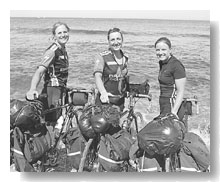
By the time Sandra Sirota, Carly Ferguson, and Heidi Straub reached Long Island, the rest was simple. They pedaled alongside the Belt Parkway from the Verrazano Bridge, hit the Rockaways and the Five Towns area, then headed east on Merrick Road to Route 27, and stuck with it the whole way to Montauk Point. What's a mere 100 miles when you've biked through the Mojave Desert, over the Rockies, across the Great Plains, and over the Appalachians?

On Saturday, after 54 days, 3,800 miles, 30 flat tires, and too many Powerbars to count, the three young women rode past the Montauk Lighthouse and dipped the tires of their touring bikes in the Atlantic Ocean.

They had started their cross-country adventure by christening their wheels in the Pacific in Ms. Straub's hometown of San Diego and finished it within easy distance of Ms. Sirota's parents' house on Napeague.

Two days earlier the young women were riding through water up to their knees and ducking a serious lightning storm in New Jersey. It was some of the worst weather of their trip, but Saturday dawned sunny and dry - perfect for the final leg of the journey.

With the opposite ocean lapping at their bikes and the dust of 14 states on their panniers, the young women were all smiles (with a few tears of joy), stumbling over each other to share road stories and hugging everyone who helped them along the way and now gathered to celebrate their success.

Their parents had come from as far away as San Diego and Bermuda and were eager to see their daughters round the final bend in the road after tracking the trip through phone chains and shared E-mail messages.

All six of them wore T-shirts from the trio that read "My daughter biked across the U.S. and I survived." They trusted their daughters' common sense, but it can't have been easy.

"You know," said Gary Sirota, Sandra's father, "there's something like 1 percent crime in this country and you read about it 99 percent of the time, but those girls had nothing but good experiences."

Mr. Sirota, who lives on Napeague and in Massapequa Park, has a bicycle shop in Wantagh and helped his daughter and her two college friends with equipment selection and touring advice.

The six parents created a cross-country support system, planning routes, sending supplies to stops along the way, offering knowledge on certain parts of the country, and generally encouraging their daughters to stick with their dream.

No one had any doubt they would make it.

The three recently graduated from Cornell, where they had been crew teammates. They rowed or trained almost every day of their school career, and the week before flying to San Diego to meet Ms. Straub, who graduated in December, Ms. Sirota and Ms. Ferguson had been competing in nationals for crew.

The women themselves, sometimes sore or soaked to the bone, bruised from a fall or sunburned, said they only really questioned the journey once. That was during the flight to San Diego as two of them looked down at all they would have to bike across before their adventure was complete.

It was Ms. Sirota who first dreamed up the idea of a cross-country bike trip. "I was thinking of going abroad and realized I hadn't even seen my own country," she said over a late morning cup of coffee at her parents' house Sunday.

She was a sophomore then and knew she would probably be in the best physical condition of her life after another two years of rowing. She told Ms. Ferguson, then Ms. Straub and another crew teammate, Liz Healy. Hasn't every bike rider toyed with the idea?

A year and a half later, each was wondering if the others were still up for it.

"We were all thinking we still had to do it somehow," Ms. Straub recalled. All four were in, but in the final weeks Ms. Healy slipped a disc in her back and was unable to join them.

The three who made the trip weren't serious bikers before they started out. "Even in training we had never biked more than 100 miles," Ms. Straub said.

"We were so busy we never had time to," Ms. Sirota added.

"You can't plan this kind of trip. Things go wrong, you learn as you go along, but that was good for us; it matched our style very well," Ms. Ferguson added.

They rode Trek 520 touring bikes, wore clip-in shoes, and carried only rear panniers (the saddlebags that hang over the back wheel of the bike). They each had a sleeping bag, and communal necessities - camp stove, toiletries, tools, and so on - were split up among each of their panniers. Their loaded bikes weighed 70, 75, and 80 pounds.

"We had everything we needed and used everything we had," they said.

As far as the three women were from home, their parents were right along with them, learning about each state and keeping up with the day-to-day travails of the journey by exchanging E-mail with one another.

June 19: Their legs are definitely getting stronger. . . . It was important that they were fit when they got to Utah because it's so hilly. It was cold at Zion . . . they got caught in a violent hailstorm there, but found a gas station where they waited it out. . . . They will be in Colorado in two days and in Denver about four days after that.

The Fergusons

"I think they had as much fun on our trip as we did," Ms. Ferguson said Sunday.

But it wasn't just their parents who were interested in their journey. As they traveled they met someone in each town, every truck stop, grocery store, and campground who wanted to hear their stories. Questions tumbled out and with them awe, envy, and admiration.

"So many people would say what a great thing it was to do, that they had always wanted to do something like that if only they had the time," they said.

June 29: The families that Carly grew up with . . . were waiting on their front lawn when they arrived at 12 a.m. . . . How could we be so lucky to have these friends and these daughters?

The Fergusons

The endless plains of east Colorado, Kansas, and Missouri brought with them a few near disasters. The first of many tires wore out somewhere along that route and they encountered one of the most formidable thunderstorms. Being the highest thing on the plains aside from the wheat, the young women stowed their bikes in a ditch, took off their metal-clipped shoes, and huddled barefoot under a raincoat until the storm passed.

On the freeway in notoriously dangerous East St. Louis, one of them got a flat, then another, then another, and finally five more. Rather than danger, what they found were plenty of locals willing to stop and see them on their way, just in case.

All that time on the road gave the three women plenty of time to think about what came next. Ms. Straub, who had a job in marketing for Black and Decker, began to wonder if that was really what she wanted to do. Ms. Ferguson was looking forward to a job in Boston working on projects to get children excited about learning. Ms. Sirota was considering working with at-risk adolescents and had been trying to set up an interview with Americorps throughout the trip.

July 13: They hit the road at 6:30 for Louisville, getting all the way across the Indiana leg (148 miles) in one day! . . . I plotted a course from my aviation charts that would avoid as much of the Appalachian Mountain terrain as possible.

Jeff Straub

After the Rockies, the bikers weren't so worried about the Appalachians. But it turned out this lower mountain range, with steeper grades, was more difficult.

Even though they found fewer and fewer campgrounds in the East, it didn't seem to matter. By that time, new acquaintances were taking them in at each stop.

They were averaging 72 miles a day, sometimes more sometimes less.

July 22: We're staying in Hershey, Pa. . . . Tomorrow is 73 miles, but we're done with the mountains! See you all in five days. We're having trouble believing there's an end to this country.

Love, Peely, Scabby, and Greasy, your daughters

They had been worn out, soaked, pelted by hail, chased by dogs across the East, but through it all, they said Sunday, they never felt they were in real trouble. "Not with people. Never once," Ms. Ferguson said.

They had proven to themselves that, despite the news, despite the problems, despite the pessimism that so many people feel, the country can still be "American the beautiful."

"The greatest thing was finding out how many cool people there are in this country," Ms. Sirota said. And they'd be pleased if their trip inspires others to get on their bikes and go. "We want to show people they can do it," Ms. Straub said.

They can't help thinking about the next trip. Maybe touring in France or the California coast. They heard New Zealand was well set up for biking.


Collision In Fog

Collision In Fog

July 31, 1997
By
Star Staff

The 554-foot freighter Summer Meadow struck the stern of the dragger Miss Nancy 30 miles south of Montauk on Sunday afternoon. A Coast Guard spokeswoman said there were no serious injuries, however, and no release of pollutants.

But Robert Hamilton of Greenport, captain of the Miss Nancy, said his crew was shaken up and had received medical attention.

He said his engine and gear were damaged when he tried to evade the freighter, which, he said, came out of the fog at high speed. The dragger was towing its net at the time. "I tried to take evasive action," an angry Captain Hamilton said on Tuesday. "I turned hard to the port, and revved the engine to the max, but the [freighter] hit our stern. We got hit."

Lieut. Vanessa Hughes of the Coast Guard's Long Island Sound Group said two small patrol boats were sent to the scene from the Guard's New London and Montauk Stations soon after 3:45 p.m., when the incident was reported. She said it remained under investigation.

Captain Hamilton, whose vessel was able to limp into Orient Harbor, said he and his crew were planning to take legal action against the Summer Meadow, a Bermuda-flagged vessel. Efforts to reach the captain of the freighter were unsuccessful.

Eye Shuttle Rounds

Eye Shuttle Rounds

Susan Rosenbaum | July 31 1997

Round and round and round she goes . . . the East Hampton Village Shuttle, that is. The question at summer's midpoint is: Has the village's $30,000 investment paid off?

Some observers have noted plenty of empty seats as the white vehicle makes its daily rounds from the Lumber Lane lot through the business district and back. But Larry Cantwell, the Village Administrator, said this week that ridership was on the rise and he was encouraged.

Starting at maybe five passengers a day at the beginning of July, the shuttle has averaged 40 to 50 riders a day over the past two weeks and went as high as 91 on Friday, when it rained.

People are using it "primarily to park in the long-term lot and ride downtown," Mr. Cantwell said.

Some, Not All

Most of the riders are employees of village businesses. However, the bus was busy last weekend during Saturday's annual Ladies Village Improvement Society Fair: At least 80 passengers were reported to have used the shuttle that day.

Not all businesses understand the importance of their employees' parking in the more remote lot, the administrator said, a practice village officials would like to see continue at least through October. He reported that employees of the A&P continue to use their own lot, making it difficult for shoppers to find nearby spaces.

The Village Board will assess the shuttle's success after Labor Day. They will have to decide whether to repeat the $400-plus-per-day free rides next year and, if so, whether to maintain the same 7 a.m. to 7 p.m. schedule.

Meanwhile, all indications from Bob Christianson, the bus driver, are that riders enjoy the service and think it's "fun to use." A few - though only two so far - are using it to get to the Post Office.