
Katrina as a Warning: Hurricane season is upon us once again

Katrina as a Warning: Hurricane season is upon us once again
Originally published Sept. 01, 2005
By
Leigh Goodstein

Jack and Barbara Connors, former South Fork residents - he is from East Hampton, she from Montauk - packed up two carloads of their belongings along with two dogs, a cat, and a bird and left their house in Slidell, La., outside of New Orleans, early this week to ride out Hurricane Katrina at a naval base in Mississippi.

Ms. Connors's mother, Blanche Riley of Montauk, said that it wasn't until yesterday that she had contact with her daughter and son-in-law. Although the Connors have returned to their neighborhood, which didn't suffer the brunt of the storm, and "didn't lose a thing," according to Ms. Riley, they are virtually prisoners in their house.

They will be without electricity for three months, Ms. Riley said yesterday. And though they have enough food to last a few days, they cannot buy gas, and A.T.M.s are not working. Stores in the neighborhood have been completely demolished. Their daughter's school will not reopen until Dec. 1.

"Everybody on the block has somebody missing," Ms. Riley said. "It's total chaos." She said she was relieved to hear that her family is safe, but added that they might have to leave Louisiana in Katrina's aftermath.

As the days of Indian summer approach and storms batter other coasts, South Fork residents have one thing on their minds: hurricane season. Although the long-range radar outlook has shown relatively clear conditions lately, experts say that the warm seas will churn up some nine hurricanes through November.

The hurricane season started in June, but the northern Atlantic states see the worst of it in the fall, and the East End must again brace itself for the major storm that is said to be statistically inevitable.

Richard G. Hendrickson of Bridgehampton, an observer for the National Weather Service for over 75 years, said, "We will have another one, but I don't know whether it will be this year or 20 years from now. The longer you wait, the closer you get to having another one."

Of the nine storms predicted by the National Oceanographic and Atmospheric Administration, between three and five are expected to be classified Category 3 or higher on the Saffir-Simpson hurricane scale, with winds of at least 111 miles per hour.

A storm of Category 3 magnitude could cut into the South Fork at Canoe Place, Napeague, Fort Pond, or Ditch Plain, creating islands as well as new inlets. If winds reach 131 miles per hour - the definition of Category 4 - the storm would "flatten everything from the present shoreline back across the few dunes remaining," Mr. Hendrickson said. Such a phenomenon has not occurred here for 190 years.

Experts say that we are 11 years into a 30-year cycle of higher-than-average storm expectations. According to NOAA, seven tropical storms appeared in the Atlantic Ocean during June and July alone, a record. Low winds and warm ocean temperatures have been blamed for their frequency.

Much of this problem is caused by global warming, according to Mr. Hendrickson. On Aug. 22, he recorded the 14th day of the month with a temperature exceeding 90 degrees. The air temperature affects the temperature of the sea, he explained.

Mr. Hendrickson said that several squalls have already formed off the coast of Africa this season. Some of them dissipated, but others moved toward Central America, the Caribbean, and even Texas, at the west side of the Gulf of Mexico. Not until the storms get as far west as the Caribbean do American forecasters begin to track them consistently, he said.

Last week, weather forecasters watched tropical storm Katrina as it picked up steam traversing the Caribbean, turned into a hurricane, and reached Category 4 hurricane status as it passed through Louisiana, Mississippi and Alabama. New Orleans was evacuated in anticipation of 150 mile-per-hour winds on Monday. Lake Pontchartrain flowed over hundreds of towns surrounding it. The coastal cities of Biloxi, Miss. and Gulfport, La., appear to have been all but completely destroyed. The Gulf Coast was hit earlier this season by Hurricane Dennis.

Katrina's effects could reach as far as the Great Lakes, according to the National Hurricane Center. Cleaning up after the disaster could cost over $20 billion, and death tolls continue to rise.

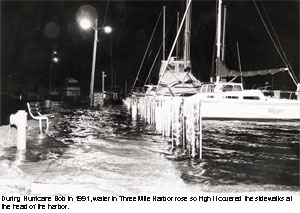
It has been 14 years since a hurricane came close to touching the East End. In 1991, Hurricane Bob veered east of Montauk, but caused a fair amount of damage anyway, uprooting trees and intensifying the ocean's swell.

Before that, Hurricane Gloria crossed the middle of Long Island in 1985 as a weak Category 3, knocking out power on the East End for up to two weeks for some residents. Because it hit during low tide, experts say, the twin forks were not damaged too critically.

Neither, though, compared in strength or magnitude to the Hurricane of 1938. The Category 3 storm came with little notice on a warm September day, battering the East End. It is said to have killed as many as 600 people. A tidal surge and high winds crushed some houses and tore the roofs off others. That morning, the Coast Guard station had received a warning only of relatively mild winds, of the sort found on the fringes of a hurricane.

It is highly improbable that we could find ourselves surprised by a hurricane today. NOAA flies airplanes into the eyes of the storms to gather information on them. But it is local weather, according to NOAA, that determines the landward movement of hurricanes. So although a hurricane can be carefully tracked, when and where it makes landfall cannot necessarily be predicted.

Although death tolls have decreased in recent hurricane history, the cost of related damage has increased dramatically. Hurricane Andrew, which hit Florida, Louisiana, and Mississippi in 1992, does not appear on the list of most deadly hurricanes, but it set the record for expense caused by damages - it cost $15.5 billion to clean up after the storm.

According to the Insurance Information Institute, hurricanes last year, none as catastrophic as hurricanes Andrew or Katrina, caused damages well into the billions of dollars.

Local governments, including East Hampton Town, enforce Federal Emergency Management Agency standards for all houses built in the flood hazard district, which includes areas along the Atlantic Ocean, Block Island Sound, and some smaller bodies of water such as Three Mile Harbor.

First floors have to be raised above the 100-year flood height - a tide whose chances of being equalled in 100 years are 1 percent. Floodproof construction, meant to prevent water from tearing houses from their foundations, and breakaway walls are also required. Those who live in flood hazard districts are required to buy flood insurance.

In 2000, the Long Island Power Authority formed a major storm review panel, meant to ensure that power is restored in a timely fashion to those who lose power during storms. After Hurricane Gloria, the Long Island Lighting Company (since replaced by the Long Island Power Authority) faced criticism for the length of time it took to restore power.

Although FEMA construction standards can protect waterfront houses from sustaining the kind of damage seen in the past, there is no sure way to avoid other dangers posed by high winds, such as falling trees. Covering windows with plywood can be effective in some situations, but flying debris can damage more than glass.

Hurricane safety tips and recommended procedures are listed at the Web sites of NOAA, FEMA, and the Red Cross.

Mr. Hendrickson said that for the moment, at least, he sees "nothing we should be alarmed about" on the hurricane front. But in the wake of the current drought, he expects a strong northeaster to blow over the South Fork within two weeks. "We have to watch our weather very closely," he said.


A Protest Against Ferry Parking

A Protest Against Ferry Parking

Originally published Sept. 01, 2005
By
Joanne Pilgrim

The growth of the Cross Sound Ferry business in Orient, and the increased traffic generated by those getting on and off the ferries, which travel to Connecticut and back, has prompted a North Fork citizens' group to plan a protest rally for Labor Day.

Members of Take Back Our Roads!, a coalition of the North Fork Environmental Council, the Orient Association, and Southold Citizens for Safe Roads, as well as other concerned members of the public, will meet at 10:30 a.m. in a field near the ferry terminal, just to the west of the Orient State Park entrance.

The group is making several "demands," including that New York State Gov. George E. Pataki and "others in a position of authority immediately press for new ferry terminals in East Hampton and Brookhaven," according to a newspaper advertisement for the protest.

The group believes that most of the people who use the ferry are coming from and going to South Fork and other Long Island locations and that new terminals would decrease the traffic through Southold.

The Towns of Southold and Shelter Island, along with the Cross Sound Ferry, filed suit against East Hampton Town last fall, seeking to overturn a town law banning vehicle ferries and high-speed passenger ferries. A federal court judge is reviewing motions submitted by both sides in that lawsuit.

The East Hampton law, which prohibits vehicle ferries and high-volume fast ferries for passengers, was enacted in 1997. It was based on a traffic study that showed that instituting such services would lead to traffic problems as severe as those that Southold is now experiencing.

In recent weeks, Southold Town Supervisor Josh Horton, citing heightened national security concerns in the wake of the terrorist bombings at underground train stops in London, which prompted the state to post National Guard troops at ferry and rail terminals, including Orient Point, has declared an ongoing state of emergency at the Cross Sound Ferry Terminal.

The declaration allowed the ferry company to use residentially zoned land for parking. By parking cars further from Route 25, the National Guard and town police would be able to conduct random searches of vehicles on line to board the ferry more easily, Mr. Horton said. Mr. Horton's actions prompted protests in front of Southold Town Hall.

The use of the land for parking has been under dispute. The ferry company had asked that the land be changed from residential to waterfront-commercial zoning, which could allow construction of more docks and expansion of its operations. But the Southold Citizens for Safe Roads petitioned against the zone change, and the ferry company's request was denied by the town board.

A Cross Sound Ferry spokesman, Stan Mickus, said yesterday that the company has been talking with law enforcement and emergency officials regarding the planned rally on Monday and is "looking to minimize any disruption in service that day."

"We serve the traveling public of Long Island," he said, "and we want to ensure the safety of our passengers."

Among the demands made by Take Back Our Roads! is that Southold Town enforce its ban on parking on the residentially zoned site and levy fines for violations, and that the New York State Department of Transportation ban parking on both sides of state Route 25 within a half-mile of the ferry terminal. The ferry company, the group says, should be forced to limit its volume of customers to those it can accommodate in its present parking lot, for which, they say, reservations should be taken.

According to the group, Cross Sound operates up to 46 ferries daily, during a 17-hour period, including a passenger-only fast ferry that was designed to transport gamblers to and from Connecticut casinos.

Recorded Deeds 11.13.97

Recorded Deeds 11.13.97

Data provided by Long Island Profiles Publishing Co. Inc. of Babylon.
By
Star Staff

AMAGANSETT

Goddard to Emily Whalen, Meeting House Lane, $550,000.

Kawalek to Neil and Joan Fabricant, Cliff Road, $275,000.

Siwicki Jr. to Fred and Jon Passarella, Montauk Highway, $1,800,000.

Neumann to Joan Bowden, Catalpa Place, $180,000.

Dukker to Kenneth Gilman and Carol Feinberg, Pine Way, $390,000.

BRIDGEHAMPTON

Wiskey Hill Inc. to Christine Reina, Bridge Hill Lane, $160,000.

EAST HAMPTON

Moritz to Hartmut and Jutta Klenke, Dominy Court, $295,000.

Cunniffe to Ralph Booth II, Jones Road, $3,150,000.

Herman to Carl Watson, Springs-Fireplace Road, $280,000.

Connor to Jose Benitez and Maria Restrepo, Winslow Avenue, $156,000.

MONTAUK

Gruetzner to Peter and Suse Lowenstein, East Lake Drive, $935,000.

Heppenstall to James Colarusso and Merrie Harris, Flag Avenue, $170,000.

Campbell to Richard and Judy Stephens, South Fairview Avenue, $225,000.

Montauk Laurel Ltd. to Jeffrey and Jeanne Hinte, Montauk Highway, $1,600,000.

NORTHWEST

Miller to Jo Anne and Michael Sirgado Jr., Clamshell Avenue, $221,500.

Cedar Woods Ltd. to Jon and Tracy Grossman, Owls Nest Lane, $192,000.

Grossman to Garth and Andrea Stein, Sylvie Lane, $380,000.

NOYAC

Brettholz to Edward Brettholz, Deerfield Road, $565,000.

SAG HARBOR

Gilson to James and Elaine Durfee, Jermain Avenue, $330,000.

Dowd to Judy Keller, Harbor Drive, $171,500.

Hill to Paul Pichardo, Denison Street, $166,000.

SAGAPONACK

Brennan Sr. to Clifford Foster, Montauk Highway, $880,000.

Fairfield Pond Assoc., L.L.C. to Michael and Erica Shein, Masefield Close, $1,445,000.

SPRINGS

Kremer to M. Ather Mirza, Water's Edge, $437,500.

Kremer estate to Vivian Mirza, Water's Edge, $250,000.

Roman to Susan Owens and Laura Medvitz, Bay Inlet Road, $350,000.

WAINSCOTT

Lambiase to Pat Libutti and Kathryn Kalajian, Two Rod Highway, $245,000.

Fridman to William and Melanie Beauclerk, East Gate Road, $430,000.

WATER MILL

Ameron Land Corp. to Gary Rabin and Donna and Wilder Fulford, Little Noyac Path, $900,000.

Fincher Jr. to Scott Russell, Montauk Highway, $280,000.

Ruls Assoc. to Abbie Patrikis, Stephen Halsey's Path, $250,000.

JP Dev. Corp. to Carole Mitnick, Winding Way, $421,000.

Pasbjerg estate to Frederick Kane Marek, Holly Lane, $2,600,000.

Cartensen to Dennis and Janet Page, Lawrence Court, $250,000.


Perfect Day For Casting

Perfect Day For Casting

November 13, 1997
By
Russell Drumm

The weather on Sunday morning was perfect for surfcasting - that is, sloppy with wind, rain, and plenty of white water. At the Montauk Lighthouse, and between there and the North Bar, striped bass in the 20 to 30-pound range hit all at once. But then it was over.

The time was between 6 and 7 a.m., and casters remembered seeing herring driven onto the rocks by surf and marauding bass. Then the bucktail lures with white pork-rind streamers started getting hit by strong fish.

In Fall Armor

By 7:30, hooded or cowled casters in their fall armor of standard foul-weather slickers, or the newer neoprene suits, thin wetsuit gloves, and boots with clamp-on, studded rock walkers, began staggering back to their cars under the weight of big fish.

Others, casting with one eye on the advancing surf, and one on the departing fish, redoubled their efforts into the southeast wind.

The small jetty at Ditch Plain remained peopled with casters throughout the weekend. Some of them reported catching mostly smaller bass.

"What a difference a day makes," one caster was heard saying on Monday morning at the Lighthouse. It was true, the wind had backed to the northwest and the fish had disappeared. But they had not gone far.

The Bass Were Thick

Fritz Hubner, captain of the Mistress Too charter boat, said that while fishing was uncomfortable on Monday during an all-day trip, the bass were thick.

He reported that two anglers caught between 30 and 35 keeper bass measuring 28 inches or longer, and many more smaller ones.

On Tuesday, a half-day outing with five anglers resulted in over 40 keepers. "Two fish weighed 28 pounds, the rest were teens," Captain Hubner said. He noted, as have the surfcasters, that the big fish, the ones in the 40 to 50-pound range, have yet to appear.

As a result, the leader board in the Montauk Locals surfcasting tournament has not changed. First, second, and third places are held by Bob Jones, Fred Kaulkstein, and Dennis Gaviola, for fish weighing 35.8, 34.8, and 33 pounds.

Gannets Are Diving

It's safe to assume that bigger fish will be caught between now and the end of the tournament in December. The gannets are here in flocks and are diving. They're diving on herring and other large prey species. The bigger bass cannot be far off.

Harvey Bennett of the Tackle Shop in Springs, back from a trip to the Midwest to retrieve two race cars he plans to refurbish over the winter, reports not many more bass or bluefish in the surf of Amagansett than there were in Ohio.

The Marlin V party boat of Montauk has called it quits for the season. The Lazy Bones, the Flying Cloud, and the Viking boats are still sailing, however.

The Cloud has been specializing in porgies and sea bass. The Bones is after bass and bluefish, and the Viking is offering trips for porgies, bass, and bluefish.


WEHM, WBEA Move In Together

WEHM, WBEA Move In Together

Stephen J. Kotz | November 13, 1997

Regular listeners of WEHM radio, who heard full albums being broadcast a week ago, may have thought the station had changed its format from adult rock. It didn't. The FM station, which had broadcast from a studio on Pantigo Road in East Hampton Village since going on the air in 1993, was simply moving in with its sister station, WBEA of Amagansett.

"It went as smoothly as it could go," said Zoe Kamitses, the general manager of Hamptons Media Holdings Inc., the owner of both stations. "We were off the air for maybe 30 to 45 seconds."

To prepare for the move, two new studios were constructed in WBEA's headquarters in Amagansett. The new set-up was tested before broadcasting was transferred to the new location last Thursday.

The shared space follows a merger, announced last summer, between the stations' parent companies, East Hampton Broadcasting Group and C&S Radio Corporation, into Hamptons Media Holdings Inc.

No Competition

Although the stations broadcast independently, having them both under one roof cuts expenses and allows for easier management, said Ms. Kamitses. It also allows for camaraderie between former competitors. "They can hop across the hall and talk to each other," said Ms. Kamitses of the stations' disk jockeys.

The move east is not the only change at WEHM. "We tweaked the format a bit," said Ms. Kamitses. WEHM retains '70s-based programming aimed primarily at a male audience between the ages of 35 and 55. Music by Paul Simon, James Taylor, Fleetwood Mac, and others is supplemented by music from the '60s, '80s, and '90s, which matches the "texture of the core songs," said Ms. Kamitses. Before the merger, WEHM's format was "weighted a little too heavily toward current songs," she said.

New Programs

WEHM also has dropped its "Jazz at Night" program and a number of programs beamed in by satellite, including "Acoustic Cafe," which aired on Saturday mornings.

WBEA is retaining its "hip, hot, current" pop-oriented format, which is aimed at slightly younger listeners, with more of an emphasis on females Ms. Kamitses said.

Among staff changes, Steve Ardolina, who worked for WBEA, is now program director for both stations, replacing Steve Richards, who resigned after the merger. Brian Cosgrove, who hosts a morning show, and Melissa Ralph, who is on the air mid-day, are now WEHM's DJs. Ms. Kamitses also said the station had increased advertising sales since the merger.


Hewitt Claims Dismissed

Hewitt Claims Dismissed

Josh Lawrence | November 13, 1997

The well-publicized battle between the "60 Minutes" executive producer Don Hewitt and the Wainscott-based Telemark Construction firm ended yesterday, as the Southampton Town Licensing Review Board dismissed all of Mr. Hewitt's claims of improper practices.

The Licensing Review Board voted not to take any action on Telemark's license to practice in Southampton. Mr. Hewitt's complaint, filed earlier this year, sought to have the town revoke or suspend the license.

The standoff between the TV producer and the building company dates back to a $650,000 renovation Telemark did on Mr. Hewitt's Bridgehampton house in 1993.

Mr. Hewitt complained Telemark had not only abandoned the job, leaving a kitchen ventilation system in violation of the fire code, but had overcharged, failed to pay its subcontractors, and had filed a fraudulent lien against the house to recover money Mr. Hewitt allegedly owed. The matter has been played out in the courts as well as before the Licensing Review Board.

The Review Board yesterday signed a resolution dismissing nearly all of Mr. Hewitt's claims. The board had called two public hearings and reviewed voluminous paperwork from both sides, before making a decision.

On the matter of the kitchen ventilation system, the board agreed Telemark was at fault. The company installed the system so that it vented into a basement crawl space, rather than outside - a fire code violation.

However, the board noted that the town's chief building inspector, Paul Houlihan, had testified "the violation was not a life safety issue but merely a nuisance."

That was not grounds to revoke Telemark's license, the board ruled.

The board also ruled that Telemark "did not willfully overcharge" Mr. Hewitt in connection with several change-work orders. Mr. Hewitt complained of expenses he was charged for that were not part of the contract.

The board ruled the builder had adjusted the contract properly and provided Mr. Hewitt documentation explaining the changes.

With respect to Telemark paying its subcontractors, the board noted "it is the general practice in the construction industry" for contractors to negotiate with subcontractors. The board also noted none of the subcontractors has filed claims against the builder for non-payment.

The board also addressed the $29,000 lien filed against Mr. Hewitt to recover money owed. The board ruled the amount of the lien was not "willfully exaggerated," as Mr. Hewitt claimed, but rather related to a settlement plan that had failed between the parties.

Roy Dalene, who runs Telemark with his brother, Frank Dalene, said he was relieved at the decision and called it a vindication. "It's been the biggest nightmare for us," he said.


Eye Control Of Montauk Water: Olmsted Group Claims The Aquifer

Eye Control Of Montauk Water: Olmsted Group Claims The Aquifer

November 13, 1997
By
Star Staff

A week before the East Hampton Town Board formally considered the extension of a Suffolk County Water Authority main from Napeague to Montauk, Robert Ficalora, a man who has a personal mission to return the management of Montauk to a select group of Montauk residents, laid claim to Montauk's water supply.

Mr. Ficalora filed a "resolution" with the County Clerk on Oct. 29 on behalf of Montauk Friends of Olmsted Parks, a corporation he founded "to administer rights held in common by and for the Proprietors of Montauk."

The Montauk Proprietors were a group of East Hampton settlers who bought the peninsula, and the right to hunt and pasture cattle there, from the Montauketts. Although the Town Trustees managed the affairs of Montauk until 1852, its ownership was in the hands of the proprietors until 1879, when the land was sold by court order.

In the document he filed, Mr. Ficalora states that the Friends have jurisdiction over Montauk's fresh water resources because they are the corporate inheritor of the proprietors' rights. His papers state that all other claims "by other corporations or municipal agencies [including the Suffolk County Water Authority] to determine the allocation of Montauk's fresh water resource are hereby extinguished."

Mr. Ficalora, who is the acting president of the Friends and whose recent lawsuit against the town and the owners of property on Old Montauk Highway in Montauk on a related issue was dismissed on Friday, said the action was taken because Montauk's water "has been inequitably administered by others in our absence," that is, the absence of active Montauk proprietors.

As for who will manage the Friends of Olmsted Parks, Mr. Ficalora has promised to hold elections for trustees of the corporation next spring.

Should Be Welcomed

He said his claim "should be welcomed by everyone who cares about Montauk. Montauk and East Hampton have reached the limit of expansive growth due to a very serious water supply constraint. This will effectively end the destructive influence of real estate development interests and looks to the protection of our property values and quality of life."

If upheld, Mr. Ficalora's claim would stop the Water Authority from extending a main between Napeague and Montauk.

"We're going to look at it," Michael LoGrande, chairman of the Water Authority, said yesterday. He said the reaction of a Water Authority attorney, after a cursory look, was that there was no basis for Mr. Ficalora's claim.

Southold Dropped It

Mr. LoGrande said that last year a similar claim to an aquifer under Southold was made by the Southold Town Trustees. "They decided not to follow up on it after they realized what was involved," Mr. LoGrande said. "Our jurisdiction is very clear."

Mr. LoGrande speculated that Mr. Ficalora had filed his resolution with the county under the mistaken impression that the Water Authority was part of county government. It is an independent authority created by the State Legislature.

A spokeswoman for County Clerk Edward P. Romaine said that office was not sure what to do with Mr. Ficalora's resolution.

Second Claim

Mr. Ficalora, who lives on Old Montauk Highway, shared in the victory earlier this month of a group of motel and property owners on the road. They saw their right to pass through the Benson Reservation, between Montauk Highway and the ocean beach, upheld when the State Court of Appeals refused to hear an appeal of the property's owner, Sunbeach Montauk II Corporation.

Nicola Biase, vice president of the corporation, had tested the right to keep the public off the property over a decade ago. The courts, however, have ruled that the common use of the land is guaranteed in deeds of local property owners that carry such a covenant. These covenants were acknowledged by Arthur Benson, who bought Montauk from the proprietors in 1879.

A little more than a year ago, the Friends of Olmsted Parks also laid claim to 272 acres of Culloden, a section of Montauk owned by 511 Equities, for which a 54-lot subdivision had been approved. No legal action has followed.

Eye Control Of Montauk Water

Eye Control Of Montauk Water

November 13, 1997
By
Carissa Katz

Pipeline Extension Is Endorsed

Calling it "the best . . . short-term, low-cost solution to a perennial crisis," William D. Akin, the president of Concerned Citizens of Montauk, reluctantly offered his group's endorsement of a Suffolk County Water Authority pipeline extension that will bring water from East Hampton to Montauk.

C.C.O.M. has often spoken out against the water main extension in the past, expressing some of the concerns that had been raised frequently by town officials.

If public water was available, would more of the constrained lots in Montauk be developed? What would happen if all the Water Authority's wells in Montauk went bad? And would the Water Authority still follow through with a years-old proposal to tap the aquifer in Montauk's Hither Woods if it is already bringing water in from the west?

Firefighting Needs

"I doubt this is the last time we face a water crisis," Mr. Akin said at a hearing on the project at East Hampton Town Hall Friday. He pointed out that the Suffolk County Water Authority only supplies a fraction of the water in Montauk now, and asked about the condition of private wells there.

Richard F. White Jr., the chairman of the Montauk Board of Fire Commissioners, believes the extension of the water main will serve firefighting needs in Montauk.

The extension would allow the Fire Department to tap into hydrants for "virtually every house on Route 27, south to Old Montauk Highway," he said, including some of the large resorts along the road there. As a result, he said, the fire portion of many people's home owners insurance "should drop, in some cases significantly."

The Growth Question

The project got the support of the East Hampton Chamber of Commerce, the Montauk Chamber of Commerce, the East Hampton Business Alliance, and the Montauk Beach Property Owners Association, as well.

Sherry Wolfe and John Keeshan of the Business Alliance, along with Robert Lamparter of the property owners association, suggested that the Water Authority should coordinate its efforts with the Long Island Lighting Company, so that pipeline and electrical wires would be laid in the same trench at the same time.

The authority has characterized the extension as a way to better supply its existing system in Montauk, rather than to provide service to new customers.

Robert DeLuca, the executive director of the Group for the South Fork, urged the town to continue to proceed cautiously on the water main extension, despite these assurances, because it had the potential to encourage growth.

In the future, Mr. DeLuca said, "the County Health Department may require that [people] connect in to public water if it's available."

He suggested the town develop its own guidelines for restricting water use and volunteered to help town officials create those guidelines.

Hy Brodsky asked the Town Board to put any new Water Authority project on hold. He pointed out that only a third of Montauk is hooked up to public water, and said the other two-thirds of the population is not having any problems with its water.

Vision Needed

"The [proposed] routes, any of them, are going through an area not supplied or serviced by the Suffolk County Water Authority," he said. He suggested that instead of a 16-inch main to bring both drinking and firefighting water to Montauk, the Water Authority sink its new well in Montauk and use an eight-inch main that would be solely dedicated to fire- fighting.

"We have to okay this with conditions," said Larry Penny, the town's natural resources director. Those include making sure the Water Authority, the Health Department, and the town pledge to work together to craft a water management plan for all of East Hampton, "so we're not always doing things in hindsight, retroactively or defensively."

The town needs to "have some vision" about the future of its groundwater, he said. "There are a lot of misuses of water . . . like bringing public water to water a golf course," he said.

The hearing will be left open for written comments until Monday.


Road Work En Route

Road Work En Route

Susan Rosenbaum | November 13, 1997

Drivers irked by slowdowns caused by recent road construction just west of East Hampton Village: Get ready - this is only the beginning.

Details have begun to surface about the rest of next year's long-awaited $5 million State Department of Transportation repair of Route 27 leading into and through East Hampton Town.

The work, according to state and local officials, is part of an even larger upgrade here, though the job's next phase - costing about the same - now is slated for 2001. The last major improvement to Montauk Highway here was in 1970.

This is "a good start," Chris Russo, the East Hampton Town Highway Superintendent, said on hearing that under way by February, weather permitting, will be the repair and resurfacing of the highway between Norris Avenue, just east of Bridgehampton, and Eastgate Road in Wainscott.

Notified Albany

"A better start," he added, though, "would be all of Route 27," including east of Montauk Village to the Lighthouse.

The work schedule, originally slated to begin three years from now, was moved up after East Hampton Town and Village officials and Assemblyman Fred W. Thiele Jr. complained to state transportation officials in Albany earlier this year.

The Bridgehampton-to-Wainscott stretch will be clean and smooth by Memorial Day, transportation officials promise, when a hiatus in the work will allow summer traffic to proceed as normally as possible.

Then, beginning after Labor Day, workers will tackle the highway from Georgica Road to Buell Lane, and, skipping some of the village's commercial core, from Newtown Lane east to Skimhampton Road - finishing by next November.

Repaved Shoulder

What is going on now is a 500-foot-long widening of Route 27, by 12 feet, 250 feet east and west of Stephen Hand's Path, where a new left-hand turnoff will be. Included is a repaving of the shoulders. The shoulder on the highway's north side is being entirely rebuilt to accommodate the new lane.

Workers are expected to complete that $800,000 job, which they began in mid-September, by year's end, "barring awful weather," said Brian Hoffman, a Transportation Department planner in Hauppauge.

Meanwhile, a new 1,000-foot lane for waiting cars has been created on Shelter Island at the South Ferry approach, complete but for landscaping, at a cost of $200,000.

Most of the improved highway will see an additional two layers of asphalt, raising it about 3.5 inches, which will entail raising roughly 60 "leeching basins," or drains, by the same measure. This, except on Woods Lane near Town Pond, where the roadway will rise only by 1.5 inches, and drains will not need adjusting.

Protect Pond

The hay bales at the Stephen Hand's Path worksite are there to prevent sediment from running off into Georgica Pond, Mr. Hoffman said. He added that between Newtown and Egypt Lanes, road workers will grind 1.5 inches of asphalt off the top and replace it, to avoid resetting the curbing there.

Traffic will be able to stream alongside the road work, albeit somewhat more slowly, by using existing shoulders, officials said. The only exception will be in front of the Jewish Center of the Hamptons on Woods Lane where the road is too narrow. Sometime in early fall, workers will close that portion of the road for about four days when drivers will have to use Toilsome Lane as a detour to Buell Lane.

Because of the residential character of the neighborhoods lining much of the highway, officials said there would be no weekend work, and no nighttime construction.

Contractors, Mr. Hoffman added, also have to maintain adequate access for emergency vehicles.

Lights, Turn Lanes

In 2001, the road improvement is expected to continue - at least to Cranberry Hole Road in Amagansett, though not farther, as of now, according to Erik Koester, an assistant regional director of the Transportation Department.

Mr. Hoffman said department planners will consult with town officials in the meantime about such matters as additional traffic lights and turn lanes. For his part, Mr. Russo recommended a turn lane at Daniel's Hole Road in East Hampton and at Abram's Landing Road in Amagansett.

Mr. Russo also noted that the Cranberry Hole Road bridge, which falls under joint jurisdiction of the Long Island Rail Road and the Town of East Hampton, is in need of repair as its "concrete abutments are decaying." Estimating the bridge job in the "millions," he said, "Someone has to do it."

$29.5 Million Cloud Hangs Over Airport

$29.5 Million Cloud Hangs Over Airport

November 13, 1997
By
Carissa Katz

A $29.5 million Federal civil rights lawsuit alleging "political and personal favoritism" was filed on Nov. 5 by Sound Aircraft Services, one of two fixed-base operators at East Hampton Town Airport, along with Shoreline Aviation and Action Airlines, associated charter companies.

The suit names the Town of East Hampton, the Town Board as a whole, and its Republican board members, both as officials and as individuals, as defendants. It also names the airport's other fixed-base operator, Myers Aero Services, and Myers Aero Fuel, along with Ben Krupinski individually and two of his companies, Aviation Resources and East Hampton Airlines.

At issue is a 1996 Town Board decision granting Aviation Resources and Myers Aero Services a 20-year lease on the last vacant hangar at the airport and changes this year in the lease of commuter ramp and tie-down space around the airport's terminal building.

Familiar Criticism

In the suit, Sound, Shoreline, and Action Airlines assert that, after the bids for the hangar had been opened and reviewed, the town helped Aviation Resources and Myers Aero stay in the running by allowing them to join forces and resubmit a higher bid.

The suit echoes much of the criticism leveled at the three Republican board members -Thomas Knobel, Nancy McCaffrey, and Len Ber nard - at the time the bids were awarded by Democratic Supervisor Cathy Lester and Councilman Peter Hammerle. The Democrats accused the Republicans of steering the lease toward Mr. Krupinski because he was a major supporter of and contributor to the local Republican Party.

Republican board members have denied this from the first. Mrs. McCaffrey said her decision was based on the fact that Myers had worked out of a tiny hangar for many years, had been at the airport longer than Sound, and deserved the chance to expand.

Service Breakdown

Sound served some 80 percent of the airplanes coming in and out of the airport; Myers supplied about 20 percent.

Mr. Krupinski owns a controlling interest in Aviation Resources and in East Hampton Airlines. In the final count, Myers Aero Services, owned by Michael Myers, and Aviation Resources submitted a combined bid for the hangar of $50,000 for the first year's rent and pledged $250,000 to finish renovations on the facility.

Sound and Shoreline Aviation had made a higher bid, $54,000, for the first year's rent and also agreed to do $250,000 worth of renovations.

Mr. Knobel and Mr. Bernard said the deciding factors for them were Mr. Krupinski's experience as a commercial contractor and therefore his ability to renovate the building more extensively for the same money by using labor from his own contracting firm and getting materials at wholesale.

Influence Alleged

Were it not for the "influence" Mr. Krupinski exercised over the Republicans, the lawsuit states, Sound and Shoreline, as the highest bidders, would have been awarded the lease. Steven Tuma and Cindy Herbst of Montauk are the principals of Sound Aviation. Shoreline and Action Airlines are based elsewhere. They are being represented by Paul R. Levenson of Kaplan, Gottbetter & Levenson of Manhattan.

William Esseks, the attorney for Mr. Krupinski and Myers, however,aid that Mr. Krupinski had no more influence over the Town Board than any other citizen. Accusing him of "inducing the board to interfere with the plaintiffs' rights, doesn't make any sense," he said. It "is not believable. It's not true."

According to the lawsuit, when Myers and Aviation Resources moved into the hangar, they automatically gained 29,200 square feet of commuter ramp space around the hangar, where planes can taxi in to drop off or pick up passengers.

Ramp Issue

The ramp space around the old terminal had been divided on a more or less equal basis between Myers and Sound, some 22,400 square feet of space each.

Sound claims that the renovation was used to justify changing the allocation of ramp space around the new terminal, which is still under discussion. It also claims Republicans pushed for a proposed agreement that would give Myers 85 percent of the ramp space adjacent to the terminal and Sound just 15 percent.

Sound and the charter airlines it services would have use of only 4,900 square feet of ramp space around the terminal, according to the suit, while Myers and East Hampton Airlines would have some 62,000 square feet of combined space around the new terminal and the hangar.

Possible Expansion

In recent months, Sound has entered into contract to buy an interest in a hangar at the airport now owned by Pacific Air Transportation Services. Were the contract to go through, its ramp space would increase.

Sound, Shoreline, and Action Air allege that Mr. Krupinski and his business affiliates, including Myers Aero Services, have been making a concerted effort to drive the competition out of business and that the Town Board, and in particular the Republican board members, have been complicit in that effort, creating "an official town policy of favoring the business interests of Mr. Krupinski, Aviation Resources, East Hampton Airlines, and Myers. . . ."

Called "Meritless"

That policy, it says, "will ultimately result in a Myers Aero Service monopoly on aircraft tie-down, maintenance, and other F.B.O. services at the airport."

Michael Myers, who owns Myers Aero Services, said yesterday he had not yet seen the lawsuit and thus declined to comment. Mr. Esseks, however, spoke on behalf of Mr. Krupinski and Myers Aero. He characterized the suit as "woefully incorrect" and "an attempt to intimidate" the town to change its decision. Mr. Esseks will file a motion to dismiss the suit on behalf of his clients.

The civil rights claims in it are "meritless as a matter of law, legally insufficient, and should not have been brought," Mr. Esseks said.

Mr. Esseks had threatened legal action against the town this summer on behalf of Myers over the space his client was given in the terminal. The company alleges that it is put at a competitive disadvantage while Sound's "superior space" could be considered a gift of town funds. Mr. Esseks said yesterday that the legal action by Sound now may cause the suit "to be reconsidered."

The Town Board retained Richard Cahn of the Melville firm of Cahn, Wishod & Lamb, to represent the board, its members, and the town. Mr. Kahn was not available for comment by press time.