A Nice Slice For Philharmonic

A Nice Slice For Philharmonic

January 29, 1998
By
Star Staff

The Entenmann family of cake and cookie fame has contributed $15,000 to the arts in education program of the Long Island Philharmonic.

Various members of the Entenmann family live at least part-time on the East End. Wendy and Charles Entenmann live full-time in Springs and own the Deep Water Seafood Company in Montauk.

The money was donated in the name of the whole family through the New York Community Trust; $5,000 was given through Best Foods Baking Company, the parent company of Entenmann's.

Concert In March

The Philharmonic's arts in education program, which benefits thousands of children and young adults on Long Island, will present a concert for youths on March 25 at Southampton High School.

"The Trumpet of the Swan," a piece by Benjamin Lee based on an E.B. White story, will be presented in two performances. A slew of eastern Long Island schoolchildren, including those from the Amagansett and Sagaponack schools, will attend.

Also on the program will be Benjamin Britten's "Young Person's Guide to the Orchestra," widely regarded as the finest introduction to classical music for children, and a commissioned work by Ray Shattenkirk designed to teach children to protect endangered species.

The Long Island Philharmonic was founded in 1979 by the folk singer Harry Chapin. His father, the drummer Jim Chapin, and half-siblings, Chris, Paul, David, and Lisa Chapin, all live in Sag Harbor.

Now in their 19th season, the orchestra of professional musicians and its adjunct 150-member Long Island Philharmonic Chorus are led by David Lockington. The 39-year-old conductor, who was born in Britain, is also the music director of the New Mexico Symphony.

Since coming to America in 1978, Mr. Lockington has been music director of the Cheyenne Symphony Orchestra, associate conductor of the Baltimore Symphony Orchestra, and musical director of the Ohio Chamber Orchestra in Cleveland.

Busy Orchestra

The orchestra has an annual budget of $1.65 million. Among its concerts in Nassau and Suffolk are ones for youths and families, free outdoor events, and chamber performances. It has also presented concerts with such pop artists as Marvin Hamlisch, James Taylor, and The Moody Blues.

The orchestra's March 21 and 22 concerts, at the C.W. Post campus of Long Island University and the State University at Stony Brook, will present the world premiere of "Three Places on Long Island," by a Long Island composer, Dana Paul Perna. The three places of the title are the Montauk Point Lighthouse, Walt Whitman's birthplace in Huntington, and Sagamore Hill in Oyster Bay.

The program will also include Prokofiev's Violin Concerto No. 2 and Beethoven's Symphony No. 2 in D major.

The arts in education program also offers master classes for young musicians, an annual Young Artist competition, and concert ticket subsidies for college students.
It's a pity . . .

It's a pity . . .

January 29, 1998
By
Editorial

It's a pity that six years of work and the best intentions have resulted in so much flak over a six-story-tall sculpture of the Portuguese Queen Catherine of Braganza, but the protest is a lesson in awareness.

The sculpture, by Audrey Flack of East Hampton, was to be unveiled on the Queens side of the East River in a ceremony commemorating the consolidation of the five boroughs into New York City. It was a gift from Portuguese-Americans and the Portuguese Government, and a gesture of friendship to the borough that was named in her honor.

Queen Catherine, whose husband, King Charles II of England, owned slaves and profited from their trade, has been decried as a slave mistress even though she left money in her will to buy slaves' freedom. Opponents of the statue have argued that it would be a perpetual insult to the black residents of Queens.

We agree. Imagine someone plunking a six-story-tall sculpture of King George on the South End Green in East Hampton Village or of the Pequods on Fort Hill in Montauk.

Queens Borough President Claire Shulman, although originally a Catherine supporter, recently joined efforts to find a place for the statue on private instead of public land. Let's hope they meet with success.

A Recent Article . . .

A Recent Article . . .

January 29, 1998
By
Editorial

A recent article in The Riverhead News-Review that claimed Riverhead's taxes were much higher than East Hampton's had us scratching our heads.

The article said that a Riverhead resident living in an average house, which it valued at $150,000, was paying more than two and a half times the property tax an East Hamptoner who owned a $150,000 house would pay. This conclusion was based on an analysis that took into account state equalization rates, which show the percentage of true market value at which the various towns assess properties.

After talking with East Hampton's Assessors and with Laverne Tennenberg, who heads Riverhead's Board of Assessors, however, the comparison seemed misleading.

"For one thing," said Ms. Tennenberg, "you're not talking about the same house. A $150,000 house here will be 1,800 square feet and on a half acre. In East Hampton, it will probably be 800 square feet on a quarter acre lot near the railroad tracks." By that measure, the supposed variance in taxes may not be as inequitable as it first appears.

Riverhead and East Hampton are quite different. One's largely a working-class town; one's a resort with a larger tax base whose part-time homeowners now outnumber year-rounders.

Ms. Tennenberg told us that Riverhead "would kill to have your seasonal homes with owners who don't send their kids to school and require little in the way of services."

They add that the average house here is more likely to be worth $250,000 rather than $150,000, which means that Riverhead's taxes may be completely within the means of the owners of $150,000 houses, while those who own $150,000 houses here have a lot less money with which to support government services.

To our surprise, 25 percent of the land in Riverhead is off the tax rolls, while only 10 percent is off the rolls in East Hampton, according to the Assessors. While the large amount of land that can never be developed will help Riverhead limit the services it has to pay for, it also contributes to the fact that Riverhead's overall assessed value is lower than ours.

Facts such as these mitigate against any attempt, even an even-handed one, to compare the two towns on the basis merely of numbers.

Free Speech

Free Speech

January 29, 1998
By
Editorial

The prime time TV news programs broke a sound barrier in the last week, using words and phrases of a sexual nature that have in the past been confined to racier venues.

Under other circumstances references to oral sex or "another head" may well have been considered obscene. This time, the media were safely within the realm of the news. Therefore, whatever was described was legally acceptable as having "redeeming social value."

The Supreme Court has ruled that community standards apply in distinguishing what is permissible in the media from what is obscene. But community standards are hard to pin down and often in flux. Explicit language once shocking to the general populace is no longer so.

The word "obscene" refers to "language regarded as taboo in polite usage" as well as to anything "designed to incite to lust or depravity," according to Merriam Webster's Collegiate Dictionary. Dictionary definitions do not, however, tell us exactly what polite usage is or how and when to know whether printed or broadcast material is "designed to incite lust."

In street talk, four-letter words are so commonplace they have lost their meaning and for a large portion of Americans they are used more for emphasis than to arouse prurient interest.

That being the case, it seemed quite out of step for The New York Times to have deleted certain words in reporting about the taped conversations between Linda Tripp and Monica Lewinsky, substituting "(expletive)" or ellipses instead.

New York Times editors may think the standards for obscenity and good taste are more conservative among its community of readers, even given the fact that children are a lot more likely to be watching the network news than reading The Times. Certainly, TV is more likely to pander to prurience - the daytime talk shows speak for themselves - and to reduce even legitimate news to a few sexy sound bites and images.

On the other hand, many of us have come to rely on The Times for thorough and in-depth coverage, which in this case would include the obscenities that arise in an undeniably obscene situation.

The investigation in Washington and the media's treatment of it have pushed popular notions of obscenity to a different level. Even when the debacle fades from view (and the sooner the better) it is likely that community standards of what constitutes obscenity and the general definition of free and protected speech will never be the same.

Opinion: Hilarious And Pithy

Opinion: Hilarious And Pithy

Patsy Southgate | January 29, 1998

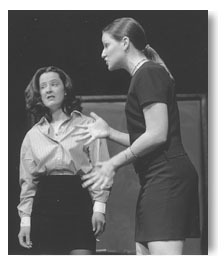
For his midwinter serving of theatrical entertainment, the irrepressible Michael Disher has come up with "January InterAct," two evenings of short plays presented in repertory by the Southampton Players at Southampton College.

Written by upcoming playwrights, these welcome dollops of drama are staged with minimalist black props on the Fine Arts Theatre's bare, black stage.

Photo by Gary Mamay

Each is pithy and, to a varying degree, hilarious. Such was the case, at least, with "A Heap of Stroppel," the four plays by Frederick Stroppel presented on Friday evening.

Thirtysomethings

They were followed on Saturday by five Robert Shaffron one-acters called "Questionable Acts - An Unguided Tour of the Human Zoo," not seen by this reviewer. The program will be repeated tomorrow and Saturday at 8.

Both playwrights' works have been performed in Manhattan at the En semble Studio Theater and on other Off-Broadway stages; Mr. Stroppel's full-length comedy "Fortune's Fools" was produced at the Cherry Lane.

His "Heap" is a medley of one-acters about New York thirty-something seekers of better sex, greater intimacy, a reliable baby-sitter, and even time travel. They approach their goals with shifting degrees of spunk and skepticism.

Libidinal Fantasies

In "A Chance Meeting," Randy (Matthew Suzan Lawrence) and Pamela (Monica Mercedes) shoot for hotter marital relations by meeting at a bar disguised as their fantasy selves, she in a black dominatrix outfit complete with garter belt and chains, he in a $50 false moustache and a corporate-raider suit.

Their exploration of their libidos is rudely interrupted by the arrival of George (Ray Hamlin), who turns out to have the best fantasy self of all.

"Single and Proud" takes place at a singles seminar led by Jackie (Laura Flynn), who goads Steve (Chris Lombardo) into putting the make on the all-too-willing Sylvia (Vay David), a raunchy grandmother with "three dead husbands" in her past.

During "ice-breakers" and "dough nut breaks" he steels himself for the assignment, but the timely arrival of Jeanette (Devin Rodger) leads the plot down a kinkier path.

Mametesque

After the intermission there's "The Mamet Women," in which Sally (Winifred Boyd) and Polly (Sharilyn Costello) squabble about child care in a bitchily Mametesque set-to.

The show closes with "Do Over," a bittersweet longer work that involves Lisa (Susan Novak) and Dennis (Mr. Hamlin again) in past and future lives that illuminate but cannot alter their attraction to one another.

Under Mr. Disher's lively direction, the actors all do splendidly. While it's hard to single anyone out, Ms. Flynn and Ms. David, who starred in CTC Live's "Waiting in the Wings," among many other local productions, deserve special mention.

Ms. Boyd and Mr. Hamlin, both Southampton College graduates who appeared last fall in the Southampton Players' "Jigsaw," and Ms. Novak, who has studied at Bay Street Theatre and the New Actors Workshop in New York, also merit our praise.

And so does Chris Lombardo, who not only designed the lighting but also plays the embattled Steve in "Single and Proud."

With these seasoned and budding actors working seamlessly together, the evening moves right along, consistently entertaining and involving. It's fun to have such contemporary themes dramatized so amusingly by such a talented cast.

Opinion: Wallach Slays 'Em

Opinion: Wallach Slays 'Em

Patsy Southgate | January 29, 1998

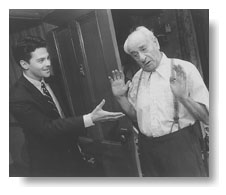
Eli Wallach holds his audience in the palm of his hand every second of his darkly hilarious performance in "Visiting Mr. Green" at the Union Square Theater in Manhattan.

Photo by James Leynse

At the Sunday matinee this reviewer attended, the laughs were so hearty the man in the next seat nearly fell out of it. Theatergoers whooped with joyful regularity. The show captivated one and all, sweeping them up again and again in waves of delight.

Rarely has there been such mass glee, and seldom has a standing ovation been so clamorous. What was going on?

Star Vehicle

The perfect match of an actor and a role, with an audience getting just what it wanted on a gloomy January afternoon, that's what.

This was a New York crowd, and a distinguished one. Jason Robards and his wife were in the row ahead, while the actress Anne Meara sat across the aisle, colleagues perhaps paying homage to a great performer. The expense-account people were obviously elsewhere.

In the past there used to be "star vehicles" - plays written for a specific actor, the way Philip Barry wrote "The Philadelphia Story" for Katharine Hepburn - and while the practice seems to have died out, one almost suspects "Visiting Mr. Green" was crafted especially for Mr. Wallach.

It's as hard to picture someone else in the role as to imagine Archie Bunker not being played by Carroll O'Connor.

Pay Dirt

According to a program note, Jeff Baron, the playwright, left a successful corporate career to be a writer. He has since worked in film, television, and opera, but this is his first play.

He certainly hit pay dirt with his topic and his star, and didn't do too badly with David Alan Basche either, who plays Ross Gardiner, the callow youth who visits Mr. Wallach's Mr. Green.

Before the house lights dim, the audience sits staring at Loren Sherman's consummately depressing set of a dingy Upper West Side apartment, dreading the tragedy that must surely lie ahead in such a dump.

Community Service

But not to worry. The laughs begin at once, with a loud banging at the door that brings on the disheveled Mr. Green to admit Ross, a dapper Harvard Business School grad with a smart briefcase.

He's come to perform the weekly community service imposed by the judge in a reckless-driving case in which he knocked down but did not harm the jay-walking Mr. Green.

Mr. Green takes one look and throws him out.

In a story line that seems a little too contrived to be believable, of course Ross returns and of course he and Mr. Green become the father and son neither ever had.

Ross wins over the irascible widower with soup from a kosher deli and cements the bond by turning out to be Jewish himself, although non-practicing and amusingly baffled by Mr. Green's rigid dietary laws and mysterious Yiddish expressions.

Saintlike, the young man bears with the old one's cranky eccentricities and maudlin rhapsodies about his wife, Yetta, "59 years and never once an argument." He even cleans up the filthy place.

But when Ross confesses to being gay, that does it. He's a "faigele" - and "Jewish boys are not faigeles," Mr. Green asserts in no uncertain terms.

Redemption

End of relationship? No way. The play is about redemption, and Mr. Baron goes on to milk it for all it's worth in what seems a rather formulaic and sentimental plot the audience adores anyway.

Mr. Wallach's presence lends all the credibility needed for a willing suspension of disbelief, while Lonny Price's brisk direction keeps it rolling

Mr. Basche, who performed "Visiting Mr. Green" with Mr. Wallach at the Coconut Grove Playhouse last spring, clearly knows Ross down to his fingertips, and brings warmth and a touching ardor to his supporting role.

Wallach In Profile

Mr. Wallach, who lives in East Hampton with his wife, Anne Jackson (they met in an Off-Broadway production of Tennessee Williams's "This Property Is Condemned"), scarcely needs any introduction.

The perfect match of an actor and a role.

A foremost interpreter of Williams's work, his long list of distinguished credits includes leading roles in "The Rose Tattoo," for which he won a Tony award, and "Camino Real."

More recently he starred on Broadway with Ms. Jackson in "Cafe Crown." Three years ago, also on Broadway, the couple played Noah and Esther in Clifford Odets's "The Flowering Peach."

In the current production, Mr. Wallach's Mr. Green at first offers rocklike resistance to any invasion of his privacy or reappraisal of his life. As he stands, soldier-straight, his face has a stoic nobility that would look right at home on Mount Rushmore. And as he makes his way down the mountain, he shows us his genius.

To Inspect Guest Rooms

To Inspect Guest Rooms

Susan Rosenbaum | January 22, 1998

Summer visitors to East Hampton will be able to relax perhaps even more than they planned once the Village Board passes new "guest room" legislation, probably next month. The new law tightens one already on the books assuring fire and safety checks on the roughly 60 village residences whose owners take in paying guests. It requires Thomas Lawrence, the building code enforcement officer, to inspect premises where one or two rooms are rented. Its passage means that those who rent rooms in their owner-occupied, single-family houses must obtain a license to do so by June 1.

Enforcement of the old law has been lax, to say the least, with no licenses issued since 1989, according to Mr. Lawrence, and few, if any, inspections made since then.

Chamber Wants It

The village estimated that roughly 60 homeowners rent one or two rooms in their houses, and that as many as a dozen guest houses, with fewer than five rooms for rent, also do business here.

Larger hostelries, such as the Huntting and Hedges Inns, and Mill House, are subject to inspection by the Suffolk County Health Department.

Citing liability concerns, Marina Van, the executive director of the East Hampton Chamber of Commerce, told the Village Board, at a public hearing on the new law Friday, that "we want licensing and will feel better if there are safety checks."

The Chamber often refers visitors to homeowners willing to rent rooms.

Ms. Van said she wanted to help compile the checklist of safety issues Mr. Lawrence will use.

Gary Reiswig, who owns the J. Harper Poor Cottage on Main Street, which has several rooms for rent, asked the board for "specifics of what will be required of me as a homeowner when the inspector comes into my home."

"We are not trying to be non-user-friendly," said Mayor Paul F. Rickenbach Jr., adding that the village was seeking to "better monitor such establishments for safety, and for the quality of life of the contiguous neighborhoods."

"These safeguards will also protect the owner," said Larry Hillel, owner of Lysander House at 132 Main Street, which also accepts paying guests. "Our old houses have charm. We just want to be involved."

Long-Term Parking

Mr. Lawrence told The Star his checklist would be completed by next week and will address such concerns as smoke detectors, general fire safety, and pool safety.

The board is expected to approve the new law specifying among other requirements, that "one residence may not contain more than two guest rooms," and that licenses must be obtained annually.

Also at Friday's meeting, the board adopted a resolution establishing $250 as the annual 12-month fee for the 1998 East Hampton Town resident long-term parking permit. The village's paid, long-term parking was initiated at the Lumber Lane lot last summer.

In other action, the board:

-- Agreed to pay Universal Steeplejack $1,500 to repair the eagle atop the flagpole on the village green. It will be remounted within the month.

-- Approved a traffic-signal maintenance contract with Johnson Electrical Construction Corporation through Jan. 31, 1999, for $350 a month.


Recorded Deeds 01.22.98

Recorded Deeds 01.22.98

Data provided by Long Island Profiles Publishing Co. Inc. of Babylon.
By
Star Staff

AMAGANSETT

Fuentes-Chao to Denise Clolery, Oak Lane, $375,000.

Ruff to Nina Gillman, Windmill Lane, $437,000.

Stewart to William and Barbara Hennessy, Clinton Academy Lane, $380,000.

BRIDGEHAMPTON

Green to William Whaley and Karen Korngold, Suwasset Avenue, $295,000.

EAST HAMPTON

Marks to Marilyn and Jonathan Prince, East Hollow Road, $590,000.

Rosinsky (trustee) to Kenneth Kuchin, 121 Main Street, $1,318,000.

Rosinsky (trustee) to Kenneth Kuchin and F. Bruce Anderson, 123 Main Street, $844,000.

Shore Retreats Inc. to Kenneth and Heather Anderson, Amagansett Drive, $150,000.

Conrad to Patricia Groom, Squaw Road, $1,100,000.

Lester to Kabonac Corp., Further Lane, $750,000.

MONTAUK

Van Wert to Richard Geller and Jacqueline Scalisi, Seaview Avenue, $230,000.

Grachek to John and Margaret Stapleton, South Greenwich Street, $179,000.

Murray to Peter and Maureen Murphy, Dogwood Street, $545,000.

NORTHWEST

S.S.T. Foundation to Forst and Silverblank Inc., Bull Path, $215,000.

NOYAC

Weil to Thomas and Barbara Farley, Sylvan Lane, $209,000.

Farrell Dev. Corp. to Raymond and Barbara Sheerin, Fourteen Hills Court, $1,650,000.

SAG HARBOR

Duthie to Stephen and Emma Hamilton, Redwood Road, $475,000.

SPRINGS

Brown Jr. to Celeste Gainey, Old Stone Highway. $315,000.

Cambria to Robert Scherma and Beryl Schonberger, Tyrone Drive, $182,000.

WATER MILL

Pensis to Norman and Estelle Rosen, Westminster Road, $870,000.


Shot Fired At Sea

Shot Fired At Sea

January 22, 1998
By
Russell Drumm

The Shinnecock-based dragger Bookie was 130 miles offshore on Jan. 10 when those topside heard a shotgun blast from below deck.

The crewman responsible for the blast had a gun in his lap with live shells on a table before him. He was demanding to be taken to shore. An emergency call was made.

"The crew felt threatened," Boatswain's Mate First Class Steve Hoagland, the Montauk Coast Guard station's executive officer, understated on Tuesday.

Moriches Coast Guard ordered the Bookie to head for Montauk, the closest port, "at all possible speed," as there was no cutter in the area and a helicopter, without boarding capability, would have been of little use.

Boarded

The matter has been turned over to a Coast Guard investigations unit. As a result, the crewman's name is being withheld, Mr. Hoagland said.

The trip to Montauk took 12 hours, according to the Coast Guard report. Just past Montauk Point a patrol boat from the Montauk station boarded the dragger. The boarding team reported no hostility. The shotgun had been taken from the crewman and secured.

"We brought the crew and put them in the [communications] center and took statements. We took statements from all of them. He said he did fire a round."

Mr. Hoagland said the man accused of firing the gun apparently never pointed it directly at anyone.

Wanted Out

Mr. Hoagland said the reason for the blast seemed to be that the crewman wanted to get ashore badly, and was trying to impress upon Capt. Frank Green that he meant business.

"He got involved in a fishery he was not experienced in. He didn't want to be offshore," Mr. Hoagland said, adding that people are sometimes lured to offshore fishing for the money and learn once at sea that they are doing hazardous and exhausting work.

Investigators are said to be determining whether the incident qualifies as a mutiny. More likely it will be seen as an assault, as defined by Federal law within the Maritime Territorial Jurisdiction, a charge that carries the possibility of jail time.


A Night At The Opera - In Springs

A Night At The Opera - In Springs

January 22, 1998
By
Joanne Pilgrim

"Some people think opera is long and boring and in another language. We hope we change your mind," said Olen Helgesen, a Springs School student, as he introduced the brand-new Springs School Opera Company in its performance last night.

The troupe - 40 fourth, fifth, and sixth-graders who survived a rigorous "audition" process - presented "The Rumor," an opera written, composed, and produced by students.

"The Rumor" grew out of a Metropolitan Opera Guild teacher-training program, Creating Original Opera. The composer Stephen Dickman, a Springs resident and an artist-in-residence in the Manhattan program, oversaw the project with Greg Pliska, another Met artist-in-residence.

To find a story line, Sue Ellen Winter, a Springs teacher, worked with six children who "brainstormed all the major issues in the lives of fourth through sixth-graders."

"We kept coming back to the idea of 'pressures'," said Ms. Winter. And the greatest pressure, the students decided, is caused by rumors.

Events turn on "a kid who starts a rumor and how it affects a group of friends," as explained in the introduction.

In the first act, singers step forward with examples as the chorus in the background keeps up a steady chant: "Pressures. Pressures."

"All around my home, I'm pressured to be the perfect child," sang one.

"I am always picked last in gym or recess. That's pressure," sang another.

"My life is miserable/It's clearly visible/no one likes me," sang Zachary Hyman, who played Kevin, the subject of a rumor about his supposed romance with a classmate.

"He's such a loser, his father's a boozer," sang Zachary's classmates in the refrain.

A comforting resolution comes about in Act Three, "Friendship," although at the very end of the opera, rumors begin to surface again.

Last year, Mr. Dickman suggested that Springs participate in the Opera Guild program, and this year the school became the only one on Long Island to do so.

"This program required a high responsibility level from each person," declared Olen, who doubled as production manager, in his introduction.

Because student responsibility is so high on the program's list of goals, Mr. Dickman and Mr. Pliska required applicants to complete a series of assignments to demonstrate their commitment.

These auditions were held in October right down the line, not just for performers but for writers, composers, electricians, carpenters, make up artists, costume and set designers, and public relations people.

Mr. Dickman and Mr. Pliska, with Ms. Winter and another teacher, Colleen Whelan, who served as co-producers, met with each work team two or three times a week.

The student composers, a group of six led by Mr. Dickman, then designed a musical motif to express the mood and feeling of the words. Musical notes, phrases, and sections are analogous to words, sentences, and paragraphs, Mr. Dickman stressed.

Each student experimented with instruments to create his or her own musical proposal; then the group chose what they thought was best.

Kyril Bromley, a pianist whose fourth-grade son, Nick, took on carpentry tasks, accompanied the cast.

Students were expected to use what they have learned in the classrooms in their opera tasks. Painted backdrops for "The Rumor" were lowered and raised with a pulley system designed by the stage crew, whose members had just studied the concept.

"This is the kind of thing that gives kids opportunities to do real work and to see the results," said Dr. William Silver, the Springs School Superintendent. "I'm excited about it."

"What this really is, is an authentic work experience," said David Dik, director of education at the Metropolitan Opera Guild.

"We looked at what the kids will need to be a part of the 21st-century work force. . . . The process deals with taking risks, working together, interacting."

Creating Original Opera is as much about teaching teachers as teaching children. A follow-up weeklong summer workshop for teachers is part of the package.

The total cost to the district is $3,500. The Metropolitan Opera Guild, an association of operatic "angels," underwrites the remainder of the $11,000 program. For inner-city schools, the entire cost is subsidized.

Ms. Whelan will likely be one of three Springs teachers to attend the summer workshop, in which teachers learn not only how to take the reins for future productions, but also, perhaps, to change their perception of the entire classroom learning process.

"This is not a program that teaches opera, but a program that uses opera to teach," explained Mr. Dik.

Also, he said, Creating Original Opera is "something that really informs students about what opera is. Kids need knowledge of how it's done to become critical consumers of the art."

"I get a lot of pleasure out of it," said Mr. Dickman, who usually oversees two productions a year, mostly in New York City schools. "The kids at Springs School are very responsive," he added.

To follow up their own production, the Springs students will visit the Met to see how it's done on a grander scale.

Ms. Winter said an annual opera night is a distinct possibility. "The kids are already talking about next year."