
Prince Defends Vendor Law

Prince Defends Vendor Law

By
Janis Hewitt

    East Hampton Town Councilwoman Julia Prince lashed out on Monday about the protest several weeks ago regarding food vendors at town-owned beaches. “I’m sorry, I’m pissed,” she told members of the Montauk Citizens Advisory Committee on Monday when the issue came up.

    She said the Facebook revolt had had no influence on the town’s change of mind. Instead, she said the proposed legislation had been found to be faulty. And, she said, it would be corrected and go through next year.

    “The legislation is good. It has to be rebid,” she said, of the request for proposals and bidding process. She added that she would like to see the minimum bid start at $10,000.

    For the past few years, town officials, and particularly Ms. Prince, have been working on revising the the way peddlers are permitted to park at the beaches, with several crowding into parking lots and hogging coveted spaces.

    The new legislation, which the town withdrew, established a point system by which vendors would be chosen to get permits. Community ties, business acumen, and the type of food to be sold were to be taken into account along with the amount bid. When the bids were opened this spring, however, Lili Adams lost her space for the Ditch Witch at the eastern Ditch Plain parking lot to Turf Lobster Rolls.

    Ms. Prince faulted Ms. Adams for losing the bid. “She knows what she’s making down there; she should have bid higher.”

    The people revolted. A Save the Ditch Witch page was started on Facebook, which got over 1,300 posts, and hundreds of e-mails were sent to town board members. Supervisor Bill Wilkinson reported receiving a threatening phone call at home in Montauk.       

    Moving on, Ms. Prince told the committee that the restrooms planned for those who use the beach at South Emerson Avenue will be completed in a few weeks. She said the town had been approached by an owner of the Sloppy Tuna, formerly Nick’s, who asked if the Tuna could buy or lease the restrooms in exchange for professional landscaping. “We told them absolutely not,” she said, reminding the committee that the restrooms are to be locked at 5 p.m. when the lifeguards go off duty.

    But the Sloppy Tuna owners had come back, offering to do the landscaping anyway, which Ms. Prince seemed to favor. “They don’t want to use it ,they want to hide it. As long as there are no strings attached, I don’t see why not.”

Blessing, Round Table, Dinner

Blessing, Round Table, Dinner

By
Russell DrummJanis Hewitt

    Montauk’s commercial and recreational boats will be blessed and the community will honor the watermen who passed over the bar during the year on Sunday during the traditional Blessing of the Fleet in Montauk Harbor. It starts at 5 p.m.

    This year’s ceremony will be the culmination of programs focusing on the Montauk fleet, which begin tonight with a round-table discussion at the Montauk Yacht Club at 6 p.m. Carl Darenberg, an owner of the Montauk Marine Basin, has promised to gather some of Montauk’s more infamous fishermen there to talk about the ones that got away and the ones that didn’t.

    Then, on Friday at the yacht club, Capt. Paul Forsberg and the Forsberg family, of the Viking Fleet, will be honored at a dinner starting at 7 p.m.

    The Montauk Chamber of Commerce decided to do away with its own harbor festival this year because for the last few years it had almost always been canceled or delayed by rain. “We wanted to concentrate on honoring the old-timers this year,” Laraine Creegan, the chamber’s executive director, said this week.

    Hundreds of boats take part in the annual Blessing of the Fleet. As usual, the parade of vessels will pass the Coast Guard cutter Ridley, which will be tied to the commercial dock next to the Gosman complex. On board for the ceremony will be the Rev. Michael Rieder of St. Therese of Lisieux Catholic Church in Montauk, the Rev. Ann Miller of the Montauk Community Church, the Rev. Alex Constantine representing the Greek Orthodox Church, and a representative of the Jewish Cener of the Hamptons.

    After each boat has been blessed, the cutter will move out of the inlet to stop at the bell buoy in Block Island Sound, where memorial wreaths will be tossed into the water. Members of the families of the seven who died in the last year will be aboard. 

    This year’s wreaths are for Charles Bradford, Louis Escaler, Capt. Norman Edwards Jr., Larry Bridges, Curtis Briand, Bill Burton, and Ron Brady. A separate wreath is dropped into the sea for those who died in the past.

    Other boat captains have been asked to leave their docks from marinas to the south and east in succession, following those who tie up at the commercial dock.

     Capt. Frank Braddick will anchor the charter boat Hurry Up in the middle of the harbor to control traffic via V.H.F. radio channel 06. In addition, the Coast Guard’s small boats, East Hampton Town Marine Patrol boats, and state police boats will be on hand to keep order.

    Tickets for the dinner tomorrow night at the Montauk Yacht Club can be bought at the chamber office, the Montauk Marine Basin, or at the door. They are $45 and include a glass of wine or beer.

    The Viking Fleet got started in Freeport in 1936 by  Capt. Forsberg’s father, Capt. Carl Forsberg. It relocated to Montauk in 1951. The fleet has been built up to include three party fishing boats, one high-speed ferry, a commercial fishing vessel, a cruise vessel, and a new boat currently under construction that will be called the Viking Fivestar.

Building Noise Conundrum on Egypt Lane

Building Noise Conundrum on Egypt Lane

By
Bridget LeRoy

    The team representing Nick Capstick-Dale at the East Hampton Village Zoning Board of Appeals meeting on Friday may have been expecting a decision on his plans for his Egypt Lane property, but instead, Andrew Goldstein, the board’s chairman, expressed concerns about the manner of construction to be used at the property.

    Mr. Capstick-Dale is tearing down most of a nonconforming house, save for a garage area, and is also replacing three cesspools that are very close to groundwater with an improved septic system farther from the wetlands.

    It was expected from the previous zoning board meeting that the necessary freshwater wetlands permit would be issued without much ado; however, noise nuisances are now the greater worry.

    Although the proposed construction will bring the house into closer compliance with existing wetlands codes, Mr. Goldstein remarked on Mr. Capstick-Dale’s intention to put the house on pilings. “The noise engendered by that kind of construction is far greater than regular construction,” he said.

    But Joseph Fischetti, an engineer from Southold, said the pilings were a necessity. “The house is the lowest on the block,” he said. “The clay layer extends three feet below the water table. You can’t build on clay,” he said. “We have to either de-water — which we can’t do because of the wetlands — or we can put pilings down into the good soil.” The pilings are approximately 8 to 10 inches in diameter, contain no creosote, and are treated “with what’s approved by the state,” said Mr. Fischetti.

    Johanna Caleca, Mr. Capstick-Dale’s attorney, said that her client and his family had rented a house across the street from his property this summer, “so he won’t be wanting to do anything that might disturb him.”

    But Joseph Aversano and Robert Caruso, neighbors, were anxious about the sounds of construction disturbing their tenant, a summer visitor who has rented their property from July through September.

    Although Ms. Caleca said that “an accommodation” had been made to the neighbors should the tenants change the structure of the lease due to the noise, to Mr. Aversano and Mr. Caruso, the accommodation — only about a week’s worth of their three-month rental income — wasn’t enough.

    “We’re happy to continue a good relationship with this neighbor,” said Mr. Aversano, “but we didn’t realize we were talking about a July construction.” He said that even the village itself tries to perform any necessary construction in the off-season.

    “It doesn’t seem fair,” added Mr. Caruso.

    “Mr. Aversano should be very happy that we are bringing the septic system up to code,” said Mr. Fischetti.

    Mr. Goldstein pointed out that driving the pilings would be probably a five-day job. The neighbors balked at the rest of the construction process being done during the summer.

    “There are certain things they’re going to do that we can’t protect you from,” said Mr. Goldstein. “But we could require that the demolition and the pilings be done before July 1.”

    The Building Department agreed that it would be willing to expedite the necessary permits so the work could be done quickly.

    It was decided that the zoning board would issue a formal determination approving the plans as soon as possible.

Read His Lips: No New Taxes

Read His Lips: No New Taxes

    East Hampton Village Mayor, Paul F. Rickenbach Jr. made it clear at the village board’s work session last week that, tentatively at least, there would be no tax increase in his bailiwick this year.

    The tentative budget of almost $18.3 million for 2011-12 calls for a spending increase of less than 1 percent and relies on non-tax revenue increasing by 2 percent.

    “At the outset it was indicated that we did not want to have a tax increase,” he said. “But there are some costs we are encumbered with.”

    The largest of those costs is the $531,750 increase in the contributions to the New York State retirement system for village employees. Mayor Rickenbach explained that the budget was maintained for 2011-12 by controlling personnel costs. “Total salaries will be less in this year’s budget than last year’s,” Mr. Rickenbach said in a budget message distributed last Thursday.

    “The remainder of the budget has been cut by about $400,000 with the majority coming from the police and Department of Public Works, which represents about 50 percent of the budget,” he said.

    “Pretty much every department’s budget will be less than last year,” the mayor said in his budget message, adding that the budget and tax rate in the village have increased by less than 1 percent a year over the past three years “and we have managed to balance our budgets and maintain an adequate fund balance each year.”

    The mayor was vocal about the 2-percent tax cap being considered by Governor Andrew Cuomo. “While I support the general tenor of the tax cap,” he said, “the legislature has to get their act together and come up with some mandate relief.”

    A hearing on the budget will be held in early June.

Bridgehampton Notes

Bridgehampton Notes

By
Jamie Bufalino

“Killer Bees” Screening

“Killer Bees,” a film that details the storied history (including nine state Class D championships) of Bridgehampton High’s basketball team and students’ relationship to the larger community, will be screened at the Bridgehampton Child Care and Recreational Center on Saturday at 5 p.m. The filmmakers behind the documentary, which premiered at last fall’s Hamptons International Film Festival, are Orson and Ben Cummings, brothers who attended the school for a time.

Admission is free, but reserving a seat has been suggested.

Sandford on Sanford

Ann Sandford of Sagaponack will talk about her new book, “Reluctant Reformer: Nathan Sanford in the Era of the Early Republic,” at the Hampton Library on Saturday at 11 a.m.

Sanford, a Bridgehampton native and distant cousin of the author, was appointed by President Thomas Jefferson as a federal attorney for New York State before serving two terms as a U.S. Senator in the post-Revolutionary period. As a senator, Sanford took a strong stance against slavery and pushed for voting rights for every man, regardless of race or religion. Refreshments will be served.

The documentary “Nefertiti’s Daughters” will be screened at the library on Monday at 7 p.m. It focuses on the role that street art played in the Egyptian uprising of 2011.

To celebrate Wednesday’s arrival of the blue moon (the second full moon to occur this month), the South Fork Natural History Museum is teaming up with the Friends of the Long Pond Greenbelt to offer a free one-hour evening hike through the fields behind the museum. It starts at 6:30. Advance registration is required by calling the museum.

Singing Workshop

Spaces are still available for a free singing workshop in late February led by Deborah Carmichael of Manhattan and Amagansett. The workshop, to be held at St. Ann’s Episcopal Church, will provide an introduction to Libero Canto, a holistic teaching approach that releases tension and leads to increased freedom and spontaneity in singing. The process was first developed before World War II by Lajos Szamosi, a Hungarian music teacher. He called it the path to free singing.

The workshop will run from Feb. 23 to 25. Those seeking more information or wishing to sign up can email Ms. Carmichael at [email protected].

Spring For Big Squid?

Spring For Big Squid?

March 19, 1998
By
Russell Drumm

Stewart Lester of Springs was readying lobster pots in his backyard last week and heard a fish hawk screaming. It told the lifelong bayman that at least one osprey had returned for the season, and that it was feeding. This, in turn, told him alewives had most likely also arrived. Bunkers (menhaden) would follow soon.

Mr. Lester said he planned to install his pound trap on the north side of Napeague and was preparing to cut new white-oak stakes with the help of some "young muscle." He concentrated on lobsters last season and didn't fish his trap.

The unseasonably warm winter could spell a better-than-normal spring squid run, he said, if things follow the pattern of 1982.

Warm Water

"They've had a good year on squid offshore this year. Hope they leave some for us," Mr. Lester said, referring to the winter dragger fleet.

Despite the recent cold snap, the fisherman said water temperatures were high for this time of year, about 40 degrees as opposed to the usual 34 to 36 degrees.

"It's got to be in the 30s for the water [column] to fold over so the bottom comes to the surface. It brings the plankton to the top, where they start blooming. If it doesn't fold over, the fish come closer to the beach."

Signs Of Action

That, he explained, is because nutrients from streams kick-start the food chain in shallow water, even if the same process is slow farther out - that is, in the area between the shallows and the warmer offshore water.

Nineteen eighty-two and '83 "were big squid years," he said. "The stuff was right on the beach in 15 to 25 feet of water," and absent between there and where the squid fed during the winter months.

The presence of trucks pulling trailored boats on the roads in March is a sign, not unlike Mr. Lester's fish hawk, that fish have begun to arrive, and that trap stakes are being sunk into bay bottom and their twine strung to catch the migrating bunker (sold as lobster bait), squid, and, later, striped bass and bluefish, all of which graze after smaller fish near shore.

Part of the bayman's prognostication is right on the money: Montauk draggermen report the best offshore squidding in some time.


South Fork Considers Cancer: East End Statistics 'Won't Stand Up'

South Fork Considers Cancer: East End Statistics 'Won't Stand Up'

Karl Grossman | March 19, 1998

The National Cancer Institute has been unable to draw any firm conclusions in its review of a breast cancer study that showed "significantly" higher rates on the East End than the rest of Suffolk.

Although agreeing that Long Island has a high incidence of breast cancer, the institute's director, Dr. Richard Klausner, said he did not believe the statistical evidence was sufficient to justify the study's conclusions.

The study Dr. Klausner analyzed was done under the direction of Dr. Roger Grimson of the Department of Preventive Medicine at the State University at Stony Brook. Dr. Grimson is chairman of the Environmental Task Force on Brookhaven National Laboratory set up by Suffolk County. His study, released in January, interpreted state data for the North and South Forks.

Statistics

The Grimson study concluded that there were 129 cases of breast cancer for every 100,000 women on the East End, compared to a rate of 110 per 100,000 for all of Suffolk County and 117 per 100,000 in Nassau County. The average throughout New York State is 102.

United States Representative Michael P. Forbes said this week that, after seeing Dr. Grimson's findings, he was so "shocked" that he had asked for an "independent analysis" by the National Cancer Institute and the Long Island Breast Cancer Study Project to "ascertain its validity."

Dr. Iris Obrams, director of the Long Island project, reviewed the Grimson study before sending it to the National Cancer Institute, which funds her project. Dr. Obrams's review was not made public.

Limited Base

In a letter Mr. Forbes received last Thursday, Dr. Klausner said the Grimson data were based on "a relatively small study in terms of the overall numbers, and with any small sample size there are many limitations about how one interprets the data."

He called the study "well designed in concept," but, given its limited statistical base, said it would not "stand up to the rigors of statistical analysis that are universally accepted across the scientific community."

For example, he wrote, "if the cases in the cluster have occurred due to different causes, then epidemiological investigations will be negative. Most clusters of diseases that are investigated are in fact of this type - no common cause can be found."

Promise Made

Dr. Klausner promised Mr. Forbes that the institute would continue to monitor closely any study of "changes in breast cancer rates on Long Island, particularly eastern Long Island."

The Grimson study was followed by a separate analysis of the same state data by the County Health Services Department.

It showed that breast cancer rates were especially high on the South Fork and in the Riverhead area for women 54 and under. That analysis, distributed in mid-February, has caused widespread concern. It has not been reviewed by the National Cancer Institute, however.


South Fork Considers Cancer: Physician Says No Hodgkin's Hazard

South Fork Considers Cancer: Physician Says No Hodgkin's Hazard

Susan Rosenbaum | March 19, 1998

Word that a 19-year-old Montauk woman had been diagnosed as having Hodgkin's disease, a cancer characterized by enlarged lymph nodes, spleen, and liver, flew through the community last weekend along with expressed concern that she is not the first recent East Hampton High School graduate with the disease.

Another graduate, who is 24 and lives in Springs, was diagnosed last month, and a third, from East Hampton, learned he had the illness in October.

But, said Dr. Gail Schonfeld, an East Hampton pediatrician, this week, "There is no cause for alarm."

Dr. Schonfeld said the number of graduates undergoing cancer treatment for the same type of cancer - not even a handful over the past six years - was "not statistically significant."

"I do not feel we have a health hazard," she added.

In The Past

Similar concerns were voiced more than 27 years ago, when two local women were diagnosed with Hodgkin's, one 27, the other 19. Then too, medical authorities called the incidence too low to be significant.

Nevertheless, Assemblyman Fred W. Thiele Jr. has agreed to ask the New York State Health Department to conduct a study on the incidence of Hodgkin's disease on the East End.

The disease, most often afflicting young people 15 to 34, can be cured in 90 percent of cases, Dr. John J. Ferry, the president of Southampton Hospital, and a pediatrician, said this week. The cure rates range from 70 to 90 percent, however, depending at what stage the cancer is found, said Stefan Madajwicz, an oncologist at Stony Brook University Medical Center.

State Studies?

Its etiology, meaning why the cancer develops, is not known, Dr. Madajwicz said, and it can take up to 10 years to evolve. Those who have had mononucleosis, a viral infection caused by the Epstein-Barr virus, are thought to be somewhat more prone to developing Hodgkin's, he said.

News of the Montauk woman's illness followed on the heels of recent reports of increased breast cancer incidence on the East End. Many have said, though, that the breast cancer reports may not have taken all factors into consideration. Further analysis has been urged.

Mr. Thiele also said that this year's state budget includes a new proposal for a "statewide cancer mapping system." The proposal, he said, is getting "largely bipartisan and serious consideration."

Dr. Madajwicz said there was "no correlation between breast cancer and Hodgkin's," other than the possibility of those treated for lymph illness developing breast cancer later.

"We cannot claim that there is no relationship to the environment," Dr. Madajwicz said, "but we do not know for sure."

Different Cancer

Non-Hodgkin's lymphoma, a different lymph-system cancer, has been linked to Agent Orange, and possibly other pesticides, though studies have not shown any such connection with Hodgkin's.

Claire Pospisil of the New York State Health Department said complete figures were available only through 1993.

Between 1989 and 1993, exclusive of New York City, Hodgkin's was diagnosed in 3.6 males per 100,000 population, and in 3 females. In Suffolk County, the rates were a little higher, at 4 males per 100,000 and 3.4 females.

Higher Incidence

While incidence rates are higher here than statewide, Dr. Schonfeld cautioned that the South Fork's population was too small to draw conclusions. "Two cases one way or another do not mean that much," she said.

Death rates from Hodgkin's declined more than 50 percent between 1973 and 1991, according to the National Cancer Institute in Washington, largely because of more effective therapy.

Dr. Schonfeld said early symptoms were most often a painless inch or two-inch-wide swelling of the lymph glands, generally in the neck, which is "firmer, harder, and more stuck down," than the usual pea-sized swollen glands that accompany upper respiratory infections. Some patients have fever, night sweats, itchiness, and a lack of appetite.


To Start Airport Work?

To Start Airport Work?

March 19, 1998
By
Carissa Katz

Litigants opposed to the runway reconstruction at East Hampton Airport failed to get a temporary restraining order to stop the work after arguing their case before State Supreme Court Justice Donald Kitson on Monday.

The same judge ordered East Hampton Supervisor Cathy Lester to sign a construction contract for the project in December following a suit brought by the chosen contractor against the town and Supervisor.

The Supervisor had refused to follow through on the contract, approved by the then-Republican Town Board majority, because she believed the project hadn't received adequate environmental or public review.

Dropped Appeal

The town was in the process of appealing the decision and was working toward a settlement with the group opposed to the runway project that would allow the town to accept a Federal Aviation Administration grant and do the runway work, but also make some concessions to the opposition.

On March 10 the Town Board, now with a Democratic majority, agreed to drop the appeal and authorized the Supervisor to sign the contract with Hendrickson Brothers, a Farmingdale firm.

F.A.A. Deadline

Litigants against the project called for a temporary restraining order to prevent the Supervisor from putting her signature on the contract. They argued the merits of their request before Justice Kitson on Monday, with attorneys for the town, the Airport Property Owners Association, and Hendrickson Brothers, making a case against the restraining order.

Although the litigants were unsuccessful on this front, they are pursuing a preliminary injunction to halt the project, according to their attorney, Pat Trunzo 3d.

The matter could take weeks or months to decide, but on March 24 the town must either accept or forfeit the $2.4 million F.A.A. grant for the project.

Still No Signature

"The town is duty-bound to proceed . . . there is no legal impediment [to signing the contract]" said Anthony Darienzo, the Huntington attorney for the East Hampton Airport Property Owners Association. The Airport Property Owners and Hendrickson Brothers have intervened in the Trunzo case on the town's side as interested parties.

The Airport Property Owners had asked to be included in the town's negotiating sessions with Mr. Trunzo and his clients, but were turned down.

Last Friday, the Supervisor said she was waiting to sign the contract until the restraining order was considered by Justice Kitson. She had not signed as of yesterday morning.

Not The Same Thing

The town's special counsel, Richard Cahn of Melville, believes it is unlikely the litigants will get an injunction against the project. "I think the merits of the case are in the town's favor," he said. He has advised the Supervisor to sign the contract and said she would do so before Tuesday.

"Planning to sign and signing aren't the same thing," said a wary Mr. Darienzo.

If the town follows the course set out in the March 10 Town Board resolution, Hendrickson reportedly plans to begin work on the runway in two weeks.

In the event that a preliminary injunction were eventually obtained, however, work on the runway might have to cease.

Economics Of 'Winter'

Economics Of 'Winter'

Josh Lawrence | March 19, 1998

Snow. You know, that white stuff that used to fall in winter? Well the lack of it, coupled with this winter's balmy temperatures have left some feeling cheated.

And it's not just skaters and sledders. Some year-round business owners who depend on the trials of winter as much as the busy summer have seen income drop because of the non-winter of '98.

"It definitely has affected our business," said Victor DiPietro, who has run Amagansett's V&V Auto Service Center for more than 20 years. Not only have cars had an easy ride . . . but the salt-free roads have kept them relatively clean, hanging V&V's relatively new car wash pretty much out to dry.

"Normally, you start having cold weather in November," said Mr. DiPietro. "What it does is it reminds people to winterize their cars . . . everything from snow tires to belts and hoses. We didn't have that this year."

Fewer Repairs

Regular winter repairs, such as dead batteries, sputtered-out starter motors, and snow-related fender-benders have been scarce at other service stations as well. At V&V, Mr. DiPietro said he had to trim back his mechanics' hours for the first time.

Less than an inch of snow fell on the South Fork this year, according to Richard Hendrickson of Bridgehampton, an observer for the National Weather Service. The average winter snowfall here is 24 inches.

"I've had my station here for 67 years," Mr. Hendrickson said. "I've had months without snow, but I've never had a whole winter without snow. That's quite a record-breaker."

Other White Stuff

"Through the entire winter months of December, January, February, and even so far into March, we're running from five to seven degrees above normal," Mr. Hendrickson said.

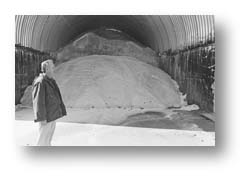
While there has been no snow removal work, the East Hampton Town Highway Department has faced other white stuff this winter: some 1,700 tons of road salt piled up in the town's highway barns.

The lack of snow has kept the Highway Department's budgetary coffers well-stocked, however. The town had earmarked $165,000 for snow removal expenses this year, including potential overtime for department employees, equipment, and materials.

Downside

"Very, very little" of that has been touched, said Christopher Russo, Town Highway Superintendent. Since money in the snow-removal budget is not transferable to other budget lines, surpluses will be carried over into next year's budget, perhaps reducing the amount of money that the department will have to raise by taxes.

The Highway Department emerg ed from last year's mild winter with a sizable surplus as well. The winter of 1995 blanketed the South Fork in snow and put the department $105,000 over budget for snow removal.

A winter without snow lessens some of the headaches for the department, but it also has its downside, Mr. Russo said. "The guys lose their edge. The guys don't get any training."

Ups And Downs

For those with small snow-plowing businesses, or even those with a snow plow, a pickup, and a few driveway jobs, the winter of 1995 was lucrative; this year such a possibility has been nonexistent.

"You know, it's been up and down. That's the way the winters are," said Randy Reichart, whose Hamptons Auto Collision on Springs-Fireplace Road in East Hampton offers snow plowing as one of its services.

"It's Gravy"

Mr. Reichart said the snow-plowing business is more of a bonus for people who have the equipment, not a necessary part of their income. "Hey, if it comes in, it's gravy. If it doesn't, it doesn't.

The mild winter has cut into his auto-body work, Mr. Reichart noted, as well.

As for farming, Mr. Hendrickson said the mild winter could mean trouble come the growing season.

"Usually, they say if the ground gets good and frozen over the winter, it breaks up better, plows over better," said Mr. Hendrickson. "It also kills a lot of the bugs that hibernate under the ground. . . . I'm pretty sure there will be a big infestation of insects."