Ready for Some Fresh Air

Ready for Some Fresh Air

Fresh Air Fund visitors got off the bus in East Hampton Thursday ready for week of fun.
Lucia Akard
By
Lucia Akard

On Thursday afternoon, a group of seven children from New York City eagerly stepped out of a bus that arrived in the Lumber Lane parking lot in East Hampton, excited to begin a weeklong vacation that promised outdoor adventures and an escape from the city in the summer. As part of the Fresh Air Fund’s summer hosting program, the children will stay with volunteer host families in East Hampton and elsewhere on the South Fork.

Each year the Fresh Air Fund sends 4,000 children from low-income neighborhoods in New York City to suburban or rural communities across 13 states from Virginia to Maine, and even Canada. The organization aims to give city children, many of whom rarely or never get to leave home, an experience outdoors.

It is not uncommon for Fresh Air Fund host families to host the same child for many years in a row, and such was the case for some of the children who arrived on Thursday. Many were met with hugs from host parents and host siblings and exclamations of how big they had grown since last summer.

The children go home with stories every year. "It's hilarious to hear about their stories on the way back and they always show us their pictures," one of the volunteer chaperons said Thursday.


CVS Foes Take to the Streets

CVS Foes Take to the Streets

About 40 people protested a proposed CVS pharmacy at the corner of Main Street and the Bridgehampton-Sag Harbor Turnpike in Bridgehampton last Thursday.
Bella Lewis
An impassioned protest that drew some 40 people
By
Bella LewisTaylor K. Vecsey

Bridgehampton’s Main Street was the site last Thursday of an impassioned protest that drew some 40 people who are hoping to keep a CVS pharmacy and convenience store from going up at the intersection of Main Street and the Bridgehampton-Sag Harbor Turnpike. Calling themselves Save Bridgehampton Main Street, the group expressed contempt in no uncertain terms for the planned two-story building, which is to have 9,000 square feet of retail space and a 4,400-square-foot basement.

Those who turned out seemed for the most part to be year-round residents hoping to get seasonal residents to join the fight. Many said they did not have anything against CVS itself, which has stores in Southampton and East Hampton, but thought such a large store in that location would exacerbate traffic and detract from Bridgehampton Main Street’s charm.

The building is to go up on a vacant lot at 2510 Montauk Highway, formerly home to a beer store, on the northwest corner of Main Street. Four roads, Lumber Lane and Ocean Road in addition to Main Street and the turnpike, converge at the intersection, as does an access road for the building that houses Starbucks.

Carey Millard, an organizer of the demonstration and former co-chairwoman of the Bridgehampton Citizens Advisory Committee who lives on Ocean Road, said, “I live down that road and it takes me three traffic lights to get through this intersection. And to have a huge chain store open from 8 a.m. to 11 at night! I like CVS and their anti-cigarette campaign, but they were turned down from Sag, and I don’t see why we should be stuck with them.”

The Topping Rose House, an upscale restaurant in a historic building, the 1840 Nathaniel Rogers House, which is being restored, and Almond restaurant, in another one of Main Street’s oldest buildings, are on three of the corners of the intersection. A petition from Save Bridgehampton Main Street calls for commercial development to be prohibited on the corner.

The CVS plan would need to go before the Southampton Town Planning Board for review, but no plans have yet been submitted, according to a staff member. The building would require a special exception permit because the town code limits stores to 5,000 square feet. Nevertheless, Ms. Millard said it appears as if the proposal will go through. Paul Kanavos of BNB Ventures, which owns the property, did not immediately return a call for comment.

“We’re a charming hamlet that ­doesn’t need an oversized store that is way out of proportion to the town,” said Julia Douglas, who had just waved a “Honk!” sign at a large truck, which did so.

“Bridgehampton should have a nice entrance to town like East Hampton. We are working hard to get the town to buy it and make a park out of it. This is a historic street; it’s just not appropriate, we have a shopping mall already,” Peter Sughrue said, manning one end of a long sign reading, “Chainstore Here?”

Saying the new building would be “a terrible eyesore,” Otis Pearsall, who has lived in Bridgehampton all his life, asked, “Did you know that this used to be the site of a historical tavern, Wick’s Tavern? They knocked it down in the ’40s, but it stood here in my childhood.”

“Already, it is a nightmare for traffic — if there is an enormous store there, which has very little parking, it is going to be mind-numbing,” Ms. Millard said before the protest, adding that Lumber Lane, “a lovely residential lane that already has traffic backed up on it,” is going to fare even worse.

“I think people are just horrified that the historic town is being threatened with a huge chain store in the middle of town, when it should be in the mall,” she said, referring to Bridgehampton Commons to the west, where there is already a Rite Aid. “We know that CVS was turned down in Sag Harbor . . . now we’re being picked on and we don’t want them either. I think we want to go on record with that.”

For more photos from the protest, click here.

Club Inches Toward Irrigation Approval

Club Inches Toward Irrigation Approval

Matt Lester, a Life Scout working toward becoming an Eagle Scout, helped members of the Garden Club of East Hampton install a butterfly garden at East Hampton Town Hall Monday.
Durell Godfrey
The project would overhaul the existing irrigation system on the golf course and add irrigation to its 27 fairways
By
Christopher Walsh

The Maidstone Club’s lengthy effort to put in a new golf course irrigation system took a step closer to success at an East Hampton Village Zoning Board of Appeals meeting on Friday with the filing of a long-awaited final environmental impact statement. The board’s unanimous vote to accept the statement, pending public comment, followed discussion with Chick Voorhis of Nelson Pope and Voorhis, which had prepared it.

The two-year process has also prompted the village to establish what is being called a “water quality working group” to study how the new irrigation system for the golf course and maintenance of the private club’s 210 acres would impact the ecological health of Hook Pond. The village allocated $35,000 for the group in its recently adopted 2014-15 budget.

While the board accepted the statement Friday and it will be filed with the State Department of Environmental Conservation on Tuesday, the public will have a 10-day period to submit written comments. Mr. Voorhis and Linda Riley, the village attorney, will then prepare a draft of a “finding statement,” which the board  must adopt within 30 days of the filing of the F.E.I.S., but Frank Newbold, the Z.B.A. chairman, said the board would try to do so in time for its meeting on July 25. 

c, 18 of which are on the west golf course and 9 on the east. The plan calls for the construction of a third well, a pump house, a .42-acre irrigation pond with a capacity of 785,000 gallons of water, and new piping. The work, expected to last eight months, requires 14 variances from the village code.

During the discussion Friday, the board pressed Mr. Voorhis on noise that would emanate from the pump house, a principal concern of adjacent property owners. The F.E.I.S., Mr. Newbold said, recommends several steps to mitigate noise to the maximum extent possible, including burial of the pump house floor two feet below the ground and providing at least a 6.5-foot-high earth barrier above its floor level. The structure is to have just one door, facing away from neighboring properties, and a switch that would shut down the pumps if the door were left open or ajar.

In addition, the pump house requires a certificate of occupancy, which Mr. Voorhis suggested could be contingent on demonstrating that noise from the pump house is not audible at any adjoining property line or public road. “These measures are to further minimize, and in my mind eliminate, the potential for noise impacts,” he said. Mr. Newbold said that revegetation of the area to be cleared for the irrigation pond would add a natural sound baffle. “We have a chance to look at it and make sure it’s maximizing the sound diminishment,” he said.

Craig Humphrey, a Z.B.A. member, asked Mr. Voorhis if the structure’s roof could be underground. “The document recommends partial burial,” Mr. Voorhis said, adding that the board has “the discretion to supervise the final design.” Mr. Humprhey also suggested requiring periodic reports demonstrating that there are no noise impacts and questioned whether an access road created for the project would be maintained upon its completion. Of the F.E.I.S. he said, “There’s some minor things in there that are pretty annoying, but I’m going to leave it alone.”

Over the long review process, the board had considered other concerns raised by nearby property owners and the East Hampton Town Trustees, who own Hook Pond. These included the volume of water to be drawn for the proposed irrigation pond, the mud that would result during wet periods, and the truck traffic required during construction.

Also on Friday, the board granted further adjournments to two high-profile applicants. Howard D. Schultz, the chief executive officer of the Starbucks chain, was granted an adjournment until July 11. Mr. Schultz seeks the continued existence, on his property at 14 Gracie Lane, of a 1,022-square-foot garage and caretaker’s apartment that is almost twice its original size.

A hearing for Loida Lewis, the widow of the business tycoon Reginald Lewis, was adjourned to July 25. Ms. Lewis seeks to allow a pre-existing one-story cottage to be reconstructed and expanded as an addition to the main residence at 165 Lily Pond Lane. She also seeks the continued existence of a 650-square-foot game room with half-bath that was converted from a garage, and 400 square feet of decking and stairs on that structure’s north side.

The board also announced five decisions on other variance applications.

•The 88,038-square-foot parcel at 70 Cross Highway owned by Thomas and Sandra Campaniello was made eligible for a building permit, despite the property’s being in a residential district requiring a lot area of 160,000 square feet.

•The owners of 247 Georgica Road were granted variances to allow the continued maintenance of pool heaters and an equipment shed within the required setbacks.

•Robert G. Shaftoe and Lorinda Bryan of 79 Pantigo Road were granted variances to allow reconstruction of an existing residence and installation of a new foundation for an addition to the house, also within required side yard setbacks.

•Flora Greenberg of 38 Dayton Lane was granted variances to allow the continued existence of an arbor, a generator, air-conditioning units, and a slate patio bordering a swimming pool. They are within required setbacks and contribute to excess lot coverage.

•H. Frederick Krimendahl II of 40 West End Road was granted a freshwater wetlands permit to allow the reconstruction of a residence near wetlands and within the required front and side yard setbacks; the installation of a new sanitary system with a retaining wall elevated to meet required minimum separation from groundwater, and the installation of a patio behind an existing structure within the required wetlands setbacks.


To Study Hook Pond

To Study Hook Pond

A group to focus on the ecological health of Hook Pond
By
Christopher Walsh

The Maidstone Club’s application to expand and modernize its irrigation system, which the East Hampton Village Zoning Board of Appeals is likely to rule on this month, has prompted the creation of a group to focus on the ecological health of Hook Pond. Frank Newbold, chairman of the village’s zoning board, described the new group at the board’s meeting on Friday.

The Maidstone Club contends that the irrigation system it plans to install would be more efficient and increase turf density, which in turn would substantially reduce runoff to Hook Pond. In addition, the club says the reduced need to apply fungicides and pesticides to the grounds would mean fewer chemicals entering the pond.

The group, whose formation will be formally announced next week, comprises Mayor Paul F. Rickenbach Jr., Barbara Borsack, deputy mayor, Becky Molinaro, village administrator, Scott Fithian and Michael Bouker, superintendent and deputy superintendent of the Public Works Department, Kim Shaw, East Hampton Town’s director of natural resources, Diane McNally and Sean McCaffrey, East Hampton Town trustees, Ken McDonald, representing the Nature Conservancy, Bob DeLuca, representing the Group for the East End, Arthur Graham, representing the Maidstone Club, and Linda James, Evelyn Lipper, and Bill Speck, all of whom own property on the pond’s shoreline.


The Plaza Is Now Carl Fisher Plaza

The Plaza Is Now Carl Fisher Plaza

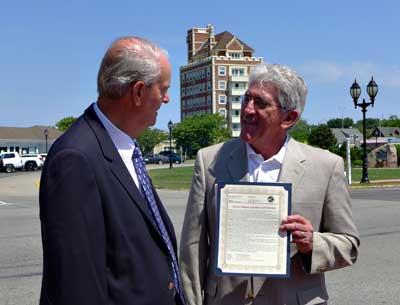
John Keeshan, who successfully lobbied to rename the Plaza after Carl Fisher, received a copy of the East Hampton Town resolution making it official on June 24 from Supervisor Larry Cantwell.
Russell Drumm
The circle was designed by the developer Carl Fisher in the 1920s
By
Russell Drumm

One Montauk resident might say to another, “I’ll meet you at the Circle,” and be understood. They and the U.P.S. delivery man would know that the non-descript address “the Plaza” was in fact the same as the circle of businesses located in the downtown section of their hamlet, the same circle designed by the developer Carl Fisher in the 1920s. So why not gussy up the address with a little history?

The thought occurred to John Keeshan, whose Keeshan Real Estate has kept busy on said circular Plaza since 1975. It seemed a perfect fit. After all, before setting out to turn Montauk into the Miami Beach of the North, Mr. Fisher, a sixth-grade dropout from Indiana, created Miami Beach, pioneered automobile headlights, established the Indianapolis Speedway, and much more.

On June 24, after a year of successful lobbying, Mr. Keeshan joined East Hampton Town Supervisor Larry Cantwell and the town board members Peter Van Scoyoc and Kathy Burke-Gonzalez for a brief dedication ceremony on the southwest corner of Montauk Highway and the renamed Carl Fisher Plaza.

“I had a book on Carl Fisher,” Mr. Keeshan said, “ ‘The Pacesetter,’ by Jerry M. Fisher [a distant cousin]. I knew about Fisher, of course, but I didn’t know his life story. Did you know he created the Liberty Highway between Manhattan and California? It turned into Route 66. I became engrossed in what he had done. When I finished the book I realized there was nothing in town with his name on it except for the plaque on a rock in front of the Tower.”

Mr. Keeshan posed his idea to residents with historic links to Mr. Fisher including Frank Tuma, whose firm, the Montauk Improvement Company, was heir to Mr. Fisher’s real estate business, and the Prado family, owners of Marshall’s service station and related businesses. Marshall Prado Sr. was Mr. Fisher’s chauffer.

Mr. Keeshan won the endorsement of a good number of residents he had canvassed in Montauk, and he checked with delivery services and the United States Postal Service to make sure the new name would not confuse mail and package handlers.

On May 13, the town board passed a resolution to rename the Plaza, a copy of which Mr. Cantwell presented to Mr. Keeshan last week. “Where’s the frame?” Mr. Keeshan said.

“We’re on an austerity budget,” the supervisor answered.

Sag Harbor’s Railroad Years at Boyd House

Sag Harbor’s Railroad Years at Boyd House

The Sag Harbor Historical Society’s exhibit on the Long Island Rail Road in that village includes a collection of artifacts that the curator, Jean Held, found along the old track route.
Lucia Akard
One of the L.I.R.R’s first branches on the East End
By
Lucia Akard

For those who know little to nothing about the Long Island Rail Road in Sag Harbor, an exhibit at the Sag Harbor Historical Society’s Annie Cooper Boyd House through October offers a good introduction to why the village was one of the first on the East End to rally for a railroad connection.

“The Long Island Rail Road Years in Sag Harbor, 1870-1939” tells the story, from start to finish, of one of the L.I.R.R’s first branches on the East End.

The whaling industry began to decline in the 1840s as gas and oil replaced whale blubber as fuel. As a result, Sag Harbor’s economy suffered and the community felt cut off from the rest of the world. Furthermore, mass transit by land was dismally bad, and when the bay froze in the winter, residents were often stranded. A photo of one such particularly cold year, during which icicles hung from the boats, is included in the exhibit.

The exhibit takes viewers through several stages of the railroad’s history in Sag Harbor, including the building of it, its opening day, the effects it had on the economy, and its eventual demise in 1939. Most interesting, perhaps, are the many problems and community conflicts that arose in the process.

According to Jean Held, who curated the exhibit, people in the community “thought the Long Island Rail Road would connect them to the world again. It didn’t work out that way necessarily. There were some rude awakenings, like the tiny amounts they gave people for their land, and then there were promises that were broken.”

There were also countless accidents, so many that the L.I.R.R. was amusingly accused of trying to control the population. For instance, on Aug. 9, 1890, five of the seven train cars derailed. And between 1872 and ’73, fours cows were run over by trains, earning the L.I.R.R the nickname “the slaughterhouse on wheels.”

As well as photographs and newspaper excerpts that illustrate the above stories, there are also a variety of objects on display, quite a few of which Ms. Held found along the old railroad tracks, including a gas lantern, pieces of “iron horse manure” (debris left over from unburnable coal), and track fasteners. Her most exciting find was a large steel rod used to break up the coal slag that she discovered about five years ago and secreted away until this summer’s exhibit. Two L.I.R.R timetables from 1938 and 1939 are on display as well.

The historical facts presented in the exhibit are combined with personal anecdotes and amusing micro-histories. Included among them is the story of a Capt. George C. Gibbs, the founder of the Montauk Steamboat Company. Captain Gibbs took issue with the fact that the L.I.R.R. had begun demanding duty on all goods that came into the village. The baymen of Sag Harbor were used to duty-free commerce and did not comply happily with the new regulations. Captain Gibbs began running a duty-free business out of his own dock, outsmarting the L.I.R.R. and providing the community with a welcome service.

Despite the problems that surrounded the railroad, community members warmed up to it when the economy began to boom from tourism. And by the early 1900s, when the popularity of the L.I.R.R to Sag Harbor was declining, residents worried that without it, the price of coal would skyrocket. Some who visit the exhibit may actually remember riding the Tunerville Trolley, a single gas-electric car that ran between 1927 and 1939, and was the last gasp of the L.I.R.R in Sag Harbor.

The Annie Cooper Boyd house is at 174 Main Street in Sag Harbor. The exhibit can be seen on Saturdays and Sundays from 1 to 4 p.m. through Oct. 13. Admission is free.


Former Baykeeper Takes Up Familiar Cause

Former Baykeeper Takes Up Familiar Cause

Defend H2O will advocate for the enactment of stronger water quality standards, sewage management reform, an end to use of the insecticide methoprene to control the mosquito population, and wetlands protection
By
Christopher Walsh

Kevin McAllister, who served as Peconic Baykeeper for 16 years until his dismissal in March, has formed a new group aimed at restoring and protecting ground and surface waters on and around Long Island.

Defend H2O, comprising Mr. McAllister, Skip Tollefsen, the former owner of Lobster Inn in Southampton, and Mike Bottini, a naturalist and writer, will advocate for the enactment of stronger water quality standards, sewage management reform, an end to use of the insecticide methoprene to control the mosquito population, and wetlands protection.

The organization, Mr. McAllister said, will continue the work he has been engaged in for the last 16 years. “It’s very important work, and certainly there’s urgency for water protection out here,” he said. “I separate myself and this organization from the others in that I speak truth to power.”

His primary efforts, he said, will be in public education, through meeting with community groups and trying to bolster participation in policy formation. Enforcement, he said, is also essential.

Mr. McAllister said a report recently issued by the Nature Conservancy, asserting that wastewater from residential septic systems and sewage treatment plants accounts for half of the nitrogen pollution in the Peconic Estuary, is indicative of his persistence in defense of marine environments. “Ten years ago I was calling out Suffolk County’s report on same,” he said. “Influences from nitrogen from septic systems were dismissed as minimal. You have to address wastewater influences on a watershed-by-watershed basis . . . but as a whole, I firmly believed that nitrogen derived from septic systems was more pronounced than what was previously reported.” The Nature Conservancy’s report, he said, “brought accuracy to that assessment.”

He warned of “gutsy political decisions” that must supercede cost considerations and implications on future development. “That’s always been the reason we kick the can down the road,” he said of the costs of, for example, overhauling wastewater management. “You could bring forward the best available technologies that do exist in the marketplace. Enough denial. When elected officials suggest we’ll pump out septic systems every year and tell the public this is going to clean up our water, I’m going to call out that stuff as being ineffective and a distraction to what we really need to do.” New York State, he said, must adhere to and enforce federal water quality standards.

Mr. McAllister said he is challenging his dismissal from the Peconic Baykeeper group. A board member cited an inappropriate romantic relationship with the group’s development and communications director and alcohol abuse on the job. Mr. McAllister would not discuss the matter. “I will continue to put the spotlight on polluters,” he said of his work with Defend H2O, “as well as on progressive solutions.”


Studying the Life of a Pond

Studying the Life of a Pond

Daisy Kelly, left, Conrad Kabbaz, and Serrana Mattiauda, interns with the Third House Nature Center, talked about the health and environs of Big Reed Pond in Montauk on Friday.
Janis Hewitt
By
Janis Hewitt

Interns studying water quality in Montauk’s Big Reed Pond for the Third House Nature Center presented their findings to a small group at the Montauk Library on Friday.

Conrad Kabbaz, Daisy Kelly, and Serrana Mattiauda explained that a contaminant called cyanobacteria, otherwise known as a blue-green algae bloom, has choked the freshwater pond of its oxygen, killing off plant life and several species of fish, including large-mouthed bass and whitefish. The bacteria can be toxic to people and to animals, who may sip from the water or as they walk around its edge.

The New York State Department of Environmental Conservation recently issued a warning that animals that come in contact with the bacteria could suffer from convulsions, seizures, and paralysis. Contact can be fatal.

The algae bloom became visible after heavy spring rains several years ago and has only gotten worse over the years, the interns said. They were surprised to see so much debris surrounding the pond, mostly from hunters who often leave shotgun shell casings and food wrappers there.

The bacteria is easily spread into other bodies of water through its spores, which can be carried on the bottoms of small boats such as kayaks, from one pond to another. Big Reed Pond is in the woods off East Lake Drive, where many take walks with dogs in tow.

“I wish I had known about it sooner,” Serrana, a senior at East Hampton High School, said of the spot. She added that if more people knew about the pond, they might get more involved in its preservation.

Conrad spoke of the birdhouses the group built with Ed Johann of the Third House Nature Center, then placed throughout the area to attract a variety of bird species, including the purple martin, whose population has been in decline in New York State. As part of their study, they entered the birdhouse placement in a GPS system in order to track and document the wildlife.

During the program, the interns regularly collected samples from the pond for testing and to establish baseline data for future studies, said Daisy. Once the samples were collected, they were not to be disturbed. “It was a lot harder than it sounds,” she said. On the last day of the program the interns found a live eel in one of the traps they set. “It was a positive sign that the pond can support life even though it’s been overrun with algae,” she said.

The interns also worked with Vicki Bustamante of the nature center to identify, tag, and locate the many types of trees and plants that surround the pond, marking invasive plants and documenting their range of growth. They went out on the pond in canoes with Matt Stedmen, also a member of the nature center, to gauge water quality and examine fish traps.

These three were the second group of interns to work with the nature center. “This group really stepped it up and could identify most of the indigenous flora and fauna that they studied,” Mr. Johann said.

The program was made possible through a scholarship award from the East Hampton Garden Club, which allowed the Nature Center to begin a long-term study of the pond, its shoreline, and the surrounding woods and grasslands. A new program with new interns will start in September.


Village Budget Sails Through

Village Budget Sails Through

By
Christopher Walsh

After a brief public hearing, the East Hampton Village Board adopted a $20.29 million budget for the 2014-15 fiscal year on Friday.

The budget represents a spending increase of $550,000 and results in a tax increase of 2.14 percent, a rate comparable to the average over the last seven years.

The proposed spending increase required the board to vote to authorize an override of the property tax cap, which it did last month.

In introducing the tentative budget at that time, Mayor Paul F. Rickenbach Jr. said that the creation of two new programs — one to supplement the volunteer ambulance corps with paid emergency medical services and one to control the deer population through sterilization — made a spending increase necessary.

Increases to the village’s snow removal budget and workers’ compensation insurance premiums are the other primary factors in the spending hike. Equipment for the Public Works Department, roadwork, roof repairs to multiple Sea Spray cottages at Main Beach, which the village own, and drainage repair at the Emergency Services Building account for additional expenditures. The spending increase, however, is almost .5 percent less than in the prior two years, the mayor said last month.

The village’s contribution to the state retirement system and its debt service will decrease in the upcoming fiscal year, which begins Aug. 1. Refinancing of two outstanding bonds will yield more savings in the future. There is also an increase in non-property-tax revenue resulting from increases in the mortgage recording tax, sales of beach parking permits, increased building permits, and rentals of village property.

Upon the board’s unanimous vote to adopt the budget, the mayor complimented Becky Molinaro, the village administrator, the department heads, and his colleagues on the board. “We feel it’s comfortable with respect to the services we are going to render, and we are moving ahead in that fashion,” he said. “Thanks to everyone that was involved.”

Joan Osborne, chairwoman of the Village Preservation Society of East Hampton, criticized the board for its $30,000 allocation to the deer sterilization program, which she called “woefully inadequate.” Earlier this month, the society launched a program to raise a hoped-for $100,000 toward a sterilization program, and previously pledged $5,000 to the village to that end.

The cost of sterilizing a doe is $1,000, Ms. Osborne said. “We were hoping,” she said, “and we’re expecting the village to come forth with more than the $30,000.” Village residents, she said, “are being inundated with deer,” which she said destroy property, carry disease, and cause motor vehicle accidents. “I would implore the village to increase that to at least $50,000 in your budget . . . so we can hopefully go forward with this project in the fall,” she said.

Mayor Rickenbach responded that if additional money is needed for a sterilization program, “we will make the appropriate transfer from other line items within the operating budget. We hear you.”

Stein, Schroeder Victorious

Stein, Schroeder Victorious

By
Taylor K. Vecsey

In a four-way race for two seats on the Sag Harbor Village Board, Robby Stein and Sandra Schroeder were victorious in Tuesday’s election, which saw a high turnout of 515 voters.

Mr. Stein, the only incumbent running this time around, was the top vote getter, with 308 votes, including 30 absentee ballots. Kevin Duchemin, who had served one term, did not run for re-election.

Ms. Schroeder, a former village clerk who retired in 2010, was elected with 270 votes, 14 of which were by absentee ballot. She worked for the village for 21 years, but came out of retirement to run for mayor last year, losing by 11 votes to the incumbent, Mayor Brian Gilbride.

Mr. Stein and Ms. Schroeder will each serve a two-year term.

John Shaka, a Save Sag Harbor board member who has lived in the village for 15 years, received 219 votes, which included 28 absentee votes. Bruce Stafford, a former board member who was ousted in a three-way race with Mr. Stein and Mr. Duchemin in 2012, finished last with 124 votes, 3 of which were by absentee ballot.

Mr. Stein said he was thankful to be re-elected for what will be his third full term. “I’m glad because I want to concentrate on these open projects and start the other things that are just beginning. I really did think that both John and Sandra, in particular, were good candidates. I’m hoping John stays involved,” he said.

“I am just thrilled. I’m so glad the people put their faith in me,” Ms. Schroeder said. She is looking forward to taking office on July 1 and getting to work on issues she mentioned during her campaign, such as a capital plan and water quality and drainage.

She expects it to be an easy transition when she joins Mayor Gilbride and Mr. Stein, as well as Ed Deyermond and Ken O’Donnell, both of whom supported her. “I know everybody. Other than Kenny I’ve already sat there with every one them.”

Mr. Shaka said he was disappointed, but enjoyed the experience. “I wanted to win but I’m really happy with the campaign I had,” he said. “The good news is that Sag Harbor has two really good people in there.” He said he intends to remain involved in village government, including the traffic calming project he has helped to spearhead.

Mr. Stafford could not be reached for comment.

According to Beth Kamper, the village clerk, 468 people voted by machine, while 43 sent in absentee ballots. There were also 4 write-in votes, 2 for Scott W. Smith, 1 for Mary Anne Miller, and 1 for Margaret Bromberg.