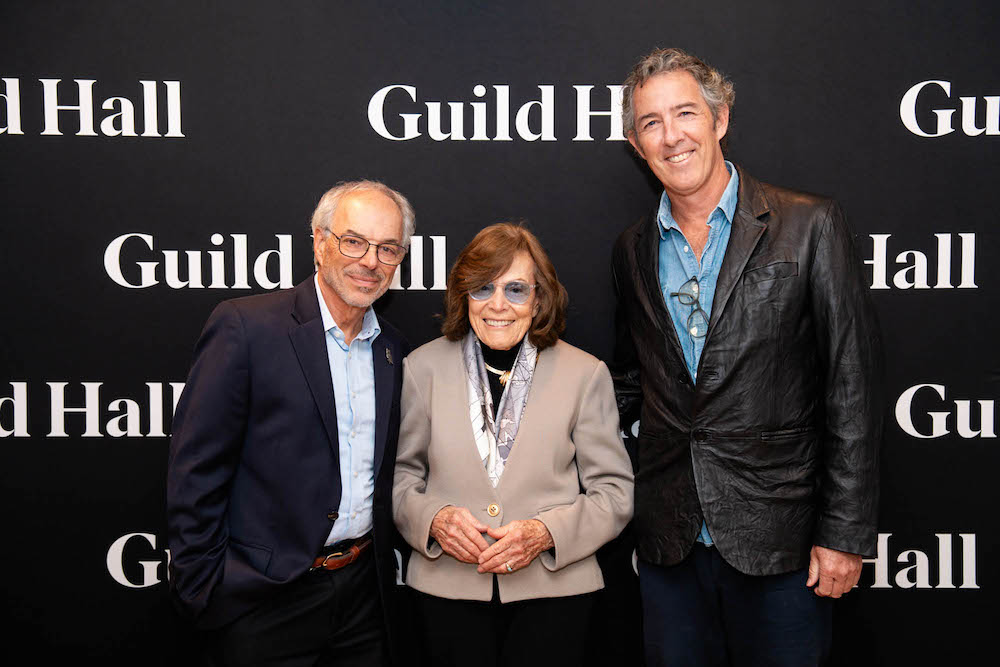
“The magnitude of our ignorance is still awesome,” the world-renowned marine biologist Sylvia Earle told a rapt audience at Guild Hall on Sunday, “but we know enough to know that one species is able to influence the nature of nature.”
There have been extinctions in the past, Dr. Earle said, but “never before has any species been faced with knowledge and choices, the ability to make the choices that will have a significant impact on not just our future, but all the rest of life on earth.”
Despite mankind’s well-documented predilection for destructive, and self-destructive, choices, it remains to be seen, she said, whether we will turn away from the course of “diminishing life, the loss of our fellow citizens on a rate that is unprecedented, the extinction of the rest of life on earth, consuming nature to foster our prosperity.”
Dr. Earle, the first woman to be appointed chief scientist of the National Oceanographic and Atmospheric Administration, holds the record for the deepest walk on the sea floor. She has led more than 100 marine expeditions totaling over 7,000 hours underwater, and is the founder of Mission Blue, which is dedicated to establishing a network of marine protected areas across the globe known as hope spots. One of these is Shinnecock Bay, which has been recognized both for its ecological significance to the region and for its cultural, recreational, and spiritual importance.
Sunday’s program, which included a discussion with the marine ecologist and author Carl Safina, was the latest in the Matthiessen Talks, public conversations that bring together writers, activists, and cultural voices launched last year by the Peter Matthiessen Center. “Mission Blue’s vision is to transform humanity’s relationship with the ocean,” said Alex Matthiessen, the center’s president, “making protection the global default through science-driven, people-powered action that secures a sustainable future for life on earth.”
“The greatest security question of our time” is the continued habitability of the earth “for us and the rest of life,” said Dr. Earle, who turned 91 last month and retains an extremely active schedule including frequent global travel. “Most troublesome is that not many people seem to be focused on that,” she said, but the good news is that enough people “recognize that we’ve never had the ability to look at the past, the present, and the future armed with evidence. It gives us insight into knowing that this is the best time ever to be on board earth.”
Never before, and never again, will there be such an opportune moment, she said, “because we’re losing the chance quickly, when you look at the trends” in biodiversity loss, changes in the chemistry of the atmosphere and of the ocean, and changes in global surface temperature. “What a miracle it is that we’re here at all,” she said, “that earth exists at all, that life is a miracle and that we should rejoice in this ability to see what those in the past could not see, and to be reminded that we have to hurry every day.”
Hurry, indeed. Dr. Earle noted that a report on the state of the planet was to be issued the following day. On Monday, the 2026 Planetary Health Check, from the Planetary Boundaries Science Lab at the Potsdam Institute for Climate Impact Research, reported that seven of the nine planetary boundaries have been breached. Climate change, change in biosphere integrity, land system change, freshwater change, modification of biogeochemical flow, introduction of novel entities, and ocean acidification are at their “highest recorded levels of transgression,” according to the report.
What sets the earth apart is not just its ocean, “but that the ocean is alive,” she said. “It’s not just rocks and water, it’s life that has been shaping rocks and water over these many eons to have a place that is just perfect, habitable for us. We’re newcomers on these ancient systems.”
We can still breathe, Dr. Earle acknowledged, but “we’re also noticing that our impact on the fabric of life, on the waters of the world, freshwater as well as the ocean, is changing and altering the temperature so that it’s getting warmer, and understanding that the excess carbon dioxide in the atmosphere has consequences. We didn’t know that when we started burning coal, oil, and gas.”
All human wealth traces back to nature, she said, “and we have consumed so much of nature so fast, within a few centuries, something that has taken literally billions of years to put in a place that’s just right for us. It just seems we’ve gone about the business of trying to wreck it. . . . It’s a world that is still habitable, but we’re on a fast track, already transgressing seven of the nine planetary boundaries that have been identified as what it takes to keep us safe, within the safe operating space.” And yet, “we still have the best chance we will ever have, right now, to move in the right direction.”
Hope spots, of which there are more than 175 around the world, are thus named because “if you get enough people, individually and working collectively toward the common goal of safeguarding the ocean the way we’ve made a policy in some places of safeguarding the land, we can really move from decline to recovery,” Dr. Earle said. “It’s protecting the fabric of life that is fundamental to protecting climate, to protecting planetary chemistry, to keeping earth within safe operating boundaries.”
People who have lived in a place for a long time, “over thousands of years or even centuries in a place, a community, families — you get to know not just your human neighbors, but you know the system that gives you life,” she said. “We have a lot to learn from those who have lived in a place successfully for a long time. The Shinnecock Nation here is one such example. It’s one of the shining examples that show the wisdom of people who have learned how to live in harmony with nature.”
When young people ask “what can I do,” she answers with a question: “What have you got?” She advises them to think about “the immense diversity, along with that common ground,” the chemical makeup common to all life on earth. “Use whatever you’ve got, your superpower,” she recommends.
Mr. Matthiessen asked if Dr. Earle had “any message of hope” based on her interactions with world leaders, “the people with the power who are causing all this destruction and leading us down this path.”
“I think the greatest cause for optimism . . . is that there is a shift,” was the answer. “ ‘Nature positive’ is a growing trend.” Global markets, she said, “have caused a disconnect from people living in a place for a long time and respecting how nature works and living within the system.”
She referred to Peter Matthiessen’s 1971 nonfiction book “Blue Meridian: The Search for the Great White Shark,” in which he wrote of a 17-month expedition to photograph great whites and the production of the documentary “Blue Water, White Death.” “I was mesmerized by what those guys did back in the late ‘60s, early ‘70s,” she said. “It was phenomenal, but it’s just lack of empathy, lack of really understanding where we are in the greater scheme of things. Respect for nature, treating others with dignity and respect . . . it’s the golden rule: Do unto fish as you would have fish do unto you.”