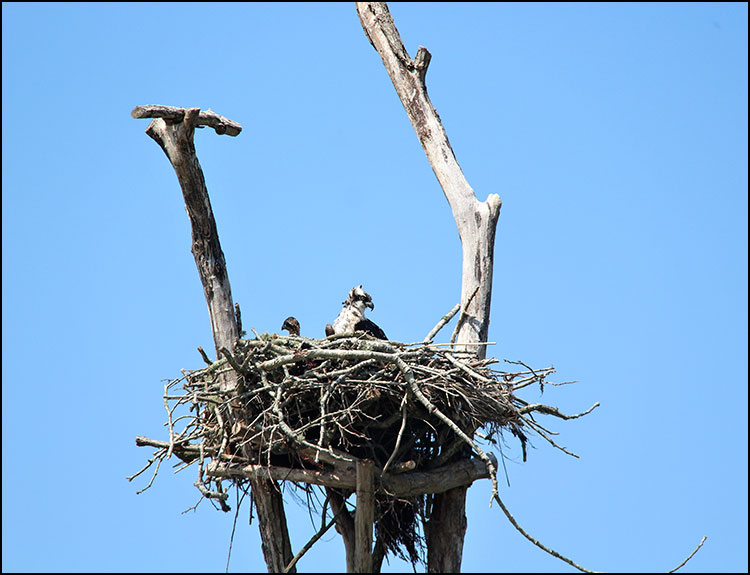
Ospreys that chose to breed on Gardiner’s Island and along the Connecticut coastline of Long Island Sound this past season suffered, according to new research by Bryan Watts, director of the Center for Conservation Biology at the College of William and Mary in Virginia.
Many starved to death, possibly due to a shortage of menhaden, one of their key food sources.
In fact, reproductive success rates were as low as they had been during the DDT years, when osprey populations were decimated — a shocking development for a region that has come to view the rebound of the osprey, decades after that pesticide was banned in 1972, as a profound and inspiring environmental success story.
“The data from Gardiner’s Island suggests there’s a problem on Long Island,” Dr. Watts said in a phone call last week. “We would like to have more data from Long Island.”
The Group for the East End has been monitoring the East End osprey population for decades. Until 2021, staff and volunteers checked nests and published their data annually, but the organization decided in 2022 to survey the nests once every three years, instead, given what was perceived as thriving numbers. They last surveyed the nests, of which there are nearly 600, in 2025.
“Because of reports of nest failures further down the coast, the group is working to accelerate our timeline and do a complete monitoring again in spring/summer 2027,” Jen Skilbred, the director of education for the environmental nonprofit, said in an email.
She shared data going back to 2018, which showed a clear downtrend in the reproductive rate, from 1.6 per nesting pair in 2018 to just 1 in 2025, a 37.5-percent decline. There were also 25 percent fewer fledglings in 2025 — 386 — compared to the high of 521 fledglings in 2019.
“This data does not directly tell us about menhaden,” wrote Ms. Skilbred. “There are many variables in the nesting success from year to year, including food availability, but also strong spring storms, extreme temperatures, and other things.”
“It’s also important to note that these numbers are all within a healthy population range,” she added.
Dr. Watts’s research illuminates reproduction rates and how they relate to healthy population levels. “On a global scale, the annual breeding performance required to maintain a stable osprey population ranges from 0.8 to 1.3 young/pair depending on the specific location,” he wrote. “We adopt the most optimistic (0.8 young/pair) reproductive rate as the ‘break even’ threshold.”
On Gardiner’s Island, the rate for 77 nests monitored was just .29, plus or minus the standard error calculation of .06. That is well below the level required to maintain the population.
Dr. Watts agreed with Ms. Skilbred that many factors are in play when it comes to the reproductive success of an osprey pair: “We talk about 20 different factors in our paper. But those factors have always been operating. The symptoms that we’re seeing, the signature is clearly food stress. They’re not consistent with other things.”
Things are far worse for ospreys that breed around Chesapeake Bay, in Maryland, with some areas showing complete failure. The reproductive rate there is twice as bad as it was during the DDT era.
“We’re seeing chicks starve in their nests,” he said. “Dead chicks in the nest. Around Gardiner’s Island, there’s an indication the symptoms have been the same.”
“It took 20 years to reach 80-to-90-percent decline with DDT,” he said. “If our current reproductive rates continue, the population will decline at twice that rate. We would expect a 50-percent decline in ospreys in just the next five to 10 years. We’re seeing 30 percent of females show up at a nesting location and choose to not even lay eggs. This year for the first time we saw large-scale abandonment of nests; 80 to 90 percent of adults left midseason. They’re not able to catch enough food to even feed themselves, much less a chick.”
“When we see a 5-percent annual decline in a bird species,” he said. “It’s alarming. Where we are right now with ospreys is 10 to 15 percent. That’s like falling off a cliff.”
It’s not clear if the crisis on Long Island will deepen. However, five years ago, the numbers down South were similar to the numbers Long Island saw this season, said Dr. Watts. They’ve gotten progressively worse.
Next week, at its annual meeting, the Atlantic States Marine Fisheries Commission will vote on the allowed menhaden harvest. It could decide to make no change, or to reduce legal catch limits by up to 50 percent. “They don’t adjust the harvest every year. This is a critical vote,” Dr. Watts explained. “Menhaden are a public resource, they’re not owned by a company. If people feel they are being overharvested, they should make their opinions known to the regulatory agencies.”
In an email, Tina Berger, the director of communications for the fisheries commission, said menhaden are managed “on a coastwide basis” and that assessing smaller regions within the coast and providing different guidance based on those assessments, is beyond the commission’s current capacity.
“The development of models and data that can address finer spatial scales is a research priority for the species,” she wrote, adding that “the latest assessment information finds the stock to be not overfished or experiencing overfishing.”
Public comment on menhaden catch limits was open until Oct. 9 but is now closed. Nonetheless, Dr. Watts said the fisheries commission had received “hundreds of thousands of comments” requesting a reduction.
It is not clear if the menhaden population is crashing in certain locations or simply moving.
“There are two competing possibilities regarding menhaden,” said Dr. Watts. “The menhaden could be low because they’re being overharvested. The other option is that their populations, at least in Maryland, are low because of climate change. There’s no question that the center of the menhaden biomass is moving north and east. Year over year, they move multiple kilometers due to the warming of the oceans. If that’s the case, and this is climate-change-driven, we could close the menhaden fishery completely and we still wouldn’t see a recovery.”
Information about the upcoming A.S.M.F.C. meeting can be found at bit.ly/4z2DjyS.