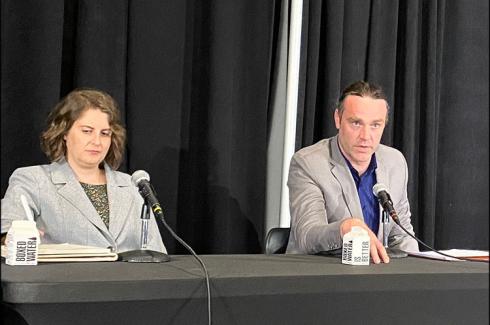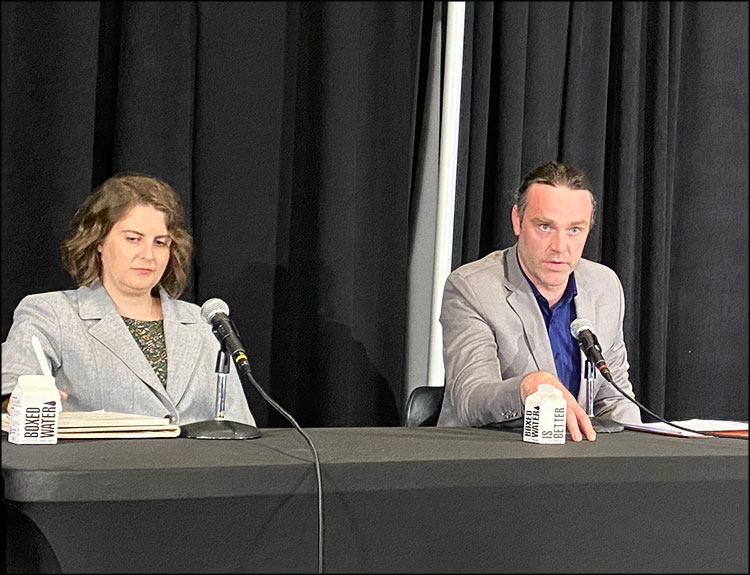
George Orwell and “1984,” his 1949 novel depicting a totalitarian state and the mass surveillance of its citizens, were repeatedly invoked during a panel discussion of surveillance technology, particularly the Flock Safety automated license plate readers that have appeared in East Hampton Town and across the United States, at LTV Studios in Wainscott on Tuesday.
“The Growth of the Surveillance State in the Hamptons and Across the Country,” hosted by Jim Vrettos and Asma Rashid, who are co-hosts of the “Radical Imagination -- Real Talk in the Hamptons” podcast, examined the proliferation of Flock Safety cameras as well as artificial intelligence, drones, Immigration and Customs Enforcement, and the militarization of police in the U.S. since the terrorist attacks of Sept. 11, 2001.
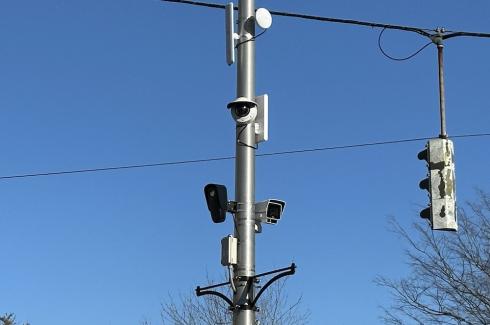
Flock Safety’s cameras operate across a cellular network, snapping still images of passing vehicles and using artificial intelligence to capture license plates as well as other attributes such as distinguishing markings. The data is instantly uploaded to a centralized cloud platform to form a searchable, nationwide investigative network.
That data use has prompted a backlash, following revelations that police officers have misused it, often hundreds of times, to track former romantic partners, and that innocent people have been harmed owing to a lack of oversight.
In “1984,” Mr. Vrettos said, “Big Brother is a mind-set and system that prepares us for an end to democracy and our ability to be critical thinkers. Many would say that that force [Orwell] described as Big Brother is already here, laying the foundation for an authoritarian and a totalitarian leader and state that practices control and domination, shame, humiliation, and disrespect. Increased governmental surveillance and loss of privacy is used to achieve these goals. Human experience data is captured and computed to predict and control behavior. Impersonal systems are trained to monitor and share our actions remotely, unimpeded by law.”
The panelists were united in urging that the public demand oversight and limits to the use of surveillance technology. With respect to automated license plate readers, or A.L.P.R.s, “There remain really serious questions as to whether that’s worth the sacrifice to civil liberties that can come into play,” said Mac Muir, who conducted more than a thousand investigations into alleged police misconduct at the New York Police Department and in Oakland, Calif.
Ali Winston, an independent investigative journalist, described a fusion of “traditional criminal justice” and “the intelligence-led approach of military-style counterterrorism policing, which is what we’ve transitioned to nationwide since the September 11th attacks.” He observed “the justification of increased surveillance authority and technological expansion into local policing,” which he said has led to the application of surveillance technology to quash dissent. “There’s been a remarkable uptick in federal and local law enforcement using this technology to push back on people who are not comfortable with the stances of the current administration and their allies.” The national security state has grown to a size that “would have been incomprehensible 50 years ago.”
Mr. Muir noted that police unions “have started to press back against the use of Flock to actually surveil police officers themselves. . . . I worry that we’re creating a moment where we can’t turn back.”
Michelle Dahl, executive director of the Surveillance Technology Oversight Project, pointed to “the general shift of policing toward a constant monitoring, rather than the original promises of the Fourth Amendment,” which protects people from unreasonable government search and seizure.
The project studies how police share and purchase data to circumvent constitutional limits on police searches, said Eleni Manis, its research director. “Most recently, we exposed the N.Y.P.D.’s use of Flock surveillance cameras without a contract.” People are “up in arms about this technology,” she said. “Flock is just one kind of the surveillance tech, but this is an opportunity for us to highlight how bad Flock is for communities.”
“We’re not seeing transparency about what the actual civil liberties costs are,” Mr. Muir said. “And we’re seeing that with Flock, over and over again, there’s way more data being collected about people than their license plate numbers.”
And there are abundant examples of its misuse, Ms. Manis said. While there are legitimate uses, “the law does not limit law enforcement to using A.L.P.R.s for these purposes. Instead, we see cops searching Flock and other license plate reader databases for ex-girlfriends. They search for immigrants on behalf of ICE. They track protesters.” One sheriff in Texas, she said, “tracked an abortion seeker all the way up to Illinois. In the absence of limits on the uses to which license plate readers can be used, you see abuses.”
Once the infrastructure of surveillance is built, those who put it there “are going to want to get their money’s worth,” Ms. Dahl said. “Secondly, even if they do continue to limit themselves to those ‘good uses,’ there’s always going to be another administration on the way. And the infrastructure, when it’s built, is incredibly hard to take down. That’s why it’s really important to get on the front end of this and keep these technologies from being entrenched in the first place.”
And, she said, “it’s very much a false narrative that surveillance will always lead to safety.”
In fact, Mr. Winston said, two decades’ worth of academic studies of the long-term impact of surveillance cameras and A.L.P.R.s “show no discernible impact on violent crime, and a slight decrease in property crime.”
Furthermore, “there’s always a defeat to a surveillance technology,” he said, “therefore the city has to put more money into improving that surveillance technology. It becomes a vicious circle.” Worse, surveillance “has the logic of cancer. There’s no natural limit, it’s metastatic. So you have to put a limit on it,” which he suggested is a decision either to stop using it or to limit its application.
Axon, which develops weapons and technology products for military and law enforcement, is building surveillance systems into light posts “in ways that are going to be less conspicuous” than a camera attached to it, Mr. Muir said. “Unless there’s a serious debate about regulating this, it’ll just happen, and a few years later we’ll go, ‘Wow, we didn’t do anything about that.’ ”
Police, he said, are a reflection of society. “That’s why this moment really calls upon people in a democracy to come up with real boundaries on this type of technology,” he said, “before it gets abused at a wider scale than it already has been.”