
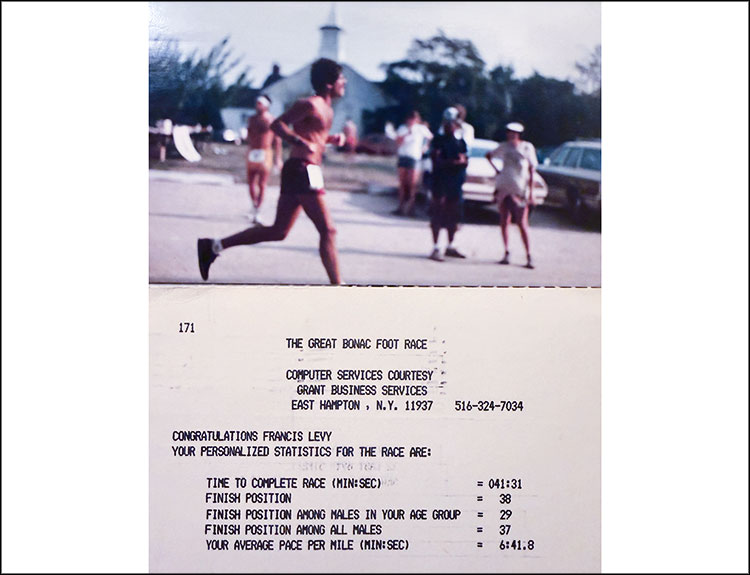
On Labor Day 1983 I ran the 10K in Springs. Two days before, I’d jogged out to Lunch on Napeague and back, a total of 15 miles, under the theory it would make a 6.2-mile (10K) race feel shorter. The notion of running a longer distance to make the actual run feel less stressful is a common training regimen.
In the actual race, I saved everything for the last mile, which I sprinted, coming in with a 41:31. Later I was sent a printout, with my name, time, and position in the race as I crossed the finish line at Ashawagh Hall.
My wife was waiting there with our basset hound, Hubert, though I don’t think either saw me in the pack.
Nevertheless, I was elated. If I got 41:31, breaking 40 would be a piece of cake. The difference was only 1:31, which seemed like nothing. Little did I realize, as I was doing it, I had reached my limit — 1:31 is a world in and of itself.
The good time was not a new beginning, but the culmination and the end of everything I had done, during a year in which I’d dieted, stopped drinking, and increased the discipline with which I tackled my workouts.
Instead of merely going out for a run, I started to sprint the mile for time at the track at East Hampton High School, and at my most fervent had even started to jump the hurdles.
I did push-ups and sit-ups. I remembered to pump my legs high, but also relax. Most important was the meditative state, in which the mind goes blank and you feel like you can keep on indefinitely.
Whenever I passed a construction site where there were scaffoldings, I leaped to reach the first bar, to show off my prowess for doing pull-ups to any passers-by. Disappointingly, there were rarely any kudos, besides those from my companion in life, from whom I am always seeking approbation.
She knew I had completed the race, but she had no more idea than I did it would turn out to be the best time I would ever attain. Just like you get a B or C every time you think you’ve aced the exam, you never realize you have won the inner race until Fate itself renders its score.
I’ve always felt deprived of my claque. Why weren’t all the doubters, who had questioned my abilities in life (generally), there to see my triumph, though even I couldn’t appreciate it?
“While the exact overall placement for Francis Levy is locked away in physical archives, a time of 41:31 in the 1983 Great Bonac 10K would historically position a runner well within the top tier of the Men’s 30-39 age group division, likely placing him within the top 20 percent to 25 percent of the overall field.”
Thank you, A.I.
I was, according to that postcard I received several days later, 38th in the race, 29th among males of my age, and 37th among all males.
One of The Star’s prominent editors has written about his experiences running in his weekly “Gristmill.” His sense of triumph and exhilaration is always mixed with a feeling of being right-sized by the act.
Running is a little like the food chain or the Great Chain of Being, with God at the top and the minerals and nutrients in the earth below. It inevitably precipitates a discussion of one’s place in the universe. In this case, I had to face the fact I was little more than a legend in my own mind.
Runners like Barbara Gubbins, an Olympic trials qualifier who would later run the local chain of running shoe stores, zoomed right past me, along with a host of others who came in under 40 minutes for the 10K.
I continued to run both the Memorial Day and Labor Day races for years, finding myself ever farther back in the pack.
In the meanwhile, I became a boxer, and learned how to skip rope and hit the speed, heavy, and double-end bags.
I attained the rank of Godan, or fifth-degree black belt, in traditional Japanese karate, which I still practice after 35 years.
I also wrote some novels and some poems.
As the years went by, the goalposts got pushed back while the finishing line got farther away, but that, I began to realize, was a good thing.
Francis Levy is a Wainscott resident and the author of the short-story collection “The Kafka Studies Department” and the novels “Erotomania,” “Seven Days in Rio,” “Tombstone,” and “The Wormhole Society.” His poems have appeared in Exquisite Corpse, Evergreen, The New York Times’s “Metropolitan Diary,” and Articoli Liberi. He recently completed a collection of poetry, “The Unavoidable Imminence of the Inexplicable.”