
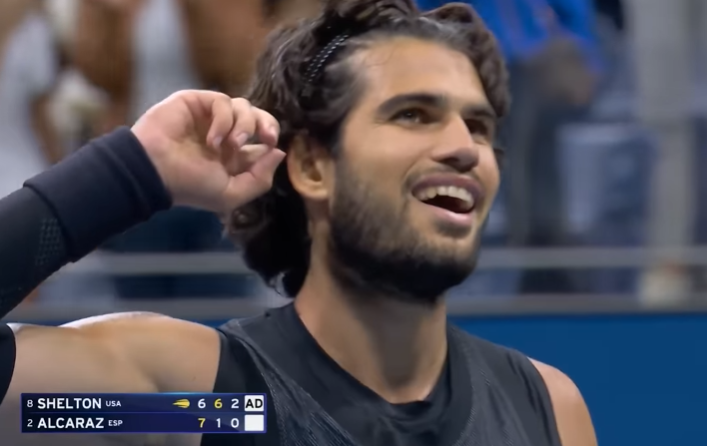
Dear Carlitos,
Please forgive this old gringo addressing you by your nickname. I heard that you prefer Carlitos because it is less formal and more musical than the sudden thud of Carlos. One imagines your response to someone calling you Senor Alcaraz: “El senor Alcaraz es mi padre. Llamame Carlitos.” Okay. Lo tengo. And since Carlitos translates as Little Carlos, your humility and lightheartedness sync up smashingly with your tennis game; a sensitive ear matches a delicate touch.
Which gets us to the point of this missive, Carlitos. I am writing to thank you for your drop shot — so exquisite, instinctive, and unapologetic. No preening or triumphant fist-pumping, no dramatic celebrations, just another part of the game. I think I speak for a worldwide community of amateurs and pros who appreciate your joyful validation of the once-reviled shot. You have alleviated more guilt than a team of therapists.
So many opponents detested the drop shot (and the dropper of the shot) that second thoughts inexorably followed a well-executed marshmallow. Some thought it cruel. Others considered it cheating. Some seniors insisted it be banned from friendly matches involving seniors. We who deploy the drop shot had no one to blame, or credit, no shining role model to point to until you stepped onto the court — buzzcut, blond, or full flow — and executed your uberdink with such equipoise and detachment that you became our knight in Nike armor.
Single-handedly, Carlitos, you turned a wimpy play into poetry, gave license to the lollipop, and provided free, if remote, lessons as to what, where, and when to use la dejada. Fans and foes alike tingle with anticipation to see that killer instinct go all cuddly, suddenly. Like watching a jaguar in the heat of battle turn into a purring pussycat. Aww. It’s awesome, all right, transforming ferocity into finesse, and yet so damn relatable. We can do that, Carlitos, we can do exactly what you do — relax our wrist and gently spin a fuzzy two-ounce ball over a three-and-a-half-foot net.
We cannot serve at 135 m.p.h. like you or dunk like LeBron or drive like Rory or do anything like Ohtani, but we can, in the right moment, on the right day, eke a plop shot over a braided barrier that dies a quick death, wins a point, and vexes our opponent. Just like you, Carlitos, and that makes our connection deep and endearing.
The drop shot used to be associated with duffers, hustlers, scoundrels, wheeze-bags, the lame and the limited. A shot of last resort. You have upended all that. Not to the extent that Steph Curry has normalized the 3-point shot, refashioning his entire sport, but not dissimilarly. Three-point attempts have doubled during the Curry Years, from 22 percent to 44 percent of all shots. Four years ago, drop shots were only 1.5 percent of all shots, but are up to 2 percent now and rising — that’s an increase of 33.3 percent in the Age of Alcaraz. Though you drop only 1 percent more than the average pro, your floaters come at such crucial junctures against such elite players on such a global stage that the effect is immeasurable and now an indispensable arrow in every quiver on tour. Even the Sultana of Swat, Aryna Sabalenka, drops a shot every so often at the U.S. Open.
In a culture that celebrates the obvious and glorifies grandiosity, you have popularized something refined and artful. TikTok offers neither time nor space for nuance. Looksmaxxing is the opposite of subtle. Sydney Sweeney is the inverse of Princess Diana. Your feathery drop shot, Carlitos, cuts against all the current currents. It’s cool. It’s elegant. It’s a finger snap, not a thunderclap.
And yet, people we all know hate it! Hate it especially when they can’t combat it. Just last week, in the first set of a match, I hit a backhanded drop shot that bounced thrice before a racket could reach it. The holder of that racket motioned me to meet him at the net.
“Do you hear that siren?” he asked.
“No, what siren?”
“The siren on the ambulance that just left the hospital.”
“I don’t hear a thing,” I said credulously.
“The next time you make me run for a drop shot, I’ll need a defibrillator.”
“But Carlos Alcaraz does it all the time,” I said.
“Not against Rod Laver he doesn’t.”
This fellow was not as old as Laver, closer to John McEnroe, but, to be fair, he did have a point and his mini-jeremiad gave me mini-pause (though no hot flashes).
La dejada, I need not tell you, Carlitos, is no piece of cake. It’s high risk, delicious reward. Slicing it too finely or too muscularly, or not disguising it sufficiently, is asking for trouble. In both points and pride. Missing comes across as too cute; hitting it too deep sets up a cookie. One has to keep in mind that any drop can be effective even when less than flawless — it draws your opponent to the net, forces him to run 45 feet diagonally, stop on a dime, halt inertia, and end up where most players feel most uncomfortable. One can respond to a possible counter-drop with a lob or a snappy rejoinder. If your drop shot is just right, his only return will be an icy stare as he catches his breath.
In the third set of the aforementioned match, when an anemic drop shot of mine hit the top of the net and flitted backward onto my side of the court, the fellow snarled, “Ha! God punished you.”
God? Punish? Who knew the drop shot was a cardinal sin? Does that make me a sinner (lowercase s, of course)? Does God really monitor every point of every Sunday morning match in East Hampton, New York?
In my defense, all I could muster was, “Blessed are the meek, for they shall inherit the earth.”
The divine drop shot is indeed a meekish exercise, Carlitos, demanding no more energy than serving up a slice of plain pizza. Sure, deft and deception are essential, but a delicate drop shot requires neither strength nor speed, only timing, a dash of chutzpah, and some experience.
Most drop shots are improvisational. After someone retreats to return a lob, for example, the geometry of the court begs you to ooze the next shot onto the block that is farthest from him and nearest to you. If the court is Har-Tru, all the better; if the court is clay, oo-la-la.
Some drop shots are pre-planned, and sometimes with malice and forethought. If the weather is sweltering, you can tire out your opponent early and often and reinforce the notion that a drop shot is just around the corner. After a particularly long point exhausts both of you, la dejada will give you a breather while taking your opponent’s diminished breath away. Even a miss is a plus.
Recently, I made sure to introduce a drop shot in the very first game of a match. My opponent stood stock still, sighed, and yelled, “Come on — hit like a man!” With that cry, he demonstrated surprise, disapproval, misogyny, poor sportsmanship, and a lack of appreciation for the finer things in life. He also encouraged me to drop more not less. In the past, those shots would have been spun with a touch of spite and vainglory, if not outright gloating. But such sins on my part would be followed by guilt and self-reproach. And my game would spiral into a maelstrom of mixed emotions and muddled strategy. No more. Not now. Because, Carlitos, I think of you before, during, and especially after all las dejadas. I visualize your Usher-like choreography and how you perform a perfect drop shot without a speck of meanness, without a ripple of rancor. It’s just a tennis shot. Nothing personal. Nothing unjust or ostentatious.
And no matter what anyone may think, it is done with a slight degree of danger and a very clear conscience.
Muchas gracias, mi amigo. Now I can drop till I drop.
Bruce Buschel is a writer who lives in Bridgehampton.