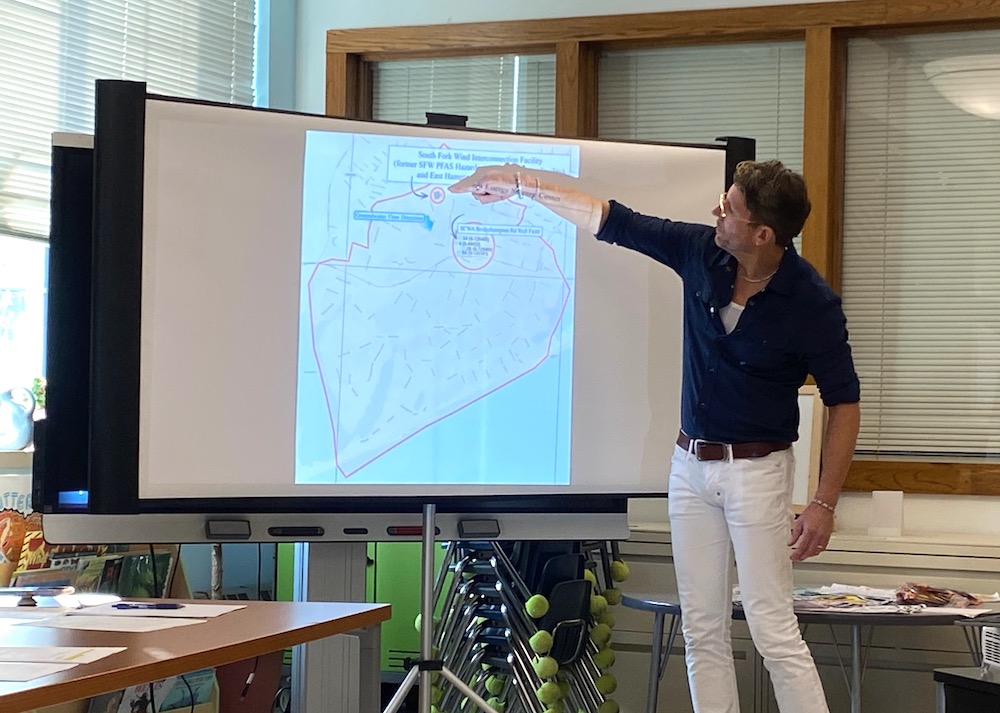
Saturday’s meeting of the Wainscott Citizens Advisory Committee got off to a rocky start when the committee’s chairman informed members and guests that, at the last minute and at the behest of the committee’s liaison to the East Hampton Town Board, he had unilaterally decided to rescind an invitation to a Wainscott resident who was to speak about contamination of groundwater with perfluorinated chemicals, or PFAS.
Also at the meeting, Councilwoman Cate Rogers, the liaison to the town board, gave Sept. 23 as the tentative date of a public information session to be given by Suffolk County officials, with the location to be determined. “We will share the details as soon as that date and location are confirmed,” she said.
The committee was to host Simon Kinsella of Wainscott, who had given a presentation at the Amagansett Citizens Advisory Committee’s July meeting that was critical of the town’s response to the Suffolk County Water Authority’s discovery of perfluoropropionic acid, or PFPrA, an ultra-short-chain chemical in the PFAS family, in wells at its Buckskill Road wellfield.
Subsequent testing showed increasing concentrations, and three drinking wells were taken out of service with a fourth available only for emergency use. PFAS are known as “forever chemicals” because they do not easily break down in the environment. There is no federal drinking water standard for PFPrA.
“I’ve gotten some comments to the effect that I should have consulted with the committee” before disinviting Mr. Kinsella, Hersey Egginton told the committee. “If that’s the consensus, then I acknowledge my error. It’s not that I don’t want to have the conversation, I do.” It “wasn’t an easy conversation with Si.”
“If somebody wants to sit here, I’ll be happy to turn over the chair,” Mr. Egginton said. “If that’s not the case, I’ll soldier on.”
Bruce Wayne Solomon of the committee said Mr. Egginton’s decision was appropriate, but Barry Raebeck, also of the committee, disagreed. “We should have decided that as a group,” he said, adding that “to put this issue off right now is inappropriate, because it’s an extremely pressing issue.”
Ms. Rogers said that “the most important thing is that, according to the Suffolk County Water Authority, the public water currently being delivered by them meets all drinking water standards.”
The New York State Health Department has established a preliminary site-specific screening level of three parts per billion while health effects continue to be studied, Ms. Rogers said. “Suffolk County Health is also testing private wells,” she added, referring to 25 wells in the affected area.
“We still do not have a final determination of the source” of the contamination, she said. “The investigation is looking closely at the 2023 fire at the [NextEra] East Hampton Energy Storage Center,” a battery storage facility known as a BESS, but the State Department of Environmental Conservation, the State Health Department, and the county have yet to make a final source determination.
The town submitted residents’ questions directly to the State and County Health Departments and the water authority, “including questions about the movement of the contamination, private well testing, potential health monitoring, and affected public wells and how residents will be notified as conditions change.” The town is also requesting a revised emergency action plan, a safety plan, and a hazardous waste management plan from NextEra by Sept. 30.
By Oct. 31, “we are requiring engineering controls designed to capture and contain all fire water and fire-related runoff,” as well as a study demonstrating that the facility is necessary for the electric grid, Ms. Rogers continued. Operators of the BESS are also required to allow the town access to the facility and to reimburse the town for associated costs.
“We have asked the D.E.C., the State Health Department, Suffolk County Health, and Suffolk County Water Authority to come before the town board,” Ms. Rogers said, “so residents can hear directly from the agencies conducting this investigation.” A date is expected to be announced “in the coming days.”
Months after the BESS fire, the state’s Inter-Agency Fire Safety Working Group, formed after that fire and two others at BESS facilities upstate, released its initial findings, the councilwoman said. “Based on the information available at the time, the state reports no harmful level of toxins and no evidence of significant offsite migration of contaminants associated with the fires.”
But in January, the water authority began using a newly developed method allowing it to test for ultra-short-chain PFAS compounds. It soon began to detect PFPrA in wells at the Buckskill Road wellfield. Subsequent testing showed increasing concentrations. On May 29, the water authority filed a federal lawsuit against the East Hampton Energy Storage Center and other companies, alleging that contaminations associated with the 2023 fire had reached its public water well supplies. “It is then that the town was alerted about the PFPrA contamination and the potential connection to the battery storage facility,” Ms. Rogers said.
Mr. Kinsella previously said that he had provided the town with an analysis in January 2024 showing that the 2023 BESS fire would have contaminated the aquifer with toxic chemicals. The town, he said, should have tested groundwater upon receipt of his analysis, which he said in June “clearly showed that the 2.2 million gallons of fire-extinguishing water used to suppress the fire would have contained toxic PFAS chemicals, which are essential components of all lithium-ion batteries.”
Asked about the town’s objection to Mr. Kinsella speaking to the committee, Ms. Rogers said, “I want to ensure that the information you all are receiving on this is based on the investigation, those involved in the investigation, and those with the testing results.” Social media, she said, is rife with “theories, a lot of unscientific information . . . and it’s an incredibly false and unhelpful conversation.”
There are more than 14,000 types of PFAS, and the “forever chemicals” are used in a wide range of products, from nonstick cookware and food packaging to clothing and home textiles, cosmetics, household cleaners and sealants, and firefighting foam.
More than 1,000 utility-scale BESS facilities are active in the United States, along with hundreds of thousands of residential and commercial installations. Their significance, said Lena Tabori, who is not on the Wainscott committee, “is that they are able to keep the sun shining and the wind blowing through storage, so they’re critically important to the whole movement of renewables, and the whole movement of renewables is critical to our overall health, because we’ve got to move off fossil fuels.” It is essential that BESS facilities be made safe because “as far as the future is concerned, we have got to have storage units.”
But in order to replace “the petroleum that poisons us,” Ms. Rogers said, “it has to be better than what would happen if you’re putting everything in the air” via fossil-fuel emissions.
She encouraged residents to visit the town’s website, where a page devoted to “drinking water questions and answers” was posted in July.