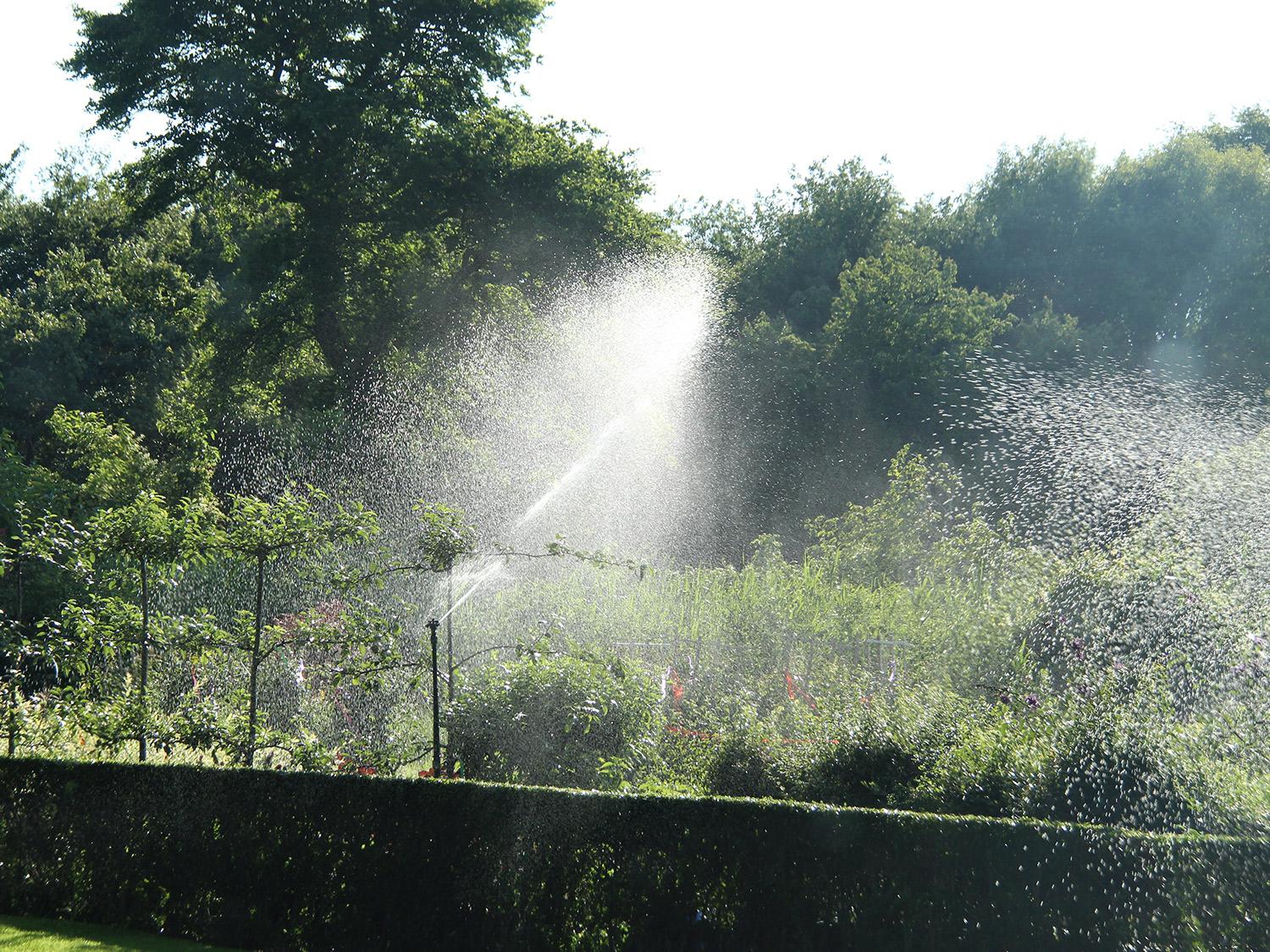
What seemed like a straightforward proposal for legislation that would create a lawn-irrigation conservation policy devolved into questions about intent and enforceability at Tuesday’s East Hampton Town Board meeting.
The new law was proposed against the backdrop of “severe drought” on the East End, as per the United States Drought Monitor. In July, the Suffolk County Water Authority mandated an “odd/even” lawn-watering schedule for its customers after pumping a record 11 billion gallons across its system, at times pumping over 540,000 gallons per minute.
Observant residents know that it doesn’t have to rain for there to be puddles on the roadways in the morning. Irrigation systems are programmed to water overnight, or in the early morning, and many of them are poorly designed. In early July, Mike Dwyer, a trustee of the Irrigation Association of New York, told The Star that most systems operate at only 30 to 40 percent efficiency.
On Tuesday, Jake Turner, the town attorney, introduced legislation that would adhere to the water authority’s July mandate. Even-numbered addresses would water on even-numbered days; odd-numbered addresses would water on odd-numbered days. Townwide, everyone would be prohibited from watering between 10 a.m. and 4 p.m.
Smart irrigation systems, which sense rainfall and won’t operate in the rain, and smart controllers, which are equipped with moisture sensors and adjust automatic systems to restrict flow to only what’s necessary, would be included in the restrictions.
New systems would need to incorporate the technology as of Jan. 1, 2027. Older systems would have until Jan 1, 2028, to be retrofitted.
The law would apply to both residential and commercial lawn waterers on either public or private wells (farmers are exempt), and violations would be punishable by fines.
“We find some folks set their irrigation and they’re back in the city during the week,” said Supervisor Kathee Burke-Gonzalez, who seemed supportive of the proposal. “We’re getting a rain bomb and they’re watering their lawn or the street.”
“When we’re driving around in a rainstorm and somebody’s irrigation is on their very green lawn, they’re irrigating the street, the lawn, everywhere else. It doesn’t make any sense,” said Councilman Ian Calder-Piedmonte. “But details matter.”
“We’re really talking about the total amount of water you’re using,” he said. “Are we targeting what we’re trying to target? Would a hand hose be allowed?” He also questioned the cost to homeowners.
“The code is for automatic irrigation systems. It doesn’t address hand watering,” Councilwoman Cate Rogers said.
“I use irrigation for my vegetable garden, but my veggie boxes are across my yard. Is that lawn?” asked Councilman Tom Flight.
“That’s for us to decide,” the supervisor said. “Part of an exception could be for vegetable gardens or flower beds.”
Councilman David Lys wondered how the law would impact golf courses, which use massive amounts of water and often water daily.
“ ‘Chemlawns’ are not worth anything,” Ms. Rogers said. “It’s important to note we’re running into more drought situations and running out of water, and it’s our drinking water. The idea of putting drinking water on a chemical lawn is beyond a waste of money. But I have a problem with this code for enforceability. Who is going to go up and down the street and look at house numbers?”
“You can get lush gardens without nitrogen, but you do need water,” said Mr. Lys. “I agree with you about enforcement.”
In a conversation with Russell Young, the director of code enforcement, Ms. Burke-Gonzalez said both agreed it made more sense to enforce the potential law through the Bureau of Administrative Adjudication, a Town Hall tribunal that has jurisdiction over civil violations.
“Does the board believe it makes sense to pursue this as long as we can address vegetable gardens, flower
gardens, golf courses, hand watering, that kind of thing?” the town supervisor asked.
“As it pertains to lawns, I’m totally supportive,” said Councilman Flight.
“If you have a flower garden on your residential property, that’s the same as a lawn,” said Councilman Lys.
“I disagree entirely on that,” said Councilman Flight.
It went back and forth. What if sprinkler spray landed on a flower, or vegetable?
What seemed simple at first, was not. The waters were muddy.
“I think code enforcement uses common sense when they’re going about their day,” said Supervisor Burke-Gonzalez. “If they’re seeing sprinklers on and it’s a hurricane, you shouldn’t have it on. If we are in a drought and people are watering massive lawns at 12 noon and there’s a prohibition from 10 to 4, that’s a violation, right?”
“The question is, how big of a problem is this, that we need to legislate for it?” Mr. Flight asked.
“Irrigation is putting a drain on our water supply,” Ms. Burke-Gonzalez reiterated.
“Most of what’s in this code comes directly from what the [water authority] recommendations are,” said Ms. Rogers.
Mr. Lys, unconvinced, said he wanted to see how a similar law in Southold was being enforced. “On the whole, I’m not there yet.”
“I’m skeptical but open-minded,” said Councilman Calder-Piedmonte.
No action was taken. The board moved on.