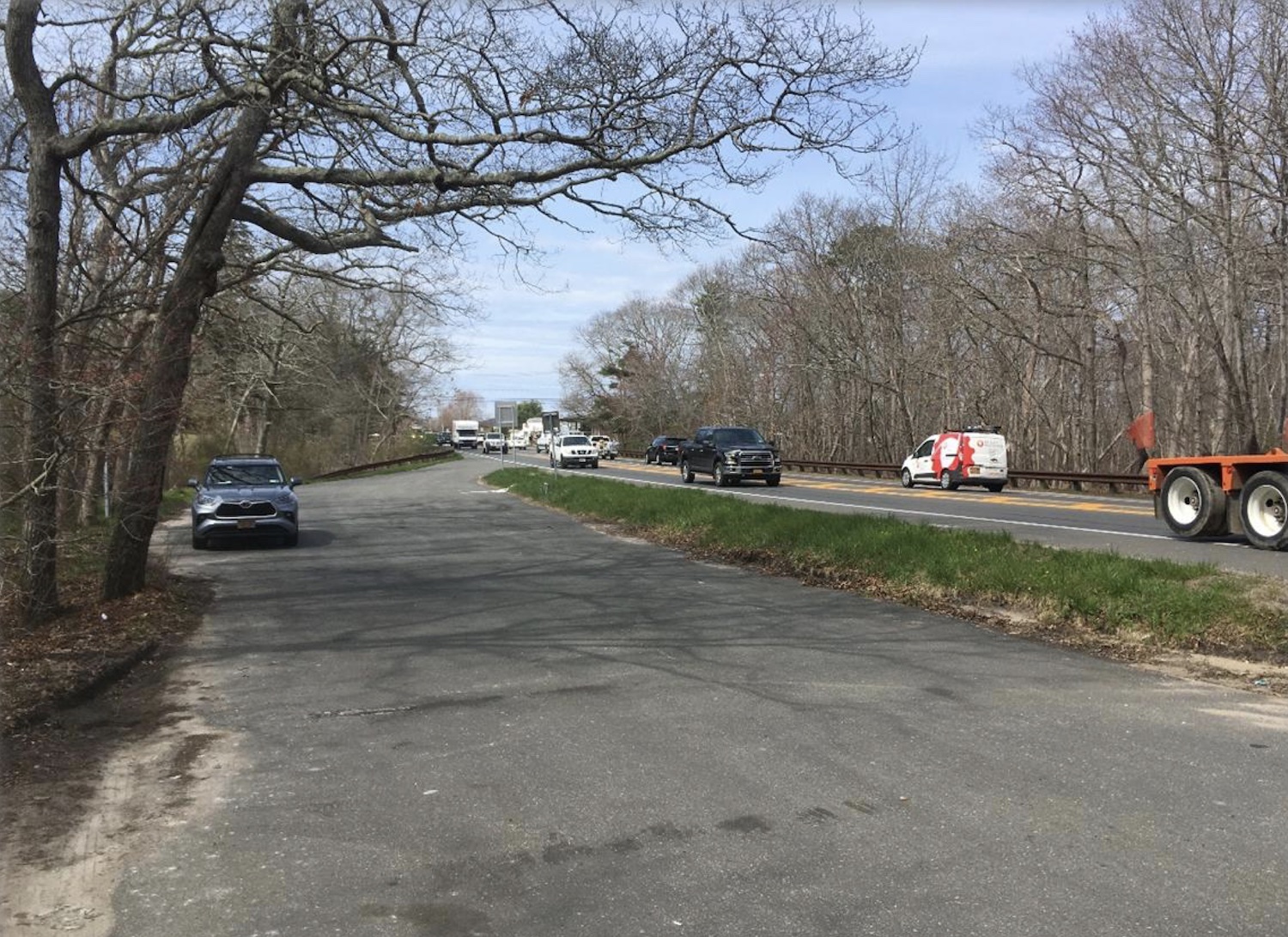
Work is imminent at the Montauk Highway rest stop on the northern edge of Georgica Pond, also known as Talmage Creek.
The stormwater mitigation project will cost just over $1 million, with $500,000 coming from the Dormitory Authority of the State of New York (which finances, designs, and manages construction projects for public and nonprofit institutions) and the remainder coming from the community preservation fund’s water-quality coffers. Both the Friends of Georgica Pond Foundation and the Peconic Land Trust are partners in the project, as well.
The primary goal of the work is to slow and treat runoff on the north and south sides of the highway, preventing it from dumping directly into the pond.
The pond’s slow-moving headwaters may barely register with drivers zipping by in cars and trucks a stone’s throw away. “You see the water down there?” Councilman David Lys said the other day, pointing at a trickle wending its way through vegetation on the north side of the highway. This meager flow was headed for a hidden culvert that passes beneath the busy roadway of Route 27. “I don’t think you would expect to see running water.”
The rundown rest area is well used, if perhaps underappreciated.
A cursory glance along the edge of asphalt in the parking area yielded a plastic container that once held Cool Cubes spearmint gum, a half-dozen Poland Spring water bottles, a Hampton Coffee cup, plastic bags, and assorted hunks of Styrofoam.
Six drivers were parked there midday on a Thursday. One truck idled for an hour, while behind it a man slept in his car. Others entered and exited, usually for brief respites — a text check, or, in the case of at least one contractor, a bathroom break. There are no toilets at the stop.
The gradient change from the highway to the 30-foot-wide pull-off area channels tainted stormwater toward the pond and is separated only by a six-foot island of grass, where more coffee cups were seen, along with plastic bottle caps and two whole bags of garbage.
“Obviously there’s a lot of trash here,” said Councilman Lys.
A tilted and windblown sign put up along the eastern edge of the property by the town’s litter action committee — but, in its current state, heading toward becoming trash itself — featured the committees new mascot, Sam the Dog, and its Instagram handle. During a brief pause in traffic, a leaf blower droned from some green estate south of the highway.
“This is a very high-profile location,” Councilman Lys said, raising his voice again to be heard over the traffic, “and this project has been a long time coming.”
He walked up to the western edge of the rest area along a new wooden guardrail, installed by the state’s Department of Transportation, and pointed to a small square of concrete mostly hidden by foliage. “Legacy drainage,” he said. Engineers identified the “watercourse,” or path, followed by stormwater runoff from Montauk Highway; this is where a track of riprap, or stone rubble, will be installed to lead the watercourse down a tiered bioswale.
Adjacent to the bioswale is the Georgica Pond Preserve, which is maintained by the Peconic Land Trust. It, too, has invested in water quality, winning a $521,235 water-quality grant from the Town of East Hampton in 2024 to install a permeable reactive barrier to trap contaminants before they hit the pond. Permits have been received, but the barrier has not yet been installed.
The main parking area at the rest stop will be porous asphalt, and permeable pavers will replace the current asphalt and Astroturf pond access, which has long been used to launch kayaks. The edge of the parking area down to the shore will be planted with native plants, including Pennsylvania sedge, little bluestem, black huckleberry, milkweed, swamp marshmallow, and sweet pepperbush.
There are a couple of beautiful oak trees in the area. “We’re going to try to keep as many of the mature ones as possible,” Councilman Lys said. One thing that will definitely be saved is a Department of Education plaque installed in 1963.
On the east side, under a flex-pave walkway, a below-grade stormwater-treatment system will collect runoff from the permeable paving area and treat the water before it enters the pond. The north side will get a split-rail fence beside the road and bioswale. Water that collects on the roadway will be diverted along a riprap outflow, north and west of the parking area.
The construction bid includes five years of maintenance. Most of the work is expected to be completed by April. The rest stop will be closed when work begins, but, Councilman Lys said, one side should always remain open.
Benches may be installed at the eastern end of the parking area. “We’ll see how it gets used,” he said. “You always want to make sure you don’t create an area that will be vandalized.”