In early November, the Atlantic States Marines Fisheries Commission Menhaden Management Board voted to reduce harvesting of menhaden, but not enough, according to at least one prominent conservation group and a scientist who has been closely watching the situation.
A recent study by Bryan Watts, director of the Center for Conservation Biology at the College of William and Mary in Virginia, highlighted in the Nov. 5 issue of The Star, concludes that deficits of menhaden, due to overfishing and climate change, are leading to worse reproduction numbers for ospreys than even during the height of the DDT era.
It’s so bad that osprey numbers could be halved in some areas in just five years.
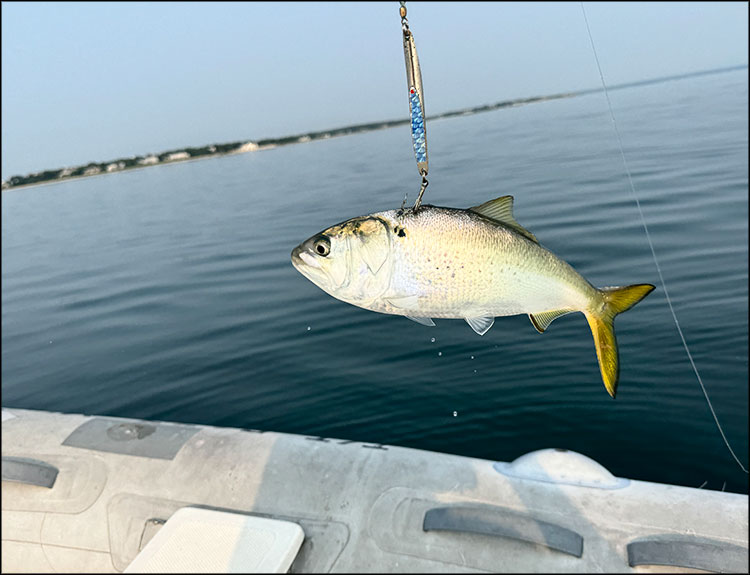
Menhaden are the most important forage fish for ospreys, striped bass, and humpback whales.
The commission voted to reduce the Atlantic menhaden catch quota by 9 percent annually over the next two years, and to cut the Chesapeake Bay catch by a third over the same time.
“Their own scientists say it’s not enough,” said Dr. Watts, in a phone call. “Their own staff is saying there needs to be a higher cut to meet the projected ecosystem requirements. There is clearly something else at play here, other than protecting the resource they’re mandated to protect, a public resource. The public expressed their concerns, and it appears they weren’t addressed.”
Two industries benefit from using menhaden: the bait industry and the darkly named “reduction” industry. Historically, there were reduction plants, a couple dozen, spanning from Novia Scotia to Florida. Now there’s a single plant, owned by Ocean Harvesters, located in Reedville, Va.
Ocean Harvesters may be only one company, but it’s mighty, with 10 ships and roughly half a dozen spotter planes working up and down the Atlantic Coast to locate schools of the fish.
When they find a big boil of fish, they call in a ship and large purse nets gather up enormous schools. Sometimes they capture so many that their nets break. According to seafoodsource.com, a seafood industry professional website, in one net break incident in 2022, nearly a half million menhaden were lost and washed up along the shore in Virginia.
Ocean Harvesters and its partner Omega Protein process menhaden into fish oil, found in dietary supplements sold at health food stores and in fish meal. They capture the fish and boil off the lipids and oil. The remaining protein is dried and ground up. Some is used for chicken and pig food, but a larger portion is being used by salmon farmers.
“The decision they made is more political than biological,” said Dr. Watts. “The industrial harvesters benefit. They’ll claim their workers and the local economy benefit, but it’s hard to see where else the benefit accrues.”
After the fisheries commission’s decision, the Theodore Roosevelt Conservation Partnership, which is interested in menhaden chiefly because of their impact on striped bass, a popular sport fish, also criticized the commission for not being stronger in its catch reductions.
“While we are encouraged by the Chesapeake Bay cap reductions in particular, this was unfortunately another year of the A.S.M.F.C. failing to manage menhaden according to its own ecosystem-based science,” said Jaclyn Lunaas, forage fish program manager for the Theodore Roosevelt Conservation Partnership.
Her group had sought a 39-percent reduction in the coastwide catch limit and 50-percent cut to the Chesapeake Bay cap.
“The board elected to establish the lowest coastwide quota in the history of the fishery, which is seemingly a positive outlook for conservation, but this decision will not meaningfully reduce actual harvest by the industrial reduction sector,” she added. In fact, she said that Ocean Harvesters has only been able to land a small fraction of its allowed quota, due to lack of fish.
Locally, the paucity of menhaden is likely impacting ospreys.
“Every kid [osprey chick] that made it to fledgling was considered a blessing,” said Jessica Chiarello, the hospital supervisor for the Evelyn Alexander Wildlife Rescue Center. She noted that many wildlife photographers told her there was a low survival rate for nestlings they were monitoring. Ms. Chiarello herself monitored a nest in Flanders where no eggs were laid.
The Group for the East End has said it will do a full survey of osprey nests this coming breeding season.
Dr. Watts said some people in Virginia have taken to providing fish for the osprey, but this is not sustainable. “Ospreys are an important part of bay culture. These people are watching the same pair in the same nest for 20 years. It grieves them their birds are struggling to produce any chicks, so they may try to help a specific pair.”
One decision, about reallocating the menhaden catch quote between states, was put off by the fisheries commission until a January meeting. At present, Virginia gets 75 percent of the coastwide quota of the fish, which obviously benefits Ocean Harvesters. In January, the fisheries commission will also rule on changes to horseshoe crab harvests.
The public can submit comments to [email protected] or to the New York State administrative commissioner for the A.S.M.F.C., Marty Gary at martin.gary.dec.ny.gov.