Elaine de Kooning’s tempestuous engagements, intellectual interventions, and artistic pursuits across half of the last century have so preoccupied biographers that even the most recent publications have lacked insightful assessments of the prodigious artwork that the frenetic life produced.
Two recent solo exhibitions that partly redressed the deficit were “Elaine de Kooning Portrayed,” at the Pollock-Krasner House and Study Center in 2015, and “Elaine de Kooning Portraits,” a large retrospective at the National Portrait Gallery in Washington, D.C., in 2015-16. However, her relevance to the art of today awaits an institutional event as comprehensive as the seven-museum traveling exhibition organized three decades ago by the Georgia Museum of Art.
The current exhibition “Elaine de Kooning” at Manhattan’s Berry Campbell Gallery, which runs through Dec. 19, is an eclectic step in that direction, featuring 34 works that manifest Elaine as a leading conduit channeling the prose of figurative and landscape painting into the poetry of Abstract Expressionism.
The show takes up the “E de K” story around the time she and Willem de Kooning spent the summer of 1948 at Black Mountain College, where she produced 17 abstractions, two of which were borrowed for this show. It then traverses through the 1950s, a period in which Elaine occasionally relocated for university teaching jobs in the American West. It also takes in her busy, mercurial late career in which she worked at 45 Alewife Brook Road in Northwest Woods, the studio that represents the most permanent address in a peripatetic career.
Visitors to the Berry Campbell Gallery will witness an egalitarian artist crisscrossing the country, painting the nation’s burgeoning poets and painters, its magnetic new president, its sun-scorched deserts and its verdant woods. There are penetrating and often beatific portraits of relative strangers and intimate partners, likenesses of uniformed workers and patrician powerbrokers, hippie-era youths and charismatic elderly patrons. Still other paintings conjure basketball players driving for the boards, while a quartet of multimedia works capture raging bulls bearing down on matadors in the bloody corridas of Ciudad Juarez, Mexico.
Perhaps the exhibition’s most palpable contribution is how it dramatizes the long-term impact of those western sojourns on her style. The panoramic skies and emblazoned topography she encountered clearly electrified her palette, inspiring prismatic colors in her pursuit of light as an exploding force at the heart of her chosen subjects.
Some of her career’s largest single portraits are here. The life-sized “Peter” (1956) depicts the artist’s younger sibling in cyclonic floral pinks and pale greens, a botanical whirlwind that challenges the young sitter’s stiff wariness. A large-scale likeness of the artist Robert Mallary builds on a strange tension between his barrel-chested long arms hugging his thick legs and the soft sensitivity of his contemplative, pink visage.
In “Frank Lima” (1963), a rarely seen portrait of the young New York School poet, the East Harlem native sits with his large hands clasped over each other in tender resignation. With head hung low he seems to be bearing multiple worlds on broad, slumped shoulders while blue, yellow, and orange squibs around his furrowed brows suggest rippling desires or muted regrets.
One of her most recurrent sitters, the Greek-born, Turkish-educated iconoclast Aristodimos Kaldis, is volubly present. With a glinting gaze and affable, knowing grin, he looms over the exhibition like a loft-dwelling version of an Old Testament prophet. The long-haired artist’s trademark shabby overcoat and oversized scarf are in riotous reds and stippled violets cascading down his mountainous frame.
Several works from her famous late-1962 commission to paint President Kennedy’s portrait for the Truman Library are in the show as well. The project famously led to over 100 sketches, drawings, and paintings, consuming a whole calendar year, a fiery passion snuffed out by the assassination in Dallas in 1963. Four artworks included here demonstrate the many rehearsals she created on the way to the official, submitted version, from nimble gestures and contour studies to an experimental collage and even a jazzy subversion of the state portrait genre.
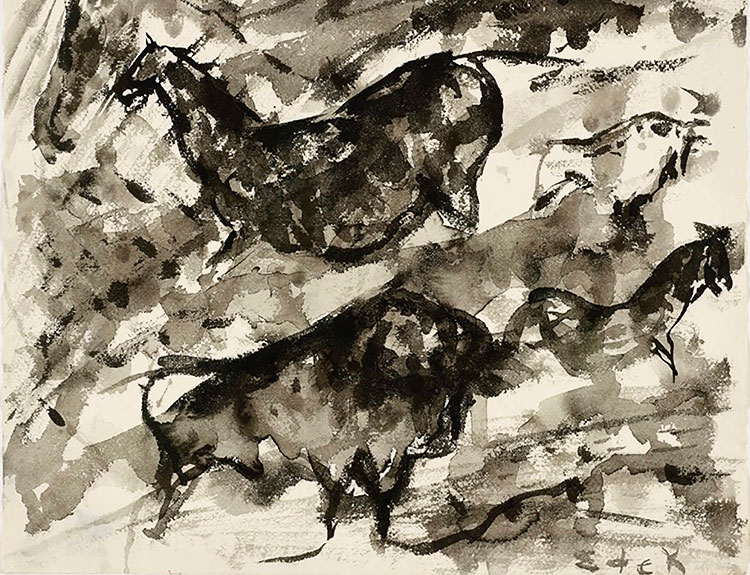
A few late works reach back to a classical myth, and beyond to prehistoric cave art, demonstrating that she made good on her claim that the subject of any work of art is, in the end, always art itself. There is a large oil painting from her Bacchus series inspired by Aime-Jules Dalou’s bronze sculpture “The Triumph of Silenus” in the Luxembourg Gardens of Paris. Then, in the encroaching shadows of her own mortality in the mid-1980s, she forged her last series inspired by animal imagery in prehistoric cave art, which she had studied on successive trips to caves in southern France and northern Spain.
“Nature is the present,” she wrote in the mid-1950s, adding the cryptic caveat that “art is the future.” Given her courageous yet sober-minded resolve, Elaine de Kooning remains the most Romantic of modernists, perhaps an art world successor to Long Island’s Walt Whitman, who viewed art-making as a phenomenon equal to American democracy, an event unfolding each day in a country he blithely defined as “life’s gymnasium.”
—
Tim Keane is a visual artist, art critic, poet, professor, and journalist. His writing has appeared in The Brooklyn Rail and Hyperallergic.