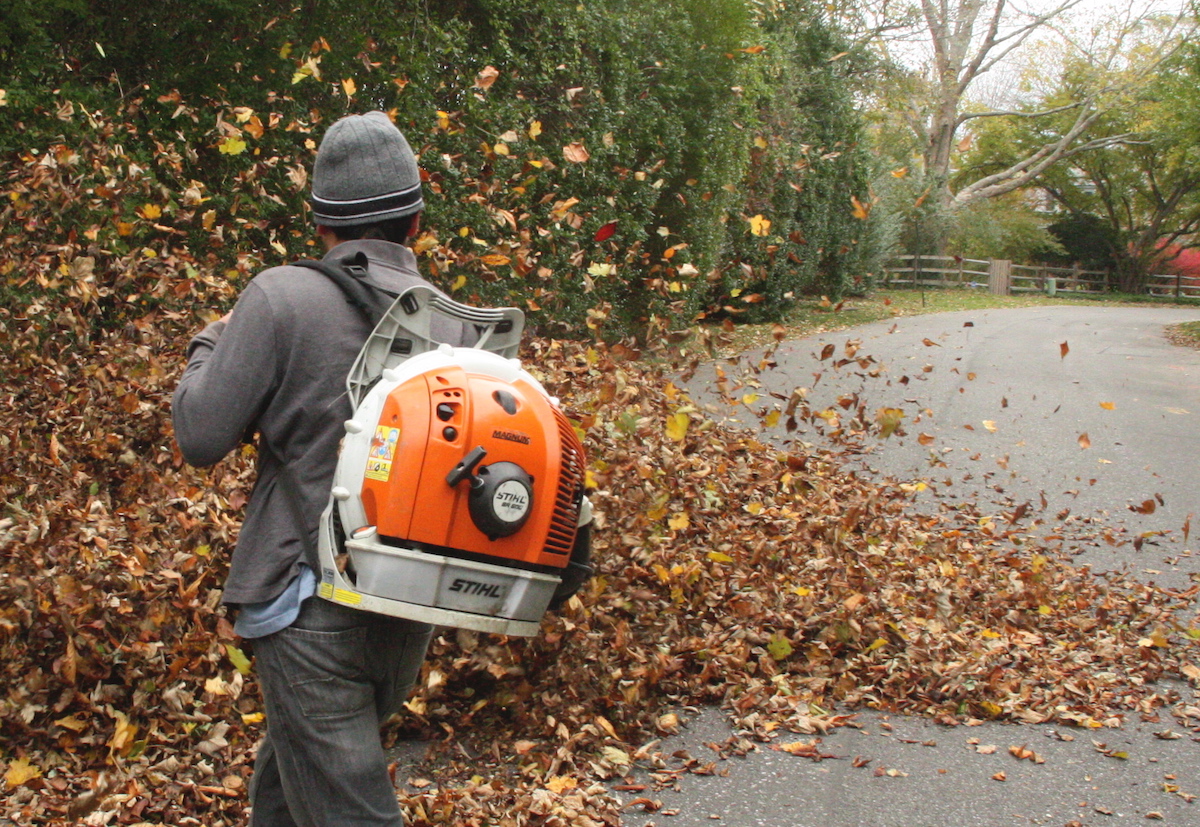
As the leaves began to fall, a dozen East Hampton Town residents appeared at last Thursday’s town board meeting to call, once again, for a year-round ban on gas-powered leaf blowers.
At present, the town prohibits the noise and air-polluting blowers only from May 20 to Sept. 20, largely to the benefit of summer residents.
“For those of us living on smaller lots, the impact is unavoidable,” said Susie Rakowski. “Many of the people who hire these landscapers aren’t even at home when these blowers are blasting away. They’re here only on weekends. We are effectively trapped in our homes.”
“Doesn’t the code say something about how we’re entitled to the peaceful and safe enjoyment of our properties?” she asked. “Many elected officials tell me they want to protect our environment, control noise pollution, and preserve our quality of life. If you truly care about the environment, you can prove it to us now. If you care about our well-being, now is the time to enact a year-round ban.”
Local villages have been more progressive in addressing the matter. Southampton Village enacted a total ban on gas blowers in 2024. North Haven bans them from May 1 until Nov. 1. East Hampton Village extended its ban this year to match North Haven’s. And Sag Harbor Village is now considering a year-round ban as well.
Aidan Corish, a Sag Harbor Village trustee, said Tuesday that he believes he has the “full support” of his board for the legislation, which could have a public hearing in December, though he noted he couldn’t speak definitively for his colleagues.
The last time Sag Harbor changed its code was six years ago. At the time, Mr. Corish said, the board let contractors know that the village’s own use of gas-powered equipment would eventually be phased out.
“They’ve had six years to make the transition,” he said. “It’s going to be hard for them to gain anyone’s sympathy. There have been a lot of technology improvements in the last six years. A full ban, without carve-outs, will also be easier to enforce.” Gas blowers could be used, he stressed, if the mayor declared an emergency, such as a hurricane. East Hampton Village Mayor Jerry Larsen said this week that he is also open to increasing the village ban, perhaps to a year-round one.
“I’m personally not opposed to a year-round ban, but I can’t speak for the board,” he said. “Southampton Village did it in 2024 and everything is working out. Their mayor said they’re not having any issues.”
Southampton Village Mayor Bill Manger did not return a request for comment.
“I believe if East Hampton Town leads, Southampton Town will follow,” said Lena Tabori, a board member of ChangeHampton, which has been circulating a petition, reported elsewhere in this issue, urging the town board to create a year-round blower ban.
The hatred people feel for the machines was apparent during the public comment portion of last Thursday’s meeting.
“These incredibly loud and obnoxious machines are the bane of our existence this time of year and up to Christmas. Then it begins again in early spring,” said Barry Raebeck.
Residents spoke of cancer and cortisol, sound rumbling through brick walls, and tiny particles that penetrate lungs. They spoke of heart attacks, strokes, feces, full throttles, benzene, battery life, bad habits, and “acoustic violence.”
Bruce Horwith explained how decibels work and said gas-powered blowers are five and a half times louder than their electric cousins.
“It’s not just that they’re louder, but their sound frequency and travel distance differ. A gas-powered leaf blower produces a noise in the 100 to 200-hertz range with long wavelengths. These travel farther and pass more easily through exterior walls, doors, and glass into neighboring houses. The electric, on the other hand, is producing a frequency in the 600 Hz or higher range. These shorter waves sound whiny and loud close up, but they dissipate rapidly in the air and they don’t travel very well through fences.”
They also spoke of money and return on investment. Francesca Rheannon, a member of ChangeHampton’s advisory board, said she’d interviewed Jackson Dodds, a landscaper who has transitioned part of his operation to electric. Because each municipality has different regulations, he told her, he has to maintain two sets of equipment, gas and electric.
“That doubles his equipment costs and upgrade expenses,” Ms. Rheannon said. “Consistent year-round regulations would help eliminate that burden.”
Indeed, Adam Goldwasser, co-founder and chief operating officer of Greener, has built a business helping homeowners switch to “mow-bots,” silent, automated lawn mowers.
“Through our work with Hamptons robotic mowing, we’ve seen firsthand how the right equipment and implementation strategy can change the economics of a landscaping operation,” he told the town board. “I want to address a fundamental question at the center of this debate. Is transitioning away from gas-powered landscaping equipment practical for local businesses? From my experience in this industry, the answer is yes. With the right equipment and utilization, going electric can improve your bottom line rather than simply add expense.”
Apart from the human financial and health costs, the use of gas impacts the environment.
“Ecosystems are disrupted and microhabitats are destroyed, with the depletion of the insect population, including pollinators and the loss of birds and other small animals,” said Basia Kinglake, a town resident. She also hinted at another issue: enforcement. Fines must be issued, she said, for violations, and the fines could increase with multiple offenses in the same calendar year.
“Most of the laws in East Hampton are great laws,” said Tom MacNiven, “but where they break down is in enforcement. This is a prime example. Homeboy pulls up in his battleship with his equipment, comes off with his gas leaf blowers, starts in, and the good citizen calls in to code enforcement and says, ‘I think there’s gas leaf blowers out there.’ Well, the chances of code enforcement getting out there to witness it, it just doesn’t happen. And it’s man-hour and it’s paperwork and it’s time. And if you had a law to just ban the damned things, we’d all save a little bit of money.”
Finally, there was an appeal to perspective.
“Change is often met with resistance, with cries of impending doom,” said Mr. Raebeck. “But we know that the doomsayers are generally proven wrong, and quickly.”
“Most of the population of East Hampton — that’s 75 percent of us that are 45 years or older — grew up in a world where gas-powered leaf blowers did not even exist,” said Mr. Horwith. “These are a creation of the last 40 or so years. We all seemed to survive pretty well without them before.”
“I remember a time when the McKee family cut just about every lawn in East Hampton from the back of a little pickup truck, with one lawn mower, a rake, and a broom,” said Mr. MacNiven.
“We’re all resistant to change,” said Gail Pellett, co-founder of ChangeHampton. “That seems to be a human given. I’m old enough to remember when all the bars and restaurants in New York City wailed that they were going to lose all their business because of the new smoking laws. It didn’t happen.”