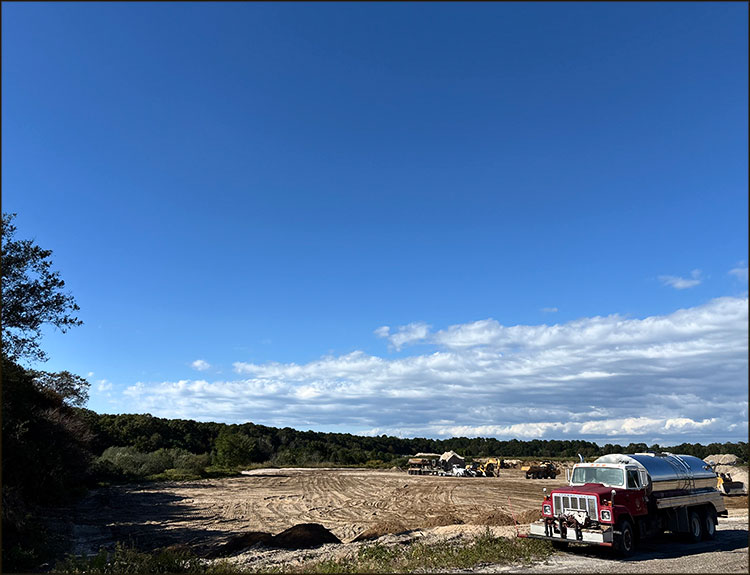
John Tintle, the owner of the former sand mine in Wainscott that his father, William Tintle Jr., purchased in 1986, looked north across its sandy acres earlier this month, days after East Hampton Town announced its intention to purchase more than half of it, assuming Thursday night’s public hearing goes well.
How would his dad feel about that?
“I think he would like the fact that part of the land is being preserved,” said Mr. Tintle. “I think he would just like that something’s happening, because it was frustrating for a long period of time, where there was nothing to talk about.”
The town hopes to buy 38.3 acres of the 70.5-acre lot for $36 million, with 33.3 acres set aside for parks, recreation, and open space and five acres for “municipal purposes.”
The elder Tintle purchased the property, then in foreclosure, from the DiGate family. At the time, there was a 16-acre, 40-to-50-foot-deep, manmade lake on the property. The Tintles mined for gravel, then for sand.
“We were removing the gravel from the sand, and the sand was going back into the lake. Between 1986 and 1996, we filled the lake in. It was crystal clear blue water,” he remembered.
Long before the nematode responsible for beech leaf disease descended on Long Island, there was the “golden nematode,” which ate potato plant roots. “The D.E.C. likes to keep track of nematode soils and make sure they’re not leaving the Island,” said Mr. Tintle. As a result, when he began to “rebuild a soil profile” on the property, he received truckloads from Sagaponack, Bridgehampton, and Wainscott.
“So, this was the perfect location to move nematode soil. When Ira Rennert was developing his massive property, we took in about 75,000 yards of soil from just that property,” he said. Everything now green in the “sand pit” is growing on soil brought from nearby farm fields. The western side of the mine is heavily wooded.
“I had a friend who was selling his nursery, back in 2006,” added Mr. Tintle. “I bought all the trees. We planted several thousand.”
Mr. Tintle, who studied economics in college, comes across as a reserved guy, and demurred when asked to pose for a photograph. He wore blue jeans and a tucked-in, blue, collared shirt with a baseball cap and goodr sunglasses, looking more like a midwestern rancher than one of the largest landowners on the South Fork.
In his office overlooking the mine, he has a Dead and Co. poster.
Mining, however, is a dangerous and controversial business.
His Sand Land mine in Bridgehampton has been “dormant since 2023” locked in litigation with Southampton Town over its impact on groundwater.
“We’re working our way through some issues with the town,” he said. He owned a third mine in Montauk that was decommissioned and sold to East Hampton Town before it became a park.
You might know it as Eddie Ecker County Park.
Mining just isn’t something that seems to mix with Long Island, but it’s an important local industry.
“It’s where all the sand for Manhattan comes from,” said Mr. Tintle. “I manufacture soils for the parks and stadiums in the city. We did the great lawn in Central Park, every major park in Battery Park City, Hudson River Park, Citi Field, and a soil blend for the new soccer stadium that’s being built next to Citi Field.”
Two payloaders scooped from a large sand deposit midmine. They emptied their loads into a dump truck, which then drove a couple of acres south to deposit the sand in piles on what could be the town land. Soon bulldozers would flatten the piles, ultimately raising the elevation of the mine a couple of feet before soil is brought in.
“We’re adjusting the grade,” said Mr. Tintle. “We’re moving a lot of earth here, and my goal is to have it hydro-seeded by the end of the month.” Hydroseeding actually began last weekend. “We’re moving 2,000 yards a day.” Each dump truck carried about 30 yards of sand, which meant nearly 70 trips daily across the mine. When complete, he said, most of the site would be about 17 to 18 feet above sea level, which he estimated to be about 10 feet above groundwater.
A massive white pile of aggregate loomed on the eastern portion of the mine, a result of a giant concrete retaining wall that was demolished and processed on site. It will eventually be sold and have a future life under roadways or patios. “In the ‘90s, everyone stopped burying all their garbage on Long Island,” explained Mr. Tintle. “We began recycling as much as we could. Concrete is one of the bulkier things that could be recycled.”
In the last five years, what was known as the Wainscott Commercial Center before the East Hampton Town Planning Board, a 50-site commercial industrial subdivision plan for the sand pit, dominated discussion of the land’s future.
The community was solidly against it. Residents questioned whether 50 commercial sites was the best use of the land and cited traffic and environmental concerns. Georgica Pond is only a few hundred feet from the southeast corner of the lot; whatever happens in the pit affects the pond.
He was unfazed. “I’m into controversial land uses. We didn’t think that was a lot of opposition for an application this size. I’ve had 300 or 400 people at meetings before.”
Mr. Tintle said various plans had been presented to the town since the late 1990s. The comprehensive plan of 2005 slowed the process and vaguely called for “further study” of the sand pit.
It took 10 years for that “further study” to materialize with the hamlet plan process. “That’s when I re-engaged with the Planning Department,” he said. However, he said there was nothing “definitive” even with the Wainscott hamlet study, which itself took a few more years and offered “an illustrated concept plan” for the parcel.
Parklands and affordable housing were promoted. “I just didn’t know how to recognize the hamlet plan while still trying to subdivide the property,” he said. Nor could he build affordable housing. He offered to sell lots back to the town, but no one seemed happy with that idea.
He continued with the 50-plot subdivision plan and produced massive environmental impact statements per the New York State Environmental Quality Review Act requirements.
Then, in March, he began discussions with the town.
“I let the town know that I would be willing to sell the property at a significant discount. That price you guys reported in the paper is a 25 percent reduction to the appraised value of the property.”
The appraisal was based on what the property would be worth had the subdivision been completed.
If the sale goes through, the town will own 38 acres, Mr. Tintle will hold and develop 19 on the northern portion of the property along the railroad tracks, and Riverhead Building Supply, which has taken over the masonry operations (which have occupied that area of the parcel, in one form or another, for 40 years) on the southeast corner, now owns 13 acres -- nine in the southeast corner and another four-acre lot just north.
“I’ll re-engage with the Planning Department to amend my original application, and I’ll propose a number of commercial lots over my 19 acres,” he said. “There’s sizable demand for commercial industrial. Let’s say I end up with 14 or 15 lots back there, that’s actually a community need.” Another need is public transportation, but he was skeptical that vision would ever be realized.
“It would be genius,” he said. “You could have a rail stop here and plumbers, electricians, and landscapers could have their trucks parked here. But you’d need the state to be involved. Even if they engaged, it’s decades away.”
The payloader droned from the center of the mine. The man operating it has worked for 40 years in the Tintle mines. An eagle soared overhead before swooping down to drink from a large puddle. It could have been a sparrow. The scale of the place swallowed everything.
The town board meetingThursday night begins at 6 p.m. at Town Hall.