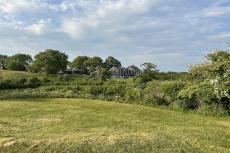
A plan to replace a large asphalt parking area, remove invasive species, and create bio-retention areas that could help filter and capture stormwater runoff before it reaches Lake Montauk moved ahead at the April 8 meeting of the East Hampton Town Board. The West Lake boat ramp, the project target, is large, denuded of vegetation, and its asphalt and hard-packed soil is on a pitch that sends it directly into the lake.
According to Patrick Derenze, the public information officer for the town, there is not yet a cost estimate for the project.
Lake Montauk is 900 acres, and its watershed is three times as large. Pesticides, fertilizer, detritus from cars driving up to Montauk Harbor, drinks spilled at Ruschmeyer’s, basically anything that hits the ground and isn’t picked up, gets washed lakeward during storms.
The board was completely supportive of the idea, and Councilman David Lys, who had presented the same plans to the Montauk Citizens Advisory Committee the evening before, indicated that “they’re all very happy” as well.
Thomas Schaefer, an engineer with D&B Engineers and Architects, explained the details with the board. The asphalt would be replaced with a permeable paver system to allow at least some runoff to be captured by seepage. The excess water would be guided into three separate bioswales by the newly graded road. A bioswale at the entrance, just off West Lake Drive, would help capture and slow runoff coming from as far away as Culloden Point. Two other bio-retention areas would be closer to the lake, on the north and south sides of the 11,500-square-foot boat ramp road.
“There has historically been the removal of vegetated buffers,” Mr. Schaefer told the board.
The bioswales would be heavily planted with native shrubs, like Virginia rose and groundsel bush, and perennial grasses and groundcovers like seaside goldenrod, Joe Pye weed, and little bluestem.
“Our goal here is to have a high-density planting to ensure the likelihood of the establishment of these plants and to eliminate the ability of invasive species to creep in,” he said. He estimated it would take three years for the new plantings to be established. His company would maintain the site for the first five years, checking it biannually for invasives, and hand it off to the town after that, when it should be in good order.
Importantly for boaters, Mr. Schaefer, after questioning from Councilman Tom Flight, said none of the existing area used for placing boats in the water and removing them would be diminished. The space for the bio-retention areas would be created by the removal of invasive species that have now colonized the north and south sides of the ramp, not by removing roadway. The boat ramp itself is in good working order and will not be replaced.
“The goal is not to disrupt the boating season,” Supervisor Kathee Burke-Gonzalez said. “Otherwise, our phones would be ringing off the hook.”
A timeline provided by Mr. Schaefer showed work beginning in the autumn and completed by February. “We’re going to eliminate the direct stormwater runoff that currently goes into the lake and try to beautify the site,” he said. Part of the beautification includes removing and replacing a chain-link fence.
Councilwoman Cate Rogers took issue with such fences, saying they “get impacted by the salt air and the salt water, and look awful.”
When Mr. Schaefer said the fencing could be changed, suggesting one coated with PVC vinyl to “increase its life span,” Councilwoman Rogers balked. “Maybe we could have something completely different that’s more environmentally friendly,” she offered.
Mr. Schaefer said he’d look into other options. Split-rail wooden fences will demarcate the bioswales.
He explained that the project, a result of the Lake Montauk Watershed Management Plan, was developed in collaboration with the town’s Aquaculture Department, Marine Patrol, and Department of Land Management. A permit application was submitted to the New York State Department of Environmental Conservation on Feb. 28, and the engineers are waiting for approval.