
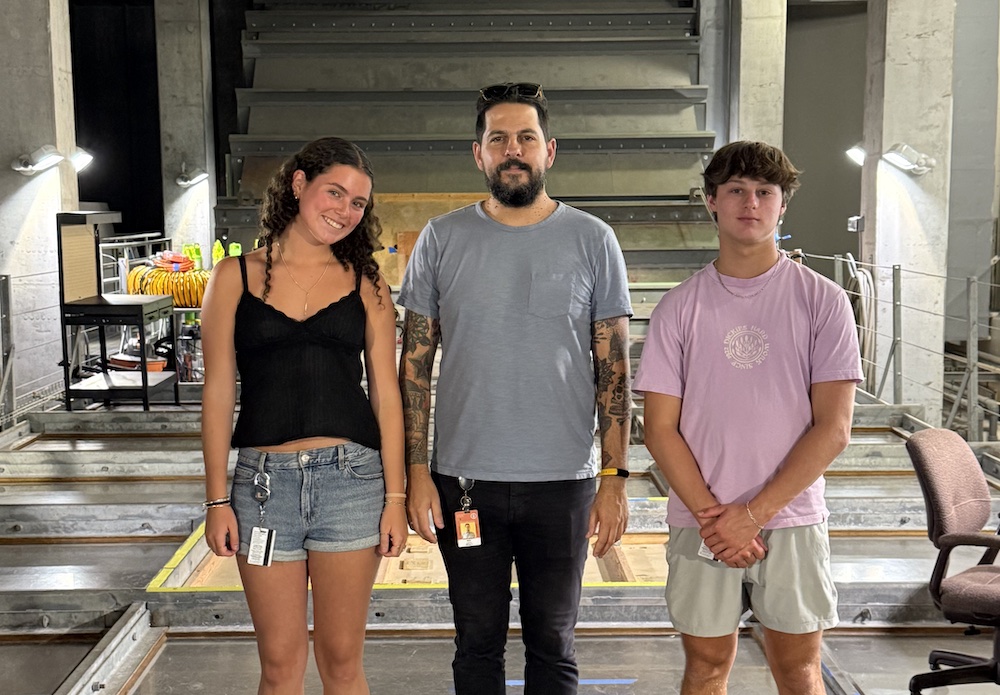
The National Science Foundation has awarded Milan Curcic, Ph.D., a University of Miami ocean scientist, a prestigious $700,000 CAREER grant that includes funding for his ongoing partnership with East Hampton High School’s science research program. The partnership has already given students a rare opportunity to study hurricane-driven waves in a state-of-the-art laboratory.
It began with a bold email sent in 2024.
Cole Dunchick, then a sophomore at East Hampton High School, was looking for a mentor as he researched how hurricanes and high winds affect ocean waves for the school’s three-year science research program. He contacted Dr. Curcic, an assistant professor of ocean sciences at the University of Miami’s Rosenstiel School of Marine, Atmospheric, and Earth Science. Dr. Curcic studies how winds and waves interact during extreme storms, with a focus on small-scale processes that can influence hurricane behavior.
Cole’s email was thoughtful, well prepared, and supported by dozens of peer-reviewed articles. But an attachment particularly caught Dr. Curcic’s attention.
“In that email he already had attached a file of a scientific poster that he made, in which he referenced some of my prior work and he even put me as a co-author on his poster,” Dr. Curcic explained.
No student had ever done that before.
“He was very forthcoming about how he was really interested in how waves are being generated by storms and what makes the surf the way it is. He had found some of my prior papers that were useful to him for what he wanted to do and he asked if I’d be willing to mentor him on his project and be a co-author on his poster,” Dr. Curcic added.
It was a bold approach and it worked. Dr. Curcic accepted the invitation and mentored Cole through the completion of his research project last year.
During the summers of 2024 and 2025, Cole spent time at the Rosenstiel School in Miami, working with Dr. Curcic in the university’s state-of-theart wind-wave tank.
“In the SUSTAIN Laboratory, I helped set up and run experiments in a wind-wave tank, installing wave staffs and working with instruments that measured wave and wind conditions. We gradually increased wind speeds to simulate storm conditions and measured how wave height and behavior changed. I also worked on experiments using mangrove models to study how coastal vegetation can reduce wave energy,” Cole explained.
Outside of the lab, Cole focused on Hurricane Erin -a storm that developed off the coast of Africa in August of 2025 and achieved Category 5 strength.
“I used Python and NOAA [National Oceanic and Atmospheric Administration] buoy data to analyze wave height, wave period, and wind during hurricanes, including a project on Hurricane Erin that compared waves on the left and right sides of the storm track. Working with [Dr. Curcic] allowed me to connect hands-on laboratory experiments with real-world hurricane data,” Cole said. “We would hold weekly meetings during the school year to stay in touch and ensure my work was on schedule, and he was always available via text or email if I needed help between meetings.”
That mentorship has since extended to Ella Menu, now a senior at East Hampton High School. Ella visited the SUSTAIN Laboratory this past summer, for the second time, and ran experiments in the wind-wave tank. She will present her work at the school’s annual Science Research Symposium next April.
“My research focuses on how ocean waves grow and change under strong wind conditions, with a particular interest in the nonlinear processes that influence wave energy,” Ella said. “Working with Dr. Milan Curcic and his research team has allowed me to move beyond simply learning about ocean science in a classroom and actually collect, analyze, and interpret data from real experiments.”
Ella said Dr. Curcic’s guidance has been as valuable as the technical experience.
“I am incredibly grateful for the opportunity to be part of this research and, especially, to work so closely with Dr. Curcic,” Ella said. “Beyond his expertise, he is an incredibly kind and dedicated mentor, and his genuine passion for both the research and my growth as a student has made this experience especially meaningful.”
Sara Smith, the principal of East Hampton High School, said she was pleased to see Dr. Curcic’s relationship with Cole create similar opportunities for another Bonac student.
“It’s impressive to see our students at the high school level engaging in that kind of scientific and academic discourse,” Ms. Smith said. “They are doing work that is often associated with the postgraduate level, and that is an incredibly valuable and unique opportunity for our students.”
The CAREER grant will support Dr. Curcic’s research over the next five years and could allow him to continue working with East Hampton students through campus visits, mentorship, and potentially local field experiments. It’s a game changer for Bonackers who want to explore weather and waves.
“Our collaboration with Dr. Milan Curcic from the University of Miami offers students in the science research program at East Hampton High School a truly exceptional gateway to real-world scientific inquiry,” said Stephanie Forsberg, Ph.D., who leads the research program along with Paul Rabito, Ph.D., and Renee McGuire.
“By working alongside university mentors and engaging with advanced research methodologies, our students are not only challenged beyond the typical classroom -they’re gaining invaluable preparation for college and future careers.”
The program has also helped students distinguish themselves in the college admissions process. Last year, Owen Browne, a member of the class of 2026, received a full scholarship to Eastern Connecticut State University’s honors program after researching how different types of music affect lettuce growth. The head of the honors program told Owen that his research experience and familiarity with college-level writing made his application stand out.
Ms. Smith has also been impressed with the ways students mature while doing their scientific research.
“We often see a student pivot once they enter the science research program,” Ms. Smith said. “They become completely engaged in their academics and their research, and they gain confidence and academic focus because the level of research they are doing is cutting edge.”
She said students also develop soft skills, including public speaking, by presenting their work at the school symposium and at competitions such as the Long Island Science and Engineering Fair.
“When they go to competition, they’re wearing a suit, presenting themselves professionally, and they’re very polished,” Ms. Smith said.
Cole, who just started his freshman year at Duke University, is already seeing the benefits of the work he did with Dr. Curcic.
“I came into college already comfortable with research, coding, and reaching out to professors, which has made the transition to college-level work much easier,” he said. “I felt that much of the work I was doing with Dr. Curcic was relevant to the work here.”
He hopes the grant will create similar opportunities for other East Hampton students.
“Being able to work directly with university researchers while still in high school is a special experience,” Cole said. “You gain so much knowledge at such a young age that it is hard to find anywhere else. I’m extremely grateful for my time with Dr. Curcic, and I’m so happy that other students will have the same experience I did.”
As Dr. Curcic considers how he will use the new grant in the years to come, one thing is certain: He’ll be spending a lot more time working with the bright young minds in East Hampton.
“There are some ideas about visiting for the symposium week in April or visiting earlier in the year when students are being recruited into the science program,” he said. “And perhaps even coming to do a field experiment locally with the students -some form of science education or outreach.”