
Montauk School has a milestone year ahead in 2027, when it will celebrate its 100th anniversary and break ground on a $34.8 million building renovation. There are several months still to go, but administrators, staff members, and students are already diving into a yearlong project that will explore Montauk’s evolution over the last century.
“The staff — you give them seeds, and they plant gardens,” said Nancy Liubenov, the assistant principal. “We came up with the Decades Project. Each grade level will take 10 years, beginning with the life of the school in the 1920s. The eighth grade is taking the most challenging — which is the ‘20s and ‘30s — seventh grade the ‘40s, going all the way down to pre-K and kindergarten sharing the 2020s.”
Teachers from the school’s Enrichment for All (E.F.A.) program are leading the effort. They will guide the grades through interdisciplinary lessons and activities incorporating the arts, writing, and math, and, perhaps most important, engaging the community. Students will learn about the role Montauk School played in each decade over the past century, nationally, locally, and personally.
“We’re also looking to have the parents be part of it,” said Ms. Liubenov. “We’re going to ask parents to do a scavenger hunt in their attics — things you can give as artifacts that we can add to each decade’s collage, because the ending piece for the students will be that they create a multimedia collage on a panel that will represent the decade that they just learned about.”
The 10 collages will be completed in time for the Montauk School art show at the end of May. Ms. Liubenov is also planning a public display of the panels in the hamlet.
“Tangibility makes it memorable. And that’s how kids learn,” she said.
The sixth graders will go first, participating next month in a week of E.F.A. time. They will study archival material from local libraries, work with the historical society, and collaborate on a mural with Joyce Raimondo, the education director at the Pollock-Krasner House.
“She is coming and working in our art classes and she is developing a mural about what our kids are like now, trying to ensconce our motto of dignity and pride,” Ms. Liubenov said. “And that mural will be mobile. They’ll mount it on plywood so we can display it now, and then, when the new construction occurs, it will be part of the new installation for the building. The P.T.A. is helping us fund that.”
“We have a super-involved P.T.A. They’re incredible. So we’re very thankful for their involvement,” said Joshua Odom, school principal and district superintendent. “It’s a lot of moving parts, but it was important for us to try to hit every domain that exists within the school so that kids understand everything you learn is connected.”
The building project is expected to start in the spring and finish by 2029. The school is currently participating in the State Education Department’s review process and awaiting permits. Mr. Odom hopes the district can begin seeking construction bids next month and break ground in April, during spring recess.
The first step will be to construct a road behind the current gym, allowing for the removal of portable classrooms (built there in the 1970s) by July.
“They go first!” Mr. Odom exclaimed.
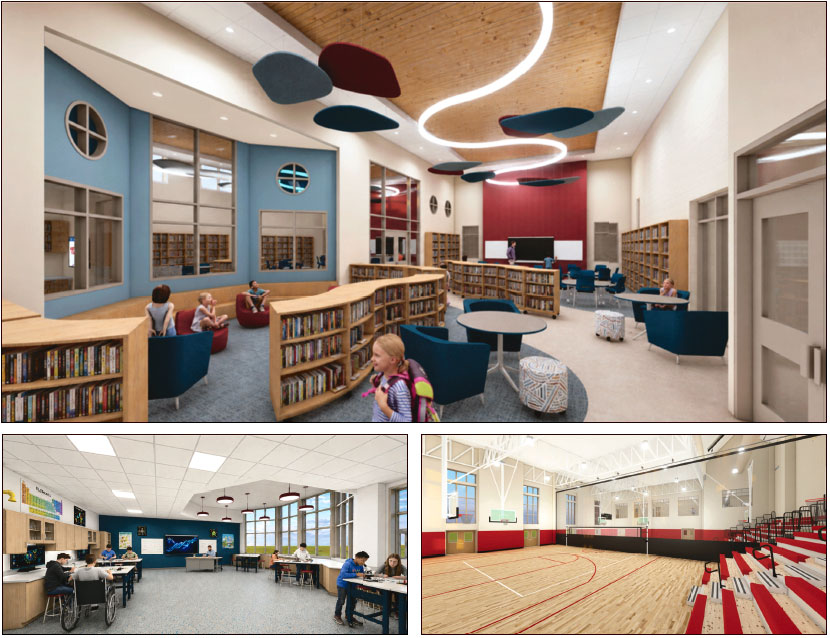
Next, crews will start construction work on the addition, which will house a new gym, science lab, and greenhouse.
The science lab will have modular tables that can come away from the walls and connect to workstations. It will accommodate more students than the current science classrooms and will be wheelchair-accessible. The new gym is expected to be ready for student use in 2028. The district has already selected its scoreboard and bleachers.
Solar panels have been added to the plans. “Those went in due to a New York State requirement,” Mr. Odom noted. “I got some feedback from the community that they wanted them, so I’m happy we’ll be able to accommodate that.”
“There’s a discussion about the canopy on the front of the school: Canopy or no canopy? I think the canopy looks great. It would be a good place for kids to hang out. It’s these little decisions that we’re looking at now.”
Student input has been instrumental in several decisions, including the design of the school’s new interiors. The kids helped select the color scheme and suggested collaborative workspaces in the hallways. The district had initially chosen a beach-inspired palette of blue and white, which the eighth graders overruled.
Mr. Odom explained why. “In our Career Compass program, where we have our eighth graders work with professionals around the community, we brought in our architects to work with them and talk about architecture. And they showed them renderings of the school and the kids said, ‘Absolutely not! Those are not our colors. We are Montauk, and we love the beach, but those are not our colors.’ “
“They had also worked with James Katsipis on a photography unit through that same Career Compass program. They went through his Instagram and his website and found color tones that they thought more accurately represented Montauk, and here we are. Our colors are red, black, and white, and they found some pictures that had these tones that they thought represented Montauk more accurately. And we’re really happy with the outcome.”
The district left some blue in the classrooms because it’s calming, but used the student-approved red in the hallways. There are still some choices to make on flooring for the new library and research center, but most of the major decisions for those two renovations have been handled.
The school’s hilltop location will create some unique challenges while the work is going on, but Mr. Odom said they always find a way forward. “We anticipate the addition itself will take two years. Work will be done during the school year, but we’ve already started working on student flow, procedures, how you access the playground, how we do student drop-off, working through all of this nitty-gritty with the construction management firm,” he said. “Parking is definitely a challenge. It’s always a challenge at Montauk School. We’ll get creative, and we have so many great community partners that I know we can find a solution there.”
In the meantime, he’s putting together a video for the community that will explain the scope and timing of the project. It should be posted on the school’s website in the next few weeks.
“This is a big thing to be trusted with, and we take that really seriously,” Ms. Liubenov said.
“It’s going to be a big improvement for the school, for the community, for everybody,” Mr. Odom added. “It’s pretty special.”