G.O.P. Aims to Be Inclusive

G.O.P. Aims to Be Inclusive

By
Christopher Walsh

The East Hampton Town Republican Committee, under its new chairman, Manny Vilar, will hold a winter gathering next Thursday from 6 to 9 p.m. at the Palm restaurant in East Hampton. 

The committee, Mr. Vilar said on Monday, will begin screening candidates for townwide offices “almost immediately,” given the State Senate’s recent vote to hold state primary elections on the same day as federal primaries, which will move the next primary election from September to June. 

All have been invited to the party, both the Palm event and as potential candidates and voters, Mr. Vilar said. 

“We’re happy to screen anybody that’s interested in East Hampton. Our purpose as a town committee is to focus on town issues, to try and bring balance to government, so we are screening anybody that’s interested in running. Party affiliation is unimportant. What’s important are the values a person brings.”

East Hampton Republicans, he said, “are interested in the bread-and-butter issues that affect every local in East Hampton: quality of life, contamination of drinking water, preserving our community and way of life.” 

Mr. Vilar was named as chairman of the committee after an unsuccessful run for town board last year. He also mounted a bid for supervisor in 2017. 

As the committee’s chairman, he succeeds Amos Goodman, who was asked to resign by committee officials in the wake of the 2018 campaign. Days after Mr. Goodman’s resignation last month, the Suffolk County district attorney’s office announced fraud-related charges against him as well as Pat Mansir, the vice chairwoman of the East Hampton Independence Party. The action followed more than a year of charges of fraud leveled by members of each party against the other. 

With that contretemps behind it, the committee still faces a challenge in winning townwide elections: As of yesterday, registered Democrats outnumbered Republicans by 8,146 to 3,753, according to the Suffolk County Board of Elections. There are, however, 4,719 registered “blanks,” or voters with no party affiliation, and 1,067 registered Independence Party voters. 

Upon his election to lead the committee, Mr. Vilar called for a coalition of voters and likened his party to the East Hampton Reform Democrats, a splinter group led by David Gruber that fielded its own candidates for town board and the East Hampton Town Democratic Committee last year. 

Mr. Vilar has asked that residents interested in screening with the Republicans call him at 631-324-0528 or send an email to [email protected] or [email protected]. 

“We’re interested in Republicans, Democrats, Independents, blanks — I don’t care. If you have an interest in East Hampton and don’t like the direction the town government is headed and think there needs to be some change, if you’re a true environmentalist, if you’re really concerned about fiscal integrity, party affiliation is unimportant. We want you to screen with us.” 

Edward F. Cox, the chairman of the New York Republican State Committee, “has given us his well wishes,” Mr. Vilar said. “We’re hoping to have a good soirée, to put a good foot forward.” 

Along with supervisor and two seats on the town board, voters will choose nine town trustees, two assessors, and town justice in Nov. 5 election. 

Tickets for the Republican Committee’s winter event are $50. Three tiered sponsorships are also available. Those interested in attending have been asked to R.S.V.P. to [email protected].

New York Likely to Legalize Recreational Marijuana Use

New York Likely to Legalize Recreational Marijuana Use

Advantages of new taxed industry are mired in a quagmire of questions about pot’s lasting effects
By
Christopher Walsh

Gov. Andrew M. Cuomo surprised many last month when he declared that New York State should legalize the adult use of recreational marijuana “once and for all.” 

The governor’s call followed the July 2018 issuance of a report from the State Department of Health concluding that the advantages of a regulated and taxed cannabis industry outweighed the potential downsides. In advocating for legalization of recreational use, the governor, like other supporters, cited criminal convictions for possession and the lasting impacts of imprisonment and a criminal record, both disproportionately affecting minorities; the fact that New Jersey was moving toward legalization, and that recreational sales in another neighboring state, Massachusetts, have already begun.

The 2018 challenge by the actress Cynthia Nixon, whose advocacy for legalization was prominent in her unsuccessful campaign for the Democratic nomination for governor, may have also influenced Mr. Cuomo’s evolution on the subject. Just a year ago, the governor had referred to marijuana as a gateway drug. 

A bill is expected to seal convictions for possession of the drug, impose three separate taxes at the cultivation and wholesale stages, and establish an Office of Cannabis Management. Growers would be prohibited from opening retail shops, and counties and municipalities would be able to ban sales, as some have already moved to do. 

Ten states, including another bordering New York, Vermont, have legalized recreational use of marijuana, as has Washington, D.C., and other state governments are debating legalization. Marijuana use for medicinal purposes became legal in New York in 2016, though the law is considered restrictive relative to other states’ laws governing such use. 

With a newly Democratic majority in the State Senate, passage of a bill legalizing recreational use of marijuana by adults 21 and older is far more likely, Assemblyman Fred W. Thiele Jr. said this month, prior to the governor’s Jan. 15 State of the State address. But the governor’s promise that a regulated industry will eventually generate annual tax revenue of $300 million, he said, should not unduly influence legislators. 

“Clearly, the governor has substantially changed his position,” Mr. Thiele said. “It wasn’t but a few years ago he was extremely resistant to even providing for a program for medical marijuana. In fact, the final legislation reflected that. Some people would say it was so stringent, with the language he put in, it was almost unworkable.”

The revenue benefit derived from regulated and taxed marijuana “is one of my least concerns,” Mr. Thiele said. “I think people in the Legislature have spent that 20 times over already.” In the context of a $176 billion budget, “I’m not saying it’s inconsequential, but it is not going to change the finances of the state in a material way. Every controversial measure that’s ever come up in the Legislature, people try to sell it on revenue — the lottery, casino gaming a few years ago. I’m going to be focused more on the impact on communities and individuals.”

“This is certainly going to be a situation where the details matter,” he said. “From my perspective, of all the things that I think need to be priorities during the 2019 session, this one is down the list pretty far. I think that electoral reform, fixing the voting system, reproductive rights, health care, and education are all more important than this particular issue.” (The State Senate passed legislation addressing election reform last week.) 

State Senator Kenneth P. LaValle is unequivocally opposed to legalization. In a statement issued yesterday, Mr. LaValle, a founding member of the Senate’s task force to address heroin and opioid addiction, said that “We have worked very hard to halt the spread of drug use and provide resources for treatment,” including mandating additional insurance coverage, enabling the administration of Narcan, increasing the number of treatment beds, and improving enforcement tools. “While these efforts have made improvements, I still meet too many people who have lost loved ones to addictions. Many families in my district have been affected by this crisis, and without more conclusive evidence concerning marijuana as a gateway drug, in good conscience, I cannot support its legalization.”

“Do I see any pluses? No,” said Karen Martin, the acting executive director of Alternatives Counseling Services, with offices in Southampton and Riverhead. “Except for now people won’t get arrested and clog the system with low-level things.” Having said that, “This isn’t your marijuana of yesteryear,” Dr. Martin said. “It’s stronger. We’ve gotten so much smarter that we’ve learned how to hybrid these things, so it is so much more potent that it’s scary. . . . Way back when, it may have been a gateway drug. Today, it is absolutely a drug that is addictive. Mind-altering, no question about that. It’s going to lead to more addiction, most likely.”

While legalization of marijuana is slowly but surely taking hold across the country, and a Quinnipiac University Poll last year concluded that New York voters supported the legal possession of small amounts of marijuana for personal use 63 to 32 percent, there has been pushback against legalization for recreational use from other quarters. In the Jan. 14 issue of The New Yorker magazine, Malcolm Gladwell wrote that “When it comes to cannabis, the best-case scenario is that we will muddle through, learning more about its true effects as we go along and adapting as needed,” likening legalization’s aftermath to the push for safer automobiles. He also referred to “Tell Your Children: The Truth About Marijuana, Mental Illness, and Violence,” in which Alex Berenson asserts conclusions self-evident in the title, at least among long-term, heavy users of marijuana. 

But Mr. Gladwell is “over-hyping the issue a bit,” said Harrison Wise, president of Wise Public Relations in Manhattan, which specializes in the cannabis industry. Mr. Wise acknowledged some legitimate concerns about detrimental effects of marijuana use, but added that some of the warnings voiced in anti-legalization statements “are completely off-base,” akin to dramatic but outlandish portrayals in the 1936 film “Reefer Madness,” which became a cult classic in the ensuing decades. 

Mr. Wise sees many upsides to legalization for recreational use, as against few, if any, downsides. “The pros are clear: revenue, revitalization of certain industries, especially in the northern part of the state — farming, hemp farming, indoor farming, extraction, manufacturing. Putting that money to good use is certainly advantageous. But it’s important that we get it right. New York is a very complex state.” 

He agreed with the governor and Mr. Thiele that a deliberate approach to legalization is warranted. “I think it’s smart for Governor Cuomo to take a more calculated approach,” he said. “I think there’s still a lot of learning that should come from the states that have already legalized recreational marijuana. A lot of that is underway. Learning from their mistakes will help us make the right choices in terms of how they roll it out. We are a very large state, there’s a lot at stake here, both from a New York City perspective as well as the larger State of New York.”

Questions to address include how many dispensaries should be permitted and where retail sales would be conducted, he said. “What is the saturation point? How much can you sell to an individual? Do you allow people to grow their own? New York City is very vertical,” and smoking on certain premises, and secondhand smoke, must be considered. “A lot of the primary cons are probably going to be centered on the five boroughs, because of the saturation of our city,” he said. 

Legalization for recreational use would also spur innovation, Mr. Wise predicted. “You’re creating new jobs, opportunities for entrepreneurs to bring types of delivery and ancillary services to consumers, or patients and consumers — let’s not overlook the medicinal aspect of legalization.” 

Mr. Gladwell argued that significant uncertainty of marijuana’s effects persists because its prohibition throughout most of the 20th century meant little research has been done. A 2017 report by a panel convened by the National Academy of Medicine “simply stated, over and over again, that a drug North Americans have become enthusiastic about remains a mystery,” he wrote. 

Dr. Martin at Alternatives said that she is not opposed to research. “Before we say it’s okay and helpful, and before we say it’s a horrible thing, don’t you think research should be ferreted? Do I see more downsides? Absolutely, only because it’s so much stronger. Alcohol isn’t being kept out of kids’ hands; marijuana won’t be kept out of adolescents’ hands now.” 

Mr. Thiele said that personal experience would likely be one of several factors in his own vote on legalization. “I grew up in the late ’60s and early ’70s,” he said. “I can tell you I tried it, and I did inhale. . . . It’s, in some ways, almost been a rite of passage. I’m not saying everybody has tried it, but certainly a lot have.” He does not use marijuana today, he said, nor is past use particularly controversial for those seeking elective office, as it was a few decades ago. 

Regardless of one’s personal experience, a newly Democratic majority in the Senate makes passage of a bill legalizing recreational use of marijuana a strong possibility in the first 100 days of Governor Cuomo’s third term, as he has called for. Seventeen newly elected legislators now serve in the Senate, Mr. Thiele noted. Many of them defeated, in last year’s primary election, a member of the Independent Democratic Conference, which was dissolved last year, or an incumbent Republican in the general election. “Not only is it a Democratic majority, but a decidedly more progressive majority,” he said.

Fed, State Primaries Align

Fed, State Primaries Align

By
Christopher Walsh

The New York State Senate passed a series of bills to reform the electoral system last week, one of which will result in federal and state primary elections being held on the same day in June. 

A Jan. 14 statement issued by the State Senate, which flipped from a Republican to a Democratic majority in the November 2018 election, said that the legislation was passed “to improve New York State’s broken electoral system.” The state “consistently ranks as one of the worst voter turnout states in the nation,” the statement said.

Democrats also control the Assembly. Gov. Andrew M. Cuomo, who is expected to sign the bills into law, is a Democrat.  

“I’m thrilled that they’re consolidating the primaries,” Cate Rogers, chairwoman of the East Hampton Town Democratic Committee, said on Monday. “Voters get fatigued” by multiple elections, she said, and “campaigns have to spend twice the money. It’s unnecessary.” 

Manny Vilar, who was elected as chairman of the East Hampton Town Republican Committee last month, agreed that aligning the state and federal primary elections is a positive development, as are the other reform measures. 

“It puts us more in sync with everything,” he said on Monday. Both Mr. Vilar and Ms. Rogers said that their respective committees are already moving to start the process of screening candidates for this year’s elections. 

The legislation scheduling federal and state primaries on the same date is also intended to ensure that the state’s election law complies with the federal Military and Overseas Voter Empowerment Act. 

In addition, the new legislation amends election law to hold limited liability companies, or L.L.C.s, to the same aggregate $5,000 contribution limit that applies to corporations. Current law allows an individual to make multiple contributions to the same candidate or committee through separate L.L.C.s. 

The amendment also requires disclosure of the identity and proportion of ownership of direct and indirect owners of an L.L.C.’s membership, and requires all of such an organization’s contributions to political committees or campaigns to be attributed to each member of the L.L.C. in proportion to his or her ownership interest. 

The State Constitution will be amended to allow for any voter to request to vote by mail without declaring a reason, subject to second passage by the next Legislature and approval by a statewide referendum. Also enacted, subject to the same conditions, is an amendment to the State Constitution removing the 10-day advance voter registration requirement. Reform measures establish an early voting system, as well, allowing eligible voters to vote in person during a designated period. 

Another amendment will require the board of elections to transfer a voter’s registration and enrollment to wherever he or she moves within the state. Finally, 16 and 17-year-olds will be able to preregister to vote, and local boards of education will be required to adopt policies to promote student voter registration and preregistration.

Review Gansett Housing Complex

Review Gansett Housing Complex

By
Jamie Bufalino

Changes to the site plan for the 37-unit affordable housing complex to be built at 531 Montauk Highway in Amagansett were discussed by the East Hampton Town Planning Board on Jan. 16. The East Hampton Housing Authority, which is working with Georgica Green Ventures on the development, cited budget constraints and, in one instance, a directive from the state, which is providing $7 million as well as tax credits for the project, as reasons for the modifications. 

The planning board had approved a site plan for the complex, which the housing authority is calling Gansett Meadow, last June. It will be on 4.6 acres between the Amagansett I.G.A. supermarket and V and V Auto. 

The plan calls for seven buildings with 12 one-bedroom, two-bedroom, and three-bedroom units, plus one with four bedrooms, as well as a common building with a laundry and meeting rooms, 74 parking spaces, a sewage treatment plant, and a rain garden. 

The rental apartments will be for those who work full time, year round, in East Hampton Town and do not own property. Only a small percentage of units will be subsidized, and renters will have to meet income eligibility requirements.

In a Dec. 21 letter, Catherine Casey, the executive director of the housing authority, informed the planning board that in the interest of cost effectiveness the seven buildings are to be prefabricated. The decision to use modular construction, she wrote, “necessitated some minor changes,” including a reduction in the size of the building footprints. 

Other alterations were made, she wrote, for budgetary reasons. In the earlier site plan, for instance, carports with solar panels were to be installed; they have since been removed. A full basement planned for the common building will now be a crawl space, and walkway pavers will be replaced by concrete. 

None of the modifications will “change the character or overall aesthetic of the project,” Ms. Casey wrote, but “serve to perfect the plans as we progress toward construction.” 

At the Jan 16 meeting, Marguerite Wolffsohn, the town planning director, listed some other differences between the original and new site plans. No longer included, she said, were low grasses screening a driveway that runs alongside Montauk Highway. 

The modified site plan also contains 5 percent more ground coverage than the previous version. Joanne Pawhul, the assistant planning director, said on Friday that the increased coverage was due to the reconfiguration of stairways and the addition of porches, and was still within the maximum allowed by zoning.

To the dismay of the developers and board members, a community vegetable garden  has been removed at the request of the state. David Gallo, the president of Georgica Green Ventures, said state officials were concerned about a garden at the north end of the property, next to the Long Island Rail Road tracks. Those tending the garden, they said, would be negatively affected by noise. 

Arthur Goldman, the director of the housing authority, assured the board that the changes to the site plan that was approved were minor and the omission of certain landscaping features was an oversight. He also said the housing authority would send an updated plan and other information to the board the following day. All of the department’s questions, he said, would be fully addressed. 

Samuel Kramer, the newly appointed chairman of the planning board, said that members  would review what the housing authority had to say, and he hoped the site plan modification would be approved at last night’s meeting.

As More Dust Bedevils Amagansett, Town Tries Possible Fix

As More Dust Bedevils Amagansett, Town Tries Possible Fix

Straw was being laid on the field north of Amagansett's business district on Tuesday afternoon with the aid of a bale-shredding machine lent by Alex Balsam of Balsam Farms.
Durell Godfrey
By
Christopher Walsh

With winds still blowing fine topsoil from Amagansett farm fields into the hamlet’s adjacent commercial district and anxious residents demanding action, the Town of East Hampton announced a plan on Tuesday that includes the placement of straw atop the barren fields and installation of snow fencing to help keep it in place.

On Tuesday afternoon, straw delivered from another farm was being laid down on the field immediately north of the business district using a bale-shredding machine lent to the effort by Alex Balsam of Balsam Farms, who is chairman of the town’s agricultural advisory committee. Balsam Farms has fields off Town Lane in Amagansett, and in East Hampton.

“We don’t use the machine for this practice,” Mr. Balsam said on Tuesday morning, “but we certainly think it will have a positive impact. We use the machine to mulch during the growing season between rows of growing crops like tomatoes, melons, and strawberries, but we’re pretty sure we can adjust it to broadcast straw out more.”

Fencing was delivered and is to be installed “as soon as practicable,” according to a statement from Town Hall issued on Tuesday afternoon. “Right now the ground is probably rock-hard frozen,” Supervisor Peter Van Scoyoc said Tuesday afternoon. The temperature surpassed 40 degrees yesterday, however, and rain and a high of 53 degrees were forecast for today, which he hoped would allow stakes to be driven into the earth.

Tuesday’s action followed the supervisor’s meeting last week with Barry Bistrian, whose family owns the field north of the municipal parking lot off Amagansett’s Main Street; Peter Dankowski, the farmer who leases the land; Corey Humphrey, district manager of the Suffolk County Soil and Water Conservation District, and Mr. Balsam to develop a plan to mitigate a situation that brought dozens of residents to the Jan. 14 meeting of the Amagansett Citizens Advisory Committee and last Thursday’s meeting of the town board. At both meetings, residents complained that the dust represents a public health emergency. It has blanketed the commercial core inside and out, including the Amagansett School.

In a letter to parents and guardians of Amagansett School students dated Friday, Seth Turner, the superintendent, said that a presentation and discussion of the situation would be held at the school board’s meeting on Tuesday evening “regarding the steps taken by school officials to address concerns” over the dust. “The health, safety, and welfare of our students is our highest priority, and every effort is being made to insure the school facility is conducive to learning.” The “outdoor air quality,” Mr. Turner wrote, had been a factor in the decision to hold recess indoors on Jan. 11, and “additional steps were taken to temporarily reduce outdoor air vent intakes to limit the dust from coming into the school.”

Last Thursday, the town board authorized an expenditure of up to $2,500 to the FPM Group, an environmental remediation services provider, for an analysis of the soil, after Amagansett residents worried aloud about arsenic, once used as a pesticide, or other, unknown compounds in the soil. Toxins aside, the tiny soil particles themselves, which have been compared in size to flour, are worrisome to residents who fear that they and their children are inevitably ingesting it.

Soil testing was conducted on Tuesday, with results expected in about one week, Mr. Van Scoyoc said on Tuesday. Mr. Bistrian “is confident that results would not show elevated levels of arsenic,” the town’s statement said, as the field was used for dairy pasturage until the 1960s, after farmers had discontinued use of the chemical.

Mr. Van Scoyoc’s office, according to the statement, contacted the State Department of Environmental Conservation’s Division of Air Resources about air quality concerns posed by the dust storms, and was informed that the measures the town is taking are those that the D.E.C. itself would implement.

After complaints about the dust storms reached the town board, Councilman Jeff Bragman suggested legislation requiring that farmers plant a cover crop after the fall harvest. The lack of such cover is blamed for this winter’s conditions. While Mr. Dankowski did plant a cover crop after harvesting potatoes, the crop did not take hold, owing to an unusually wet autumn.

Mr. Van Scoyoc said on Tuesday that Mr. Bistrian and Mr. Dankowski will not plant potatoes in the field in question in the future “due to the uncertainty of establishing a cover crop.” While that is “likely to take care of the longer-term problem,” he said, the town board is considering legislation to codify the annual planting of a cover crop. Mr. Dankowski did not return a call seeking comment.

At the town board’s meeting last Thursday, Mr. Van Scoyoc told the crowd that the farmer and property owner were “very dismayed with what’s happened.” Both “feel terrible and are very sympathetic with residents” and mindful of the health concerns, inconvenience, and damage to property posed by the dust. Both, he said, “feel that the climate has changed to the point where they cannot reliably harvest potatoes and expect to get a cover crop on the field because it stays wet later into the fall.” He said that Mr. Dankowski had told him that 30 working days were lost to rain between Sept. 30 and Nov. 9. “Soils were too soft to get into the field with equipment,” he said.

As of Tuesday morning, conditions in Amagansett remained bleak. Organic Krush, a takeout shop on Main Street adjacent to the municipal parking lot, had closed indefinitely because of conditions that have made employees sick. Lena Vergnes, the manager, said in an email on Tuesday that the cafe’s owners “decided to close the Amagansett store as they didn’t feel it right to put their employees and customers at such a risk when every few days or so we were inhaling fine dust particles and consequently feeling the effects on our health. We are also an organic eatery promoting healthy living, and it feels defeating to not be able to serve food due to an issue like this. However we won’t give up demanding that something be done so we can be there for the community again soon.”

“We do not plan to reopen until action is taken to cover the fields,” Ms. Vergnes wrote. Yesterday morning, the cafe was still closed, a message on its answering machine explaining the reason. “We hope the situation at the farm behind our store will be remedied quickly so we can be back in business soon,” the message said.

Chris Clark, who works at Innersleeve Records on Main Street, had just returned to Amagansett from out of town on Tuesday morning. “It’s pretty bad,” he said, “seeing how it was overnight,” referring to the winds that had once again left Main Street and the structures and vehicles lining it covered with dust. “Same kind of deal, a lot of really fine, flour-like dust all over the place, in underneath the doors, covering everything outside.”

Residents were planning to attend yesterday’s meeting of the agricultural advisory committee, another Amagansett resident, Carter Burwell, told The Star on Tuesday.

This article has been updated with the version that appeared in print on Jan. 24, 2019. 

East Hampton Steps Up to Help Coast Guard Neighbors

East Hampton Steps Up to Help Coast Guard Neighbors

Joshua Borsack, at his desk at Strong Insurance Agency in East Hampton, showed just a fraction of the gift cards he and his wife, Summer Borsack, have collected for Coast Guard members stationed in Montauk.
Carissa Katz
By
Taylor K. Vecsey

As members of the Coast Guard stationed in Montauk and Shinnecock continue to stand watch, braving dangerously low temperatures on the water without the benefit of a paycheck in this fifth week of the partial government shutdown, the East Hampton community is coming together to take care of them.

"We are doing all we are able to do to get the support of the local community to support our Montauk Coast Guard,” said Summer Borsack, who, with her husband, Joshua Borsack, started a drive at his business, Strong Insurance Agency in East Hampton. "It not only helps meet their obvious immediate needs, but to build morale as these people are working without pay in freezing weather conditions," Ms. Borsack said.

There are 27 members at Coast Guard Station Montauk and 11 assigned to the Coast Guard Cutter Bonito, a separate unit out of Montauk. Most live in Montauk or Springs. A few who work at Coast Guard Station Shinnecock also live in Springs. They are among 42,000 active-duty Coast Guard members who did not receive pay on Jan. 15, the first time in the nation's history that service members have not been paid during a shutdown, according to a statement from Coast Guard Commandant Adm. Karl Schultz.

About 800,000 federal workers have been furloughed or forced to work without pay since the shutdown began on Dec. 22. President Donald Trump is demanding $5.7 billion to pay for wall at the southern border, and he is at an impasse with the Democrat-controlled House, with neither willing to approve funding-tied legislation. 

Unlike other branches of the military, the Coast Guard falls under the Department of Homeland Security, whose agencies are affected by the shutdown. Active-duty personnel are considered essential workers who must continue their duties with the promise they will receive back pay. When, however, no one knows. 

The uncertainty has triggered several members of the community to collect donations for their neighbors who are serving in the Coast Guard.

The East Hampton Food Pantry is also answering the call to help and has started a collection for the Station Montauk families. "We want to show our appreciation for these brave men and women for what they do to help protect and serve the community,” said Vicki Littman, the chairwoman of the food pantry. Those wishing to contribute are asked to drop off nonperishable foods at the food pantry building behind Town Hall at 159 Pantigo Road in East Hampton, Monday through Thursday, 9 a.m. to 2:30 p.m. 

The Borsacks have had several friends who served in the Coast Guard over the years. After checking in with the family of a Coast Guard member who runs the cutter out of Montauk, they were moved to lend a hand. "It started off with a small conversation, seeing how their family is doing. It evolved into something bigger fairly quickly after seeing there was an immediate need," Ms. Borsack said.

In just a few short days since the drive began last week, the Borsacks collected nonperishable foods, hygiene products, paper products, gift cards, and more. "The community has been so generous," Mr. Borsack said. 

The American Legion in Amagansett is taking donations daily between 2 and 7 p.m. for Coast Guard families, asking for gift cards to local restaurants and grocery stores, monetary gift cards, and toiletries, canned goods, and other essential items. 

Both the Borsacks and the American Legion are working with the United States Coast Chief Petty Officers Association, a nonprofit made up of active and retired Coast Guard members that is not affiliated with the Coast Guard, an important point because federal ethics regulations prohibit members from directly accepted donations. However, the Coast Guard's legal officials in New London issued a determination recently that allows Coasties to accept donations through the C.P.O.A. because it disseminates donations equally and does not favor those with a higher rank.

A truckload of groceries was picked up at Strong Insurance on Friday and the monetary donations that have come in so far have been handed over, as well. The Borsacks are trying to distribute the donations almost as quickly as they receive them. 

The couple, members of East Hampton Presbyterian Church who also serve on boards there, said the church offered monetary donations through the board of deacons and its mission committee and even held a special offering on Sunday to give to the C.P.O.A. Mr. Borsack said Monday that the church and deacons have pledged over $4,000 to the cause.

Scot McCachren, the church pastor, also reached out to the East Hampton Clericus, made up of churches and synagogue leaders on the South Fork, for donations. "We have also reached out to local civic organizations for donations. We are members of Rotary, and they agreed to a donation of $1,000. One of the carriers we work with through Strong Insurance Agency, Security Mutual, is looking to make a donation," Ms. Borsack said. Some local businesses, like One Stop Market and Luigi's, have donated gift cards. She is trying to get donations from the grocery stores as well.

"It's so important that the Coast Guard experience community support during this time. We can be present for them while they are working hard without pay," Ms. Borsack said.

Meanwhile, other members of the business community are also finding ways to help. At East Hampton Physical Therapy in Montauk, military and furloughed government employees can enjoy free physical therapy services for the next two weeks. "We can’t take your financial pain away, but we can certainly help with your physical pain," Dr. Rachel Lys posted on her office’s Facebook page.

By phone on Monday, Dr. Lys said she saw that a friend in the Coast Guard who used to live in Montauk but lives in Georgia now, was asking for toilet paper. "It really pulled at my heart. It's through no fault of their own. Their job is keeping us safe, and they can't even provide for their own," she said.  

Strong Insurance Agency, which is at 41 Pantigo Road, across from the East Hampton Post Office, will take donations Monday through Friday, 8 a.m. to 4 p.m. (The office is closed Monday in observance of the Rev. Dr. Martin Luther King Jr.'s birthday.) 

Requested items include nonperishable food, toilet paper, personal hygiene items, toiletries, laundry items, trash bags, paper towels, cleaning items, and gift cards to local food stores and eateries, for entertainment, and for gas. Checks can be payable to the Chief Petty Officers Association. Ms. Borsack can be reached at [email protected].   

Van Scoyoc, Lys, and Overby Will Run Again in 2019

Van Scoyoc, Lys, and Overby Will Run Again in 2019

East Hampton Town Supervisor Peter Van Scoyoc, right, Councilman David Lys, and Councilwoman Sylvia Overby celebrating Mr. Lys’s victory in November. All three will run to keep their seats.
Durell Godfrey
By
Christopher Walsh

East Hampton Town Supervisor Peter Van Scoyoc, Councilwoman Sylvia Overby, and Councilman David Lys have announced their intentions to seek the Democratic Party's nomination to run for re-election in November.

Mr. Van Scoyoc, Ms. Overby, and Mr. Lys announced their intentions to the East Hampton Democratic Committee at its meeting on Wednesday.

Mr. Van Scoyoc, who was elected to the town board in 2011 and re-elected in 2015, is halfway through his first two-year term as supervisor. Ms. Overby, also elected to the board in 2011, is in the final year of her second four-year term.

Mr. Lys was appointed to the board one year ago to the seat vacated by Mr. Van Scoyoc upon his election to supervisor. He won election to the seat in November, with 71.4 percent of the vote, for the final year of Mr. Van Scoyoc's term.

According to a statement issued by the Democratic Committee, Mr. Van Scoyoc spoke of the town board's work, under his supervision, on water quality protection and remediation, renewable energy, affordable housing, historic preservation, and resiliency planning. Protection of ground and surface waters, through legislative efforts and water quality improvement projects, will remain a priority, as well as furtherance of renewable energy efforts.

Councilwoman Overby told the committee that she looks forward to continuing to address affordable housing needs. The town board voted unanimously on Thursday to acquire an approximately 3.92-acre parcel on Route 114, for $900,000, on which up to 27 units are to be constructed. "Each little bit counts," she said, according to the Democratic Committee's statement, "and with this project we will have increased our affordable housing throughout the town and provided more affordable opportunities for families and seniors." She also referred to advancing the comprehensive plan's hamlet study process.

Should he earn the committee's nomination, Mr. Lys will conduct his first election for a full four-year term. The committee will also screen candidates for assessor, superintendent of highways, and for the nine trustee positions, seven of which are now held by Democrats. Betty Mazur, the committee's vice chairwoman, is making appointments for prospective candidates who wish to screen.

The nominating process is happening earlier this year than in years past, following the New York State Legislature's passage of several election reform measures last week. Among the reforms is the consolidation of the federal and state primaries, which will now be held on the same day. Last year's primary election was held in September. This year, it will be held in June. Thus, nominating petitions will be carried in February and March instead of in June and July.


Oyster Farms a Boon or an Eyesore?

Oyster Farms a Boon or an Eyesore?

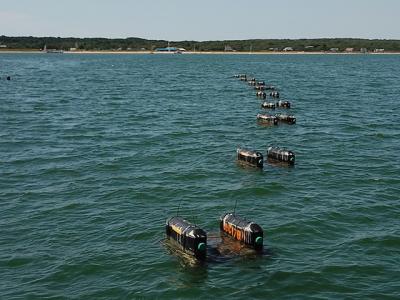
The floating cages used to grow oysters in Gardiner’s Bay in Amagansett are an eyesore and a navigational hazard, some people complained at a hearing last week on the Suffolk County Aquaculture Lease Program.
Clayton Sachs
Lease program in Gansett called environmental benefit and reeking nuisance
By
Christopher Walsh

An egregious encroachment on waters that have been sailed for generations, or a not-in-my-backyard intransigence that impedes environmental and economic gain for East Hampton residents? Both opinions were aired long and loud at the Jan. 9 informational session on a 10-year review of the Suffolk County Aquaculture Lease Program at Town Hall.

Hosted by the town trustees, the event was billed as an opportunity for public comment on the program, under which parcels are leased within a delineated zone for private, commercial shellfish cultivation, and which resulted in a lawsuit by the Devon Yacht Club in Amagansett against multiple parties, including holders of lease sites. That lawsuit was settled last week (as is reported elsewhere in this issue). 

New York State ceded title to approximately 100,000 acres of bottomland to Suffolk County in 2004 and authorized the county to implement an aquaculture lease program. Over a three-and-a-half-year development process, the county delineated a 29,969-acre cultivation zone in which leases would be issued, identifying 859 10-acre lease grids, each with a 10-acre buffer zone, though the program had a 600-acre cap over its first 10 years. 

Twenty-two of those lease sites are in town waters. Just two are in use, but 12 leases are pending, said Susan Filipowich, a senior environmental analyst with the county’s Planning Department. 

At issue, among those complaining about oyster cultivation in Gardiner’s Bay at the Jan. 9 meeting, are the gear used to grow them. Rather than situating gear on the bay bottom, oyster farmers use floating cages, kept at the surface by pontoons. These, some at the meeting said, present both an eyesore and a navigational hazard, the latter prompting the yacht club’s lawsuit. 

Many of those offering comment prefaced their remarks with the assertion that they support aquaculture. Curtis Schade, the Devon Yacht Club’s commodore, said that he supported the goals of the program, “but the floating gear makes the surface of our bays unusable for others.” Floating oyster cages represent “the taking of a public resource for the benefit of a private individual,” he said. The 22 lease sites in East Hampton are “all clustered in one of the most actively used areas of the bay.” 

Reading a statement from Concerned Citizens of Gardiner’s Bay that she said was signed by approximately 78 home owners, Christina Islay said that the group supports a clean and healthy bay and opportunities for fishermen to harvest, but does not support “allowing surface equipment and gear to be placed in locations that are frequented by boaters, sailors, or other recreational users, or destroy scenic views of residents and visitors to our nearby parks.” 

Cages have broken free of their moorings and floated to the shore, where they are difficult to move, speakers said. The stench of rotting oysters from such cages is another problem, they said. 

Peter Mendelman, an owner of Seacoast Enterprises, which operates four marinas in Three Mile Harbor, said he is also in favor of aquaculture, but spoke of nearly hitting a cage’s buoy while delivering a boat to Montauk. 

“It’s a public-use area, and boats go fast though there,” he said. “Surface gear is extraordinarily dangerous.” He advised that lessees have insurance, given our litigious society. “Please,” he said, “put the gear on the bottom. Surface gear is a major conflict.” 

Patrick Coleman of Amagansett likened the conflict to that at the national level over construction of a wall on the United States-Mexico border. “You’ve got everyone in favor of border security, but can’t come to a satisfactory conclusion. It seems that everyone is in favor of the oyster grower, we just have to figure out how to coexist with that recreational user.” 

Floating cages “seem to be in conflict” with the goals of the town’s Local Waterfront Revitalization Plan, Mr. Coleman said, reading passages from the L.W.R.P. that emphasize preservation of panoramic water views and the prevention of man-made structures. “That floating gear is not aesthetically pleasing, and hundreds of contiguous acres of floating black plastic pontoons covered in bird droppings destroys our scenic vistas.” 

But Bob Valenti of Multi Aquaculture Systems on Cranberry Hole Road in Amagansett, who holds one of the active leases in town waters, said that there are important reasons for oyster growers to float cages. “One of the reasons you float the cages is not to become an obstruction, but simply because in the spring and summer, the phytoplankton that they eat” is plentiful near the surface. “All these animals do is filter seawater,” he said. 

Growing oysters on the bay bottom is problematic, he said. “Bad weather flips the cages, the wonderful oysters can’t move, and get suffocated under the sand and die.” His approximately 30 floating cages are almost 1,500 feet offshore, in waters as shallow as four feet, and are submerged in the winter months, he said.  

Adam Younes of Promised Land Mariculture Company agreed. Floating cages allow significantly faster growth, protection from predators and parasites, easier access, and reduced labor costs, “not to mention that they look and taste better because they’re not covered in muck,” he said. A strong bottom current topples cages, which become buried by shifting sand, leading to suffocation. 

It is neither logical nor reasonable “for industry outsiders to demand I use a certain type of gear,” Mr. Younes said. Floating gear is “an integral part of the modern-day oyster aquaculture operation.” His lease site is 2,000 

feet offshore, he said, allowing ample space “for other stakeholders to enjoy the nearshore beach area unimpeded by an oyster farm.” 

Remarks from Chuck Westfall, an oyster farmer, caused an outcry. “The entire program is utilizing less than 1 percent of the surface area — a fraction of 1 percent is what is actually being used now. That’s after 10 years. I don’t see how less than 1 percent of the total surface area can create all this navigational hazard we’re talking about. . . . It’s a Nimby issue.

The room erupted in groans and murmurs, prompting East Hampton Town Supervisor Peter Van Scoyoc to demand that they let him speak. 

“I didn’t think I’d be popular,” Mr. Westfall quipped. 

Stephen Frattini, a veterinarian who works with fish farmers and has a practice in Dutchess County, reminded the audience that this country is the second-largest consumer of seafood yet imports 90 percent of its supply. “The East End of Long Island is on the leading edge of aquaculture in the United States,” he said. “If we’re going to make a national move to decrease our reliance on foreign and imported seafood, it’s going to come from aquaculture.”

Rather than constricting the program, he asked that it be expanded and that “regulatory efficiencies” be built in. “Let’s try to make aquaculture in New York and the United States the best it can be.”

No Pay for Coast Guard

No Pay for Coast Guard

As of Tuesday, members of the Coast Guard, which has stations in Montauk and at the Shinnecock Inlet, are working without paychecks as the federal government shutdown continues into its fifth week.
Jane Bimson
Private group raising money for daily needs
By
Isabella Harford

Members of the Coast Guard stationed in Montauk and Shinnecock, like others throughout the country, did not receive expected paychecks on Tuesday as a result of the federal government shutdown, which is entering its 27th day today. One-time emergency paychecks went out at the end of last month, but Coast Guard employees are now continuing to work without compensation.

The Coast Guard is the only branch of the military unable to pay its members during the shutdown because its funding comes from the Department of Homeland Security. All other branches of the military receive funding from the Department of Defense, whose fiscal 2019 budget was approved before the shutdown.

“Unfortunately, without an appropriation, a continuing resolution, or another legislative measure, the Coast Guard will not be able to meet the 15th payroll,” was the message on the Coast Guard’s web page. 

Coast Guard Station Montauk is an active search and rescue and law enforcement unit, which operates in Gardiner’s and Napeague Bays, Block Island Sound, and the South Shore of Long Island, as well as areas along coastal Connecticut.

On Monday, Coast Guard Station Shinnecock updated its Facebook page, stating, “Due to the lapse in federal funding, information on this social media site may not be up to date.” The message came shortly before Coast Guard employees were to receive paychecks. 

New York Fish, a grassroots organization dedicated to recreational and commercial fishing, has stepped into the financial vacuum by fund-raising on behalf of the Coast Guard. The organization is funneling donations to the Long Island Chief Petty Officers Association, a fraternal organization, since legally donations cannot be given directly to the Coast Guard. 

“The men and women of the Coast Guard are heroes” and “fishermen recognize this,” Daniel G. Rodgers, the New York Fish director, said. “All of it . . . every penny” will be donated directly to members of the Long Island Coast Guard.

The money will be used to help members of the Coast Guard buy food and gas and make mortgage and car payments. Donations can be mailed to Long Island C.P.O.A., P.O. Box 71, West Sayville 11796. Information can be found on the New York Fish Facebook page and website.

The local Coast Guard took part in recovering a plane that crashed in the ocean off Amagansett in June, killing its occupants, who were highly regarded members of the community. A few weeks later, the Coast Guard saved seven people from a sinking ship in the waters off Montauk Point. These are only a few examples on a long list of vital efforts.

Commuter Help on the South Fork Is Near

Commuter Help on the South Fork Is Near

Local shuttle buses will pick up commuters at Long Island Rail Road stations and take them to places of employment.
Durell Godfrey
Hampton Hopper proposed for ‘last mile’ shuttle bus
By
Christopher Walsh

Expanded weekday Long Island Rail Road service is set to launch on March 4, and now the Town of East Hampton is choosing which provider to use for the “last mile” shuttle bus service that is to take riders to and from train stations and places of employment. 

The Hampton Hopper, which has operated an app-based shuttle network using converted school buses since 2014, was recommended by a committee put together to evaluate respondents seeking to provide that service, Jeanne Carroza, the town’s senior purchasing agent, told the town board at its work session on Tuesday. 

Five reputable companies had responded to the request for proposals, issued in September in cooperation with the Town of Southampton, and the committee selected four to be interviewed. 

The board has not finalized its selection of the provider, but Ms. Carroza said that should the Hampton Hopper be chosen, it would cover routes using two 25-passenger buses. Exact routes are to be determined and subject to modification based on ridership.

The L.I.R.R.’s additional morning and afternoon trains will operate for a total of 260 days during the 13 months from March of this year through March of 2020. A $500,000 grant from New York State is to be split evenly between East Hampton and Southampton, each town independently choosing and contracting with a shuttle provider. The $1-per-ticket revenue will also be split between the towns. 

Shuttle service is to be divided into seven units to meet trains arriving at the East Hampton, Amagansett, and Montauk stations and cover routes to places where people work, including in Springs. 

One unit will meet trains arriving in East Hampton at 7:03 and 9 a.m.; another will return passengers to the station for westbound trains departing at 3:12 and 5:14 p.m. A shuttle will also take arrivals on the 7:03 a.m. train in East Hampton, where it will terminate, to Montauk. Another will meet passengers at the train arriving in Montauk at 9:05 a.m. Still another will return passengers to the Montauk station at 2:48 and 4:50 p.m. 

Units will collect passengers from the train arriving at 9:05 a.m. in Amagansett, and return them there for trains leaving the hamlet at 3:07 and 5:09 p.m.  

It is hoped that “ridership finds it convenient and efficient,” Supervisor Peter Van Scoyoc said, so that the service is widely used. “We know as a municipality, hearing from a number of businesspeople, it’s becoming more difficult to hire and retain workers, given long commute times on the highway. This is one way in which we can overcome some of that by creating a more efficient way” to get to and from work. 

A successful program would remove vehicles from the roads, alleviating “trade parade” traffic heading east in the mornings and west in the afternoons, and reduce carbon dioxide emissions. “While we’re not certain how many will immediately take advantage” of the service, Mr. Van Scoyoc said, “we have a good proposal.” 

Ultimately, he said, “a dedicated light rail shuttle running back and forth between Speonk and Hampton Bays and Montauk could alleviate a great deal of traffic.” The service that will begin in March is “not a perfect solution,” but “we need to make the best of what’s being offered.”